
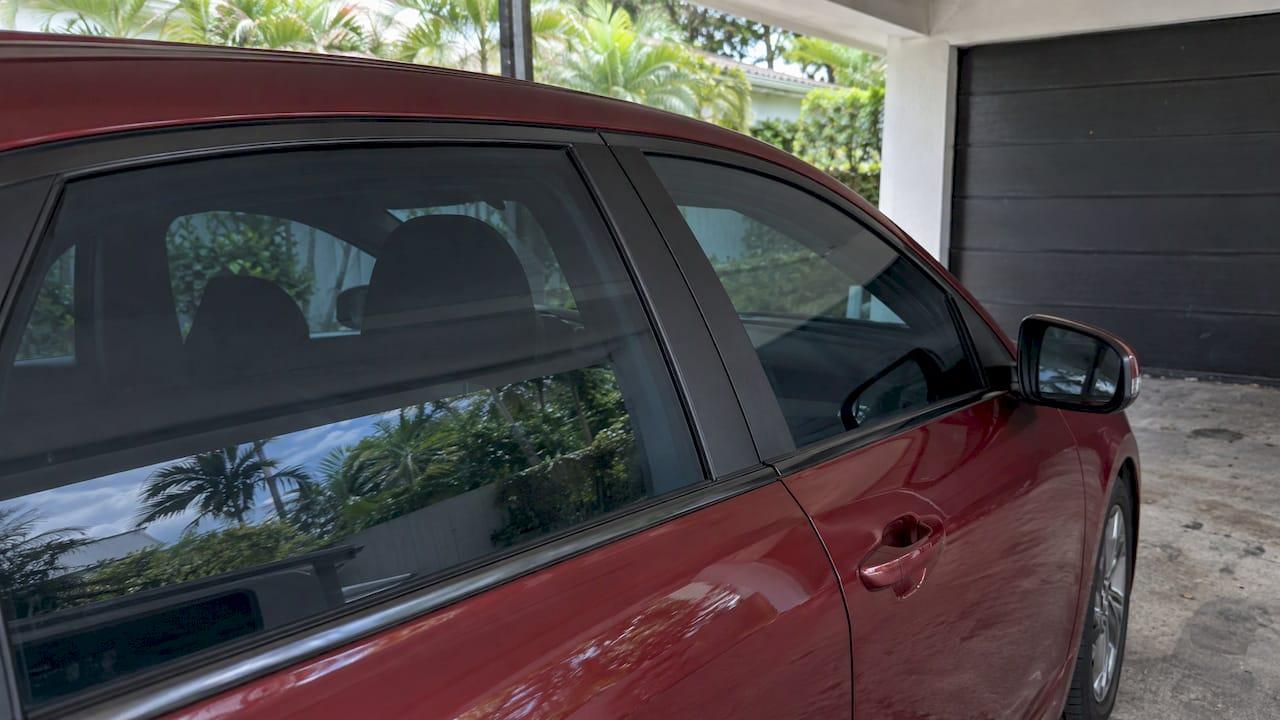
Ceramic tint can show a faint blue tone in some light and shades, but a quality ceramic film should look neutral, clean and even on your glass. The color you see depends on the film's construction, how light or dark it is, the glass underneath and the Miami sun hitting it. Below is what drives each of those, so you can pick a ceramic film that looks the way you want before it goes on.
TL;DR
- Ceramic tint can look slightly blue, especially in lighter shades, because the ceramic particles are what give the film its tone.
- Quality ceramic film is designed to look neutral. 3M describes its Ceramic IR Series as an attractive neutral color, with a cool blue shade among its tint levels.
- Shade (VLT), glass type, viewing angle and sunlight all change how the same film looks.
- Ceramic film should not purple or fade the way cheap dyed film does. Ask for the warranty in writing.
- We tint at your home or office anywhere in Miami-Dade, so you can see the film on your own car in your own light.
Table of Contents
- Why ceramic tint can look blue
- What "neutral" ceramic tint color means
- How shade, glass and light change the color
- Ceramic vs. dyed tint: color over time
- Does ceramic tint look the same on cars, homes and offices?
- Ceramic film is not the same as a ceramic coating
- How to choose a ceramic tint color you will like
- Our perspective
- Book mobile ceramic tint in Miami-Dade
- FAQ
- Sources
Why ceramic tint can look blue
Dyed tint gets its color from dye in a layer of film. Ceramic tint works differently. It uses microscopic ceramic particles that manage heat and infrared light, and those particles also shape the film's hue. Because the film is not simply a dark dye layer, a light ceramic shade can show a cool, bluish cast, most noticeably in daylight and at an angle.
That is not a defect. It is the film's technology showing through. 3M, for example, describes its Ceramic IR Series as a neutral color and lists a cool blue shade among its multiple tint levels. So "blue" is a design choice in some products and a subtle side effect in others.
What you should expect:
- Light shades (roughly 50% VLT and lighter): more likely to show a cool tint, because there is less dark pigment or carbon to mask it.
- Medium and dark shades: the film reads as smoke, charcoal or black, and the blue is hard to notice.
- Windshield film: very light and nearly clear, so you mainly see a slight cool glow in direct sun.
If you want to understand the numbers behind shade, our guide to visible light transmission explains what each percentage means in practice.
What "neutral" ceramic tint color means
A neutral film does not push the glass toward blue, purple, brown or green. Through it, the world looks the same color, only dimmer. On the car it looks like a smooth, even gray or black rather than a tinted sheet.
Here is how to judge neutrality on a sample or on a finished window:
- Look at it from straight on and from an angle. The color should stay consistent. A shift from gray to blue to purple as you move is a sign of lower-grade film.
- Check for haze. Clear, clean film should have no cloudiness, mottling or milky patches, especially in lighter shades.
- Look at the whole window. The tone should be even from edge to edge, with no darker band or lighter patch.
- Look at it in more than one light. Check it in shade, in direct sun and at dusk.
- Compare it with your factory glass. Rear privacy glass on many SUVs and trucks is already dark, so the film on the front doors should be judged against it.
Tint color is easiest to judge on your own vehicle. That is one reason we install at your location: you see the actual film, on your actual glass, in the light where you park.
How shade, glass and light change the color
Two cars with the same film can look different. Four things explain most of the difference.
Shade (VLT)
VLT is the percentage of visible light the film and glass let through. A lower number means a darker look. Ceramic film does not need to be dark to perform. Madico, for instance, says its nano-ceramic automotive films are available from 3% to 90% VLT and do not need to be dark to do their job. That matters for color: the lighter the film, the more of its natural hue you see, and the darker the film, the more it simply looks black or charcoal.
If you are choosing a number, our posts on what tint percentage means and on front windows at 35 to 50% VLT walk through the trade-offs. Always check the current Florida rules for each window before you pick a shade.
The glass underneath
Film sits on glass that is already tinted. Most factory glass has a slight green or blue-green cast, and the film adds to it. 3M notes that its published performance data is based on film applied to 1/4-inch, 73% VLT automotive green glass. A car with privacy glass in back and clear glass in front will show two different results from one roll of film.
Reflectivity
A film that reflects a lot of light looks mirror-like and shows color shifts at an angle. 3M describes Ceramic IR as an absorptive nano-ceramic technology with low visible-light reflectivity, which is part of why it reads as a clean, even look rather than a shiny one. Madico likewise describes its Black Pearl NC car film as having a rich factory-black appearance and a non-reflective finish.
Sunlight and angle
Midday Miami sun, early morning light and a cloudy afternoon all change how a window looks. Light shades show more of the cool tone in direct sun. Dark shades hide it. When you look at a sample, hold it at a few angles in the light where you will actually use the car.
Ceramic vs. dyed tint: color over time
The other half of "color" is what happens in year three. Cheap dyed film can fade and turn purple or brown as the dye breaks down in strong sun. That is a common complaint in a place like Miami, where windows bake for hours.
Ceramic film does not rely on dye for its performance, so it is designed to hold its color. This is why our shop installs ceramic films only. The warranties we offer reflect that:
| Film | Warranty |
|---|---|
| 3M Ceramic IR | Lifetime |
| SunTek CIR | 5 years |
| Uviron KoolMax | 3 years |
The warranty is the practical way to judge color stability. A film maker that stands behind its product for years or for life is telling you it expects the color to hold. Ask for the terms of whichever film you choose, and we will walk you through them.
Does ceramic tint look the same on cars, homes and offices?
Not exactly. The film technology is the same idea, but the glass and the goals are different.
- Cars: shades are chosen for privacy, heat and legal limits, and the look is usually black, charcoal or a light neutral tint. Glass curvature and rear privacy glass matter.
- Homes: window film is judged from outside and inside. A light ceramic film on a flat pane can show more of its cool tint from outside at certain angles. Double-pane and low-E glass change the look, too.
- Businesses: storefronts and offices often prioritize an even, uniform look across many panes, so consistent film from one roll matters.
We handle all three. If you are tinting a property, see our pages on residential window tinting and commercial window tinting.
Ceramic film is not the same as a ceramic coating
People sometimes mix up ceramic window film with liquid products. A ceramic coating on glass is a surface treatment that changes how water behaves on the outside of the glass. It does not darken the window, and it does not control heat or UV the way a tint film does. Film is a layer applied to the glass that sets the shade, the color and the heat rejection. If you want both, the film goes on first and coatings are a separate care step.
How to choose a ceramic tint color you will like
Use this short checklist before you book.
- Decide on the look. Do you want a dark, private black, or a lighter tint that keeps the cabin bright?
- Pick the shade by window. Many owners use a medium shade in front and darker in back. Our guide to tint at night covers visibility.
- Check the rules. Florida limits how dark front windows can be, so confirm the current VLT limits with the state before you choose.
- Choose the film by warranty and heat goals. Lifetime, 5-year and 3-year options are all ceramic.
- Ask to see the film on your glass. We bring samples to you.
- Plan the finish. Wait for the film to cure before judging the final look, and avoid rolling windows down for the period your installer recommends.
If heat is your biggest goal, our posts on infrared vs. ceramic tinting and windshield tint heat reduction go deeper. Driving an electric vehicle? See ceramic tint benefits for EVs.
Our perspective
We have tinted cars in Miami-Dade for 28 years, and the question we hear most about color is whether ceramic will look blue. Our honest answer: it depends on the shade, the glass and the film, and a well-made ceramic film looks clean and even.
That is why we install ceramic films only. We do not want your tint turning purple in two summers. We work with 3M Ceramic IR, which carries a lifetime warranty, SunTek CIR with a 5-year warranty and Uviron KoolMax with a 3-year warranty.
The other part is the installation. We cut patterns by computer for an exact fit, and our 60-inch rolls let us put a large windshield on in one piece with no seam. A seam or a poorly trimmed edge shows color differences more than any film choice does.
We also come to you. Seeing the film on your own car, in your own driveway or parking lot, is the best way to decide on a color. We have worked on Tesla, luxury and exotic vehicles, and we know owners of those cars care about the details.
Jose
Book mobile ceramic tint in Miami-Dade
We come to your home or office anywhere in Miami-Dade, so you never have to wait at a shop. Published starting prices:
- 2 front windows: from $200
- Windshield tint: from $150
- Full car + windshield: from $450
- Old tint removal: $50 to $150
For all vehicle types and service details, see our mobile window tinting page, or our ceramic tint page for film options. Ready for a quote? Call now or get a quote on our site.

If you have old tint that has turned purple or bubbled, we can remove it before the new film goes on. We serve Miami, Kendall, Homestead, Cutler Bay, Pinecrest and the rest of the county, and you can see our service areas.
Our 3M window tinting page covers Ceramic IR and Crystalline films.

FAQ
Does ceramic tint look blue?
Sometimes, slightly. Ceramic particles give the film its tone, and a lighter shade can show a cool cast in bright light. 3M describes its Ceramic IR Series as neutral in color, with a cool blue shade among its levels. Darker shades usually look black or charcoal.
Is ceramic tint darker than regular tint?
Not necessarily. Darkness comes from the VLT percentage, not the film type. Ceramic film is made in a range of shades, from very light to very dark, so you can get strong heat performance without going dark.
Will ceramic tint change color over time?
Ceramic film is designed to hold its color because it does not depend on dye, which is what tends to fade and turn purple in cheaper film. The practical protection is the warranty. Our 3M Ceramic IR carries a lifetime warranty, SunTek CIR 5 years and Uviron KoolMax 3 years.
Can I see the color before I commit?
Yes. Because we are mobile, we can show you film samples at your home or office and judge them against your own glass in your own light. Call or use our quote form to schedule.
How much does ceramic tint cost in Miami?
Our published starting prices are $200 for 2 front windows, $150 for a windshield and $450 for a full car with windshield. Final pricing depends on your vehicle and the film you choose, so request a quote.
Sources
- 3M Ceramic IR Series brochure
- 3M Ceramic IR automotive window film brochure
- Madico ceramic window tint
- Madico Black Pearl NC nano-ceramic tint
- Diamondbrite ceramic coating on glass