
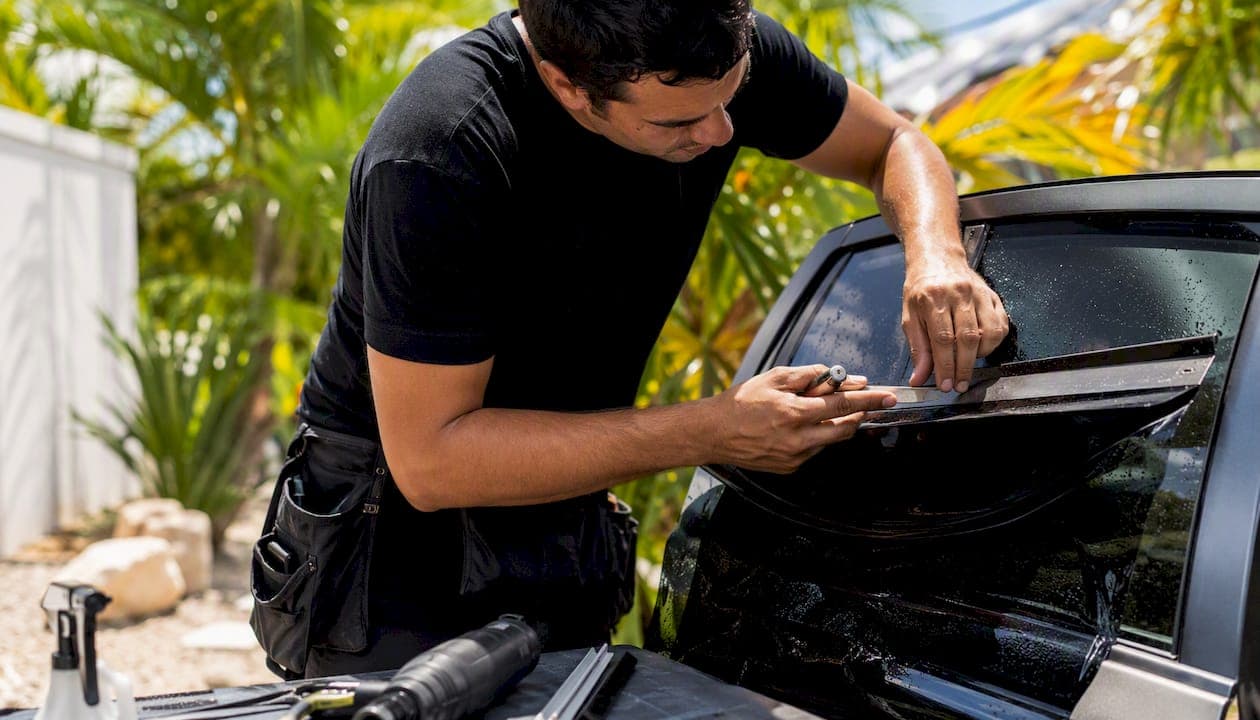
Visible light transmission, or VLT, is the percentage of visible light that passes through a material and reaches your eye. The higher the VLT percentage, the brighter and clearer your view. The lower it is, the darker the appearance, with more privacy and glare reduction. Whether you're choosing sunglasses, picking an automotive tint, or selecting window film for your home or office, VLT is the single most practical number on any product spec sheet.
Key Takeaways
VLT is a photopic-weighted percentage that tells you how much visible light passes through a material, and reading it alongside UV rejection and IR blocking gives you the full picture for any tint or glazing decision.
| Point | Details |
|---|---|
| VLT definition | VLT is the percentage of visible light (380–780 nm) that passes through a material, from 0% (opaque) to 100% (fully clear). |
| Eye-weighted measurement | VLT uses the CIE 1931 photopic luminosity function, so it reflects perceived brightness, not raw energy. |
| Typical ranges | Window films commonly range from 5%–70% VLT; residential glazing targets 50% or higher for daylighting. |
| VLT vs. UV/IR | Low VLT does not guarantee UV or IR blocking; check UV rejection and IR rejection separately. |
| Read specs carefully | Confirm whether VLT is film-only or film-plus-glass, and look for CIE or NFRC compliance on the label. |
Table of Contents
- What is visible light transmission and why does the spectrum matter?
- How VLT is measured and what the numbers on a spec sheet mean
- Common VLT ranges for sunglasses, car tint, and window film
- Why low VLT doesn't automatically mean better heat or UV rejection
- How to read product labels and compare VLT specs
- Practical tips from an installer's perspective
- Legal limits and safety considerations you should know
- Get Professional VLT Guidance from Southmiamitint
- A note on how these recommendations are framed
- Sources
What is visible light transmission and why does the spectrum matter?
VLT doesn't measure all light equally. It focuses on the visible light spectrum, which runs approximately 380–700 nm. Within that band, each wavelength corresponds to a color: violet at the short end, red at the long end, with green, yellow, and blue in between.
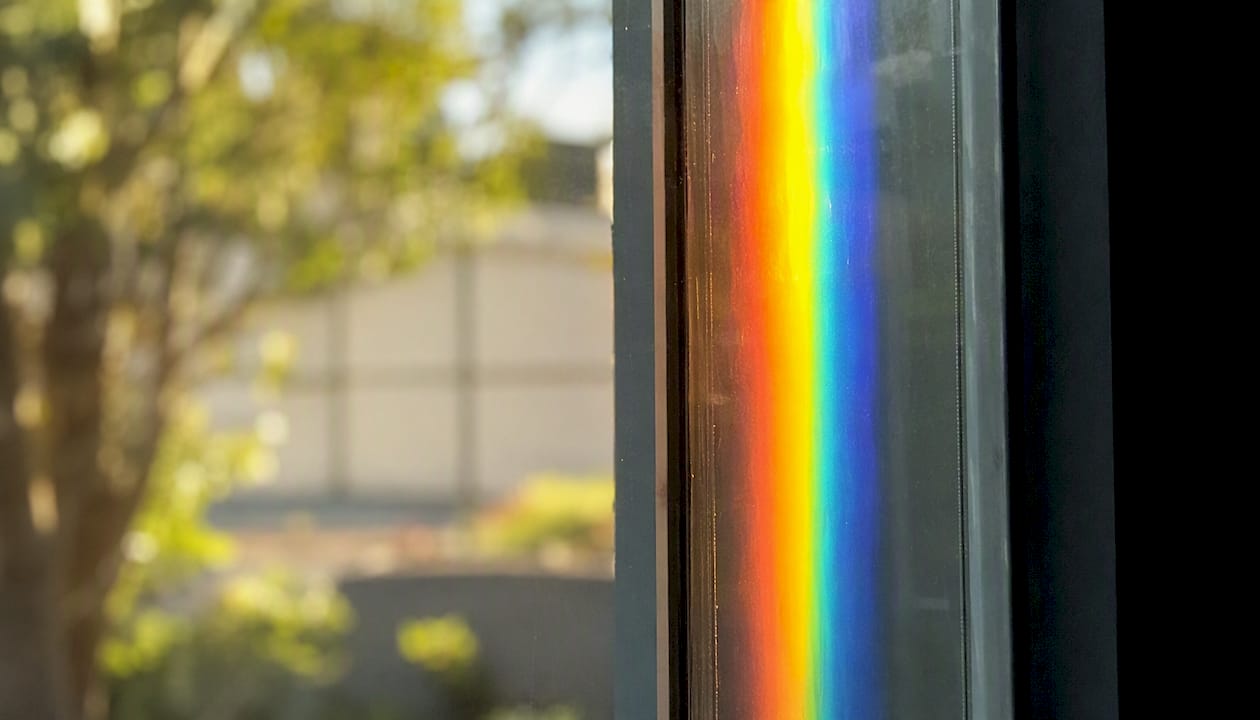
Your eye doesn't respond equally to every wavelength. It peaks in sensitivity near 555 nm, which is green. This is called photopic vision, and it's the reason VLT is an eye-weighted measurement rather than a simple average of all light energy. A film that blocks mostly red and violet wavelengths will look brighter to you than one that blocks the same total energy but targets the green-yellow range.
This also explains why VLT tells you how bright things will look, not how much raw energy passes through. That distinction matters when you're comparing products side by side.
How VLT is measured and what the numbers on a spec sheet mean
The basic formula is straightforward: VLT = transmitted light intensity divided by incident light intensity, expressed as a percentage. In practice, manufacturers don't use a simple ratio. They weight the measurement using the CIE 1931 photopic luminosity function, written as V(λ). This function assigns a weight to each wavelength based on how sensitive the human eye is at that point.
The result is an integral: for each wavelength from 380–780 nm, multiply the material's spectral transmittance by the eye-sensitivity weight and by a standard illuminant (usually D65, which approximates daylight). Sum those values and divide by the total illuminant energy. That ratio, expressed as a percentage, is your VLT.
In a lab, a spectrophotometer measures transmittance at each wavelength under controlled conditions. The NFRC (National Fenestration Rating Council) standardizes how this is reported on window and glazing labels, so you can compare products from different manufacturers on equal footing. VT also appears on NFRC labels alongside U-factor and SHGC, making it easy to evaluate a window's full performance profile in one place.
When reading a spec sheet, check for:
- Measurement basis: Is the VLT for the film alone, or for film combined with a standard glass substrate? Film-only values are typically higher.
- Standard used: Look for CIE or NFRC compliance. An unlabeled or proprietary measurement is harder to verify.
- Illuminant: D65 is the most common standard daylight illuminant for VLT testing.
- Additional metrics: UV rejection percentage, infrared (IR) rejection, and SHGC should appear alongside VLT for a complete picture.
Common VLT ranges for sunglasses, car tint, and window film
Window films typically range from about 5% to 70% VLT depending on their purpose, and residential glazing commonly targets 50% VLT or higher for adequate daylighting. Here's how those numbers translate across common applications:
| Application | Typical VLT Range | What It Means in Practice |
|---|---|---|
| Very dark sunglasses / ski goggles | 5%–15% | Maximum glare reduction; not suitable for low-light conditions |
| Standard daytime sunglasses | low to moderate VLT | Good glare control with comfortable outdoor brightness |
| Automotive rear/side windows | 5%–35% | Privacy and heat reduction; legal limits vary by state |
| Automotive driver windows | 35%–70% | Balances privacy with safe nighttime visibility |
| Residential window film | 35%–70% | Reduces glare and heat while maintaining interior light |
| Commercial glazing | 35%–70% | Daylighting-focused; architectural defaults often range between 0.3 and 0.8 |
A few concrete examples help anchor those ranges:
- 5%–20% VLT: Very dark tint. Strong privacy, significant glare reduction, but noticeably dim interiors and reduced nighttime visibility for drivers.
- 35%–50% VLT: The practical middle ground for most automotive side windows. Comfortable in daylight, still usable after dark.
- 50%–70% VLT: Good daylighting for homes and offices. Reduces glare without making a room feel dim.
- 70%+ VLT: Near-clear. Minimal visible effect, but films in this range can still deliver UV and IR rejection.
Automotive VLT limits vary by state and by window position (windshield, front side, rear side, rear). Always verify the legal limit for your jurisdiction before choosing a film. For a current summary of automotive tint compliance requirements, the AEONCUT tint compliance guide is a useful reference.
Why low VLT doesn't automatically mean better heat or UV rejection
This is the most common misunderstanding in tint selection. VLT measures only the visible portion of the spectrum (roughly 380–700 nm). UV radiation sits below 380 nm, and infrared (IR) heat sits above 700 nm. A very dark film can block visible light effectively while doing little to stop IR heat or UV radiation, and a nearly clear film can block both aggressively.
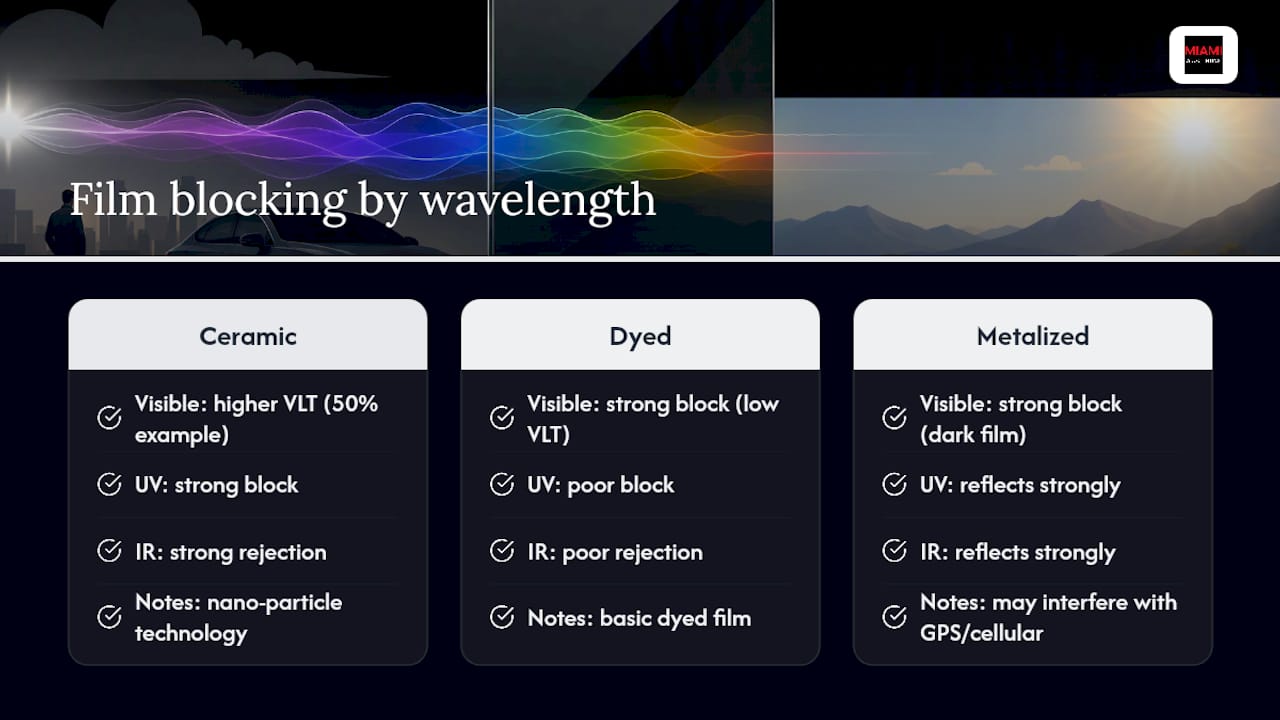
How a material transmits, reflects, absorbs, and scatters light determines its performance across all wavelengths, not just the visible band. Metalized films reflect IR and UV but can interfere with GPS and cellular signals. Multi-layer and ceramic films use nano-particle technology to selectively block IR and UV while maintaining higher VLT. That's why a ceramic film at 50% VLT can outperform a basic dyed film at 20% VLT for heat rejection.
For a full performance comparison, look at three numbers together: VLT, UV rejection percentage, and total solar energy rejected (TSER) or IR rejection. SHGC (Solar Heat Gain Coefficient) is the complementary metric on architectural glazing labels. A lower SHGC means less solar heat enters, regardless of how dark the glass looks. You can explore how ceramic and carbon film technologies compare for a practical breakdown of how film type affects these numbers.
How to read product labels and compare VLT specs
Comparing VLT across products is straightforward once you know what to look for. Follow these steps:
- Confirm the measurement basis. Film-only VLT and film-plus-glass VLT are different numbers. Most automotive films are tested on a standard glass substrate; some residential films are tested on film alone. Compare like with like.
- Check the standard. CIE and NFRC compliance means the measurement followed a defined, repeatable method. A spec sheet that lists only a brand-specific test is harder to cross-check.
- Look at VLT alongside UV% and IR rejection or SHGC. A film with 35% VLT and 99% UV rejection is a very different product from one with 35% VLT and 40% UV rejection.
- Note color shift and haze claims. Some films add a blue or gray cast. If clarity matters to you, ask for a demo panel or check the manufacturer's clarity rating.
- Verify installer warranty and testing. A reputable installer will provide a written warranty and can show you the film's certified test data, not just marketing copy.
Common label abbreviations: VLT and VT are interchangeable (Visible Light Transmittance). Tvis appears in some European and architectural specs and means the same thing. SHGC is Solar Heat Gain Coefficient, a separate metric for total solar heat. For a deeper look at how tint percentage labels work and what they mean for your vehicle, the tint percentage guide covers the full picture.
Practical tips from an installer's perspective
Choosing the right VLT is easier when you start with your primary goal, then check the numbers.
- For daytime driving: 35%–50% VLT on side windows gives you good glare control without sacrificing nighttime visibility.
- For privacy: 20%–35% VLT on rear windows is effective. Go lower only if local law permits and you've tested visibility after dark.
- For home daylighting: Target 50%–70% VLT. You'll reduce glare and heat without darkening your rooms.
- For heat management in a sunny climate: Prioritize IR rejection and SHGC over VLT. A 50% VLT ceramic film can keep interiors cooler than a 15% dyed film.
- Don't skip the night test. Before committing to any film below 35% VLT for a driver window, view the film in low-light conditions. What looks fine at noon can feel dangerously dim at 10 PM.
- Surface prep matters. Even the best film underperforms on a poorly cleaned surface. Edge sealing and proper cure time (typically a few days to two weeks depending on climate) affect long-term clarity and adhesion.
Pro Tip: Ask your installer to show you a demo panel of the film in both direct sunlight and shade before installation. Haze and reflectance issues that aren't obvious indoors become clear immediately under natural light.
For more guidance on matching VLT to your specific vehicle and goals, the car tint selection guide walks through the decision step by step.
Legal limits and safety considerations you should know
Automotive tint laws set minimum VLT levels for each window position, and they vary significantly by state. Front side windows in many U.S. states require 35% VLT or higher; some states allow darker rear windows with no minimum. Windshields are almost universally restricted to a small non-reflective strip at the top. ICNIRP guidance on visible radiation underscores that optical radiation reaching the eye has safety implications, which is part of why regulators set visibility minimums for drivers.
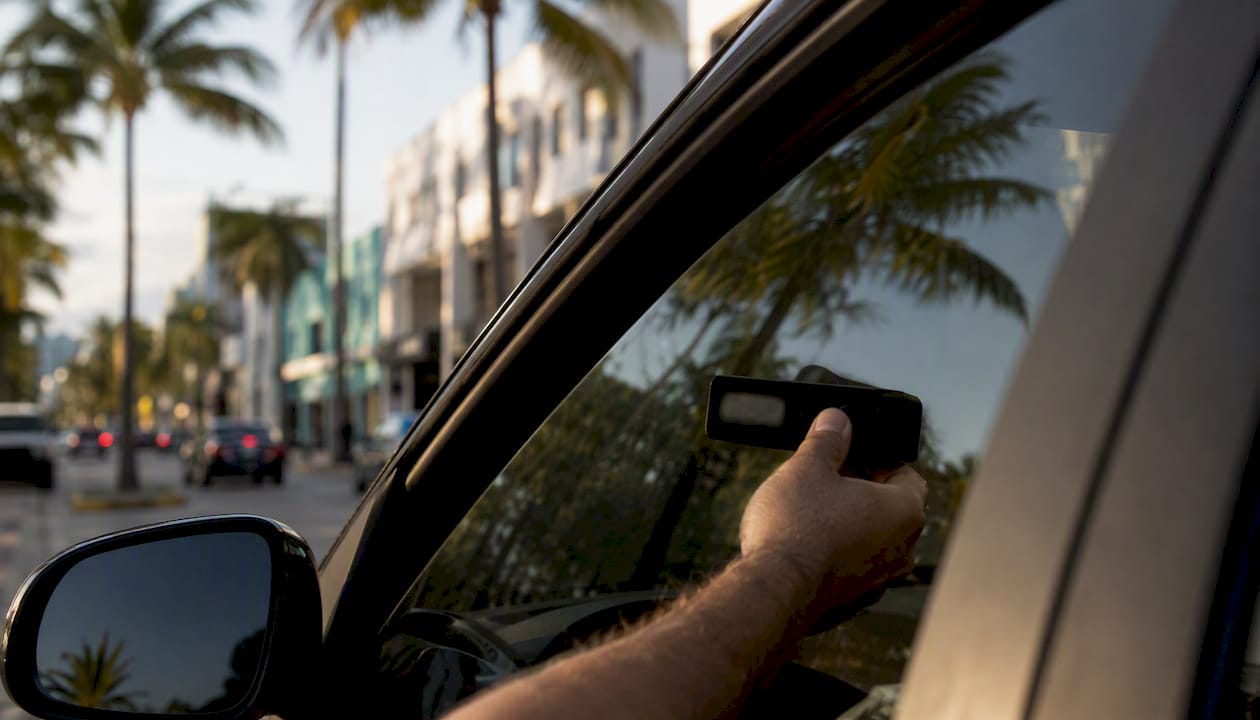
Beyond legal compliance, low VLT on driver windows affects emergency responder visibility during a traffic stop, and very dark films can interfere with lane-keeping cameras, rain sensors, and other ADAS systems mounted near the windshield. Before choosing a film below 35% VLT for any window a driver looks through, check your state's specific limits. For a practical summary of current automotive tint regulations, the 2026 window tinting regulations guide is a solid starting point. A professional installer can also measure and certify your film's VLT after installation to confirm compliance.
This article provides general information about VLT and tinting. Verify current legal limits with your state's DMV or a licensed installer before making a final decision.
Get Professional VLT Guidance from Southmiamitint
Knowing your VLT target is the first step. Getting it installed correctly is the second. Southmiamitint provides mobile window tinting for cars, SUVs, trucks, and residential and commercial properties throughout Miami-Dade County. Films include 3M Ceramic IR, 3M Color Stable, and Iviron KoolMax ceramic tint, all installed at your location.
Book a ceramic tint installation or explore 3M film options for your vehicle to find the VLT and performance spec that fits your goals.
A note on how these recommendations are framed
Working in mobile window tinting across Miami-Dade, I've seen firsthand how often buyers focus on darkness alone and overlook the metrics that actually determine comfort and performance. The VLT ranges and selection tips in this article reflect practical installation experience with 3M Ceramic IR, 3M Color Stable, and Iviron KoolMax films, combined with the published standards from NFRC and CIE. Where specific credentials, certifications, or case study data are available, those details can be added here by the publisher to further support these recommendations.