
Visible Light Transmission (VLT) is the percentage of visible light that passes through a tinted window, and it is the single most important number to understand before choosing any car tint. A 5% VLT blocks 95% of light, creating the near-opaque look of a limousine, while a 70% VLT lets most daylight through and looks nearly clear. VLT directly controls how dark your windows appear, how much privacy you get, and whether your tint is legal in your state. Getting this number wrong costs you money, visibility, and potentially a traffic citation.
What does VLT mean in window tinting?
VLT stands for Visible Light Transmission, and it measures one thing precisely: the share of visible light that travels through your glass after the tint film is applied. The number runs from 0% to 100%. Lower numbers mean darker tint. Higher numbers mean lighter, more transparent glass. Common window tint VLT levels you will encounter are 5%, 20%, 35%, 50%, and 70%, each producing a noticeably different appearance from outside and inside the vehicle.
The VLT percentage is not just an aesthetic label. It determines how much your driver can see at night, how much privacy passengers have during the day, and whether your car passes a roadside inspection. VLT meaning in window film is strictly about visible light brightness, not heat or UV protection. Those are separate properties entirely, and confusing them is one of the most common mistakes car owners make when shopping for tint.
How is VLT actually measured on your car?
This is where most car owners get surprised. The VLT percentage printed on a tint film roll is not the number that matters legally. What matters is the net VLT of the combined glass and film together.
Here is how the math works:
- Your factory glass already has a built-in VLT. Most factory automotive glass transmits 70 to 90% visible light before any film is added.
- You multiply the glass VLT by the film VLT to get the net result. A car with 80% factory glass VLT fitted with a 35% film produces a net VLT of roughly 28% (0.80 × 0.35 = 0.28).
- That 28% is what a law enforcement officer measures with a handheld photometer during a traffic stop.
The practical implication is significant. A 35% film on one vehicle may read as 28% on another vehicle with darker factory glass. Law enforcement uses photometers with a tolerance of plus or minus 3%, so a film that seems legal on paper can fail an inspection depending on your specific vehicle's glass. Because every vehicle's factory glass has a unique VLT, the same film rating produces different final darkness on different cars.
Pro Tip: Ask your installer to measure your factory glass VLT before selecting a film. Any professional shop should do this as a standard step, not an afterthought.
What VLT does not tell you about your tint
VLT is strictly a brightness and see-through metric. It tells you nothing about how much heat or UV radiation the film blocks. This distinction matters enormously for car owners in hot climates like Miami.
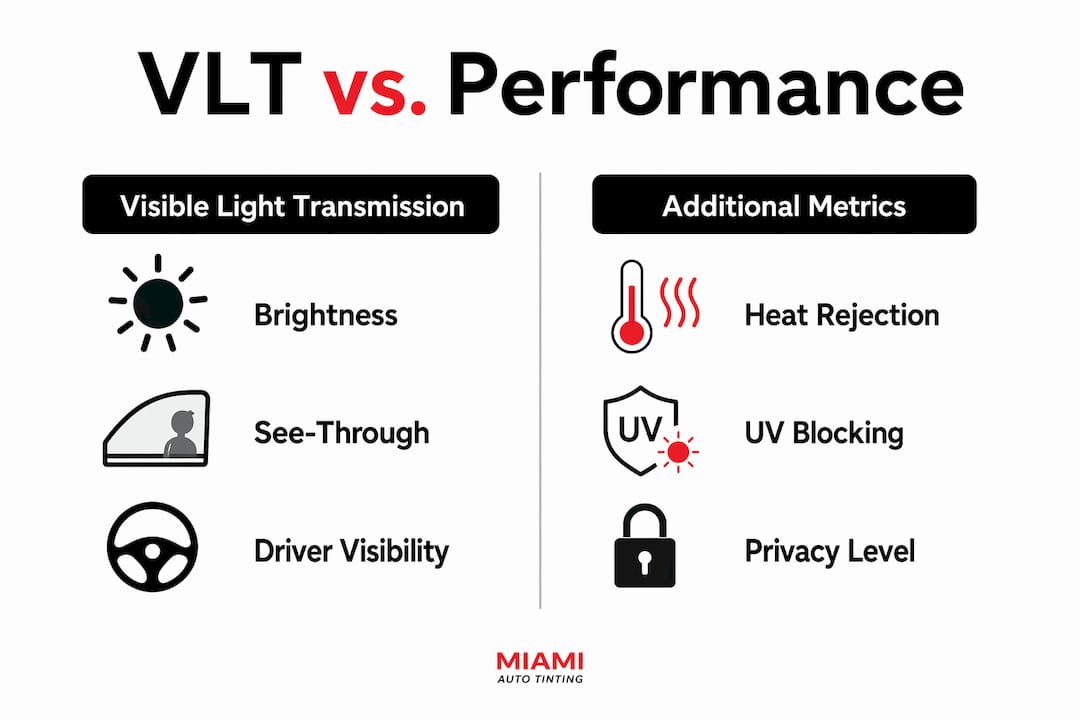
Two films can share an identical 35% VLT and look exactly the same from the outside, yet perform completely differently on a summer afternoon. A basic dyed film at 35% VLT may block minimal infrared heat, while a ceramic film at the same 35% VLT can reject well over half the solar heat entering through the glass. VLT only measures visible light; heat protection depends on the film technology, specifically whether it uses ceramic nano-particles or other infrared-blocking materials.
| Film Type | VLT | Heat Rejection | UV Blocking |
|---|---|---|---|
| Dyed film | 35% | Low (15 to 25%) | Moderate (up to 99%) |
| Carbon film | 35% | Moderate (40 to 50%) | High (up to 99%) |
| Ceramic film (e.g., 3M IR, Iviron Kollmax) | 35% | High (50 to 70%+) | High (up to 99%) |
| Ceramic film | 70% | High (50%+) | High (up to 99%) |
The table above shows why VLT percentage alone is an incomplete shopping criterion. Premium ceramic films can reject over 50% of infrared heat even at a light 70% VLT, which is a meaningful advantage over dyed films with similar VLT. For UV protection specifically, most quality films across all types block up to 99% of UV rays regardless of VLT. You can explore how UV protection for cars extends beyond tint to full vehicle care.
Pro Tip: When comparing tint quotes, always ask for the Total Solar Energy Rejected (TSER) spec alongside the VLT. TSER gives you a real-world heat rejection number that VLT alone cannot provide.
How state laws regulate VLT by window position
Window tint laws in the United States are not uniform. Federal standards set a baseline for windshields, but each state controls side and rear window limits independently. Getting this wrong means fines, mandatory removal, and re-tinting costs.
Here is what federal and state law generally covers:
- Windshields: Federal regulations require at least 70% VLT on the portion of the windshield below the AS-1 line. The AS-1 line is the manufacturer's marking near the top of the windshield indicating the boundary for legal tint strips.
- Front side windows: These are the most strictly regulated windows in most states. Many states require 28% to 35% minimum VLT on driver and passenger windows.
- Rear side windows and rear windshield: Rules are more relaxed here. Some states allow any darkness on rear windows, especially for SUVs and vans.
- Medical exemptions: Several states allow darker front window tint for drivers with documented medical conditions such as lupus or extreme photosensitivity.
| State | Front side window minimum VLT | Rear side window minimum VLT |
|---|---|---|
| Florida | 28% | 15% |
| California | 70% | Any (with rear view mirrors) |
| Texas | 25% | 25% |
| New York | 70% | 70% |
| Arizona | 33% | Any |
Florida's rules are particularly relevant for Miami drivers. The state requires 28% minimum VLT on front side windows, which means a 35% film on factory glass with 80% VLT produces a net of about 28%, sitting right at the legal edge. Each window position carries different VLT rules, and installers who skip the net VLT calculation put you at legal risk. You can read a detailed breakdown of Florida tint legal requirements before booking your installation.
The AS-1 line is the consistent regulatory reference point across all states for windshield tint legality. If your installer does not mention it, ask about it directly.
How VLT affects your daily driving experience
Choosing the right VLT is a balance between three competing priorities: privacy, nighttime visibility, and heat comfort. No single VLT level wins on all three.
- 5% VLT (limo tint): Maximum privacy. From outside, you cannot see into the vehicle at all. At night, however, 5% VLT creates serious visibility limitations for the driver, especially in low-light urban environments. It is also illegal on front side windows in virtually every U.S. state.
- 20% VLT: Strong privacy with moderate nighttime visibility. Popular on rear windows of sedans and SUVs. Still illegal on front side windows in most states.
- 35% VLT: The most popular balance point for front side windows. You get meaningful privacy during daylight, acceptable night visibility, and legal compliance in most states including Florida.
- 50% VLT: Light tint with minimal privacy. Primarily chosen for glare reduction and UV protection without a dramatic appearance change.
- 70% VLT: Nearly clear. Chosen mainly for UV and heat rejection using ceramic technology, where the film does its work invisibly. This is the only option legal on windshields below the AS-1 line.
Nighttime driving deserves specific attention. Darker tints reduce the amount of light reaching your eyes from streetlights, headlights, and traffic signals. If you drive frequently at night or in poorly lit areas, a 35% or lighter front window VLT is the practical choice. For rear windows, where you rely on mirrors rather than direct vision, darker options like 20% or 15% are both legal and practical for privacy. For a deeper look at how privacy tint options work across VLT levels, Southmiamitint has a dedicated guide worth reading before you decide.
Key takeaways
VLT is the foundational metric in window tinting, but it must be evaluated alongside heat rejection specs, factory glass VLT, and your state's legal minimums to make a genuinely informed choice.
| Point | Details |
|---|---|
| VLT measures light only | VLT percentage tells you darkness level, not heat or UV rejection performance. |
| Net VLT is what counts legally | Multiply factory glass VLT by film VLT to find the number law enforcement actually measures. |
| Ceramic films outperform at any VLT | Films like 3M IR and Iviron Kollmax reject 50%+ heat even at lighter VLT levels. |
| State laws vary by window position | Front side windows face the strictest limits; Florida requires 28% minimum VLT on front glass. |
| 35% VLT is the practical sweet spot | It balances privacy, nighttime visibility, and legal compliance for most U.S. drivers. |
What I've learned after years of tinting cars in Miami
Working with car owners across Miami-Dade, I see the same mistake repeatedly. Someone walks in asking for "the darkest legal tint" without knowing their factory glass VLT, and they end up with a net VLT that fails a Florida inspection. The film label said 28%, but the combined reading came out at 22%. That is a citation waiting to happen.
My honest recommendation is to stop chasing the darkest number and start asking about net VLT and heat rejection together. A 35% ceramic film from 3M IR or Iviron Kollmax will keep your car dramatically cooler than a 20% dyed film, and it will keep you legal on your front windows. In Miami's heat, the ceramic technology matters far more than shaving a few percentage points off your VLT.
I also caution against installers who skip the factory glass measurement step. Any shop worth trusting will measure your specific vehicle's glass before recommending a film. If they quote you a film without asking about your car's make and model, walk out. The right tint for your vehicle is always a calculated choice, not a guess.
One more thing: check your state's current laws before installation, not after. Regulations update, and what was legal two years ago may have changed. Florida's 28% front window rule has stayed consistent, but other states have tightened limits recently.
— Jose
Get professional ceramic tinting in Miami with Southmiamitint
Southmiamitint installs 3M IR, 3M Color Stable, and Iviron Kollmax ceramic tint on vehicles across Miami-Dade, and the service comes to you. Mobile installation means no waiting at a shop. Every job starts with a factory glass VLT measurement so your net VLT is calculated before a single film is cut. Ceramic films from Southmiamitint reject over 50% of infrared heat at legal VLT levels, keeping your interior cooler without pushing you past Florida's 28% front window limit. If you are ready to tint with confidence, explore ceramic window tint options starting at $249, or check 3M tint services for advanced heat rejection performance.
FAQ
What is VLT in window tinting?
VLT stands for Visible Light Transmission and measures the percentage of visible light that passes through a tinted window. A lower VLT percentage means a darker tint; a higher percentage means a lighter, more transparent film.
How does factory glass affect my final VLT?
Factory glass already transmits 70 to 90% of visible light, so the net VLT of your installed tint equals your glass VLT multiplied by your film VLT. A 35% film on 80% factory glass produces a net VLT of approximately 28%.
Does a lower VLT mean better heat rejection?
No. VLT measures light transmission only, not heat rejection. Two films with identical VLT can differ significantly in heat blocking, depending on whether the film uses ceramic nano-particles or basic dye technology.
What is the legal VLT for car windows in Florida?
Florida requires a minimum of 28% VLT on front side windows and allows 15% VLT on rear side windows. Windshields must meet the federal 70% VLT minimum below the AS-1 line.
What VLT level is best for daily driving?
35% VLT is the most popular choice for front side windows because it balances privacy, daytime glare reduction, and nighttime visibility while staying legal in most states including Florida.