
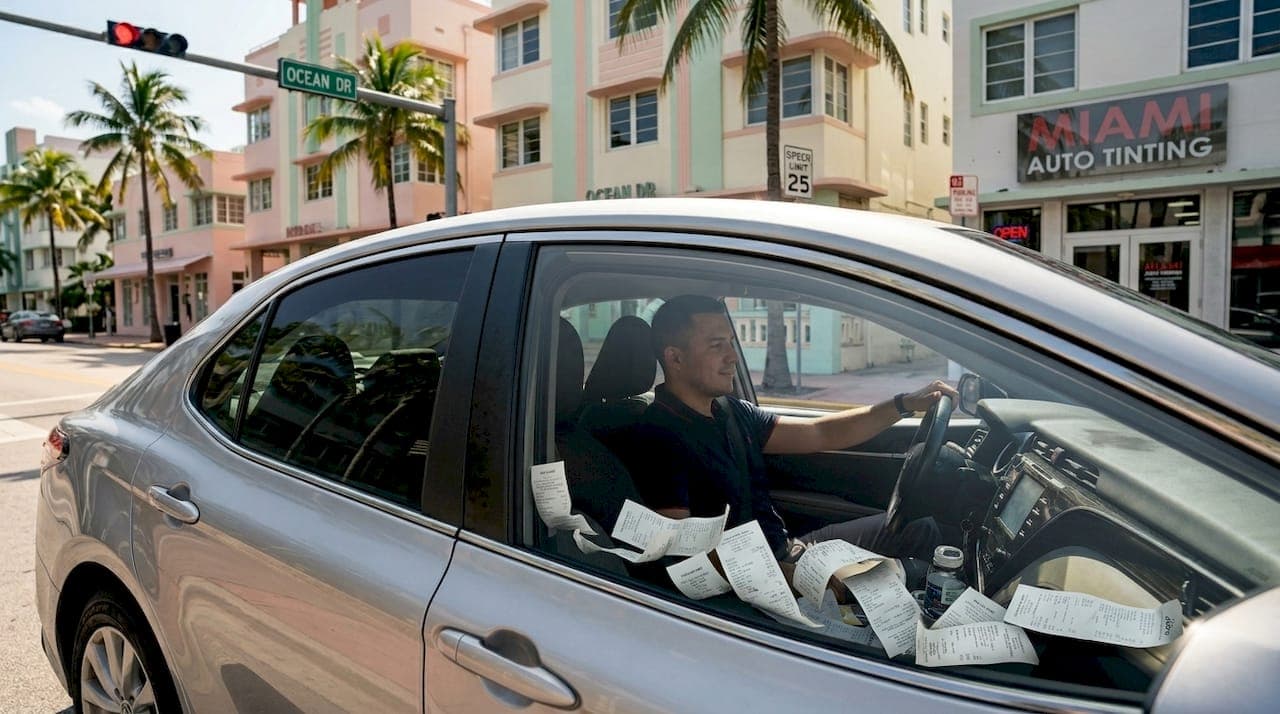
Many Miami car owners assume that any window tint is basically the same thing. You pick a shade, pay someone to install it, and your car stays cooler. If only it were that simple. The truth is that the type of tint film you choose determines how well your car handles South Florida's relentless sun, extreme UV exposure, and year-round humidity. Choosing the wrong tint can mean faded interiors, uncomfortable cabin temperatures, and a film that starts peeling within two years. This article breaks down everything you need to know so you can make a confident, informed decision.
Table of Contents
- Understanding window tint: Dyed vs. ceramic explained
- Performance in Miami's climate: Heat, UV, and clarity
- Durability and maintenance: Long-term value for your vehicle
- Cost and value: What do Miami car owners really pay?
- Why Miami drivers should rethink window tint choices
- Get expert Miami tinting: Ceramic and dyed options available
- Frequently asked questions
Key Takeaways
| Point | Details |
|---|---|
| Ceramic offers lasting protection | Ceramic window tint provides superior heat and UV resistance, perfect for Miami’s sunny climate. |
| Dyed tint fades faster | Dyed tint is affordable but tends to fade and lose effectiveness much quicker than ceramic options. |
| Long-term value matters most | Investing in ceramic tint saves money by reducing interior damage and maintenance over time. |
| Miami conditions demand quality | Miami’s intense sun and humidity amplify the importance of choosing high-performance tint. |
| Professional installation recommended | Expert installation maximizes the benefits and durability of your chosen tint. |
Understanding window tint: Dyed vs. ceramic explained
The window tint market has two very different products that often look similar from the outside but behave in completely different ways. Understanding what each one is made of will change how you think about tinting entirely.
Dyed window tint is the most common and affordable option on the market. It works by layering dye between an adhesive layer and a protective outer coating. When sunlight hits the glass, the dye absorbs some of the solar energy and reduces glare. That is essentially where the technology stops. The dye does not reflect heat or block infrared radiation in any meaningful way. It makes your windows darker, but it does not make your car significantly cooler.
Ceramic window tint, on the other hand, uses nano-ceramic particles embedded in a non-conductive film. These particles are engineered to block infrared radiation and UV rays without reducing visibility or interfering with electronic signals. This is a fundamentally different approach. Where dyed tint absorbs, ceramic tint rejects. That one distinction creates a massive gap in real-world performance, especially in a city like Miami.
The benefits of ceramic window tint go well beyond aesthetics. Ceramic films can reject up to 99% of UV rays and significantly cut down on infrared heat entering the cabin, which is something dyed films simply cannot match.
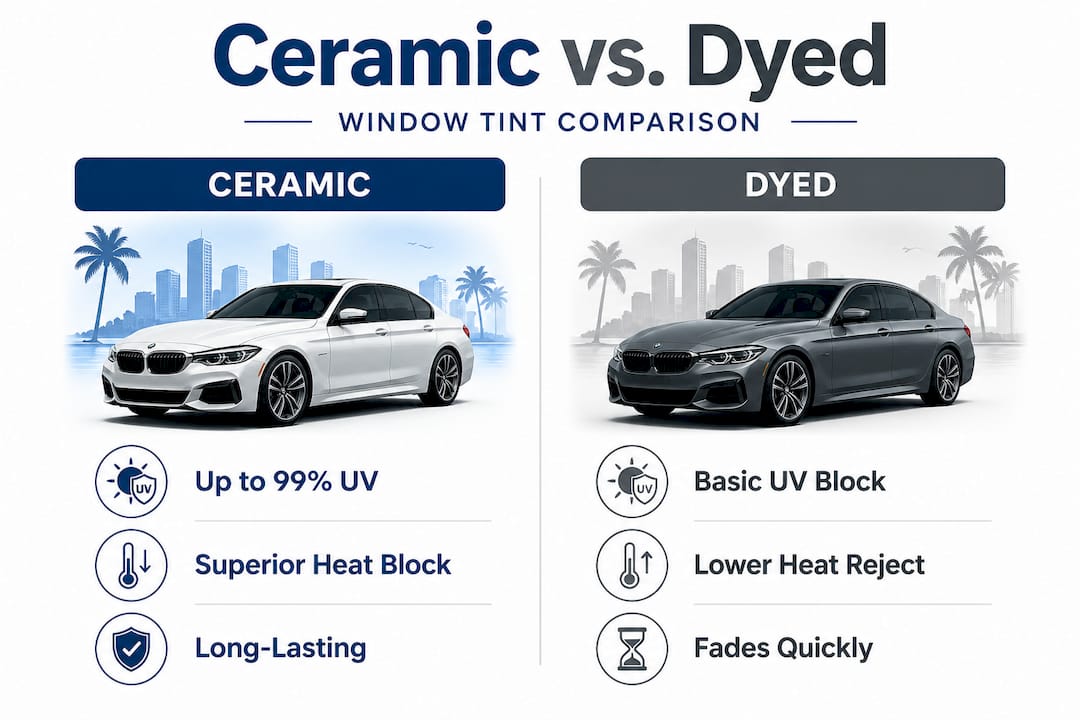
Here is a direct side-by-side comparison of what each film actually delivers:
| Feature | Dyed Tint | Ceramic Tint |
|---|---|---|
| Heat rejection | Low to moderate | High (up to 60% or more) |
| UV protection | Moderate | Up to 99% blocked |
| Optical clarity | Decent when new | Excellent, long-term |
| Signal interference | None | None |
| Fade resistance | Fades within 2 to 5 years | Stable for 10+ years |
| Price range | Budget-friendly | Premium |
Key distinctions for Miami drivers:
- Ceramic tint keeps cabin temperatures meaningfully lower during summer months
- Dyed tint may look similar but offers far less infrared heat rejection
- Ceramic films like 3M IR and Iviron Kollmax maintain optical clarity over time
- Dyed tint can turn purple or bubble as heat degrades the dye layer
- Ceramic tint does not interfere with GPS, Bluetooth, or cell signals
- Both types are legal in Florida as long as VLT (visible light transmission) limits are met
Performance in Miami's climate: Heat, UV, and clarity
Miami's climate is genuinely one of the toughest environments for any vehicle. Average annual temperatures stay well above what most U.S. cities experience, and South Florida ranks among the highest in the country for UV index exposure year-round. That matters a lot when you are deciding which tint to put on your car.
Heat rejection is the first major battleground. Ceramic tint wins here, and it is not close. A quality ceramic film can block up to 60% or more of solar heat. Dyed films typically block somewhere in the range of 20% to 35%. That gap becomes very real when you sit in a parked car on a July afternoon in Miami and feel the difference between a ceramic-tinted vehicle and a dyed-tinted one. Cabin temperatures can vary by 20 to 30 degrees Fahrenheit depending on tint type, which directly affects how hard your AC has to work and how much fuel you consume.
UV protection is the second critical category. UV rays cause two major problems in your car: they damage your health and destroy your interior. Long-term UV exposure while driving is linked to skin aging and increased cancer risk. On the interior side, UV radiation breaks down dashboard plastic, cracks leather seats, bleaches fabric, and causes the kind of fading that makes a car look old fast. The choice between ceramic and dyed tint significantly affects how long your interior holds up. Ceramic films block up to 99% of UV rays. Most dyed tints are rated closer to 50% to 70% UV rejection, which sounds decent until you realize that means nearly one-third of UV rays are still getting through every single day.
Optical clarity is often overlooked but incredibly important for drivers. Ceramic tint does not compromise visibility. Films like the 3M IR series and Iviron Kollmax are engineered to deliver crystal-clear vision in both directions. Dyed tint can look fine initially, but as the dye degrades from sun exposure, it may reduce sharpness and introduce slight distortion. In Miami traffic, you want full clarity.
Pro Tip: Most Miami drivers focus only on the VLT percentage (how dark the tint is) when they should also be asking about the TSER rating, which stands for Total Solar Energy Rejected. A higher TSER means your tint is doing more actual work blocking heat. Ceramic films consistently outperform dyed films on TSER, which is why ceramic tint outperforms dyed options for South Florida drivers who experience heat exposure every single day.
For context on how significant the benefits of window tinting are in Miami's climate, consider that UV exposure through car glass contributes to skin damage even on short commutes, and interior temperatures in parked cars can exceed 130°F in direct sun without any tinting at all.
Durability and maintenance: Long-term value for your vehicle
Beyond daily performance, durability and upkeep make a huge difference in long-term satisfaction. You do not want to pay for tinting every two years because you chose a film that could not handle Miami's sun.
Dyed tints are particularly vulnerable to heat degradation. The dyes used in the film begin to break down when exposed to consistent, intense UV and infrared radiation, which is exactly what Miami delivers every day. Depending on the quality of the dye and installation, you can expect a dyed film to last anywhere from two to five years before it starts to fade, turn purple, or develop bubbles. That bubble formation is not just ugly; it also means the film is separating from the glass and its UV-blocking capabilities are dropping further.
Ceramic tints hold up dramatically better. The nano-ceramic particles in these films are inorganic, meaning they do not break down from UV exposure the way dyes do. A professional-grade ceramic film installed correctly can last ten years or longer with minimal degradation. The Miami climate and window tinting relationship is a demanding one, and ceramic is the film built to survive it. When you factor in how often dyed tints need replacement, the cost gap between dyed and ceramic narrows considerably over time.
Maintenance matters for both types. Here are the steps to extend the life of your tint, whether ceramic or dyed:
- Wait at least 48 to 72 hours after installation before rolling down your windows. The adhesive needs time to fully cure, especially in Miami's humidity.
- Clean tinted windows with ammonia-free cleaning products only. Ammonia breaks down adhesive and accelerates fading in dyed films.
- Use a soft microfiber cloth when wiping down tinted windows. Abrasive materials scratch the protective outer coating.
- Avoid parking in direct sunlight for extended periods when possible, even with ceramic tint. While ceramic is highly resistant, every UV-free hour extends the film's life.
- Inspect the tint edges every six months for signs of peeling or lifting. Catching this early allows for spot treatment before full replacement is needed.
Pro Tip: If your dyed tint is starting to look slightly purple around the edges, that is not just a cosmetic issue. It means the dye has already degraded significantly, and your UV protection has dropped well below the film's original rating. Replace it before the next Miami summer.
Cost and value: What do Miami car owners really pay?
Once you understand performance and durability, the final step is weighing cost versus long-term value. Price is always part of the conversation, but it should not be the only part.
For a typical sedan in Miami, dyed tint installation generally runs between $80 and $150 depending on the number of windows and the installer. It is the budget option, and it shows in both performance and longevity. Ceramic tint installations are priced higher, reflecting the advanced materials involved. Ceramic window tint pricing in Miami starts from around $249 for professional-grade films like Iviron Kollmax, 3M IR, and 3M Color Stable, which are the exact films we use at South Miami Tint.
That price difference sounds significant upfront. But consider what you are actually comparing. If a dyed tint lasts three years and costs $120, you might pay for it two or three times over the decade that a ceramic film would hold up. The math shifts. Beyond replacement costs, there are also the interior repair costs that come from inadequate UV protection. Leather restoration, dashboard replacement, and seat reupholstering all cost far more than the price difference between dyed and ceramic tint.
When you think about window tinting essentials for Miami, the smart approach is to treat tinting as protection, not just a cosmetic upgrade. Protection costs more upfront and saves more over time.
How to weigh price against performance:
- Calculate your break-even point. How many dyed tint replacements equal one ceramic installation?
- Factor in AC savings. A cooler cabin means less AC use, which improves fuel economy year-round in Miami.
- Consider resale value. A car with well-maintained ceramic tint and a pristine interior commands more when you sell.
- Ask about warranties. Quality ceramic films often carry manufacturer warranties. Dyed films typically offer limited or no coverage.
- Compare total cost of ownership, not just the sticker price of the installation.
Why Miami drivers should rethink window tint choices
Here is something we see constantly working with Miami drivers: people choose dyed tint because they think they are being financially smart. They spend less now, figure they will deal with it later, and then come back two years down the road frustrated with fading film, a hot cabin, and a cracking dashboard. That pattern is so common it almost feels predictable.
Miami is genuinely not like other cities when it comes to sun exposure. You are not getting a few intense summer months like you would in Atlanta or Houston. You are getting near-constant UV exposure for twelve months a year, high ambient humidity that accelerates adhesive degradation, and salt air near the coast that is uniquely hard on materials. The city itself demands better.
What frustrates us is the assumption that because tint looks the same from the outside, it performs the same. A 35% VLT dyed film and a 35% VLT ceramic film look nearly identical to the naked eye, but they are performing at completely different levels. The ceramic version is actively rejecting infrared heat. The dyed version is mostly just blocking visible light and letting heat through. That difference is not visible. You feel it every time you get into your car on a 90-degree afternoon.
The ceramic tint advice for Miami we share with every customer comes down to one honest observation: the drivers who invest in ceramic tint once and do it right almost never come back with regrets. The ones who go with dyed film frequently come back within three years frustrated. That real-world pattern tells you everything you need to know about the value equation in a Miami context.
The uncomfortable truth is that cheap tinting in Miami often costs more in the long run, in replacements, in interior damage, and in comfort. Treat it as the protective investment it actually is.
Get expert Miami tinting: Ceramic and dyed options available
South Miami Tint brings professional mobile window tinting directly to you, wherever you are in Miami-Dade County. No waiting at a shop.
Whether you are interested in the premium performance of Iviron Kollmax ceramic tint, the trusted 3M IR series, or the 3M Color Stable film, we offer transparent pricing and mobile installation at your home, office, or anywhere that is convenient for you. Our team handles both ceramic and dyed tint installations with the expertise that Miami's climate demands. If you are ready to protect your interior, lower your cabin temperature, and add lasting value to your vehicle, you can schedule your ceramic tint installation directly on our website and get a fast, no-obligation quote. Quality tinting should be accessible, and we make it exactly that.
Frequently asked questions
Will dyed tints protect my car from Miami's sun?
Dyed tints offer basic protection, but they are significantly less effective than ceramic tints at blocking heat and UV in Miami's climate. For a city with year-round intense sun exposure, ceramic tints outperform dyed options in nearly every measurable category.
Do ceramic tints fade over time?
Ceramic tints resist fading far better than dyed tints, maintaining both clarity and performance for a decade or more under normal conditions. The nano-ceramic particles do not degrade under UV exposure the way dyes do, meaning your tint protects your car interior just as well in year eight as it did in year one.
Is ceramic tint worth the higher price?
For Miami drivers, ceramic tint delivers superior heat rejection, near-total UV blocking, and long-term durability that makes the upfront investment pay off. Starting from $249, ceramic tinting in Miami is a cost-effective decision when you factor in replacement costs and interior protection over time.
Can I install ceramic or dyed tint myself?
Professional installation is strongly recommended, especially for ceramic films, because improper application causes bubbling, peeling, and voids the manufacturer warranty. The precision required for a clean, lasting result is best left to experienced installers.
Does window tinting affect visibility?
Ceramic tints are engineered for optical clarity and actually improve comfort by reducing glare without distorting your view. Dyed tints can reduce sharpness over time as the dye layer breaks down, which is why ceramic tints are preferred by drivers who want both protection and clear visibility in all lighting conditions.