
The most effective approach is a clear or lightly tinted nano-ceramic film on the windshield, paired with ceramic film on the side and rear windows, installed by a professional. Look for high Total Solar Energy Rejected (TSER) and infrared rejection (IRR) numbers on the spec sheet, not just a low visible light transmission (VLT) percentage. Pair the film with a sunshade and smart parking, and you get the best real-world cabin cooling available on the market today.
TL;DR:
- Nano-ceramic and crystalline films provide the highest infrared rejection, with up to 66% TSER and 95% IRR, significantly outperforming dyed or metalized options.
- Windshield heat reduction is maximized by clear ceramic films, which block most infrared radiation while maintaining visibility and legal tint limits.
- Pairing ceramic film on all windows with sunshades and good parking habits enhances cabin cooling more effectively than tint alone.
- As most heat enters through the windshield, installing high-performance film there offers more benefit than tinting side windows first.
- Professional installation and verifying manufacturer-rated TSER and IRR are crucial for achieving the best heat rejection and durability outcomes.
Table of Contents
- Windshield Tint Heat Reduction: How Film Types Compare
- The Metrics That Actually Predict Heat Reduction
- Windshield Vs. Side and Rear Windows: Where Tint Helps Most
- How to Choose a Tint for Heat Reduction: Your Buying Checklist
- DIY Film Kits Vs. Professional Installation
- Sunshades, Parking, and Ventilation: What Multiplies Tint's Effect
- What South Miami Tint Installs and Why
- Balancing Comfort, Visibility, and Legal Compliance
- Ready to Book Ceramic Tint for Real Heat Relief?
- Sources
- FAQ
Windshield Tint Heat Reduction: How Film Types Compare
Not all window film fights heat the same way, and the differences matter more than most car owners realize. Some films absorb solar energy and slowly release it as heat inside the cabin. Others reflect it before it ever reaches the glass. The best modern films reject infrared radiation selectively, which is the part of sunlight responsible for most of the heat you feel on your skin and dashboard.
Dyed film sits at the bottom of the performance range. It works by absorbing sunlight rather than blocking it, which means it darkens the cabin without doing much for heat. It fades over time, turns purple in Miami's sun within a couple of years, and offers the weakest thermal performance of any film category on the market.
Metalized film uses microscopic metal particles to reflect solar energy, and it performs noticeably better than dyed film for heat rejection. The tradeoff shows up the first time you try to use a GPS app or get cell reception with a metalized-tinted windshield. Metal particles interfere with radio, GPS, and increasingly with the sensor arrays modern cars rely on for lane-keeping and adaptive cruise control.
Carbon film improves on both. It has no metal content, so it will not interfere with your phone signal, and it blocks a meaningful share of infrared radiation. Car and Driver notes carbon film can block up to roughly 40% of infrared radiation, putting it well ahead of dyed film while still trailing true ceramic options. Carbon also resists fading better than dyed film, which makes it a reasonable mid-tier choice for owners who want better performance without the ceramic price tag.
Ceramic film is where heat rejection gets genuinely strong. Ceramic particles are non-conductive and non-metallic, so they don't cause signal interference, and they reject infrared radiation far more effectively than dyed or carbon options. SunTek's ceramic tint data confirms ceramic films block a larger share of infrared radiation than metalized alternatives while avoiding the GPS and radio problems that come with metal content. Ceramic also holds its color and clarity far longer, which matters in a climate that puts film through constant UV stress.
Crystalline and nano-ceramic film represents the top tier. These films use multiple layers of nano-ceramic particles engineered to reject infrared radiation while staying nearly clear, which is exactly why they're legal and practical for windshields where dark tint isn't. 3M's Ceramic IR Series advertises up to 66% TSER and up to 95% infrared rejection using this technology, numbers that dyed or metalized film simply cannot approach.
Here's how the categories stack up for practical decision-making:
- Dyed film: Lowest cost, weakest heat rejection, fades and discolors within a few years.
- Metalized film: Strong heat rejection, but interferes with GPS, radio, and cellular signals.
- Carbon film: No signal interference, moderate infrared rejection, better fade resistance than dyed.
- Ceramic film: High infrared rejection, no signal interference, strong durability, ideal for side and rear windows.
- Nano-ceramic/crystalline film: Highest infrared rejection available, stays clear enough for windshield use, premium pricing.
For windshields specifically, ceramic and crystalline are really the only serious options, since they deliver heat rejection without the darkness that would violate windshield visibility rules. For side and rear windows, standard ceramic film covers most owners' needs, with carbon as a budget-conscious step down.
The Metrics That Actually Predict Heat Reduction
TSER, VLT, and IRR are printed on every reputable film's spec sheet, and understanding what each one measures is the difference between buying based on marketing language and buying based on performance you'll actually feel.
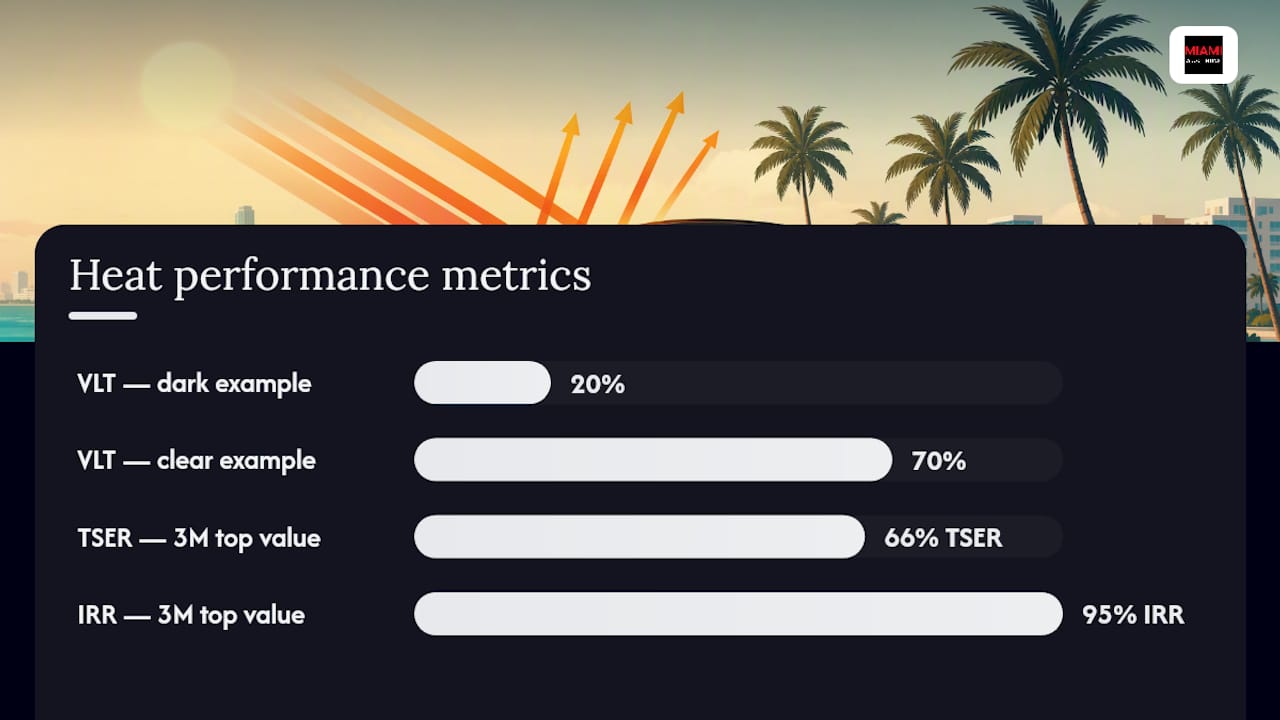
VLT (Visible Light Transmission) tells you how much visible light passes through the film, expressed as a percentage. A 20% VLT film is quite dark; a 70% VLT film is nearly clear. Here's the part most buyers miss: VLT measures darkness, not heat rejection. A film can be nearly clear and still block the majority of solar heat, which is exactly how clear ceramic windshield film works.
TSER (Total Solar Energy Rejected) measures the total percentage of solar energy, across the full spectrum including infrared, ultraviolet, and visible light, that the film keeps out of the cabin. This is the single most useful number for judging real-world heat reduction, because it accounts for the full range of energy that heats up your car.
IRR (Infrared Rejection) isolates just the infrared portion of sunlight, which is the wavelength range responsible for the "sun on your skin" feeling of heat. A film can have a modest VLT and still deliver exceptional infrared rejection, which is exactly the profile that makes selective nano-ceramic film so effective on windshields.
The insight worth remembering: selective IR rejection predicts how hot your cabin feels far better than how dark the glass looks. A film that lets in plenty of visible light but rejects 90%+ of infrared can feel cooler than a dark film with weak IR performance.
Statistic to keep in mind: 3M's Ceramic IR Series brochure lists up to 66% TSER and up to 95% infrared rejection for its top-tier nano-ceramic product line, figures that illustrate just how much daylight separates premium ceramic film from dyed or basic metalized options.
When you're comparing spec sheets, prioritize in this order:
- TSER first. This is the broadest, most honest measure of total heat rejection.
- IRR second. This tells you specifically how well the film handles the heat wavelength that matters most for comfort.
- VLT third, mainly for legal compliance. Use it to confirm the film meets your state's visibility requirements, not to judge thermal performance.
- UV rejection as a health check. Nearly all quality films block over 99% of UVA and UVB, according to the Skin Cancer Foundation, so this number should be near-universal across ceramic and crystalline products.
The absorption versus reflection distinction also affects your dashboard and upholstery, not just cabin air. Dyed film absorbs solar energy and reradiates a portion of it as heat, some of which still transfers into the cabin and onto interior surfaces over time. Reflective and selective-IR films block more of that energy before it converts to heat at all, which is part of why ceramic-tinted cars show less dashboard cracking and less faded upholstery after a few Florida summers.
Pro Tip: When an installer hands you a brochure, skip straight to the TSER and IRR rows. If those numbers are missing entirely, ask for the manufacturer's official spec sheet. A shop that can't produce one usually isn't installing what it claims.
Windshield Vs. Side and Rear Windows: Where Tint Helps Most
Independent heat testing points to a finding that surprises a lot of car owners: the windshield is the largest single source of cabin heat gain, not the side windows most people tint first. A high-performance clear ceramic film applied across the full windshield stabilizes cabin temperature more effectively than an untreated windshield, and the same testing found this works best when paired with ceramic film on the side and rear glass rather than relying on either alone.
Part of the reason comes down to glass type. Windshields use laminated glass, two layers of glass bonded with a plastic interlayer, which already blocks a significant share of UV radiation on its own. Side and rear windows use tempered glass, a single sheet that's heat treated for strength but does little to filter UV. That's why the Cancer Council Australia points out that side and rear windows commonly transmit more UVA than the windshield does, making UV-specific film especially valuable there even though the windshield handles more of the raw heat load.
If you want windshield film, here's how to approach it without running into trouble:
- Check your state's windshield tint law first. Most states allow only a clear or very light non-reflective ceramic film on the top few inches, or a nearly clear full-windshield film with high VLT, so confirm your state's exact rule before booking anything.
- Choose a nano-ceramic or crystalline product built for windshields specifically, following this car visibility checklist to maintain crystal clear views and legal compliance. These are engineered for high VLT with strong IR rejection, which keeps you compliant while still cutting heat.
- Ask the installer for the film's VLT percentage in writing. This protects you if you're ever questioned during a vehicle inspection or traffic stop.
- Pair the windshield film with ceramic side and rear tint. Testing shows the combination outperforms either treatment alone, since the windshield handles the biggest heat load while the side glass handles UV exposure for occupants.
How to Choose a Tint for Heat Reduction: Your Buying Checklist
Picking the right film comes down to matching performance data with an installer who can back up their claims. Here's what actually separates a good decision from an expensive mistake.
Start with the numbers, not the sales pitch. Ask for the manufacturer's TSER and IRR figures for the specific film being proposed, not a generic "our ceramic tint blocks heat" claim. A legitimate shop can pull the manufacturer spec sheet on the spot. If they can't, that's a signal to keep asking questions.
Ask about film composition directly. Is it dyed, carbon, ceramic, or nano-ceramic/crystalline? Some installers use vague language like "premium tint" to describe what is actually a basic dyed product. Naming the film family should get you a straight answer.
Get warranty terms in writing. Reputable ceramic film installations come with manufacturer-backed warranties covering fading, bubbling, and delamination, typically lasting for as long as you own the vehicle. If a warranty isn't offered or isn't in writing, treat that as a red flag on film quality or installation confidence.
Ask specifically about signal interference testing. Ceramic films generally avoid the radio and GPS interference issues that come with metalized products, but it's worth confirming the exact film type before installation, especially if your car relies on sensor-based safety features behind the glass.
Ask about installation practices, not just the product. Edge sealing, dust-free curing environments, and proper trimming all affect how long a film performs at its rated specs. A film with excellent lab numbers can underperform badly if installed in a dusty garage with rushed edges.
A few practical points to bring into any consultation:
- Request the film's TSER, IRR, and VLT figures before booking, not after.
- Ask how the installer handles bubbles or edge lifting if they appear within the warranty period.
- Confirm whether the quoted price includes a full re-installation for defects, not just a partial patch.
- Ask how long the shop has installed the specific film brand you're considering.
- Get the warranty length and coverage terms in writing before paying a deposit.
Pro Tip: If a quote seems unusually low compared to others you've gathered, ask which film family is included. A ceramic-priced quote using dyed film underneath is one of the most common ways low-cost tint jobs disappoint owners within a year.
DIY Film Kits Vs. Professional Installation
DIY tint kits are widely available, and the upfront cost savings look appealing. The problem is that installation quality directly affects thermal performance, and this is one area where a shaky first attempt costs you more than money.
Bubbles, edge lifting, and improper curing all reduce a film's effective infrared rejection, even when the underlying product is genuinely high quality.
DIY can make sense when:
- You're working with a flat, simple side window on an older vehicle with no complex curves.
- You're using a basic film for a low-stakes application, like a garage or shed window, not a daily driver.
- You've practiced on scrap glass first and have realistic expectations about visible seams or minor imperfections.
Professional installation is strongly recommended when:
- You're tinting a windshield, where precision cutting and legal compliance both matter.
- You're installing a premium ceramic or crystalline film, where a poor install wastes the performance you paid for.
- Your vehicle has curved rear glass or complex window shapes, which are genuinely difficult to fit without air pockets.
- You want a warranty that actually holds up, since most manufacturers require professional installation for warranty coverage to apply.
A simple rubric: if the film costs more than a tank of gas, get it installed professionally. Premium ceramic film represents a real investment in cabin comfort and UV protection, and a rushed DIY job can undercut most of that value in the first year.
Sunshades, Parking, and Ventilation: What Multiplies Tint's Effect
Film alone doesn't stop every source of cabin heat. Films are excellent at blocking radiant solar heat coming through glass, but they can't do anything about conductive heat soaking through an unshaded metal roof or hood on a 95 degree Miami afternoon. That's exactly why pairing tint with a few low-cost habits produces noticeably better results than tint by itself.
- Use a windshield cover or external canopy when parking for extended periods. Testing reported by Carscoops found external canopies reduced cabin temperatures by roughly 18°F (10°C), while a standard windshield cover delivered around 14°F (8°C) of improvement over an untreated baseline, both meaningful drops on top of what tint alone provides.
- Crack your windows for 30 to 60 seconds before starting the engine, or use the "flush and go" method: open all doors briefly to push out the trapped superheated air before you sit down, then turn on the A/C at a low fan speed with the windows still cracked for the first minute of driving.
- Park strategically whenever you have a choice. Facing away from direct afternoon sun, or choosing partial shade over full sun exposure, meaningfully reduces the heat load your tint and A/C system need to manage.
- Keep your A/C system maintained. A system with a struggling compressor or low refrigerant won't capitalize on the head start ceramic tint gives you, since tint reduces the amount of heat entering the cabin but your A/C still has to remove it.
- Layer in a reflective interior shade for the dashboard on top of tint, particularly on the windshield, which general auto maintenance guidance recommends as a low-cost way to protect the dashboard from UV-driven cracking even when film is already installed.
None of these measures replace quality tint, but stacking them delivers a bigger combined temperature drop than any single step taken alone.
What South Miami Tint Installs and Why
South Miami Tint installs 3M Ceramic IR, 3M Crystalline, 3M Color Stable, and Iviron KoolMax ceramic films, chosen specifically because they fall into the selective infrared rejection category rather than older dyed or metalized technology. In a market like Miami, where cars sit in direct sun for hours and interior temperatures climb fast, that distinction is not a marketing detail. It's the difference between a tint job that looks good on day one and one that actually keeps a dashboard from cracking three summers later.
3M Crystalline and 3M Ceramic IR are built around nano-ceramic layers that let installers offer meaningfully clear windshield options alongside standard side and rear tint, which matters for Florida drivers who want heat performance without running into visibility issues. Iviron KoolMax rounds out the ceramic lineup as another selective-IR option, giving customers a range of ceramic-tier products rather than a single fixed choice.
Because installation quality affects real-world IR rejection as much as the film itself, mobile ceramic installation happens at the customer's home or workplace with the same edge-sealing and curing standards a shop environment would apply. Every job comes with manufacturer-backed film warranties, which matters more with ceramic and crystalline products than with basic dyed film, since the warranty terms are one of the clearest signals of how confident a company is in both the product and the install.
Balancing Comfort, Visibility, and Legal Compliance
The clearest recommendation in this entire topic is also the one most overlooked: chase infrared rejection numbers, not darkness. A film that's nearly clear can outperform a dark one on actual heat reduction, and readers get this backwards constantly because "dark tint" has become shorthand for "good tint" in a lot of casual advice online. It isn't. Selective IR rejection is what separates a film that genuinely cools your cabin from one that just makes it harder to see out of at night.
The second thing worth saying plainly: legal compliance and thermal performance are not actually in tension anymore. A decade ago, meaningful heat rejection often meant a film dark enough to risk a citation. Nano-ceramic technology broke that tradeoff. You can now get a legal, nearly clear windshield film with genuinely high IR rejection, which means there's very little excuse left for skipping windshield treatment out of fear it will look too dark or draw police attention.
Before you book anything, check your state's specific windshield and side-window tint laws, and ask any installer for the manufacturer's TSER and IRR figures in writing. If they can't produce them, that tells you something about what you're actually paying for.
— Jose
Ready to Book Ceramic Tint for Real Heat Relief?
South Miami Tint is the mobile alternative to sitting in a shop waiting room for hours. Installation happens at your home or office anywhere across Miami-Dade County, using 3M Ceramic IR, 3M Crystalline, and Iviron KoolMax, all selective-IR ceramic films chosen specifically for the heat performance this article covers, not the basic dyed film that still gets sold as "tint" at budget shops.
Ceramic mobile installations start from $249, and every job comes with manufacturer-backed warranty coverage on the film. If you're weighing windshield-specific film, the 3M lineup South Miami Tint installs covers both nearly clear ceramic options and deeper side/rear tint, so you can match the right film to each window rather than settling for one compromise across the whole car. Request a quote online or by phone, and a technician can walk you through TSER and IRR numbers for your specific vehicle before you commit to anything.
Sources
FAQ
Does Tinted Glass Reduce Heat in a Car?
Yes, quality tint reduces cabin heat by blocking a portion of solar energy before it passes through the glass, though performance varies enormously between film types. Basic dyed film offers modest improvement, while ceramic and nano-ceramic films can reject up to 95% infrared radiation according to 3M's published specs.
How Much Heat Does Window Tinting Reduce?
Heat reduction depends on the film family and its TSER rating.
Which Window Tint Has the Best Heat Reduction?
Nano-ceramic and crystalline films deliver the strongest heat reduction currently available, thanks to selective infrared rejection that blocks heat without requiring dark tint. South Miami Tint installs several films in this category, including 3M Ceramic IR and 3M Crystalline, specifically for this reason.