
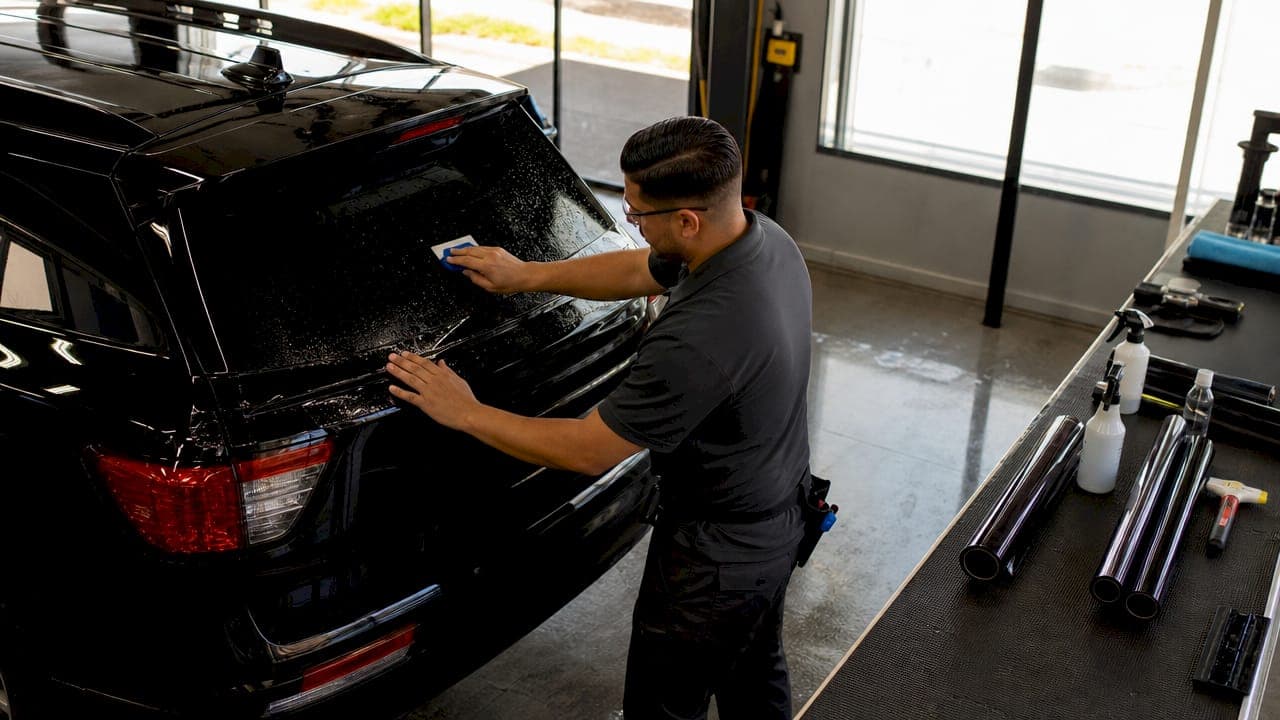
Ceramic tinting is defined as window film embedded with nano-ceramic particles that block heat, UV rays, and infrared radiation across a broad solar spectrum, while infrared window film targets specific infrared wavelengths to reduce heat with minimal visible darkening. The distinction matters enormously for Miami drivers, where summer cabin temperatures can make a car feel like an oven within minutes. Products like 3M Ceramic IR and Iviron Kollmax ceramic tint represent the ceramic category, while dedicated infrared films use magnetron-sputtering technology to achieve near-clear heat rejection. Understanding the infrared vs ceramic tinting difference comes down to two key metrics: infrared rejection percentage and TSER (Total Solar Energy Rejection), which measures heat blocked across the full solar spectrum.
How infrared and ceramic tints compare for Miami heat rejection
Miami's climate is one of the harshest tests any window film can face. Direct sun, high humidity, and long driving seasons mean your tint works harder here than almost anywhere else in the country.
Ceramic tints reject 60% to 98% of infrared heat and reduce cabin temperatures by 15 to 30°F compared to dyed films. That range translates directly to whether your air conditioning runs on overdrive or keeps up comfortably on a 95°F afternoon in Brickell. Nano-ceramic films specifically block 90% to 98% of infrared radiation, making them the top performers in this category.
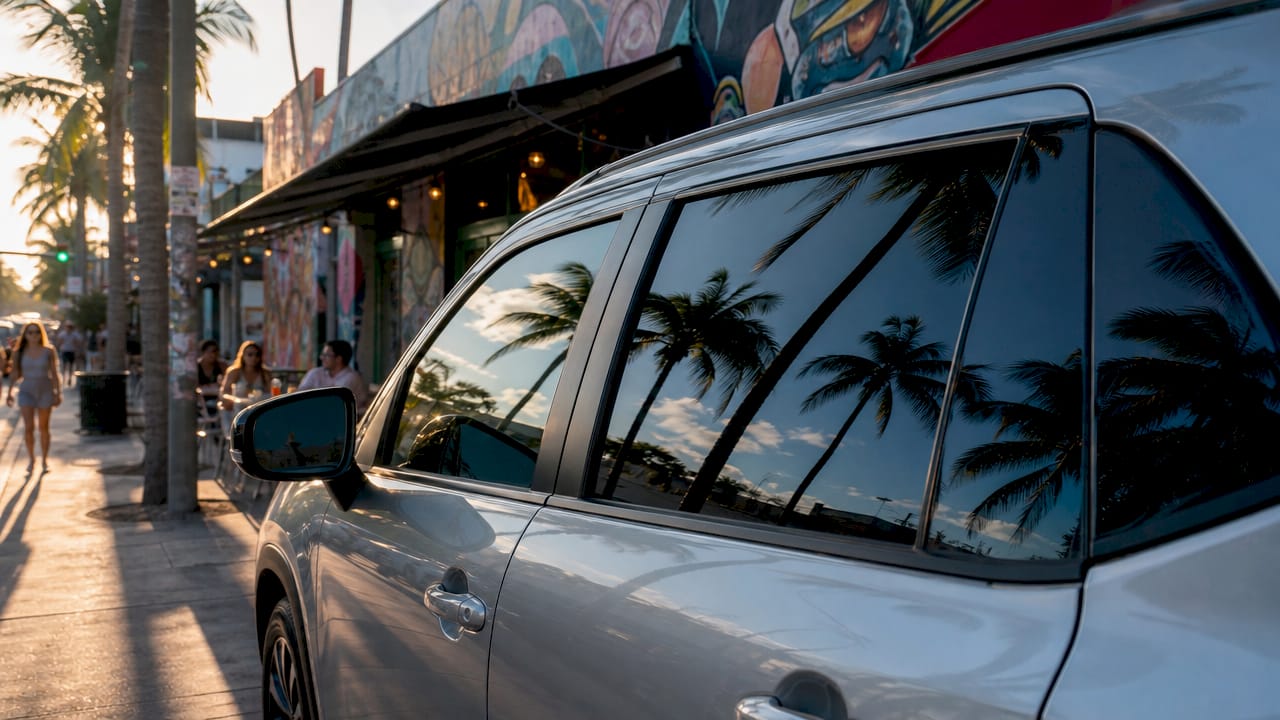
Dedicated infrared films take a different approach. Infrared films can block over 99% of infrared radiation at specific wavelengths and reflect up to 80% of solar heat. The catch is that this figure often applies to a narrow wavelength band, not the full infrared spectrum. That distinction is where many buyers get misled.
Infrared rejection percentages can be misleading when reported only for narrow wavelengths. TSER is the more accurate measure because it covers the full solar spectrum from 780 to 2500 nm. A film marketed as "99% IR rejection" may only be measuring a slice of the infrared band, while a ceramic film with a stated 66% TSER is blocking that share of all solar energy hitting your glass. For Miami drivers, TSER is the number to ask for.
Pro Tip: When comparing tint quotes in Miami, always ask the installer for the TSER rating on the specific film, not just the infrared rejection percentage. A higher TSER means more total heat blocked, regardless of how the IR number is marketed.
| Film Type | IR Rejection | TSER | Cabin Temp Reduction |
|---|---|---|---|
| Nano-ceramic (e.g., 3M Ceramic IR) | Up to 95% | Up to 66% | 15 to 30°F |
| Dedicated infrared film | Up to 99% (narrow band) | Varies by product | Varies significantly |
| Dyed film | Low (10 to 30%) | Low | Minimal |
| Carbon film | Moderate (40 to 60%) | Moderate | 5 to 15°F |
What UV protection do infrared and ceramic tints actually provide?
UV protection is where ceramic tint pulls decisively ahead, and the gap matters for both your skin and your car's interior.
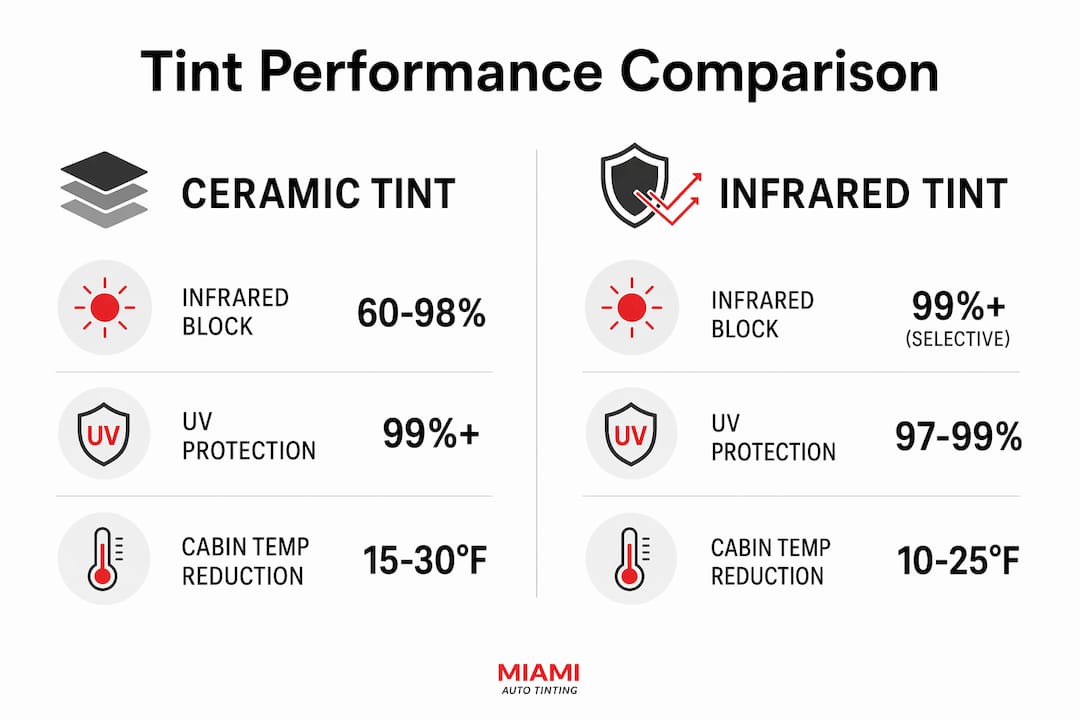
Ceramic tints block 99% or more of UV rays, protecting occupants from UVA and UVB radiation during daily commutes. Dermatologists classify car window glass as inadequate UV protection on its own, and Miami's year-round sun exposure makes this a real health consideration, not just a comfort upgrade. Dashboard cracking, leather fading, and seat discoloration are all accelerated by UV exposure, so this protection also preserves resale value.
Dedicated infrared films vary more widely on UV blocking. Some high-quality infrared films include UV inhibitors and perform close to ceramic levels, but this is not guaranteed across all products. When comparing options, UV rejection should appear as a separate specification on the product data sheet, not bundled into the IR rejection figure.
Here is what ceramic tint's UV protection delivers in practical terms:
- Blocks 99%+ of UVA and UVB rays, reducing cumulative skin exposure during daily driving
- Prevents dashboard and upholstery fading, which directly affects resale value on vehicles in Miami's intense sun
- Protects child passengers who spend extended time in rear seats, where UV exposure through side glass is often overlooked
- Maintains protection even at lighter VLT (Visible Light Transmission) percentages, so you get UV blocking without maximum darkness
- Works consistently over the film's lifespan, unlike dyed films that degrade and lose UV rejection as the dye fades
Appearance, durability, and signal interference compared
This is where the choice between film types affects your daily experience beyond just temperature.
Ceramic tints resist discoloration, fading, and bubbling better than dyed or metalized alternatives, with a typical lifespan of 10 to 15 years with proper care. In Miami's UV-heavy environment, dyed films often start showing purple tinting or bubbling within two to three years. Nano-ceramic films do not scatter visible light, which means they maintain optical clarity without the haze that cheaper films develop over time.
Dedicated infrared films can be manufactured at very light VLT levels, sometimes appearing nearly clear. This makes them attractive in states or counties with strict tint laws, since you get heat rejection without obvious darkening. Florida law requires front side windows to allow more than 28% VLT, so near-clear infrared films can be a legal advantage for drivers who want maximum heat rejection on the windshield or front glass.
Signal interference is a decisive factor for modern vehicles. Metalized tints cause GPS and mobile device interference, which is a real problem in cars loaded with navigation systems, toll transponders, and Bluetooth antennas. 3M Ceramic IR uses a metal-free design that avoids this entirely, maintaining strong signal performance across all vehicle electronics. Dedicated infrared films using magnetron-sputtering technology may or may not contain metallic layers depending on the product, so this requires direct confirmation from the manufacturer.
Pro Tip: If your car has a built-in navigation system, a toll transponder like SunPass, or a rear-window defroster, confirm that any film you choose is explicitly labeled metal-free before installation.
| Feature | Ceramic tint | Infrared film |
|---|---|---|
| Lifespan | 10 to 15 years | Varies (5 to 12 years typical) |
| Color stability | Excellent, no purple shift | Good in quality products |
| Signal interference | None (metal-free) | Depends on construction |
| Optical clarity | High, no haze | High in near-clear versions |
| VLT options | Wide range | Often lighter shades |
What does infrared vs ceramic tinting actually cost in Miami?
Price is where many Miami drivers make their decision, and the numbers are worth understanding clearly before you book an appointment.
Ceramic tint installation runs $500 to $900 for a full vehicle, with SUVs at the higher end of that range. 3M Ceramic IR installation for an SUV costs $700 to $800 in the Miami area specifically. Standard dyed or carbon films run $200 to $350, while dedicated infrared films fall somewhere in between depending on the brand and technology used.
Here is what drives the cost difference and why it matters:
- Film material quality: Nano-ceramic particles and magnetron-sputtered layers cost more to manufacture than dyed polyester, and that cost passes through to installation pricing
- Installer experience: A poorly installed ceramic film will bubble, peel, and lose performance within a year. Labor quality matters as much as film quality in Miami's heat and humidity
- Warranty coverage: Premium ceramic films from 3M and Iviron Kollmax carry manufacturer warranties of 10 years or more. Budget films often carry no warranty or limit coverage to one to two years
- Mobile vs. shop installation: Mobile tinting services in Miami eliminate the need to drive to a shop and wait, which adds convenience without necessarily adding cost. Southmiamitint operates as a mobile tinting service across Miami-Dade, bringing installation to your location
- Vehicle size: Sedans cost less than SUVs or trucks due to total glass surface area
For drivers with a tighter budget who still want heat rejection above what dyed films provide, a quality infrared film is a legitimate middle-ground option. The trade-off is a shorter lifespan and less comprehensive UV protection compared to ceramic.
How to choose the right tint for your Miami vehicle
The right choice depends on how you use your car, where you park it, and what you prioritize. Work through these considerations in order:
- Assess your heat exposure. If you park outdoors in Miami during the day, ceramic tint's superior heat rejection for hot climates pays for itself in reduced AC load and interior protection. If you park in a garage most of the day, a quality infrared film may be sufficient.
- Check Florida's VLT laws. Front side windows must allow more than 28% VLT. If you want a darker look on rear windows, ceramic films are available in a wide VLT range. Near-clear infrared films are useful if you want heat rejection on the windshield without legal issues.
- Consider your electronics. Modern vehicles with GPS, SunPass, or multiple antennas need a metal-free film. Ceramic tint is the safe default. Confirm any infrared film is metal-free before committing.
- Think about long-term value. Ceramic tint at $600 to $900 that lasts 15 years costs less per year than a $300 film replaced every four years. Factor in the UV protection benefit to your interior's resale value.
- Prioritize installer reputation over price. The ceramic tint advantages only materialize with correct installation. A quality film installed poorly performs worse than a mid-grade film installed well.
Key takeaways
Ceramic tint outperforms dedicated infrared film for Miami drivers on every major metric except upfront cost, making it the better long-term investment for heat rejection, UV protection, and durability.
| Point | Details |
|---|---|
| TSER beats IR percentage | Always ask for TSER data; it measures total solar heat blocked, not just a narrow wavelength band. |
| Ceramic UV protection | Ceramic tints block 99%+ of UV rays, protecting both occupants and vehicle interiors from Miami's year-round sun. |
| Signal interference risk | Metal-containing films disrupt GPS and mobile signals; ceramic and confirmed metal-free infrared films avoid this problem. |
| Cost vs. lifespan | Ceramic tint costs more upfront but lasts 10 to 15 years, making it cheaper per year than budget alternatives. |
| Installation quality matters | Film performance depends heavily on installer skill; choose a provider with verified experience and manufacturer-backed warranties. |
What I've learned after years of tinting Miami cars
I've seen the full range of tint decisions play out on Miami vehicles, and the pattern is consistent. Drivers who choose ceramic tint based on TSER data are satisfied long-term. Drivers who choose based on a low price or a high-sounding IR percentage often come back within three years with bubbling, faded film and a car that still gets too hot.
The terminology confusion is real. Retailers sometimes use "infrared tint" and "ceramic tint" interchangeably, but these terms describe different things entirely. Ceramic is a material technology. Infrared rejection is a performance metric. A ceramic film has high infrared rejection. An infrared film may or may not use ceramic particles. When a shop can't explain that distinction clearly, that tells you something about the quality of advice you're getting.
Miami drivers also underestimate UV protection as a daily health factor. You're in the car for 30 to 60 minutes a day, often in direct sun. That cumulative UVA exposure through untinted or poorly tinted glass adds up over years of driving. Ceramic tint addresses this completely. Most dedicated infrared films do too, but you need to verify the UV spec separately.
My recommendation is straightforward: if you're keeping your car for more than three years and parking outdoors regularly in Miami, ceramic tint is the right call. The ceramic vs. carbon comparison shows the same conclusion. Infrared film is a valid option for specific situations, particularly near-clear applications on windshields or for drivers on a strict budget who understand the trade-offs.
— Jose
Get professional ceramic tinting in Miami, delivered to you
Southmiamitint installs 3M Ceramic IR and Iviron Kollmax ceramic tint across Miami-Dade as a fully mobile service, meaning the installation comes to your home, office, or wherever your car is parked.
Ceramic window tinting starts at $249 for cars, with SUV pricing available on request. Every installation uses manufacturer-backed film with a 10-year warranty. If you want the performance of 3M Ceramic IR film with up to 95% infrared rejection and zero signal interference, Southmiamitint brings that directly to you. Book an appointment or request a quote online to get your vehicle protected before Miami's next heat wave.
FAQ
What is the main difference between infrared and ceramic tinting?
Ceramic tinting uses nano-ceramic particles to block heat, UV rays, and infrared radiation across a broad spectrum. Infrared tinting targets specific infrared wavelengths and may not provide the same UV protection or overall heat rejection as ceramic.
Which tint is better for reducing heat in a Miami car?
Ceramic tint is the better choice for Miami heat reduction. Ceramic films reduce cabin temperature by 15 to 30°F and deliver higher TSER ratings than most dedicated infrared films.
Does ceramic tint interfere with GPS or phone signals?
Ceramic tint does not interfere with electronics. Ceramic tint is metal-free, which means it has no impact on GPS, Bluetooth, or mobile signals, unlike metalized films.
How long does ceramic window tint last in Miami's climate?
Ceramic tint lasts 10 to 15 years with proper care, resisting the fading, bubbling, and discoloration that dyed films develop within a few years under Miami's intense UV exposure.
Is infrared tint legal in Florida?
Florida law requires front side windows to allow more than 28% VLT. Near-clear infrared films often meet this requirement easily, making them a legal option for drivers who want heat rejection without visible darkening on front windows.