
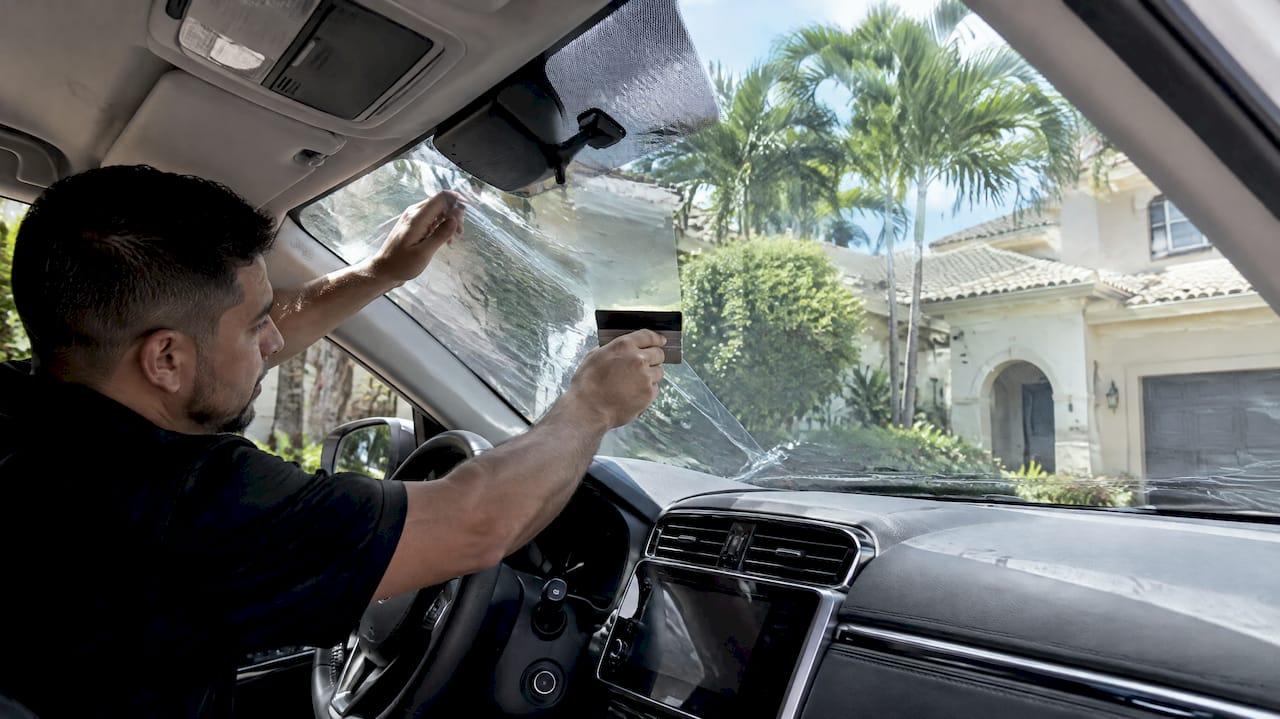
3M Crystalline on a windshield gives you strong heat and UV rejection while the glass stays nearly clear. 3M reports up to 64% total solar energy rejection and 99.9% UV block, and the light shades are made for the front glass, where you need full visibility. In Miami-Dade, where the sun hits a windshield for most of the year, that combination is the reason drivers ask for it. We install it at your home or office, so you never wait at a shop.
TL;DR
- Crystalline is a multilayer optical film that rejects up to 64% of total solar energy and blocks 99.9% of UV, according to 3M's data sheet.
- The light shades (CR 70 and CR 80) keep the windshield bright and clear, with 97% and 95% infrared rejection on 3M's measurement.
- UV protection is similar across quality ceramic films. What Crystalline adds is infrared performance, which is what you feel as cabin heat.
- Florida allows sunscreening material only within the rules for the top of the windshield, so check the line before you choose a shade.
- A windshield is the hardest window to tint. We cut each pattern by computer and install it ourselves, at your location.
Table of Contents
- What 3M Crystalline is
- The benefits you get on a windshield
- How to read the numbers on the data sheet
- Is Crystalline worth it in Miami-Dade?
- Florida rules: what you need to know first
- Why installation decides the result
- Keeping the outside of the glass clear
- Crystalline compared with other ceramic films
- Our perspective
- Book Crystalline installed where your car is
- FAQ
- Sources
What 3M Crystalline is
Crystalline is 3M's clear-looking automotive window film. It is built from a proprietary multilayer optical film with more than 200 layers. The film does not use dye or metal to cut heat. The layers are engineered to reflect infrared energy, the part of sunlight that you feel as warmth on your hands, lap and dashboard.
That matters on a windshield for one reason: the front glass is the largest window in your car and it faces the sun directly. A film that works without darkening the glass is the one that fits here.
We install 3M Ceramic IR and 3M Crystalline, among other ceramic films. You can see the full range on our 3M window tinting page.

The benefits you get on a windshield
Less heat reaching you
The 3M data sheet lists up to 64% total solar energy rejection for the Crystalline series. Total solar energy covers visible light, UV and infrared together, so it is the broadest number on the sheet.
In practice, less solar energy through the glass means a cooler dashboard, a steering wheel you can touch sooner after parking, and an air conditioner that has less to fight on a Miami afternoon in traffic on the Palmetto or US-1.
Near-total UV block
3M reports 99.9% UV block. UV is what fades dashboards, leather and door panels, and it reaches your skin through the glass on every drive. A windshield film covers the largest opening in the car.
One honest point: UV rejection is standardized across most high-end ceramic films, so UV alone is not what separates one premium film from another. The difference you pay for is infrared performance and heat management.
Heat rejection without a dark look
On a windshield you cannot go dark. Crystalline's strength is that it rejects infrared at light shades. The data sheet lists two light options:
| Shade | Visible light transmission (VLT) | Infrared rejection (IRR) |
|---|---|---|
| CR 70 | 64% | 97% |
| CR 80 | 72% | 95% |
Source: 3M Automotive Window Film Crystalline Series data sheet, August 2025.
VLT is the share of visible light that passes through the film and glass. A higher number looks lighter. If you want to understand it better, our guide to visible light transmission explains how to pick a shade.
Glare reduction
The same sheet lists glare reduction for these shades. On Auto 75 glass, CR 70 reduces glare by 13% and CR 80 by 2%. The lighter the film, the less glare it cuts, so if low sun on the Dolphin Expressway bothers you, CR 70 is the shade that gives the more noticeable change.

A clear view for day and night driving
Because the light shades pass most visible light, the windshield looks close to untinted. That is useful at dusk and on poorly lit roads in Kendall and Pinecrest, where you want nothing between you and the road. If night driving is a concern for you, read our note on tinted windows at night.
How to read the numbers on the data sheet
Heat figures from different brands are often not comparable, because each measures something different. Here is what the Crystalline sheet means by each term.
- Total solar energy rejected (TSER): the share of all sunlight energy, visible, UV and infrared, that the film and glass keep out. This is the number closest to what you feel in the cabin.
- IRER: infrared energy rejection over the 780 to 2,500 nanometer range. It includes infrared that the film absorbs and then re-radiates into the car.
- IRR: rejection measured at 900 to 1,000 nanometers on the film alone, without glass. It is a narrow band, which is why it can read 97% while total energy rejection reads 64%.
The practical rule: compare TSER with TSER and IRR with IRR. A 97% infrared figure does not mean 97% less heat. It means the film is very effective in one band of the spectrum, and that is what makes the film strong against heat while staying light.
Is Crystalline worth it in Miami-Dade?
For most drivers here, yes, because heat is the problem the film solves. A professional guide to ceramic tint says the premium for nano-ceramic film pays off in hot places, citing cities such as Atlanta, Phoenix and Houston, and locations above 85°F for three months. Miami-Dade sits well inside that profile, with long, humid, sunny seasons.
Crystalline suits you best if:
- You park outside at home, at work or at a condo lot, and the cabin bakes.
- You want the heat benefit on the windshield without a darker look.
- You drive a Tesla, a luxury car or an exotic with a large, curved windshield and a glass roof area where heat comes in.
- You want a film from a major manufacturer with a strong warranty. Our 3M Ceramic IR installs carry a lifetime warranty.
Our cost guides cover what 3M Crystalline costs on a full vehicle ($580 to $1,200) and when it is worth the cost. For windshields specifically, our published prices start at $150 for windshield tint. The price for Crystalline depends on your vehicle, so we quote it by phone or through the form.
Florida rules: what you need to know first
Florida law permits sunscreening material along a transparent strip at the top of the windshield, as long as it does not go below the AS/1 line. The AS/1 line is a small marking printed on the edge of the glass by the manufacturer. Film must stay above it.
This changes how you plan the job. Many drivers want film across the whole windshield for the heat benefit. Whether that is allowed for your vehicle, and which shade, depends on the law and on how the glass is marked. Before you book, read our guides to Florida's AS-1 line rule, the windshield tint strip and how to prove your windshield tint is legal. For a ruling on a specific vehicle or a citation, the authority is the Florida Highway Safety and Motor Vehicles office or the court that issued the citation.
We confirm the placement with you at the car before we cut anything.
Why installation decides the result
The windshield is the largest and most curved piece of glass on the car, and the film has to be shaped to it. Any dust, edge gap or crease is in your direct line of sight. That is why the installer matters as much as the film.
Here is how we handle it:
- Pattern. We cut the pattern by computer for an exact fit to your make and model, instead of trimming by hand on the glass.
- Film width. We work with 60-inch rolls, so large windshields go on in one piece, with no seam.
- Experience. The owner installs the film. We have 28 years of experience and work on Tesla, luxury and exotic vehicles.
- Location. We come to your home or office anywhere in Miami-Dade, so the car is installed in a clean, shaded spot you choose, and you do not drop it off.
If you notice any issue after a tint job, our guide on common tinting installation issues shows what is normal during curing and what to call us about.
Keeping the outside of the glass clear
Film protects the inside of the glass from heat. Some drivers also add a ceramic coating for glass on the outside so water beads off and the windshield stays easier to clean. The two work on different sides of the glass, and you can use both.
Crystalline compared with other ceramic films
We install ceramic films only. Here is how the options we carry fit different needs.
| Film | Warranty | Best fit |
|---|---|---|
| 3M Crystalline | See 3M and our quote | Windshields and front glass where you want the clearest look with strong heat rejection |
| 3M Ceramic IR | Lifetime | Full-car tint with high infrared heat rejection |
| SunTek CIR | 5-year | Full-car ceramic tint with good heat control |
| Uviron KoolMax | 3-year | Ceramic tint for heat reduction and UV protection |
All of them are ceramic, so all of them are built for heat reduction, UV protection and privacy. Our ceramic tint page goes through each option. If you are not sure which film suits your car, tell us how you use it and where it is parked, and we will match the film to it.
Our perspective
We have tinted cars in Miami-Dade for 28 years, and the windshield is the question we hear most. Drivers want the heat gone but not the view.
That is why we recommend a clear, high-infrared film for the front glass. Crystalline does that job: the light shades stay bright, and the heat benefit comes from the film's construction, not from darkness.
The film is half the result. A windshield needs a computer-cut pattern, a wide enough roll to avoid a seam, and an installer who has done hundreds of curved windshields. We do the work ourselves, at your driveway or office lot, and we only use ceramic films.
If you tell us your car and where it parks, we will tell you which shade and film fit, and what the Florida line means for your glass.
Jose
Book Crystalline installed where your car is
We are a mobile service. We come to your home or office anywhere in Miami-Dade, including Miami, Kendall, Homestead, Cutler Bay and Pinecrest. You get a quote by phone or online form and we schedule the installation at your location.
Our published starting prices are $150 for a windshield tint, $200 for two front windows and $450 for a full car plus windshield. Old tint removal runs $50 to $150. For Crystalline, we quote by vehicle.

Start with our mobile window tinting page or request a quote from the quote page.
FAQ
Does 3M Crystalline work on a windshield?
Yes. The light shades are designed to keep the glass clear while rejecting infrared. 3M lists 97% infrared rejection for CR 70 and 95% for CR 80, and up to 64% total solar energy rejection for the series. You will feel it as a cooler dashboard and less heat on your skin.
Is 3M Crystalline worth it for a car in Miami?
If you park in the sun, it is a strong choice. The heat benefit of premium ceramic film is greatest in long hot seasons, and Miami-Dade has them. Because the film is clear at light shades, you also keep the visibility you want on the windshield. We can quote it for your vehicle by phone.
Is windshield tint legal in Florida?
Florida allows sunscreening material along a strip at the top of the windshield, and it may not go below the AS/1 line. Anything beyond that depends on the rules for your vehicle. We check the glass with you before installation.
Can you install it at my home or office?
Yes. We are fully mobile across Miami-Dade County. You pick a spot at home or at work, and we bring the film and tools there. Our locations page lists the areas we serve.
Sources
- 3M Automotive Window Film Crystalline Series data sheet
- Ceramic Window Tint: Complete Guide to Types, Cost, and More (TintGrade)
- Florida Statutes, Section 316.2952