
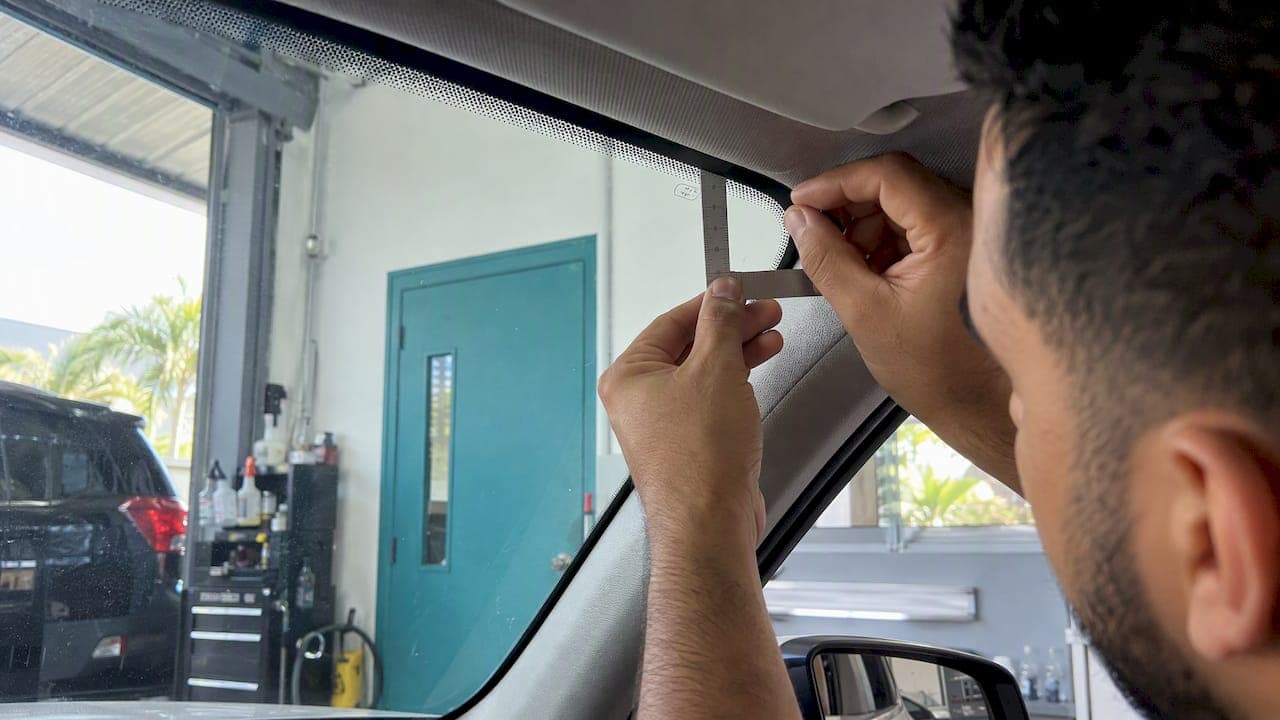
Partly. In Miami, as everywhere in Florida, you can tint only the top strip of the windshield, above the AS-1 line etched into the glass by the manufacturer, and that film must be non-reflective. Tint on the main viewing area below that line is not allowed, no matter how light or how "clear" the film is. The side and rear windows have their own darkness limits, covered below.
Miami-Dade has no stricter local tint ordinance. The state law applies, and Miami-Dade police and Florida Highway Patrol enforce it. We install tint on cars, SUVs and trucks across Miami-Dade every week, so this guide covers what we tell customers before we open a roll of film.
TL;DR
- Windshield: non-reflective film is allowed only above the AS-1 line (usually about 5 inches from the top). Nothing goes below it.
- Front side windows: at least 28% of light must pass through. Back sides and rear window: 15% on sedans, 6% on SUVs, vans and trucks.
- "Clear" ceramic film is still film. It is not exempt from the windshield rule.
- Medical exemption: possible for certain conditions with Form HSMV 83390, a physician's certification and a $6.50 fee per vehicle.
- Need it done right? We install legal strips and side-window tint at your home, office or work site in Miami-Dade.
Table of Contents
- What Florida law says about the windshield
- Legal tint limits for every window in Florida
- Quick answers to the questions Miami drivers ask
- How enforcement works in Miami-Dade
- Why tinting the main windshield is a bad idea anyway
- How to cut windshield heat legally
- Medical exemptions for light-sensitive conditions
- Our perspective: what we see on Miami jobs
- What to ask before you book any tint installer
- Legal tint, installed where you are
- FAQ
- Sources
What Florida law says about the windshield
The rule sits in Florida Statute 316.2952. It bars any sunscreening material or covering on the windshield except a short list of exceptions, and the AS-1 strip is one of them.
In practice:
- Film is allowed above the AS-1 line.
- That film must be non-reflective.
- Below the line, in the area you look through to drive, no aftermarket film is allowed.
If your windshield has no visible AS-1 marking, the common reading among installers is the top 5 inches. Our guide to the windshield tint strip and AS-1 rules walks through how to find the mark on your own glass.
What the AS-1 line is and where to find it
AS-1 is a marking the manufacturer etches into the glass. Look in the upper corner of the windshield, usually the passenger side, for small etched text with the letters "AS-1". The line is typically about 5 to 6 inches from the top edge, though it varies by make and model, so measure your own car instead of assuming.
Why "clear" ceramic film does not get a pass
This is the most common misunderstanding we hear. Customers ask whether a nearly invisible ceramic film is legal on the full windshield because it barely changes the look of the glass. The statute does not turn on how dark the film looks. It restricts sunscreening material on the windshield, and that includes light, clear and heat-rejecting films.
One caution: some people point out that certain products are sold as "windshield film" in other states. What a product is called or how it is marketed has no bearing on Florida law. If you drive on Florida roads, the Florida rule applies.
Legal tint limits for every window in Florida
The numbers below come from the statutes: 316.2953 for the front side windows and 316.2954 for windows behind the driver. Read the statute text itself if your vehicle is unusual, such as a limousine or a vehicle used for commercial passenger service.
| Window | Sedan | SUV, van or truck |
|---|---|---|
| Windshield | Non-reflective film above AS-1 line only | Same |
| Front side windows | 28% VLT or more | 28% VLT or more |
| Back side windows | 15% VLT or more | 6% VLT or more |
| Rear window | 15% VLT or more | 6% VLT or more |
VLT means visible light transmission: the percentage of light that passes through the glass and film together. A lower number means a darker window. Remember that your factory glass already blocks a little light, so the film you pick must be lighter than the final number you need to reach.
The statutes also cap how mirror-like the film can be. The front side limit is 25% reflectivity and the back side limit is 35%. A shiny, mirrored film can fail even if its darkness is fine.
A violation is a noncriminal traffic infraction, handled as a nonmoving violation under chapter 318, according to the statute. It is a ticket, not a criminal charge.

Quick answers to the questions Miami drivers ask
Is 35% tint legal in Florida?
On the front side windows, yes: 35% lets more light through than the 28% minimum, so it complies. On the windshield, no. A 35% film anywhere below the AS-1 line is not allowed.
Is 30% tint legal in Miami?
On the front sides, yes, since 30% is above 28%. On the back sides and rear glass, 30% is lighter than the 15% (sedan) and 6% (SUV, truck) limits, so it is legal there too. It is not legal on the main windshield.
Will I get pulled over for 20% tint?
20% on the front side windows is darker than the 28% minimum, so it is illegal there and can be a reason for a stop. On the back windows it is fine for a sedan only if your car is rated at 15% or lighter, and 20% passes that test. For the full picture of how officers treat dark tint, see the next section.
How enforcement works in Miami-Dade
Dark tint is an easy, visible reason for a traffic stop, and officers cite safety: they cannot see what is happening inside the vehicle. A Miami Herald report on a high-profile 2024 Miami-Dade traffic stop discussed how tint and rolled-up windows factor into officer safety concerns, and noted that legal experts still debate how far a driver must go in keeping windows down beyond handing over documents.
What that means for you in daily terms:
- A tint violation is often the stated reason for the stop, not an add-on.
- A stop for tint can lead to other checks: license, registration, insurance.
- Tickets are cheaper than the cost of removing and redoing illegal film, but they can recur every time you are stopped.
Florida's driver agency notes that someone issued a citation generally has 30 days to pay, contest, or take a driver improvement course, as listed on the citation. Check the citation itself for the exact options and the clerk of court that handles it.
For more on how local rules play out across the county line, see our comparison of window tinting laws in Miami and surrounding areas.
Why tinting the main windshield is a bad idea anyway
The law aside, there are practical reasons to leave the viewing area alone.
Driver-assistance cameras. Many newer vehicles mount cameras and sensors near the top center of the windshield for lane keeping, automatic braking and similar features. Aftermarket film in that path can interfere with how the system reads the road. If you want to understand how glass treatments affect what a camera sees, this explanation of ceramic coating on windshield glass shows what a coating does to the surface, and why you should check the manufacturer's guidance before changing anything in front of those cameras.
Night driving. Even a light film reduces visibility in low light, on unlit stretches of the Turnpike or on side streets in Pinecrest and Cutler Bay.
Inspection and resale. A cracked or poorly cut film on the windshield can be a point of friction when you sell or trade the vehicle.
How to cut windshield heat legally
South Florida sun is hard on a dashboard. You have legal options that do not touch the main viewing area:
- Install the AS-1 strip. A non-reflective strip above the line cuts glare when the sun is low, and it is the one legal windshield film. We cut and fit it to your windshield.
- Tint the side and rear windows with ceramic film. Most of the heat you feel comes through the side and rear glass as well. A ceramic film rejects heat without needing a very dark shade, so you can stay within the 28%, 15% or 6% limits.
- Use a removable sunshade when parked. It is not tint, so no law applies.
- Park in shade or a garage when you can.
If you want to compare film types before you decide, read how to choose the right window tint shade for your car in Miami.
Medical exemptions for light-sensitive conditions
Florida lets some drivers go darker than the standard limits for medical reasons. Section 316.29545 provides for exemption certificates for people with lupus, any autoimmune disease, or other conditions that call for limited exposure to light. Conditions named on the state's application include albinism, total or facial vitiligo and xeroderma pigmentosum.
To apply, you complete Form HSMV 83390, which requires a physician's certification. The fee is $6.50 per vehicle as of the July 2025 revision of the form, and you receive a decal and certificate for that vehicle. The exemption is not transferable.
If you think you qualify, talk to your treating physician first. We cannot decide eligibility. Do not tint darker on the strength of a verbal note, and keep the certificate in the vehicle.
Our perspective: what we see on Miami jobs
We have been tinting vehicles for more than 25 years, and the same three mistakes come up again and again.
First, drivers buy tint from someone who does not mention the AS-1 line, then get stopped. Second, people assume darker means cooler. It does not. A quality ceramic film at a legal shade rejects more heat than a cheap dark dyed film, and it keeps you on the right side of the law. Third, people tint the windshield with a "clear" film because a friend told them it was fine. It is not, and we will not install it.

We work with 3M Ceramic IR, 3M Crystalline, 3M Color Stable and Iviron KoolMax ceramic films. For almost every customer who wants a cooler cabin, the best answer is a legal-shade ceramic film on the side and rear windows plus a clean AS-1 strip on top. You get heat reduction, UV protection and privacy without handing an officer a reason to pull you over.
If you have already got tint that might be too dark, ask us to check it. We would rather tell you now than have you find out on the side of the road.
— Jose
What to ask before you book any tint installer
A short checklist you can use with any shop, including us:
- Which VLT will each window end up at? Ask for the number with the factory glass included.
- Will you leave the main windshield alone? The answer should be yes, apart from the strip above AS-1.
- Which film brand and type? Ceramic, carbon and dyed films perform very differently for heat.
- Is there a warranty on the film? Ask what it covers in writing.
- What happens if I am stopped? A good installer will tell you the legal limits plainly, as in our guide to what makes window tint legal for Florida drivers.
If you want to know what the work itself involves, our tint installation inspection process for South Florida explains what to check once the film is on.
Legal tint, installed where you are
We come to your home, workplace or parking lot anywhere in Miami-Dade, including Kendall, Homestead, Cutler Bay and Pinecrest. Published starting prices:
| Service | Price |
|---|---|
| 2 Front Windows | from $150 |
| Windshield Tint (legal strip) | from $150 |
| Full Car + Windshield | from $500 |
Other services, including ceramic, carbon, residential, commercial and old tint removal, are quoted by request. You can see all of our options on the main services page, compare film lines on our 3M window tinting page, or read about mobile window tinting prices. Get a quote online or call now and tell us your year, make and model. We will tell you the legal shades for each window before we start.
FAQ
Can I put clear ceramic film on my whole windshield in Florida?
No. Florida allows non-reflective film only above the AS-1 line. Clear, light or heat-rejecting film below that line on the main viewing area is not allowed, regardless of how little it changes the look of the glass.
How dark can my front side windows be in Miami?
They must let in at least 28% of light, with film and factory glass counted together. The statute also caps reflectivity at 25% on the front sides. The same rule applies to every vehicle type.
Is the tint law different in Miami than the rest of Florida?
No. Miami-Dade follows the state statutes, and local police enforce them. What changes is how often you may be stopped in a dense urban area, not the legal limits. Our post on Miami's tinting laws goes deeper.
Can I get a medical exemption for darker tint?
Possibly, if you have a qualifying condition such as lupus, another autoimmune disease, albinism or xeroderma pigmentosum. You need Form HSMV 83390 signed by a physician and a $6.50 fee per vehicle. Ask your doctor whether your condition qualifies.
What should I do if my current tint is illegal?
Have a professional measure it with a meter, then decide whether to replace the film or remove it. We handle old tint removal and re-tinting at your location, and we can fit a legal film in the same visit.
Sources
- Florida Statute 316.2952, Windshields; requirements; restrictions
- Florida Statute 316.2953, Side windows; restrictions on sunscreening material (2026)
- Florida Statute 316.2953 (statutes index, nonmoving violation text)
- Florida Statute 316.2954, Windows behind the driver (2026)
- Florida HSMV, Form 83390: Application for Sunscreening Medical Exemptions
- Florida HSMV, TL-55 Sunscreening Medical Exemption Certificate
- Florida HSMV, Traffic Citations
- Miami Herald, legal experts on the 2024 Miami-Dade traffic stop