
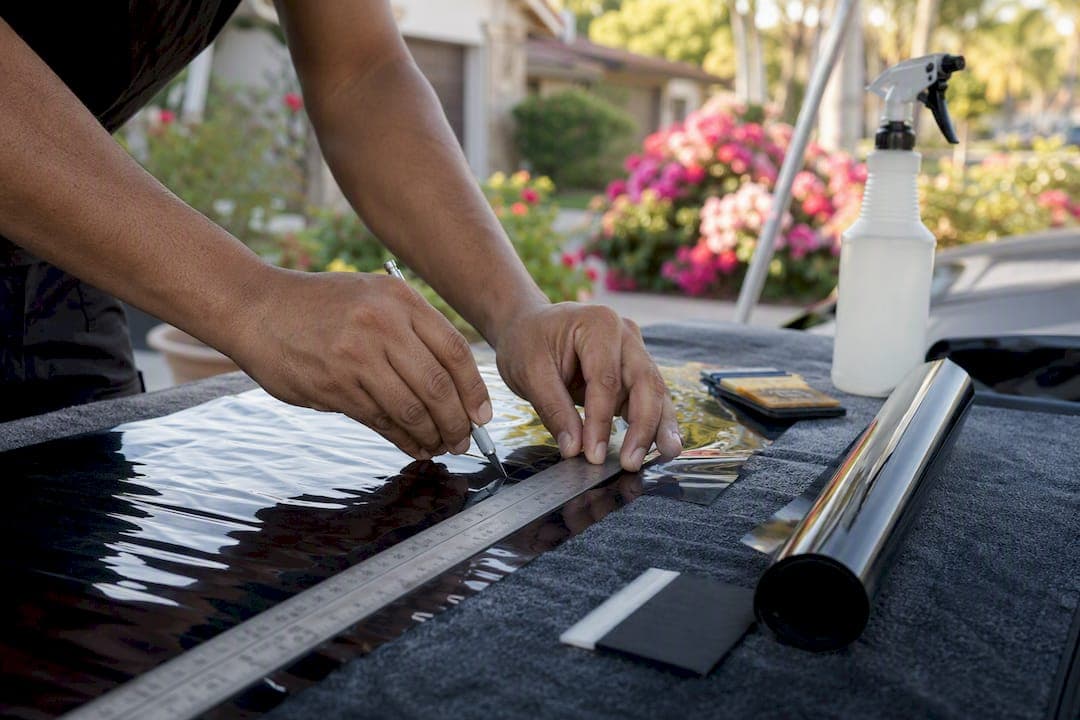
Florida sets clear minimums for tint darkness, and staying compliant while beating Miami's heat comes down to combined VLT, not just the film label on the box. Front side windows need a combined total of at least 28% light transmission. Rear windows on sedans need at least 15%. SUVs, vans, and trucks can go as low as 6% on rear glass. Windshields only allow tint above the AS-1 line or the top 5 inches.
For most sedans, that translates to a practical film range starting in the mid-thirties to about half on front doors, depending on how dark the factory glass already is. Rear windows on sedans generally have a higher film percentage than SUVs and trucks, which can have darker rear tints due to classification differences.
- Front doors: film ~35 to 50%, adjusted for factory glass
- Rear/rear window (sedans): film ~15 to 35%
- Rear (MPVs, SUVs, trucks): film as low as 6 to 15% where legal
- Windshield: top band only, AS-1 line or top 5 inches
The number that actually matters isn't the film percentage. It's the combined VLT: factory glass VLT multiplied by film VLT. Ask your installer to measure your factory glass and hand you that math before you commit to a shade.
Key Takeaways
Choosing the right tint percentage in Miami means starting from Florida's legal VLT floors, then adjusting film darkness based on your car's actual factory glass measurement.
| Point | Details |
|---|---|
| Know the legal floors | Front windows need 28% combined VLT, sedan rears need 15%, and MPV rears can go as low as 6%. |
| Combined VLT is the real number | Factory glass VLT multiplied by film VLT determines legality, not the film percentage alone. |
| Front film range | Most sedans use 35 to 50% film on front doors depending on factory glass darkness. |
| Ceramic films outperform dyed film | 3M Ceramic IR and Iviron KoolMax reject more heat and UV at the same shade level than older dyed films. |
| Verify before you install | Southmiamitint measures factory glass and provides written combined-VLT calculations on every mobile job starting from $249. |
Table of Contents
- What Is the Best Tint Percentage for Miami Cars by Window?
- How Florida's Tint Law Works and How Installers Verify It
- Which Tint Level Balances Heat, Privacy, and Visibility?
- What Should You Ask an Installer Before Booking Mobile Tint in Miami?
- A Local Installer's View on Miami's Most Popular Tint Choices
- Book Mobile Ceramic Tint Installation in Miami-Dade
- Where to Verify Miami's Tint Rules and Get Local Guidance
- Sources
What Is the Best Tint Percentage for Miami Cars by Window?
Every window on your vehicle has its own legal floor, and the right film choice depends on what your factory glass already does before any film goes on.
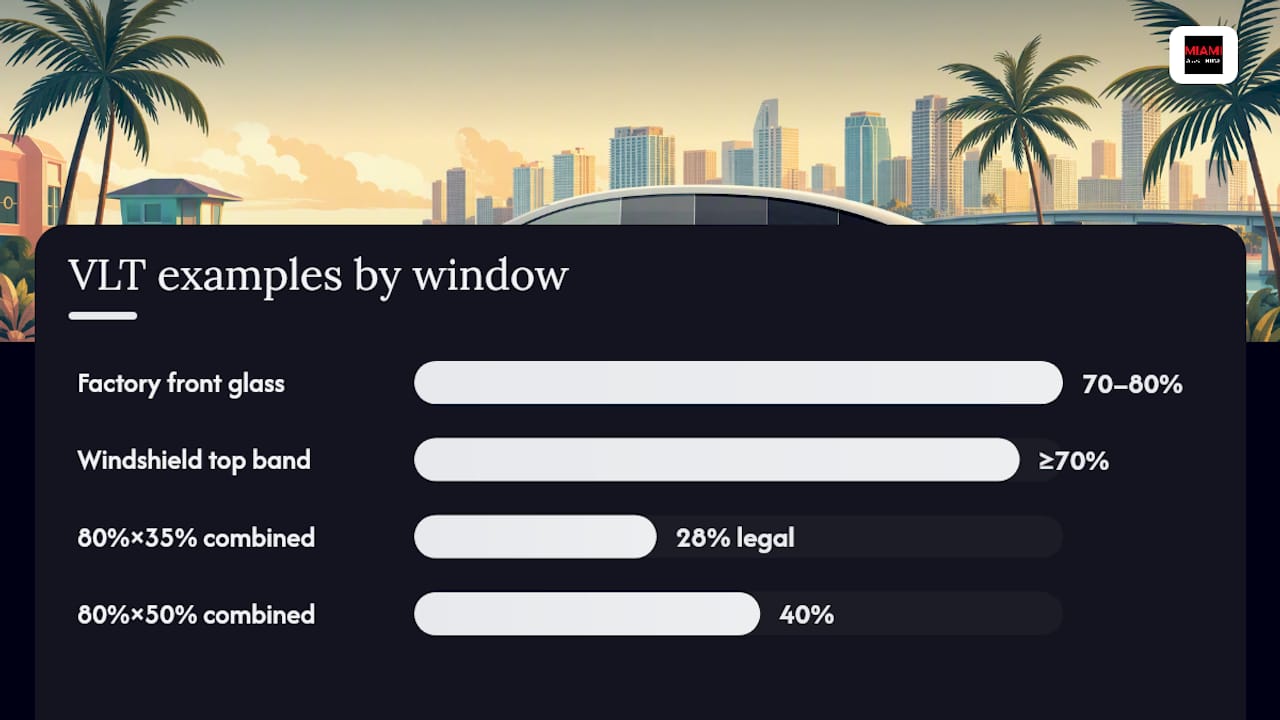
Most factory front glass runs 70% to 80% VLT, so your film choice needs to account for that starting point rather than a flat number.
- 35% film on 80% factory glass: 0.80 × 0.35 = 0.28, or 28% combined. That's right at the legal floor, with almost no margin for error if your glass measures slightly darker than advertised.
- 50% film on 80% factory glass: 0.80 × 0.50 = 0.40, or 40% combined. This gives a noticeably lighter look with more buffer against enforcement questions.
Rear side and rear windows work differently by vehicle class.
Windshields only allow film on the top band, either above the manufacturer's AS-1 line or within the top 5 inches if there's no line marked. Most drivers stick with a light, non-reflective strip here rather than pushing the darkness, since guides recommend keeping that band above 70% where it's measured.
The gap between "legal" and "looks good" almost always comes down to your factory glass number, which is why measurement beats guesswork every time.
How Florida's Tint Law Works and How Installers Verify It
Florida Statute 316.2953 is short, but it decides everything about your project. Windshields are limited to the AS-1 line or top 5 inches.
The math behind "combined VLT" is simple once you see it written out: factory glass VLT × film VLT = combined VLT.
- 0.75 (75% factory glass) × 0.35 (35% film) = 0.2625, or about 26.25% combined, below the 28% front-window floor
- 0.80 (80% factory glass) × 0.35 (35% film) = 0.28, or 28% combined, right at the floor
That quarter-point swing above shows why the same film percentage can pass on one car and fail on another depending on the glass underneath it. A reputable installer measures your factory glass with a handheld VLT meter before recommending anything, then documents the expected combined result in writing. Our VLT breakdown walks through this measurement process in more detail if you want the full picture.
Pro Tip: Ask for a written combined-VLT sheet before the installer opens a roll of film. If they can't produce one, they're guessing, and you're the one who gets the ticket.
Getting pulled over for illegal tint in Florida is a nonmoving infraction rather than a criminal matter, but it still comes with a base fine plus court costs, and you may be ordered to remove or replace the film. Written measurement documentation from your installer is your best defense if an officer questions your tint at a checkpoint.
Which Tint Level Balances Heat, Privacy, and Visibility?
The percentage you choose changes more than your car's looks. It changes how hot your cabin gets, how much UV exposure you take on, and how safely you see the road at night.
Ceramic and infrared films like 3M Ceramic IR and Iviron KoolMax reject far more heat and UV per shade level than older dyed films. That means you can choose a lighter, fully compliant percentage and still feel a real difference in cabin temperature on a July afternoon, instead of needing extreme darkness just to stay cool.
Night driving safety is where a lot of Miami drivers overcorrect.
- If you drive frequently after dark, lean toward the lighter end of the front-window range (45 to 50% film) rather than the legal minimum.
- Save your darkest, most private tint choice for rear windows, where visibility trade-offs matter far less.
- Very dark front or driver-side windows can also create friction at valet stands, parking garages, and gated communities where staff want to see inside the car.
- Darker rear glass has little downside for resale and adds real privacy for passengers and cargo.
The practical rule: get your front windows legal and comfortable to drive at night first, then choose rear darkness based on how much privacy or heat rejection you want.
What Should You Ask an Installer Before Booking Mobile Tint in Miami?
A rushed tint job is the most common way Miami drivers end up with a ticket or a redo. Before you book anyone, mobile or shop based, run through this list.
- Ask them to measure your factory glass first. A number on a spec sheet isn't the same as what your actual car's glass transmits, and the 5 to 10% variation between models is enough to shift a legal film choice into illegal territory.
- Get the film brand and line in writing. Confirm whether you're getting 3M Ceramic IR, 3M Color Stable, or Iviron KoolMax, and ask what warranty coverage comes with each.
- Confirm the install conditions. Mobile tinting needs a clean, shaded space and enough time for the film to cure properly, usually with a final inspection 24 to 48 hours later.
- Watch for red flags. Any installer who quotes a film percentage without measuring your glass, or who won't hand you a combined-VLT calculation, is asking you to gamble on a fine.
Pro Tip: A legitimate quote should always separate "film percentage" from "combined VLT." If an installer only ever mentions one number, ask which one it is before you sign anything.
A Local Installer's View on Miami's Most Popular Tint Choices
Most Miami customers we talk to gravitate toward ceramic IR films, and it's not just about looks. The heat coming off a black dashboard in July makes heat rejection the deciding factor for a lot of families and daily commuters alike.
We measure factory glass VLT on every vehicle before recommending a shade, because guessing at combined VLT is how good customers end up with a citation. If you want to know exactly where your car lands before you commit to a percentage, reach out and we'll walk you through the numbers.
Book Mobile Ceramic Tint Installation in Miami-Dade
Skip the shop visit and the guesswork on legal compliance. Southmiamitint brings the measurement, the calculation, and the installation to your driveway or office parking lot anywhere in Miami-Dade County.
Our mobile technicians install 3M Ceramic IR, 3M Color Stable, and Iviron KoolMax ceramic films, and every job starts with an onsite VLT measurement of your factory glass, not a guess based on your car's model year. You get a written combined-VLT calculation before installation begins, so you know exactly where your car lands relative to Florida's legal floors. Service starts from $249, and every install includes a manufacturer warranty on the film itself.
If you're ready to see real numbers for your vehicle instead of a rough estimate, book a mobile tint appointment and we'll bring the meter, the film, and the paperwork to you.
Where to Verify Miami's Tint Rules and Get Local Guidance
Cross-check any installer's recommendation against the source law rather than a sales pitch.
- Florida Statute 316.2953, the official state law setting VLT limits by window and vehicle type
- Southmiamitint's local regulations breakdown for Miami-Dade specifics by vehicle class
- A shade selection guide covering heat, privacy, and night driving tradeoffs
- An external VLT math primer showing how combined glass and film percentages are calculated
Sources
- Chapter 316 Section 2953 - 2025 Florida Statutes - The Florida Senate
- Legal Tint in Miami: VLT Rules and Requirements - LegalClarity
- Understanding Window Tinting Laws in Miami-Dade County