
3M tint is a premium automotive window film that blocks up to 99.9% of UV rays, rejects up to 95% of infrared heat, and protects modern vehicle electronics from signal interference. For Miami car owners, those numbers matter every single day. The city's intense sun exposure accelerates interior fading, spikes cabin temperatures, and strains air conditioning systems year-round. Understanding why use 3M tint means understanding how advanced film technology solves real problems that standard dyed films simply cannot handle. Southmiamitint installs 3M Ceramic IR, 3M Color Stable, and Iviron Kollmax ceramic films across Miami-Dade, giving local drivers access to the full range of performance options.
Why use 3M tint: heat and glare rejection explained
3M Ceramic IR window films reject up to 95% of infrared heat and block up to 66% of total solar energy entering through the glass. That level of performance is not achievable with basic dyed films, which absorb heat rather than reflect it. The result is a measurably cooler cabin, even when your car sits in a Miami parking lot at noon in july.
The technology behind this performance is nano-ceramic particle construction. Ceramic particles embedded in the film reflect infrared radiation before it converts to heat inside the cabin. Standard dyed films absorb solar energy and re-radiate it inward, which is why they feel warm to the touch on a sunny day.
Glare reduction is a direct byproduct of this technology. Ceramic IR films cut visible light transmission to controlled levels without making the interior feel dark or cave-like. For Miami drivers navigating I-95 or the Palmetto Expressway at sunrise or sunset, reduced glare is a genuine safety benefit, not just a comfort perk.
- Infrared rejection: Up to 95% with 3M Ceramic IR film
- Total solar energy rejection: Up to 66% (TSER)
- Glare reduction: Controlled visible light transmission without excessive darkening
- Heat source: Infrared radiation accounts for the majority of solar heat gain through glass
- Standard dyed film limitation: Absorbs and re-radiates heat rather than reflecting it
Pro Tip: Park your car facing east in the morning and west in the afternoon when possible. Even with 3M Ceramic IR film installed, reducing direct sun exposure extends the film's performance life and keeps your cabin cooler before you even start the engine.
What types of 3M car window tints work best for Miami?
3M offers three main automotive film lines, and each one targets a different balance of price, performance, and appearance. Knowing the difference saves you from overpaying for features you do not need or underpaying for a film that fails in Miami's climate.
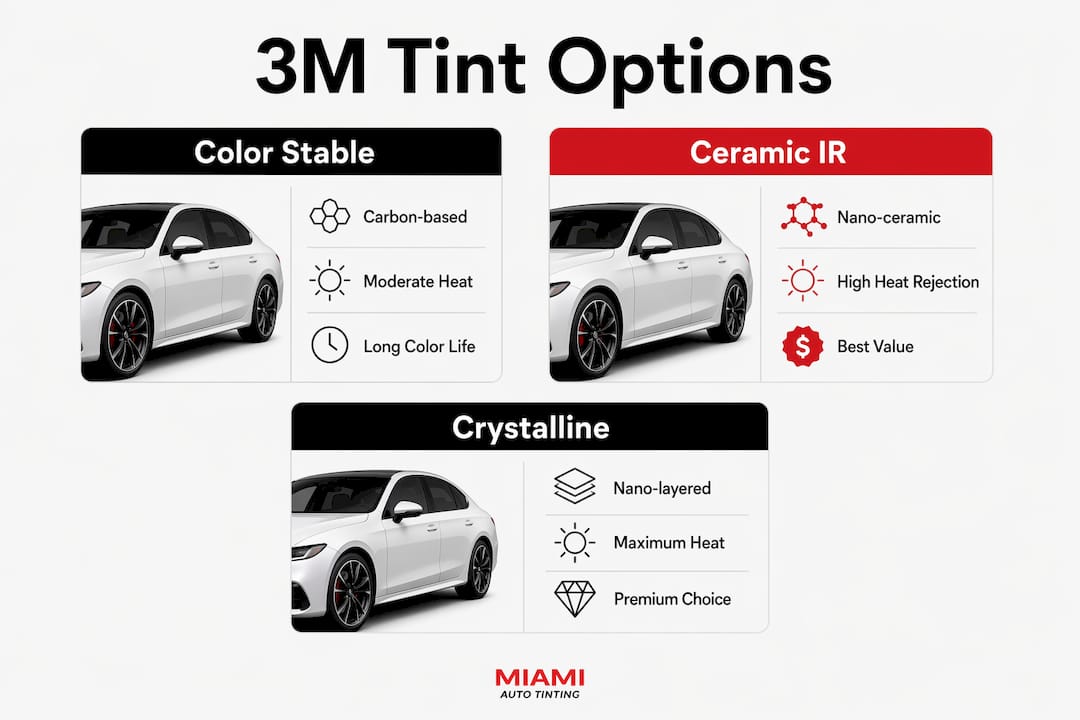
3M Color Stable
3M Color Stable is a carbon-based film designed for long-term color stability. Inferior dyed films fade, bubble, and degrade quickly under intense UV exposure, but Color Stable's carbon construction resists those breakdown mechanisms. It is the entry point into the 3M lineup and delivers reliable UV blocking and a clean appearance that holds up over years of Miami sun. The benefits of 3M Color Stable tint are most visible after two or three years, when cheaper films have already turned purple or started peeling.
3M Ceramic IR
3M Ceramic IR is the best value choice for Miami drivers who want serious heat rejection without the price of the top-tier film. Ceramic IR rejects 90–95% of infrared heat at a lower cost than the Crystalline series. The nano-ceramic particle construction delivers the advantages of 3M IR tint without metallic components, which matters for modern vehicles. Drivers who commute daily or park outdoors consistently get the most out of this film.
3M Crystalline
3M Crystalline is the premium option. It uses over 200 nano-layers of optical film to achieve maximum infrared reflection while maintaining a very light tint appearance. This makes it the right choice for drivers who want the highest heat rejection but prefer a nearly clear look on their windows. The Crystalline series carries a higher price point, but its multi-layer nano-technology is unmatched in the 3M lineup for total solar performance.
| Film Series | Technology | Heat Rejection | Best For |
|---|---|---|---|
| Color Stable | Carbon-based | Moderate | Budget-conscious, daily use |
| Ceramic IR | Nano-ceramic | Up to 95% IR | Hot climates, best value |
| Crystalline | 200+ nano-layers | Highest available | Maximum performance, light appearance |
The 3M IR film Pinecrest and broader Miami-Dade market consistently shows Ceramic IR as the most popular choice among daily drivers. Crystalline suits luxury vehicles or drivers who want maximum performance with minimal visible tint.
Why is 3M tint better for modern vehicles with electronics?
3M's non-metallic film construction is the single most important feature for modern connected vehicles. Non-metal films prevent signal interference, keeping GPS, satellite radio, keyless entry, toll transponders, and driver assistance systems working correctly. Metallized films create a Faraday cage effect around the cabin, which blocks radio frequency signals from passing through the glass.
This matters more in 2026 than it did a decade ago. Modern vehicles rely on wireless connectivity for navigation, over-the-air software updates, 5G connectivity, and advanced driver assistance systems like lane-keep assist and automatic emergency braking. A metallized film that disrupts these signals is not just inconvenient. It is a safety issue.
Miami drivers specifically depend on SunPass toll transponders, which require unobstructed radio frequency transmission through the windshield. A metallized film can cause missed toll reads and unexpected charges. 3M Ceramic IR and Crystalline films avoid this entirely.
- GPS navigation: Unaffected by non-metallic 3M films
- SunPass and toll transponders: Full signal transmission maintained
- Keyless entry and push-start systems: No interference
- Satellite radio: Clear reception preserved
- 5G and connected car features: Non-metal construction prevents signal blocking
Pro Tip: If your vehicle has a heated windshield or embedded antenna wires, always confirm with your installer that the film selected is non-metallic. Southmiamitint's 3M Ceramic IR and Crystalline options are both non-metal and safe for these systems.
How does 3M tint protect your car's interior and cut long-term costs?
3M automotive films block up to 99.9% of UV rays with an SPF rating above 1,000. That level of UV blocking prevents the photochemical breakdown that causes leather to crack, dashboards to warp, and fabric seats to fade. In Miami, where UV index readings regularly hit 11 or higher, this protection is not optional for any car owner who wants to preserve resale value.
UV damage is cumulative and invisible until it is too late. A car parked outside in Miami for three years without window tint will show measurable interior degradation. The window tinting benefits for interior protection extend to every surface the sun touches, from the steering wheel to the rear seat upholstery.
Cars with 3M tint experience reduced air conditioning load, which translates directly to lower fuel consumption and faster cabin cooling. A cooler starting cabin temperature means the AC reaches comfort level sooner and runs less aggressively. Over a full Miami summer, that reduction adds up across hundreds of driving hours.
- UV rays cause photochemical breakdown of leather, vinyl, and fabric
- A cooler cabin reduces the time the AC runs at maximum output
- Lower AC demand reduces fuel consumption on every trip
- Interior preservation maintains resale value over the vehicle's life
- Premium 3M films carry a lifetime warranty against peeling, bubbling, and color shift
The lifetime warranty point deserves emphasis. Cheaper dyed films may cost less upfront, but replacement costs after two or three years of Miami sun eliminate any savings. 3M's warranty-backed durability makes the math work in favor of the premium film over any multi-year ownership period.
What should Miami car owners know before getting 3M tint installed?
Florida law sets specific limits on automotive window tint darkness, and those limits vary by window position. The front side windows must allow more than 28% visible light transmission. The rear side windows and rear window have more flexibility for non-sedan vehicles. Choosing a film that performs well within legal limits is a practical requirement, not just a preference.
Certified professional installation is the only way to activate the lifetime warranty on 3M films. Drivers in hot climates get better results from Ceramic IR or Crystalline series compared to basic alternatives, but only when the film is installed correctly. Bubbling and peeling in cheaper films often trace back to poor installation rather than the film itself.
Maintenance after installation is straightforward. Avoid cleaning the interior glass for the first few days after installation to allow the adhesive to cure fully. Use a soft microfiber cloth and ammonia-free cleaner for ongoing care. Ammonia-based cleaners degrade the film's adhesive layer over time.
- Florida tint law: Front side windows must exceed 28% VLT
- Installation: Use a certified installer to maintain warranty coverage
- Cure time: Avoid cleaning interior glass for 3–5 days post-installation
- Cleaning: Ammonia-free cleaner only on tinted surfaces
- Film selection: Match the series to your parking situation and daily driving habits
Pro Tip: If you park outdoors most of the day, prioritize Ceramic IR or Crystalline for maximum heat rejection. If your car lives in a garage and you drive mainly at night, Color Stable delivers strong UV protection at a lower price point.
Key Takeaways
3M tint is the most effective automotive window film for Miami drivers because it combines UV blocking above 99.9%, infrared heat rejection up to 95%, and non-metallic construction that preserves all vehicle electronics.
| Point | Details |
|---|---|
| UV protection | 3M films block up to 99.9% of UV rays, preventing interior fading and cracking. |
| Heat rejection | Ceramic IR rejects up to 95% of infrared heat, keeping cabins cooler in Miami sun. |
| Electronics safety | Non-metallic construction preserves GPS, SunPass, and keyless entry signals. |
| Long-term value | Lifetime warranty and reduced AC load offset the higher upfront cost over time. |
| Film selection | Ceramic IR is the best value for Miami; Crystalline suits maximum performance needs. |
What I've learned after years of tinting cars in Miami heat
Most car owners think window tint is primarily about privacy or appearance. After working with hundreds of Miami drivers, I can tell you the real reason people come back and refer their friends is heat rejection and interior preservation. A car that has been sitting in the sun for two hours in august is genuinely uncomfortable and potentially damaging to everything inside it. The right film changes that experience completely.
The misconception I hear most often is that a darker tint means better heat rejection. That is simply not true. 3M Crystalline can be nearly clear and still outperform a dark dyed film on every heat metric. The technology is in the nano-layers, not the shade. Drivers who choose a film based on darkness alone are leaving real performance on the table.
I also see people underestimate what signal interference costs them in daily life. Missing a SunPass read on the Dolphin Expressway, losing GPS lock in Brickell, or having your keyless entry act up in a parking garage are all real consequences of metallized films. Non-metallic 3M films eliminate those problems entirely. For anyone driving a vehicle built after 2018, that matters more than most people realize.
The window tinting advantages that actually move the needle for Miami drivers are heat rejection, UV blocking, and signal clarity. Everything else is secondary. If you are choosing between film series, start with Ceramic IR and only move to Crystalline if you want the lightest possible appearance with maximum performance. Color Stable is a solid choice for anyone on a tighter budget who still wants 3M's durability and UV protection over cheap alternatives.
— Jose
Southmiamitint brings certified 3M installation to your door
Southmiamitint is a certified 3M installer serving Miami-Dade with mobile tinting for cars, homes, and commercial properties. The mobile service means a professional comes to your home, office, or anywhere convenient, so you never have to drop off your car or wait at a shop.
The full 3M lineup is available through Southmiamitint, including 3M Ceramic IR, 3M Color Stable, and Iviron Kollmax ceramic film. Every installation is backed by the manufacturer's warranty, which only applies when a certified installer does the work. Get a fast mobile tint quote or learn more about 3M tint options in Miami to find the right film for your vehicle and budget.
FAQ
What is 3M IR tint?
3M IR tint, also called 3M Ceramic IR, is a nano-ceramic automotive window film that rejects up to 95% of infrared heat while blocking 99.9% of UV rays. It uses non-metallic ceramic particles to reflect solar energy without interfering with vehicle electronics.
How does 3M Color Stable tint differ from Ceramic IR?
3M Color Stable uses a carbon-based construction that resists fading and bubbling, while Ceramic IR adds nano-ceramic particles for significantly higher heat rejection. Color Stable is the more affordable option; Ceramic IR is the better choice for Miami's intense heat.
Will 3M tint affect my GPS or SunPass?
No. 3M Ceramic IR and Crystalline films use non-metallic construction that does not block radio frequency signals. GPS, SunPass, keyless entry, and satellite radio all function normally after installation.
Does 3M tint come with a warranty?
Yes. Premium 3M films carry a lifetime warranty against peeling, bubbling, and color shift when installed by a certified professional. That warranty does not apply to self-installed or uncertified installations.
Is 3M window tint legal in Florida?
Yes, as long as the film meets Florida's visible light transmission requirements. Front side windows must allow more than 28% VLT. A certified installer will confirm legal compliance for your specific vehicle before installation.