
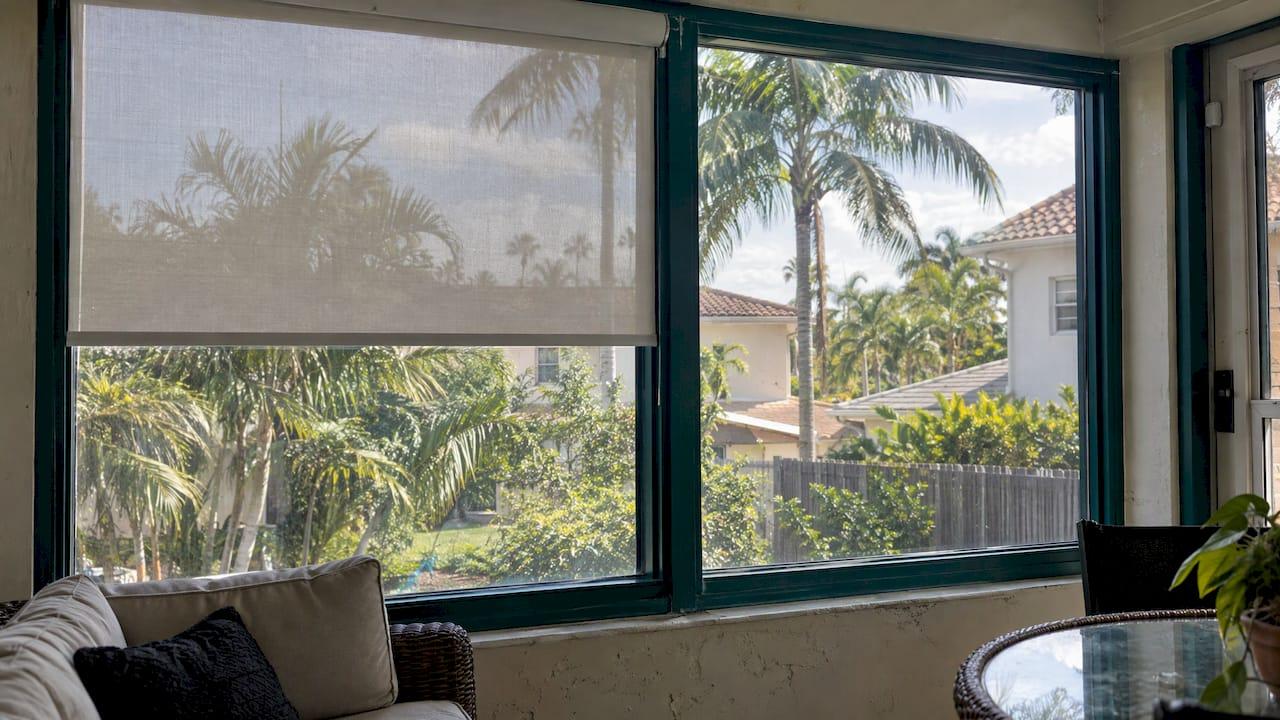
For most Miami-Dade windows, window film is the better fit if you want heat and UV control without losing your view or giving up floor and window space. Solar shades suit people who want an adjustable layer they can raise or lower. Blackout curtains suit bedrooms where darkness matters more than daylight. Cars are a separate case: shades don't work on a moving vehicle, so film is the real choice there.
Below, we compare the three on heat, glare, privacy, cost and upkeep, then explain how to choose for a car, a home or a business.
TL;DR
- Window film works at the glass. It cuts heat, glare and UV and keeps your view. It stays on for years and never needs adjusting.
- Solar shades and screens add a mesh layer. Outside-mounted screens cut more heat than inside shades, and inside shades can be raised or lowered.
- Blackout curtains block the most light, which is great for sleep. They also block the view and daylight when closed.
- Cars can only use film. In Florida, front side windows must allow at least 28% visible light.
- Mix them if you like: film on sun-facing glass, curtains only in bedrooms.
Table of Contents
- How each option works
- Heat: where the sun is stopped matters
- Glare, daylight and your view
- UV protection and privacy, day and night
- Cost: what you pay and what you keep paying
- Durability, cleaning and storm exposure
- Which one fits your situation
- Our perspective
- Get film installed where you park
- FAQ
- Sources
How each option works
All three reduce what the sun does inside your space. They just do it in different places.
Window film
Film is a thin layer bonded to the glass. It blocks or absorbs part of the sun's energy before it warms the room. Ceramic films are designed to reject infrared heat and UV while staying clear enough to see through. We install only ceramic films: 3M Ceramic IR (lifetime warranty), SunTek CIR (5-year warranty) and Uviron KoolMax (3-year warranty).
Solar shades and solar screens
Solar shades are roller-style fabric shades with a tight weave. Solar screens are similar mesh panels, usually mounted outside. The weave's openness factor sets the trade-off: a lower openness blocks more heat and glare but reduces outward visibility, while a higher one lets in more light and view.
Blackout curtains
These are thick, lined curtains made to stop most light. Well-made blackout fabric can block up to about 99% of incoming light when coverage is right, while most films mainly reduce glare, UV or heat rather than darken a room. That is a different job. Curtains are for darkness. Film is for comfort and protection while the room stays bright.
Heat: where the sun is stopped matters
The biggest difference is location. Heat stopped outside the glass never enters the room. Heat stopped inside has already passed through the window.
The U.S. Department of Energy's Building America Solution Center (PNNL) cites research showing exterior screens cut solar heat gain by 46%, while interior screens cut it by 14%. So an interior shade or curtain is the weakest of the heat fixes, even though it feels effective once you pull it down.

Film sits on the glass itself, so it works from the first day and during every hour of sun, with nothing to remember to close. That matters in Miami, where west-facing glass gets strong afternoon sun for much of the year.
For curtains, the DOE figure often quoted is a 33% heat gain reduction for medium-colored draperies with white plastic backings, and only when they are closed over windows in direct sun. That means closing out the view to get the benefit.
If you want the numbers for car glass, our guide to windshield tint heat reduction in Miami shows what infrared-rejecting ceramic film does on the largest piece of glass in the car.
Glare, daylight and your view
Glare is where the three options feel most different.
- Film: reduces glare and keeps the view mostly intact. You still read the room's natural light and see the yard, the pool or the street.
- Solar shades: cut glare well, and the same PNNL guide says a solar screen greatly reduces heat gain and glare while preserving the view outward when the sun is on the window. Darker, tighter weaves look dimmer and soften the view.
- Blackout curtains: remove glare by removing the light. Fine for a bedroom or media room, not for a living room you use all day.
One common concern is whether film makes a room dark. Film comes in a range of shades. Lighter ceramic options keep a room bright and still reject a large share of heat, since ceramic is designed to block infrared, which you can't see anyway. We help you pick the shade at the quote so the room looks the way you want.
UV protection and privacy, day and night
UV fades floors, art, furniture and fabrics. Film is made to block UV at the glass, on every pane, all the time. Shades and curtains protect only what they cover while they are down or closed.
Privacy depends on the time of day:
- Daytime: shades and tinted film both limit what people see from outside, because it is brighter outside than inside.
- Night: this reverses. With lights on inside and darkness outside, people can see in more easily, especially through fabrics with 5-10% openness. Standard film behaves the same way, so for night privacy you still want a curtain, blind or a privacy-focused film.
That is why many Miami homeowners pair film on the glass with a simple curtain in bedrooms and bathrooms. Film handles the sun. The curtain handles the night.
Cost: what you pay and what you keep paying
Costs vary a lot by window size and product. These are typical U.S. ranges from published sources, not our prices:
| Option | Typical U.S. cost | Typical lifespan |
|---|---|---|
| Professional window film | $5-$12 per sq ft installed | 10-20 years with care |
| Ceramic film, professional | $14-$20 per sq ft | Varies by brand and warranty |
| Exterior solar screens | $15-$40 per window | 10-15 years |
| Cellular shade, 36 x 54 in. | $75-$200 each | Varies |
| Thermal curtains | $20-$50 per panel | Varies |
Sticker price is only part of it. Shades and curtains have to be operated, cleaned and sometimes replaced. Film is one install. A fitted shade also takes about an hour of installation per window, while a mobile film crew can do several windows in a visit.
We publish prices for vehicles: 2 front windows from $200, windshield tint from $150 and a full car with windshield from $450. Old tint removal runs $50-$150. For homes and businesses, the price depends on the glass area and film, so we quote after we see the windows.

Durability, cleaning and storm exposure
Miami adds three factors most national guides skip: salt air, constant sun and hurricane season.
Lifespan. Film is rated for years, not months. The warranty is a good guide to quality: our 3M Ceramic IR carries a lifetime warranty, SunTek CIR 5 years and Uviron KoolMax 3 years. For car owners, our guide to tint film durability explains what affects how long film stays clear.
Cleaning. Film cleans like glass once it has cured. Use a soft cloth and a non-abrasive, ammonia-free cleaner. Our step-by-step film care guide covers the routine. If you want to keep glass beading water and easy to wipe, a ceramic coating on glass is a separate step some owners add after film has fully cured. Mesh screens, by comparison, can trap dust and pollen in the weave and need regular washing.
Storms. Outside screens and shutters take the wind and rain, and some impact-resistant shading devices, such as Bahama shutters, can double as protection against flying debris. Standard solar film is a comfort and UV product. Take it down or leave it up as you would any other treatment, and follow your usual hurricane preparation with shutters, panels or impact glass.
Which one fits your situation
Your car, SUV or truck
Film is the only practical choice. Windshield sun shades help while parked, but film works while you drive too. Ceramic film is designed to reject infrared heat without the dark look. EV owners also have a reason to care, since cabin cooling draws on the battery (see EV window tint benefits).
Florida sets limits, so legal film matters:
- Front side windows: at least 28% visible light transmittance and no more than 25% reflectance.
- Windows behind the driver: at least 15% transmittance and no more than 35% reflectance. For multipurpose passenger vehicles, the minimum is 6%.
- Violations are noncriminal, nonmoving traffic infractions.
We select film to match these rules. For the windshield, read our guide to Florida windshield tint law. Choosing between factory and aftermarket glass? See factory tint vs aftermarket film.
Your home
Choose film for sun-facing windows, sliding doors and large glass where you want to keep the view and the daylight. Add curtains only for bedrooms. Choose exterior screens if you want a removable outside layer on a few windows. If you're unsure, a mix is common: film on the west and south glass, a shade or curtain where you need night privacy. Sunrooms get the most sun, and our sunroom tint guide shows what cuts the heat and glare there. See our residential window tinting service for what we install.
Your business
Storefronts and offices need glare control on screens, comfort for staff and customers, and a clear look from the street. Shades can look cluttered and need daily handling. Film is installed once and needs no staff attention. See our commercial window tinting page.
Our perspective
After 28 years of tinting in Miami-Dade, we see the same pattern. People buy shades or curtains first, close them all day, then wonder why the room feels like a cave and still runs warm.
Film fixes the problem at the glass. You keep the view, you keep the light, and the sun's heat and UV are reduced without a daily routine. That is why we only install ceramic films, including genuine 3M Ceramic IR with a lifetime warranty.
We also come to you. Our mobile crew works at your home or office anywhere in Miami-Dade, so you never leave your car at a shop or arrange your day around an appointment. We cut patterns by computer for an exact fit, and our 60-inch rolls let us do large windshields in one piece with no seam.
If you still want a curtain for the bedroom, keep it. Film on the glass and a curtain at night is a good pair.
Jose
Get film installed where you park
We install ceramic film at your home, office or driveway across Miami-Dade, including Kendall, Homestead, Cutler Bay and Pinecrest. Car pricing starts at $150 for a windshield, $200 for two front windows and $450 for a full car with windshield. Homes and businesses get a quote based on glass area.

Ready to compare? Get a quote for mobile window tinting, see the ceramic tint options or read about 3M ceramic film.
FAQ
Is window film better than solar shades?
For heat, UV and view, film usually wins, because it works at the glass all day with nothing to operate. Shades win when you want to raise and lower the cover. Many homes use both.
Can people see through solar shades?
In daylight, usually not clearly from outside. At night with lights on indoors, people outside can see in more easily, especially through more open weaves. For night privacy, add a curtain or blind.
Are blackout curtains or window film better for heat?
Closed blackout curtains block light and can reduce heat gain, but they leave the glass itself hot and shut out your view. Film cuts heat and UV while the window stays open to the light. Choose curtains for sleep and film for everything else.
How long does window film last?
Professionally installed film is commonly cited as lasting 10-20 years with proper care. Our films carry warranties of 3 years (Uviron KoolMax), 5 years (SunTek CIR) and a lifetime (3M Ceramic IR).
Sources
- Window Attachments for Solar Control and Energy Efficiency, PNNL Building America Solution Center
- Florida Statutes 316.2953 (2025)
- Florida Statutes 316.2954 (2025)
- Interior vs. Exterior Solar Screens
- Blackout Curtains vs Window Film: Which Blocks More Light?
- Do Blackout Curtains Keep Heat Out?
- Solar Shades vs Roller Shades
- How to Insulate Windows for Summer Heat
- Window Film Energy Savings Calculator
- How to Install Window Shades
- Ceramic coating on glass