
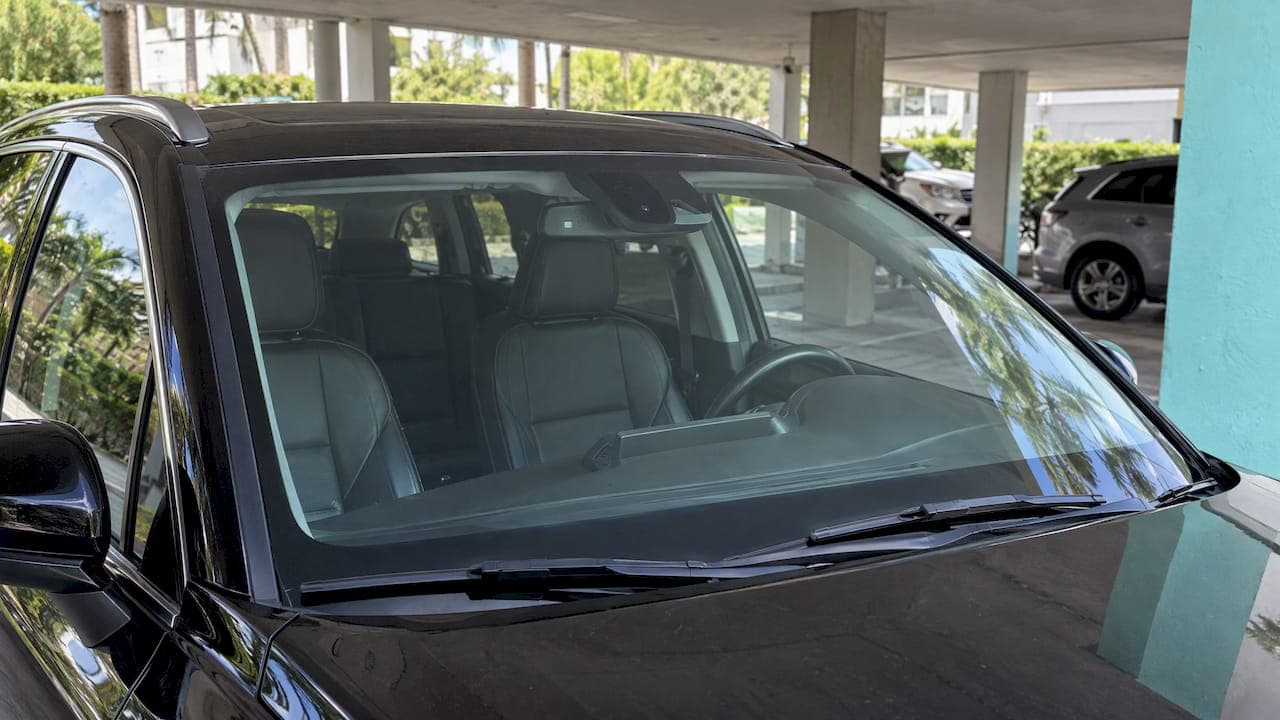
Yes, a clear window film can block heat. Ceramic films use nanoparticles that reject infrared energy without a dark or mirrored look, so you keep a nearly see-through window. The trade-off is simple: the lighter the film, the less total heat it stops. A near-clear film typically rejects roughly 35% to 40% of total solar energy, while a very dark ceramic can reject more than 60%. This guide shows the numbers, explains what they mean, and helps you pick the right film for your car, home or business in Miami-Dade.
TL;DR
- Clear ceramic film works by rejecting infrared and UV light, not by darkening the glass, so a 70% VLT film still looks almost clear.
- On 6 mm clear glass, 3M's lightest ceramic films reject about 36% to 40% of total solar energy. Darker versions reject 56% to 62%.
- UV blocking is high at every shade: 3M's data sheets list 99.2% to 99.8% for the films below.
- Car windows and home windows need different film families. Never move an automotive film onto house glass or the reverse.
- We install ceramic film on site anywhere in Miami-Dade, so you don't have to drop your car at a shop.
Table of Contents
- Is there a clear film that really blocks heat?
- What the performance numbers say
- How clear ceramic film keeps the view and still cuts heat
- Clear film for cars: what changes in Miami
- Clear film for homes and offices: check the glass first
- Which film should you pick?
- Looking after film and glass
- Why we believe in ceramic, clear or dark
- Book a mobile install
- FAQ
- Sources
Is there a clear film that really blocks heat?
There is. The International Window Film Association (IWFA) says that visibly clear film can be as effective as dark film for controlling solar energy in some respects, and that film in the 65% to 75% VLT range looks nearly clear. VLT means visible light transmission: the share of visible light that passes through the glass and film together. A 70% VLT film lets 70% of visible light in.
Heat from the sun does not come only from visible light. A large part arrives as infrared, which you cannot see. Ceramic films target that invisible part. That is why a film can look clear and still make a car or room feel noticeably cooler.
The same IWFA page says window film can block up to 84% of the sun's heat and more than 95% of its UV rays. Treat 84% as the top of the range, reached by high-performance, darker products. A clear film will land lower, and the next section shows how much lower.

What the performance numbers say
The most useful figures come from manufacturer data sheets. They are measured on a standard 6 mm clear glass sample, so your real result will shift with your own glass. 3M says in its own sheets that these are typical values, not specification limits.
| Film (3M, on 6 mm clear glass) | VLT | Total solar energy rejected | UV blocked |
|---|---|---|---|
| Ceramic IM 70 | 75.7% | 39.5% | 99.6% |
| Ceramic IM 5 | 8.7% | 61.8% | n/a in our source |
| Color Stable CS IR 70 | 70% | 36% | 99.2% |
| Color Stable CS IR 5 | 8% | 56% | 99.8% |
Three things stand out.
- Going nearly clear costs you roughly 20 points of total solar energy rejection. Ceramic IM 70 rejects 39.5%, while the very dark IM 5 rejects 61.8%. That gap is the price of keeping the glass light.
- UV protection barely changes with shade. Even the lightest films in the table block over 99% of UV on 3M's tests. If your main worry is skin exposure or a dashboard that cracks and fades, a clear film already does that job.
- Heat and glare are not the same number. The same 3M sheet for Ceramic IM 70 lists 56% glare reduction, and the CS IR 70 sheet lists 21%. Pick the film for the problem that bothers you most.
Reading the heat metrics
You will see several abbreviations on a spec sheet. Here is what they mean in plain terms.
- TSER (total solar energy rejected): the share of all solar energy the glass and film keep out. Higher is better.
- SHGC (solar heat gain coefficient): the share that gets in. Lower is better. The European Window Film Association explains that the North American SHGC counts the radiation that passes through plus the radiation absorbed and released inward as heat.
- IRER (infrared energy rejection): 3M's Ceramic IR bulletin says this covers solar infrared from 780 to 2,500 nm and includes infrared that is absorbed and reradiated into the vehicle. The narrower IRR figure only measures 900 to 1,000 nm, so do not compare an IRR number from one brand with an IRER number from another.
The practical rule: compare films by TSER or SHGC first, then VLT, then UV. A big infrared number alone can mislead you if the film only stops a narrow band. If you want a deeper explanation, our post on what infrared rejection means in tinting walks through it.
How clear ceramic film keeps the view and still cuts heat
Older films cooled a window by getting darker or by adding a metal layer that reflects light. Ceramic film takes another route. 3M says its Ceramic Architectural Series uses ceramic nanoparticles to absorb and reject heat and control infrared light, and that its light options transmit nearly all visible light. Because the particles are non-metallic, the film does not give the mirror look of reflective film.
The research frontier is moving too. In 2018, MIT researchers reported a coating that rejected up to 70% of incoming solar heat and stayed highly transparent below about 89°F, then turned frosty at or above that temperature. That was a lab result, not a product you can buy for your windshield. For real installs today, ceramic film with published data sheets is the proven option.

Clear film for cars: what changes in Miami
Miami sun is hard on a car. The interior sits in direct light for hours, and the dashboard, seats and steering wheel soak up heat. A clear or light ceramic film on the glass cuts the infrared that causes that buildup, and it blocks UV that ages leather and plastic.
Here is how we think about choosing a shade for a vehicle:
- You want the stock look, or you need a lighter shade for the windshield: go for a high-VLT ceramic. You will get meaningful heat rejection without a visible tint. Our article on windshield tint and heat covers this in detail.
- You want privacy and the strongest heat cut on side and rear glass: a darker ceramic gives you the higher rejection shown in the table above.
- You drive an EV: heat load affects cabin cooling. We wrote about ceramic tint for EVs, including sensor-safe film.
- You drive a truck: big cabins and lots of glass benefit from high infrared rejection more than from a dark shade. See truck window tint and IR rejection.
Tint law sets limits on how dark film can be on a windshield and on front side windows. Tell us your vehicle and we will go through what applies before we cut a single piece.
Why a windshield needs a one-piece install
A large windshield is where clear film pays off most, because you look through it all day. We use 60-inch rolls so a big windshield can be covered in one piece with no seam. Computer-cut patterns give an exact fit at the edges. A seam running through your line of sight is the kind of flaw you only notice after the install, so we plan around it before we start.
Clear film for homes and offices: check the glass first
The same technology works on house and storefront glass, but the safety side is different. Glass heats unevenly under film, and that is what can break it.
The U.S. Department of Energy's 2024 documentation says window films can be transparent, tinted or metalized polyester attached to existing interior or exterior surfaces, and that modeled films significantly reduced whole-window SHGC. It also notes that blocking summer heat can block useful winter heat. In South Florida, where cooling dominates the year, that trade-off leans in your favor. In a colder climate it would not.
Then comes the glass. IWFA's 2026 flat-glass guide says that all glass except tempered glass is susceptible to thermal breakage if the wrong film is installed, and that insulated glass units need special attention and manufacturer-specific compatibility rules. The guide says a compatibility review should weigh:
- how much heat the film absorbs
- glass type and thickness
- single, dual or triple glazing
- coatings or existing tint
- window orientation
- climate and altitude
- uneven shading across the pane
IWFA's older paper on avoiding glass failure adds that thermal stress fractures come from uneven temperature across a pane and can be worsened by edge damage, heat absorption, and interior or exterior shading. A tree shadow or a deep overhang across half a window is enough to matter.
The practical steps for a home or office:
- Identify your glass: single pane, dual pane, tempered, or coated.
- Look for chips or edge damage and tell your installer.
- Ask which film the manufacturer approves for that exact glass.
- Choose a film for the glass, not for the look of a sample.
One more point from IWFA's 2026 automotive guide: automotive films should not be substituted for architectural products without specific manufacturer approval. They are different product classes with separate approvals and data. We handle residential tinting and commercial tinting on select properties, and we match the film to the glass before we quote.
What it can do for your cooling bill
The U.S. General Services Administration reports that window heat gain accounts for 28% of cooling-energy demand in U.S. commercial buildings, and that solar-control films can reduce cooling energy. Its study also found that savings varied with climate and glazing, and that film absorbing heat on interior double-pane windows reached room-side temperatures up to 140°F. That last number is the reason film choice matters on double-pane glass: the right film for the glass keeps that heat in check. Do not expect a fixed percentage off your bill. Expect a cooler room near the glass and less work for your AC.
Which film should you pick?
Use this as a short decision guide.
| Your priority | Film direction | What to expect |
|---|---|---|
| Look unchanged, UV protection first | Near-clear ceramic, about 70% VLT | Around 36% to 40% total solar energy rejected on 3M's tested glass, over 99% UV blocked |
| Balanced heat cut and privacy | Medium ceramic | More rejection, a visible but light shade |
| Maximum heat cut and privacy | Dark ceramic, such as the 5% shades | Around 56% to 62% rejected in 3M's tests, strong glare reduction |
| Large windshield or panoramic glass | Light ceramic, one-piece install | Heat and UV cut without blocking the view |
Among the films we install, you can choose from three ceramic lines, all ceramic and nothing else:
- 3M Ceramic IR, with a lifetime warranty
- SunTek CIR, with a 5-year warranty
- Uviron KoolMax, with a 3-year warranty
Because we only work with ceramic, you never have to ask whether a quote is for dyed film that will fade. Read more on our 3M Ceramic IR page or the ceramic tint page. If you are not sure whether factory glass tint is enough, our guide to factory tint versus aftermarket film explains the difference.
Looking after film and glass
Good film lasts when it is cleaned right. 3M's 2024 data sheet says its film is made for glass substrates, wet application and professional installation. It recommends nonabrasive cleaners and rules out knives, scrapers, brushes, abrasive materials, tapes, suction cups and stickers on the film.
In practice:
- Use a soft microfiber cloth and a non-ammonia glass cleaner.
- Do not put suction-cup mounts or sticky tags on tinted glass.
- Keep any scraping or razor work away from the film.
- Follow your installer's cure time before rolling windows down.
Film is also separate from glass-surface treatments. If you are curious about protecting the outside of the glass, a ceramic coating on glass is a different product from tint film and does not replace it for heat rejection.
Why we believe in ceramic, clear or dark
Our perspective
After 28 years of tinting, our view is simple: the best film is the one that fits your glass, your vehicle and the way you use it. Many drivers ask for the darkest shade because they think dark means cool. The spec sheets say something more useful. A ceramic film with strong infrared rejection does the real heat work, and shade is mostly a privacy and style choice.
That is why we install only ceramic. We would rather give you a light, clean-looking film that rejects heat well than sell you a dark film that does less. Our 3M Ceramic IR carries a lifetime warranty, and we offer SunTek CIR and Uviron KoolMax for different budgets and needs.
We also come to you. We install at your home or office anywhere in Miami-Dade, owner-installed, with computer-cut patterns so edges fit exactly. We have worked on Tesla, luxury and exotic vehicles, where an exact fit and sensor-aware work matter. If we think a film is wrong for your glass, we say so before the job.
Jose
Book a mobile install
We bring the film to your driveway, garage or parking lot in Kendall, Pinecrest, Homestead, Cutler Bay and across Miami-Dade. Published starting prices:
- 2 front windows: from $200
- Windshield tint: from $150
- Full car plus windshield: from $450
- Old tint removal: $50 to $150
See the current options on our home page, or learn how our mobile window tinting works.

For a quote, use our online quote form and tell us your vehicle or window type, your glass, and the shade you have in mind.
FAQ
Is there a clear window film that blocks heat?
Yes. Ceramic films use nanoparticles to reject infrared energy while keeping visible light high. On 3M's tests, a film with about 70% VLT rejected roughly 36% to 40% of total solar energy. Darker films reject more, so the shade you choose sets how much heat you stop.
Does heat blocking window film actually work?
It does, within the limits of the product. IWFA says film can block up to 84% of the sun's heat, but that figure belongs to high-performance films. A near-clear film will block less, and results depend on your glass. Check the TSER or SHGC number on the data sheet, not the marketing label.
Is there a clear film that blocks UV rays?
Yes. 3M's data sheets list UV blocking of 99.2% to 99.8% for the Color Stable films above, and 99.6% for Ceramic IM 70. That is true even for the lightest shades, so a clear film still protects your skin, dashboard and upholstery from UV exposure.
Can I put car window film on my house windows?
No. Automotive and architectural films are different product classes with separate approvals, and IWFA warns against swapping them without manufacturer approval. Home glass can also crack from thermal stress if the film does not suit it. Have an installer check your glass type first.
Sources
- IWFA: Does window film need to be dark to work?
- MIT News: See-through film rejects 70 percent of incoming solar heat
- 3M Ceramic IM series technical data sheet
- 3M Color Stable automotive data sheet
- 3M Ceramic IR series product bulletin
- EWFA technical paper on infrared energy rejection
- 3M Sun Control Window Film Ceramic Architectural Series
- U.S. DOE OSTI: Window film measure documentation
- IWFA Flat Glass Solar Education Guide
- IWFA: Avoiding glass failure
- IWFA Automotive Education Guide
- GSA: Solar-control films findings