
Window film marketing loves big numbers. You've probably seen ads screaming "98% infrared rejection!" or "blocks virtually all heat!" and felt confident you'd found the solution to Miami-Dade's brutal sun. Then the film goes on, summer hits, and your car still feels like a convection oven. That disconnect is common, and it's not your fault. The window film industry leans hard on single statistics that sound impressive but tell only part of the story. This guide cuts through the noise and shows you exactly what to look for when choosing film for your car or property in Miami-Dade.
Table of Contents
- What does heat rejection really mean for window film?
- Types of window films and how they perform in Miami-Dade
- How to spot real performance vs. marketing claims
- Why professional installation makes all the difference
- Our take: What most Miami homeowners and drivers miss about window film
- Ready to stay cool with expert-installed window film in Miami?
- Frequently asked questions
Key Takeaways
| Point | Details |
|---|---|
| TSER beats IRR | Total Solar Energy Rejected (TSER) is the most accurate number for real heat comfort—not just a high IRR stat. |
| Ceramic films excel | Ceramic window films deliver the best balance of heat rejection, clarity, and durability for Miami-Dade. |
| Installation is key | Professional, edge-to-edge installation ensures you get the full benefit from any window film. |
| Demand transparency | Ask dealers for certified TSER and SHGC values, not just marketing numbers. |
| Go beyond darkest tints | Lighter, high-grade ceramic films often outperform darker, cheaper tints for Miami heat. |
What does heat rejection really mean for window film?
Most people assume heat rejection is a simple number, higher is better, done. But solar energy hitting your windows is made up of several components: visible light, infrared radiation, and ultraviolet rays. No single stat captures all of them at once, which is exactly where the marketing confusion begins.
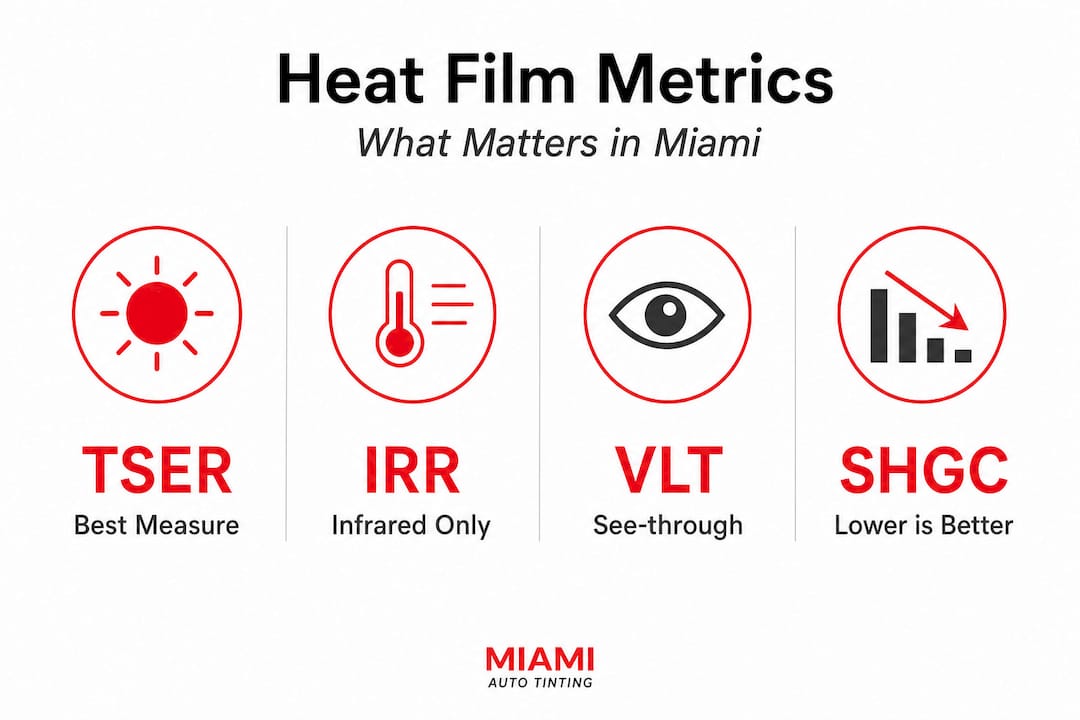
TSER (Total Solar Energy Rejected) is the number that actually matters most. It measures the percentage of the entire solar spectrum blocked by the film. When you're comparing two films and want to know which will keep your home or car cooler, TSER is the honest answer. It factors in visible light, infrared, and UV combined.
IRR (Infrared Rejection) covers only the infrared portion of the solar spectrum. This is the stat that gets hyped in ads. A film claiming "98% IRR" may only block infrared wavelengths in a narrow band, say 900–1000 nanometers, while letting through heat-carrying infrared at other wavelengths. Window tint heat rejection claims are frequently built around these narrow-band measurements, which is why two films with the same "98% IRR" label can feel completely different in practice.
VLT (Visible Light Transmission) tells you how much visible light passes through. Florida law requires a minimum VLT for driver-side windows, so darker isn't always a legal option, and as you'll see later, darker isn't always more effective either.
SHGC (Solar Heat Gain Coefficient) is a complementary metric used more in architectural settings. A lower SHGC means less heat enters through the glass, which is what energy-conscious homeowners want.
Here's how these properties compare across common film types:
| Film type | TSER | IRR | VLT | SHGC | Miami suitability |
|---|---|---|---|---|---|
| Ceramic (premium) | 55–65% | 90–97% | 40–70% | 0.35–0.45 | Excellent |
| Metalized | 45–55% | 85–92% | 15–40% | 0.40–0.52 | Moderate |
| Dyed only | 25–40% | 45–65% | 15–45% | 0.55–0.70 | Poor to fair |
| Carbon hybrid | 40–55% | 70–85% | 30–55% | 0.45–0.58 | Good |
Notice that a ceramic film at 65% VLT (quite light) can have a TSER of 60%, while a nearly black dyed film at 20% VLT may only hit 38% TSER. Darker is not the same as cooler. Understanding how Miami's climate affects tinting helps explain why this gap matters so much here versus, say, Chicago.
Pro Tip: Always ask for the TSER value at the specific VLT you're considering. A film may have great TSER at 20% VLT but mediocre TSER at 50% VLT. The comparison only means something when VLT is matched.
Types of window films and how they perform in Miami-Dade
Miami-Dade has some of the most intense solar conditions in the continental United States. The combination of year-round sun angle, high humidity, and extreme UV index means not every film that performs decently in a northern climate will hold up or deliver here.
Ceramic window films are the clear frontrunners for Miami's environment. Brands like 3M IR, 3M Color Stable, and Iviron Kollmax ceramic tint use nano-ceramic particles that reject heat without relying on metal layers. This means no electronic interference with GPS, Bluetooth, or cellular signals, which matters in modern cars loaded with tech. Ceramic films also maintain optical clarity, resist fading, and hold up well against humidity. The ceramic tint benefits for Miami drivers are significant, with reliable performance year after year.
Metalized films reflect solar energy using metallic layers. They do reject heat reasonably well, but the metal content creates two real problems in Miami: signal interference and corrosion risk. Salt air and humidity accelerate the breakdown of metalized layers over time, which can lead to bubbling, discoloration, and reduced performance within just a few years. For most Miami-Dade owners, metalized film is a short-term compromise.
Dyed films are the budget option. They absorb heat rather than reflect or reject it, which makes them far less effective overall. In Miami's sustained summer heat, dyed films tend to fade within 2 to 3 years and offer limited TSER. The low upfront cost often leads to higher long-term cost because replacement comes sooner and the comfort gain is minimal.
For Miami-Dade car and property owners, ceramic films provide optimal balance: superior TSER and IRR without the drawbacks of metal, resulting in 10 to 30% energy savings and interiors that run 10 to 20°F cooler. That's not marketing fluff. That's the consistent outcome reported by homeowners and drivers who make the switch from dyed or basic carbon films.
Here's a direct performance comparison:
| Film type | Durability in Miami | Signal interference | Heat feel improvement | Energy savings |
|---|---|---|---|---|
| Ceramic | 10–15 years | None | High (10–20°F cooler) | 10–30% |
| Metalized | 4–7 years | Possible | Moderate | 8–18% |
| Dyed | 2–4 years | None | Low | 3–8% |
| Carbon hybrid | 7–10 years | Minimal | Moderate to high | 8–22% |
The window tinting benefits for Miami drivers extend beyond comfort. Reduced glare, UV protection for skin and upholstery, and lower AC load all contribute to the overall value. And when you look at ceramic vs. dyed tint side by side, the performance gap in Miami conditions becomes obvious fast.
How to spot real performance vs. marketing claims
Now that you understand the science and the film types, here's the practical part: how to shop without getting tricked by inflated numbers.
The core issue is that IRR marketing overhypes narrow-band measurements, while burying the full TSER and SHGC data that actually predicts real comfort. A film rated "98% IRR" may measure that peak only at 1000 nanometers, which sounds great but represents a tiny slice of the heat-carrying solar spectrum. The full TSER might only be 45%. Meanwhile, a quality ceramic film with "only" 93% IRR could have a TSER of 62%, making it noticeably more effective in daily use.
Here's a checklist to use when evaluating any window film for your car or Miami-Dade property:
- Ask for the TSER value, not just IRR. If a dealer can't provide it, walk away.
- Request NFRC or ISO lab-tested specifications. Third-party testing from the National Fenestration Rating Council ensures the data is standardized and comparable.
- Compare TSER at matched VLT levels. A film at 20% VLT shouldn't be compared to one at 50% VLT on the same TSER score.
- Check SHGC for home or commercial windows. A lower SHGC number means less solar heat enters, which is especially important for south-facing windows.
- Verify VLT for Florida legal compliance. Florida requires front side windows to transmit at least 28% of light. Going below that creates legal risk.
- Look for brand-specific technical data sheets. Films like 3M IR series publish detailed performance specs by film model. Legitimate brands always support their claims with documentation.
A lighter-shade ceramic film rated at 50% VLT can outperform a near-black dyed film at 15% VLT on heat rejection. Color is not performance. TSER is performance.
Miami ceramic window tints earn their reputation because they're sold with real data behind them. When a dealer shows you certified TSER numbers and lab sheets, that's the sign you're dealing with a professional operation, not a marketing campaign.
Pro Tip: Ask your installer to show you the product's technical data sheet before you commit. Any reputable film brand publishes these, and they should list TSER, IRR, VLT, SHGC, and UV rejection percentages all in one place. If the only spec sheet you see is a brochure with one big IRR number, that's a red flag.
Why professional installation makes all the difference
You can choose the best ceramic film on the market and still end up disappointed if the installation is poor. This is one of the most overlooked factors in the entire window tinting decision. Film performance specs are measured under laboratory conditions with perfect installation. Real-world results can fall short when installation cuts corners.
The most common installation failures that hurt heat rejection performance include:
- Film cut too short: Gaps around the edges allow heat to pass through unfiltered. Even a few millimeters of uncovered glass at the edges undermines the thermal seal across the entire window.
- Contaminated application surface: Dust, grease, or residue under the film creates micro-bubbles and adhesion failures that grow over time, especially in Miami's heat.
- Wrong adhesive type for humidity: Not all installation solutions and adhesives perform the same in high-humidity environments. Miami requires products formulated to cure and bond properly even in conditions where humidity regularly tops 80%.
- Improperly annealed edges: On vehicles, film that isn't properly heat-shrunk around curved windows develops stress points that peel over time.
- Misaligned overlaps on larger residential panels: On home and commercial windows, seams that don't align correctly create visible lines and inconsistent heat rejection across the glass.
Professional edge-to-edge installation is essential to achieving the ROI that premium films promise. This is not a job where "good enough" delivers the energy savings and comfort those TSER numbers represent.
The benefits of ceramic tint only fully show up when every square inch of glass is covered correctly. A real-world window tinting case study shows how a Miami family's results changed dramatically when they moved from a rushed install to a proper professional application.
Pro Tip: The single most overlooked installation factor in Miami is surface preparation humidity management. Professional installers time their work to control humidity during the cure period, which prevents the cloudy haze that looks like bad film but is actually a bad installation day.
Our take: What most Miami homeowners and drivers miss about window film
We've worked with hundreds of car owners and homeowners across Miami-Dade, and the pattern is consistent. Someone buys a film with an impressive single-stat claim, feels mildly better for a few months, then wonders why their neighbors with a "weaker looking" film seem far more comfortable.
The misunderstanding is almost always the same: darker equals better, and bigger IRR numbers equal better. Neither is reliably true.
The real game-changer in Miami is certified TSER measured at a matched VLT, installed edge to edge by someone who understands how humidity affects the cure process. That combination, not the flashiest number in the brochure, is what actually keeps interiors cooler through August. Why Miami's climate makes window tinting essential is not about having any tint, it's about having the right tint installed right.
Ceramic films like 3M IR and Iviron Kollmax cost more upfront than dyed or basic carbon alternatives. But in Miami's climate, they pay back faster because they don't degrade in 3 years, they don't interfere with electronics, and their TSER holds steady over time. Chasing a lower upfront price on a dyed film often means paying twice within 5 years.
The customers who get the best results approach this as a data-driven decision, not an aesthetic one. They ask for spec sheets, they verify TSER, they use a qualified installer, and they choose ceramic. That combination consistently produces the 10 to 20°F interior cooling and 10 to 30% energy savings that real performance films promise.
Ready to stay cool with expert-installed window film in Miami?
If you've made it this far, you now know what separates a film that genuinely performs from one that just markets well. The next step is putting that knowledge to work with a team that actually delivers certified performance in Miami-Dade conditions.
South Miami Tint offers mobile window tinting for cars, homes, and commercial properties across Miami-Dade, using 3M IR, 3M Color Stable, and Iviron Kollmax ceramic window tint in Miami. Every installation is edge-to-edge and matched to Miami's humidity and legal requirements. Whether you want 3M ceramic film for your home or mobile car window tinting at your location, the films we use come with real spec sheets and the install quality to back up every number on them. Reach out today to get the comfort Miami's sun demands.
Frequently asked questions
Is ceramic window film legal on all Miami-Dade cars?
Ceramic film is legal as long as you select a VLT percentage that meets Florida's window tint law, which requires at least 28% light transmission on front side windows.
How much cooler will my car or home actually feel?
A quality ceramic film can reduce interior temperatures by 10 to 20°F and lower energy bills by 10 to 30%, depending on window size and sun exposure.
Does film darkness always mean better heat rejection?
Not at all. Certified ceramic films at lighter shades regularly outperform much darker dyed films on TSER, the metric that actually measures full-spectrum heat rejection.
Do window films block UV as well as heat?
Yes, premium ceramic films block over 99% of UV rays, protecting your skin, vehicle interior, and home furnishings from sun damage while also reducing heat.
How long does a premium window film last in Miami's climate?
Ceramic window films typically last 10 years or more, even under Miami's intense sun, salt air, and humidity, significantly outlasting dyed or metalized alternatives.