
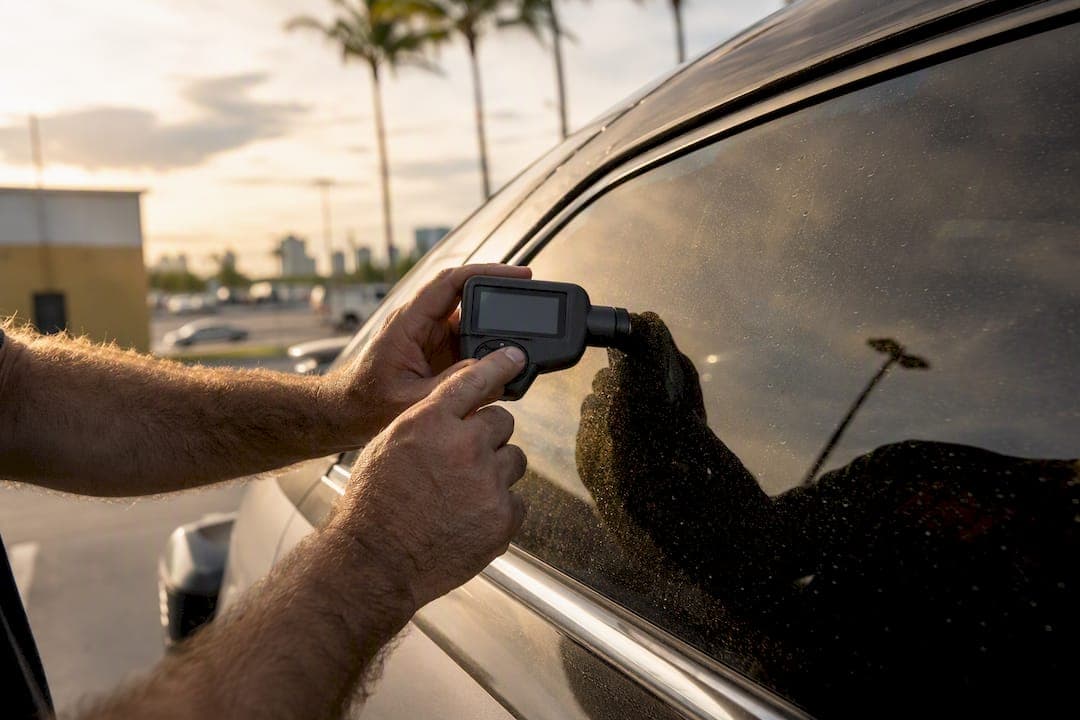
Infrared rejection (IRR) measures how much infrared light a window film blocks, and infrared is the wavelength that carries the most heat energy from the sun. It's a useful number, but it's not the full heat picture. The metric that tells you how much total heat a film actually blocks is TSER, or Total Solar Energy Rejected, because it accounts for ultraviolet and visible light too.
- Infrared makes up roughly 53% of the solar energy that hits your glass.
- A film's IR number alone can't tell you how hot your car or room will actually feel.
Key Takeaways
TSER, not a standalone infrared percentage, is the metric that most accurately predicts how much total heat a window film actually blocks.
| Point | Details |
|---|---|
| Infrared is the biggest heat source | Infrared makes up about 53% of solar energy, more than UV and visible light combined for heat purposes. |
| IRR alone is incomplete | A high IR rejection number ignores the solar energy carried by UV and visible light. |
| Full-spectrum beats single-wavelength | Ask for IRER across 780 to 2,500 nm instead of a peak single-wavelength claim. |
| Always request TSER and spec sheets | Legitimate installers can produce spectral data sheets backing every percentage they quote. |
| Southmiamitint installs verified films | Southmiamitint provides on-site mobile installation of 3M Ceramic IR, 3M Crystalline, and Iviron KoolMax with spec sheets available on request across Miami-Dade County. |
Table of Contents
- What Is Infrared Rejection and Why It's Not the Whole Story
- IRR vs IRER vs TSER: What Each Number Actually Tells You
- How Infrared Rejection Gets Tested and Reported
- How Infrared Rejection Affects Comfort in Cars and Buildings
- Which Film Types Actually Block Infrared
- How to Choose Infrared Rejection Tinting Without Getting Fooled
- When Does Infrared Rejection Matter Most?
- Getting Real Heat Rejection Numbers, Not Just Marketing Claims
- Where to Verify Infrared Rejection Claims Yourself
- Frequently Asked Questions
- Sources
What Is Infrared Rejection and Why It's Not the Whole Story
Infrared rejection tells you how much of the infrared band a film blocks, but infrared is only one slice of the sun's energy hitting your glass. The rest comes as ultraviolet and visible light, and all three contribute to how hot a space feels.
The solar spectrum breaks down roughly like this: ultraviolet makes up about 3%, visible light about 44%, and infrared about 53% of total solar energy. Infrared carries the most heat because it's absorbed by surfaces (your dashboard, your skin, your walls) and re-radiated as warmth you feel even after the sun moves. Visible light adds heat too, and UV contributes less warmth but does most of the fading damage.
- UV: about 3% of solar energy, minimal heat, major fading culprit
- Visible light: about 44%, contributes brightness and a meaningful chunk of heat
- Infrared: about 53%, the largest single source of radiant heat
Picture the sun's energy as a pie cut into three unequal slices. Infrared is the biggest piece, which is why manufacturers built entire product lines around blocking it.
IRR vs IRER vs TSER: What Each Number Actually Tells You
Manufacturers throw around three different acronyms, and confusing them leads buyers to overpay for a number that doesn't predict comfort.
IRR (Infrared Rejection) measures how much infrared a film blocks, often at a single wavelength or a narrow slice of the IR band. IRER (Infrared Energy Rejection) is broader. It reports rejection across the full 780 to 2,500 nanometer range, which is a far more honest picture of how a film behaves across real sunlight. TSER (Total Solar Energy Rejected) goes further still, combining UV, visible, and infrared rejection into one number that reflects total heat blocked.
Here's the cheat sheet:
- If a spec sheet lists only "IR rejection" with no wavelength range attached, treat it as a marketing number, not a performance guarantee.
- IRER is more useful than IRR because it covers the full infrared band installers actually deal with.
- TSER is the number that most directly predicts how much cooler your cabin or room will feel, because it accounts for all parts of solar energy including infrared, visible, and ultraviolet light.
- A film advertising 99% IR rejection is blocking 99% of infrared only. That's not the same as blocking 99% of total solar heat, since infrared is just one part of the equation.
A good baseline is to look for TSER on quality automotive or residential films along with a full-spectrum IRER figure rather than a single-wavelength claim.
How Infrared Rejection Gets Tested and Reported
Not all IR percentages come from the same test. Some manufacturers measure rejection at a single wavelength, commonly near 950 nanometers, because it produces an impressively high number. Others test across the full 780 to 2,500 nanometer spectrum, which captures how the film performs against the entire infrared range hitting your glass, not just one favorable point on the curve.
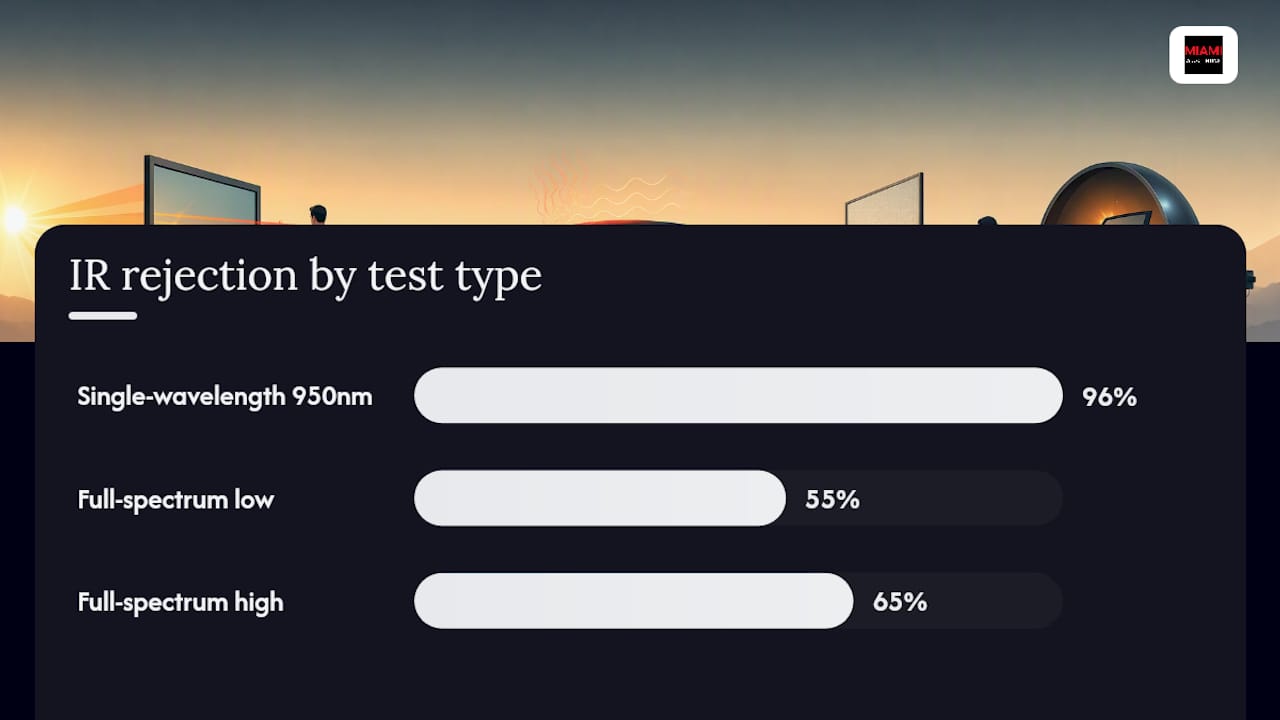
That gap matters. A film advertised at 96% IR rejection at a single wavelength might land closer to 55% to 65% when tested across the full spectrum, according to installer-reported spec comparisons. Neither number is fabricated. They're just answering different questions.
Legitimate manufacturers back their claims with spectrophotometer testing and publish spectral data sheets showing performance across the full range, not a cherry-picked point.
Pro Tip: Ask your installer for the spectral data sheet, not just the marketing brochure. If they can't produce one, or the sheet only shows a single wavelength, ask why the full-spectrum number isn't listed.
- Single-wavelength tests (often 950 nm): quick, common in marketing, easy to inflate
- Full-spectrum tests (780 to 2,500 nm): slower to produce, far more predictive of real comfort
- Spectral data sheets and lab reports: the paper trail that separates a real number from a headline
How Infrared Rejection Affects Comfort in Cars and Buildings
High IR rejection translates into things you can actually feel. Less radiant heat lands directly on your skin and on your dashboard or furniture. Your air conditioning reaches a comfortable temperature faster, which can ease AC runtime over a long, hot day. Interior fabrics, leather, and finishes fade more slowly because infrared and UV both accelerate material breakdown.
But IR rejection alone doesn't control the whole thermal experience. Visible light still carries close to 44% of solar energy, so a film with excellent IR numbers and mediocre TSER can still leave a car or room warmer than expected. That's why two films with similar IR claims can feel noticeably different once you're sitting inside on a 95 degree Miami afternoon.
- Expect less direct radiant heat on skin and surfaces
- Expect faster cooling once the AC kicks on
- Expect slower fading on dashboards, seats, and flooring
- Don't expect IR rejection alone to eliminate glare or overall warmth. That's TSER's job
There are trade-offs too. Very dark films block more visible light but may run into legal VLT limits depending on your state, and some metalized films can interfere with radio, GPS, or cell signal. A detailed breakdown of VLT percentages and legal limits is worth a look if you're deciding how dark to go alongside your heat goals.
Which Film Types Actually Block Infrared
Ceramic and spectrally selective films use non-metallic particles engineered to interact with infrared wavelengths while letting more visible light through than older dyed or metalized films did. That's the technology behind products like 3M Ceramic IR, 3M Crystalline, and Iviron KoolMax, three ceramic tint options installers reach for specifically because they target infrared without darkening the glass as much as older films required.
- Ceramic tint: strong IR and TSER performance, no signal interference, higher price point
- Spectrally selective films (like Crystalline): built to reject IR and UV while keeping VLT light, ideal where visibility matters
- Metalized films: decent heat rejection, cheaper, but can interfere with GPS, radio, or cell signal
- Dyed films: lowest cost, weakest IR performance, tend to fade over time
How to Choose Infrared Rejection Tinting Without Getting Fooled
Before you sign off on any film, run through this checklist:
- Ask for the TSER figure, not just an IR percentage.
- Ask whether the IR number is full-spectrum (780 to 2,500 nm) or a single-wavelength claim.
- Request the spectral data sheet from the manufacturer, not a marketing flyer.
- Ask which lab standard or spectrophotometer test produced the numbers.
- Ask what cabin or interior temperature reduction to realistically expect for your specific climate and vehicle or window setup.
Watch for these red flags:
- A headline IR percentage with no wavelength range listed anywhere
- No TSER figure offered when you ask directly
- Vague or evasive answers about which lab or test method was used
- Pressure to buy based on the IR number alone, with no mention of VLT or warranty terms
A buyer's guide to heat rejection film can help you compare quotes side by side once you have real numbers in hand instead of marketing language.
When Does Infrared Rejection Matter Most?
In a climate like Miami's, where cars sit in direct sun for hours and interior temperatures can spike fast, ceramic and spectrally selective films earn their higher price tag. Short-term parked heat responds more to TSER, since that's what determines how much total solar energy actually gets into the cabin before you ever start the engine.
Ongoing AC load over months of daily driving is where full-spectrum IR performance shows its value, easing the strain on your system trip after trip. If you're torn between a slightly lighter VLT and stronger heat rejection, ask your installer to show you both numbers side by side. The right balance depends on your priorities, not just the biggest number on the brochure.
Getting Real Heat Rejection Numbers, Not Just Marketing Claims
Southmiamitint installs film based on the numbers that actually predict comfort, not the biggest percentage on a brochure. We bring 3M Ceramic IR, 3M Crystalline, and Iviron KoolMax directly to your car, home, or office across Miami-Dade County, and every install comes with the manufacturer's spectral data sheet on request, so you can see the full-spectrum IR and TSER figures before you commit.
If a competitor quotes you a single eye-catching IR percentage with no TSER attached, that's worth a second question before you book. Southmiamitint's mobile team installs on-site at your location, saving you a shop visit, and can walk you through exactly what your film's TSER and IRER numbers mean for your specific vehicle or windows. Ready to see real numbers for your situation? Get a quote on ceramic mobile tint and we'll schedule your install around your day, not ours.
Where to Verify Infrared Rejection Claims Yourself
- Southmiamitint's ceramic vs infrared comparison for local climate context
Ask for spectral data, TSER, and full-spectrum IR numbers before trusting any single headline percentage.
Frequently Asked Questions
What is infrared rejection in tinting? Infrared rejection describes how much infrared light a window film blocks, usually reported as IRR or the broader IRER across 780 to 2,500 nanometers. It's one piece of a film's total heat performance, not the whole story.
Is a higher IR rejection percentage always better? Not automatically. A high number measured at a single wavelength can look impressive while performing far lower across the full infrared spectrum. Always check whether the figure covers the full range.
Why does TSER matter more than IR rejection alone? TSER combines UV, visible, and infrared rejection into one figure, giving you the actual share of total solar heat a film blocks rather than just its infrared performance.
Do ceramic films block more infrared than regular tint? Ceramic and spectrally selective films, including 3M Ceramic IR, 3M Crystalline, and Iviron KoolMax, are engineered specifically to target infrared while preserving visible light transmission, which typically outperforms standard dyed film on heat rejection.
Can infrared rejection interfere with my phone or GPS signal? Metalized films can occasionally interfere with radio, GPS, or cell signal because of their metallic content. Ceramic and spectrally selective films generally avoid this issue since they use non-metallic particles.
Sources
- IR Rejection Explained: What Does It Really Mean in Window Film? — KSB Window Film
- How to read a window tint spec sheet: TSER, IR, and VLT | EuroLuxe Detailing
- Difference between IR rejection and TSER — Pacco Architectural Films