
For most U.S. car and home owners, ceramic or spectrally-selective film is the right starting point. These two film types deliver the strongest heat control without sacrificing visibility or triggering electronics interference. Your immediate next step: measure your window orientation (south- and west-facing glass takes the most heat), then request an IR rejection and SHGC spec sheet from a pro before committing to any product.
Three quick checks before you buy anything:
- Window type: Single-pane or double-pane? Double-pane windows need non-absorbing, spectrally-selective, or ceramic films to avoid thermal stress on seals.
- Orientation: South- and west-facing windows drive the most cooling demand. Prioritize those first.
- Climate: Cooling-dominated (Florida, Texas, Arizona)? Go low-SHGC ceramic. Mixed climate (Midwest, Mid-Atlantic)? Choose spectrally-selective to preserve some winter solar gain.
Pro Tip: Request the film's SHGC and IR rejection values in writing before signing any contract. A vendor who cannot provide those numbers is not worth hiring.
Table of Contents
- How does thermal-reduction window film actually lower interior heat?
- Which film type is right for your situation?
- What metrics should you compare on a spec sheet?
- How do car and home tinting needs differ, and does placement matter?
- How to choose the right film for your window, climate, and budget
- Which films perform best, and what do real-world results look like?
- What to expect during installation, curing, and long-term care
- What does the research actually say about film performance?
- What is the best film approach, and what should you do right now?
- Key Takeaways
- What installers wish you knew before the appointment
- Southmiamitint brings mobile tinting directly to your car or home
- Useful sources and where to learn more
How does thermal-reduction window film actually lower interior heat?
Solar-control window film works by intercepting sunlight before it converts to heat inside your car or home. The film sits between the glass and the interior, and it reduces heat through three mechanisms: reflecting solar infrared radiation back outside, absorbing infrared energy within the film itself, and blocking ultraviolet wavelengths entirely.
The key metric here is the Solar Heat Gain Coefficient, or SHGC. It measures the fraction of solar energy that passes through a window as heat. Standard single-pane clear glass carries an SHGC of roughly 0.70 to 0.86, meaning up to 86% of the sun's heat energy passes straight through. A quality ceramic film can bring that number down to 0.25 to 0.35, performance comparable to factory-installed low-E coatings.
The inward-flowing fraction matters as much as the film itself. When an absorbing film sits on the interior glass surface, it heats up and re-radiates energy into the room. Move that same film to the exterior surface, and the absorbed heat dissipates outside instead. LBNL modeling showed SHGC dropped significantly when an absorbing layer moved from interior to exterior on double glazing.
One point that surprises most owners: a nearly clear film can still cut significant heat. Visible light and infrared radiation travel at different wavelengths. A spectrally-selective film blocks the near-infrared portion of the solar spectrum while transmitting most visible light, so your room stays bright while the heat load drops. Heat gain through windows accounts for 28% of cooling energy demand in U.S. commercial buildings, which shows how much is at stake even before you factor in residential applications.
What film blocks, by mechanism:
- Reflected IR: Bounced back outside before it enters the glass assembly
- Absorbed IR: Trapped in the film layer; dissipates outward if film is exterior-mounted
- UV (below 400 nm): Blocked by specialized coatings; quality films achieve 99%+ UV rejection
- Visible light: Partially reduced depending on VLT rating; spectrally-selective films minimize this reduction
Which film type is right for your situation?
Six film categories cover the market. Each handles heat differently, and the right choice depends on your priorities.
- Dyed film: The budget entry point. Dyed films absorb solar energy and convert it to heat within the film. Heat rejection sits at 25–45%, and the organic dyes fade within 5–8 years under UV exposure. Suitable for temporary use or low-priority windows, but not the right call for anyone serious about long-term heat control.
- Metalized/reflective film: Uses microscopic metal particles to reflect infrared heat back outside. Heat rejection is strong (60–75% total solar energy), but the metallic layer can interfere with GPS, cell signals, and Wi-Fi. Also produces a mirrored exterior appearance that some HOAs and historic districts prohibit.
- Carbon film: A step up from dyed. Carbon particles absorb and block IR without the signal interference of metalized films. More durable than dyed options, with better heat rejection and a matte finish that avoids the mirror look.
- Ceramic film: The current performance leader for both cars and homes. Nano-ceramic particles block IR and UV while allowing higher visible light transmission compared to dyed or metalized films. Ceramic and crystalline films use advanced layering to block IR and UV while maintaining VLT in the 50–70% range. No signal interference. Best choice for hot-humid climates like South Florida, Texas, and the Gulf Coast.
- Spectrally-selective film: Engineered to target near-infrared wavelengths specifically. Spectrally-selective products show high visible transmission while blocking solar infrared wavelengths that carry most of the heat. Ideal for mixed climates, historic buildings, and any installation where a mirrored appearance is not acceptable.
- Low-E retrofit film: Applied to the interior glass surface, these films add a low-emissivity coating that reduces radiant heat exchange in both directions. Best for heating-dominated climates where you want to retain winter solar gain while reducing summer heat. Less aggressive on SHGC than ceramic, but adds meaningful U-factor improvement.
For hot-humid climates (Florida, Gulf Coast, Southwest): Ceramic or spectrally-selective reflective film. Prioritize low SHGC over everything else.
For mixed climates (Midwest, Mid-Atlantic, Pacific Northwest): Spectrally-selective film preserves winter solar gain while cutting summer heat. Avoid heavily absorbing films that block passive solar warming in winter.
For vehicles: Ceramic film is the clear winner. No signal interference, strong IR rejection, and available in VLT ranges that comply with state tint laws.
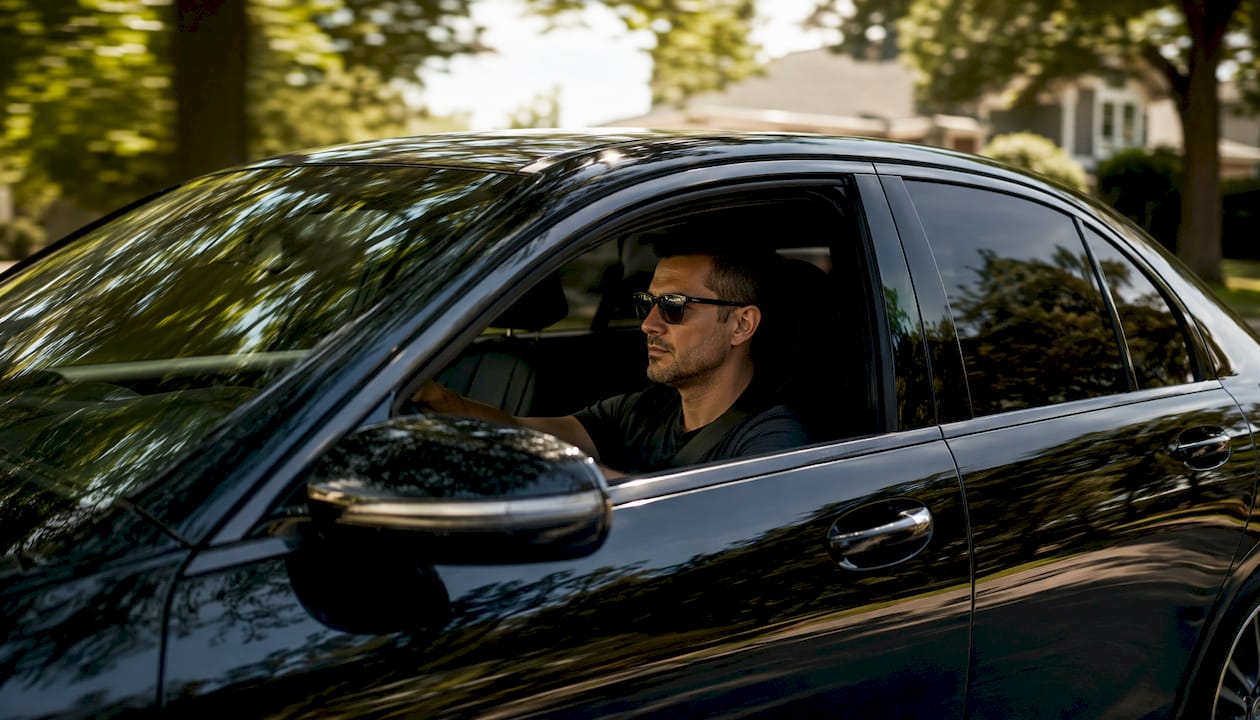
Pro Tip: Do not choose film shade (VLT) before choosing film material. A 50% VLT ceramic film rejects more heat than a 20% VLT dyed film, and it keeps your visibility at night. Material beats shade every time.
What metrics should you compare on a spec sheet?
Reading a film spec sheet is straightforward once you know which numbers matter. Here are the five metrics worth your attention.
- SHGC (Solar Heat Gain Coefficient): The primary metric for residential and commercial windows. Lower is better for cooling. Target SHGC below 0.40 for south- and west-facing windows in warm climates. SHGC is the preferred North American metric over the older Shading Coefficient, and because SHGC + TSER ≈ 100%, a film's TSER (Total Solar Energy Rejected) is simply the complement.
- VLT (Visible Light Transmission): The percentage of visible light passing through film and glass together. Higher VLT means more daylight but requires better film technology to maintain heat rejection. For homes, 40–70% VLT is the practical range. For vehicles, state law sets the floor.
- IR rejection %: The fraction of near-infrared radiation blocked. Premium ceramic films reach 95%+ IR rejection. This number is most relevant for automotive tinting, where occupant comfort depends on blocking the heat you feel directly.
- UV blocking %: Quality films block 99%+ of UV-A and UV-B. The Skin Cancer Foundation certifies films meeting this threshold, and most professional-grade films carry that certification.
- Emissivity / U-factor: Relevant for Low-E retrofit films. Lower emissivity means less radiant heat exchange through the glass. U-factor measures total thermal resistance; a lower U-factor means better insulation year-round.
Typical performance ranges by window type:
| Metric | Single-Pane (no film) | Double-Pane (no film) | With Ceramic Film | With Spectrally-Selective Film |
|---|---|---|---|---|
| SHGC | 0.70–0.86 | 0.70–0.86 | 0.25–0.35 | 0.25–0.35 |
| VLT % | 75–90% | 70–80% | 40–70% | 50–75% |
| IR rejection % | Near 0% | Near 0% | 80–95% | 70–90% |
| UV blocking % | Near 0% | Near 0% | 99%+ | 99%+ |
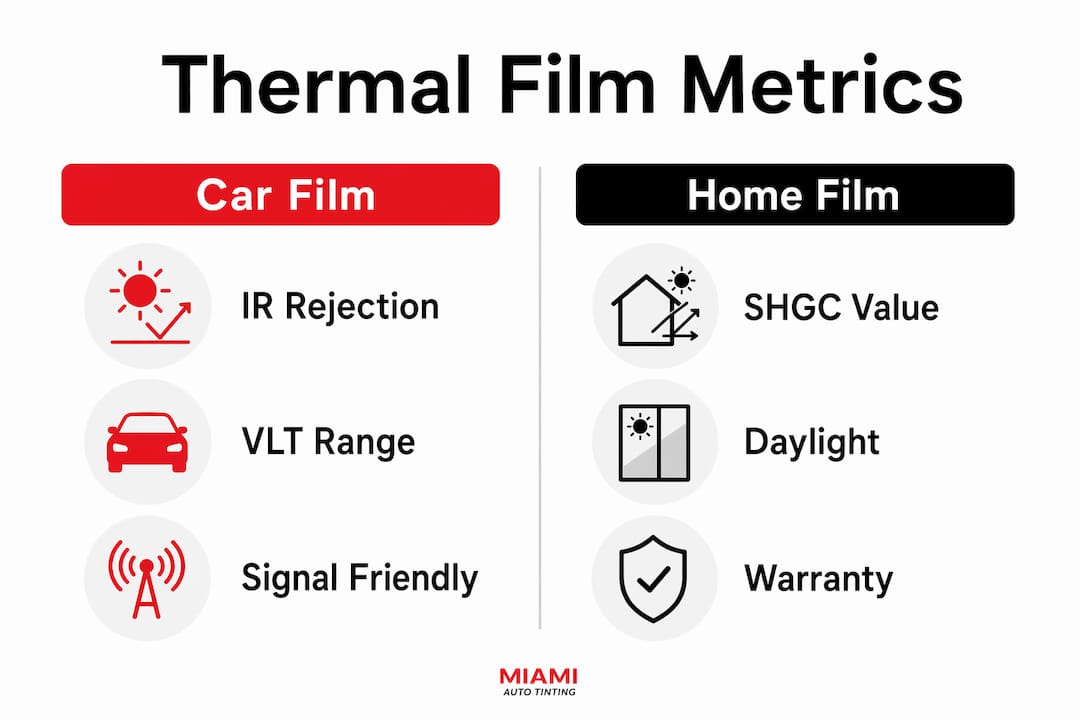
For cars: Prioritize IR rejection % and VLT (to stay within your state's legal limit). SHGC is less commonly listed on automotive spec sheets but maps directly to how much heat your cabin absorbs.
For homes: SHGC is the primary number. Pair it with VLT to confirm you are not sacrificing too much daylight, then check the warranty period and whether it covers fade and performance degradation.
A lighter ceramic or crystalline film can achieve similar heat rejection to a much darker dyed film while preserving night visibility. That is the single most important spec-sheet insight for vehicle owners choosing between film options.
How do car and home tinting needs differ, and does placement matter?
Vehicle tinting and residential film share the same physics but operate under very different constraints.
Automotive considerations:
- State VLT laws set a hard floor on how dark you can go. Most states require 35% VLT or higher on front side windows; some allow darker rear glass.
- Vehicle glass is curved, smaller per pane, and closer to occupants than residential glass. IR rejection matters more per square foot because you feel the radiant heat directly.
- Automotive film is always interior-mounted. Exterior application on curved glass is not practical.
- No IGU (insulated glass unit) seal concerns. You can use absorbing films without worrying about thermal stress on double-pane seals.
Residential and commercial considerations:
- Window area is larger, so SHGC improvements produce bigger absolute energy savings.
- Double-pane windows require careful film selection. Absorbing films on the interior face of an IGU heat the interior pane and transmit more heat into the room. Exterior-applied or reflective films avoid that problem.
- Placement choice changes effective SHGC significantly. Exterior placement of absorbing films on double-pane windows reduces SHGC more effectively than interior placement because absorbed energy dissipates to the outside.
- Building codes, HOA rules, and historic district requirements may restrict reflective exterior films.
When exterior film is the right call: Single-pane windows, older commercial facades, and buildings where interior film would heat the glass assembly and stress seals. When interior spectrally-selective film is better: historic buildings, restricted exteriors, and double-pane windows where exterior application is impractical or prohibited.
Pro Tip: For double-pane windows, always confirm with your window manufacturer that the film you are considering is approved for IGU application. Some manufacturers void their seal warranty if an incompatible film causes thermal stress. Spectrally-selective and ceramic films that reject heat through reflection rather than absorption are the safest choice for IGUs.
How to choose the right film for your window, climate, and budget
Follow these steps in order. Skipping step one is the most common mistake owners make.
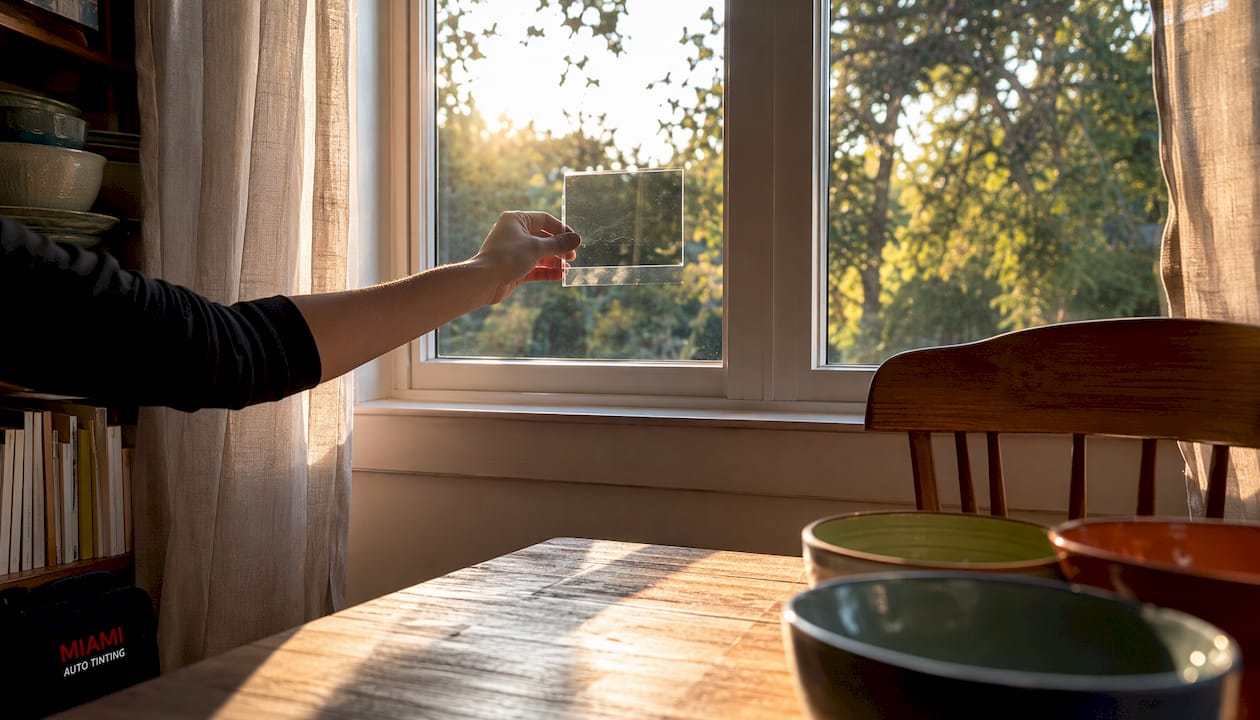
- Inspect your glass. Is it single-pane or double-pane? Are the seals intact (no fog between panes)? Any existing low-E coating? Cracked glass or frame damage? Film on a failing window is money wasted. Fix structural problems first.
- Match your climate to your film goal. Cooling-dominated climates (ASHRAE Climate Zones 1–3, covering Florida, the Gulf Coast, and the Southwest) need the lowest possible SHGC. Mixed climates (Zones 4–5) benefit from spectrally-selective films that balance summer cooling with winter solar gain. In mixed-climate zones, spectrally-selective films capture summer cooling benefits while preserving as much winter solar gain as possible.
- Set your metric targets. For homes: target SHGC below 0.40 on south- and west-facing glass. For vehicles: target IR rejection above 80% and confirm VLT compliance with your state law.
- Budget and timeline. Professional residential film installation runs $7–$15 per square foot for ceramic or spectrally-selective film. A typical 15-square-foot window costs $105–$225 installed. A whole-house project covering 15–20 windows runs $2,500–$5,000 depending on film grade. Automotive tinting varies by vehicle size and film type; mobile tinting pricing for ceramic film starts at $249 for a standard vehicle. Cure time runs 7–30 days for most solar films.
- Ask the right questions before hiring. A good installer answers all of these without hesitation:
- What is the SHGC and IR rejection rating of the film you are recommending?
- Is this film rated for IGU application on my window type?
- What does the warranty cover: labor, materials, fade, and performance?
- What is your removal policy if the film fails?
- Can you provide a sample patch before full installation?
Red flags: No test data on file, no written warranty, pressure to install the same day without a site assessment, and no mention of cure time or aftercare.
Which films perform best, and what do real-world results look like?
Four film categories cover most practical needs for U.S. car and home owners.
- Ceramic IR film (best all-around balance): Strong IR rejection, high VLT, no signal interference, and long lifespan. Best for vehicles in any climate and for residential south- and west-facing glass in hot-humid zones. Southmiamitint carries the 3M IR ceramic line and the Iviron Kollmax ceramic line, both of which target IR rejection above 80% while maintaining comfortable VLT levels.
- Spectrally-selective reflective film (best for heavy sun exposure): Highest SHGC reduction per dollar for residential applications. Blocks near-IR while transmitting visible light. 3M Crystalline is the benchmark product in this category, achieving high visible transmission with strong solar heat rejection. Best for large glass areas, sunrooms, and commercial facades.
- Low-E retrofit film (best for combined heating and cooling savings): Adds emissivity reduction to the interior glass surface. Reduces radiant heat loss in winter and solar heat gain in summer. Best for double-pane windows in mixed climates where year-round energy savings matter.
- High-VLT crystalline options (best for visibility with heat control): For owners who want maximum daylight with meaningful heat reduction. Ceramic and crystalline films use nano-ceramic particles or advanced layering to block IR and UV while allowing higher VLT compared to dyed films.
Real-world performance: Reflective spectrally-selective films reduced HVAC energy demand by up to 29% in modeled warmer climates. An absorbing liquid-applied film saved about 8% cooling in St. Louis when applied interior to double-pane windows but increased heating needs in winter. The gap between those two outcomes illustrates why film type and placement together determine results, not film type alone.
Pro Tip: If you are tinting a vehicle in South Florida, the Iviron Kollmax ceramic line is worth asking about specifically. It is engineered for high-humidity, high-UV environments and holds up well in the conditions Miami-Dade sees year-round.
For owners looking at automotive tinting options across different U.S. markets, the same ceramic-first principle applies regardless of region.
What to expect during installation, curing, and long-term care
Professional installation follows a consistent sequence. Knowing what good work looks like protects you from shortcuts.
Installation checklist (what a professional should do):
- Measure each window precisely and cut film to fit with clean edges
- Clean glass thoroughly, removing all dust, adhesive residue, and debris
- Apply film to the interior surface (or exterior, if specified) using a slip solution
- Squeegee out air and moisture from center to edges without leaving tracks
- Seal edges cleanly with no lifting or gaps
- Inspect for bubbles, haze, or trapped particles before leaving the site
Curing timeline:
- Days 1–7: Expect haze, water pockets, or cloudiness. This is normal adhesive curing, not a defect.
- Days 7–30: Most solar-control films finish curing within this window. Thicker security films can take up to 90 days. Cold conditions slow curing significantly.
- After full cure: Film should be clear, flat, and free of bubbles. Any remaining haze or lifting at this point is a workmanship issue.
Maintenance do's and don'ts:
- Do not clean windows for at least 30 days after installation
- Use a soft microfiber cloth and ammonia-free cleaner after cure is complete
- Do not pull blinds or shades tightly against the film during the cure period; trapped moisture between the film and a shade can cause delamination
- Avoid abrasive scrubbers or razor blades on filmed surfaces at any point
Lifespan and warranty: Applied films have commercial lifespans between 6 and 15 years depending on product and application. Professional-grade ceramic and spectrally-selective films sit at the top of that range. Verify that your warranty covers both materials and labor, and that it addresses fade and performance degradation, not just physical defects.
For a detailed look at common installation issues and how to spot poor workmanship before you accept the job, Southmiamitint's installer guide covers the most frequent problems and their fixes.
Pro Tip: Schedule installation on a dry day above 50°F. Cold and humidity are the two conditions that extend cure time most and increase the risk of delamination. In South Florida, avoid scheduling during heavy rain season if the install involves exterior film.
What does the research actually say about film performance?
The most rigorous U.S. data on solar-control films comes from GSA and Lawrence Berkeley National Laboratory (LBNL) modeling studies. Their findings are worth understanding directly, not just as marketing talking points.
Key LBNL/GSA findings:
| Scenario | Film Type | Placement | Result |
|---|---|---|---|
| Warm climate, single-pane | Reflective spectrally-selective | Interior | Up to 29% HVAC cooling energy reduction |
| Mixed climate, double-pane | Absorbing liquid-applied | Interior | ~8% cooling savings; increased winter heating |
| Double-pane, warm climate | Absorbing film | Exterior vs. interior | SHGC dropped significantly (exterior placement) |
| Commercial buildings | Any solar-control film | Interior | Windows drive 28% of cooling energy demand |
The pattern is consistent: reflective films outperform absorbing films in warm climates, and exterior placement outperforms interior placement on double-pane assemblies. The 8% cooling savings from an interior absorbing film on double-pane glass in St. Louis came with a winter heating penalty, which is exactly the trade-off ASHRAE guidance warns about.
ASHRAE's position on seasonal trade-offs: Reducing SHGC too aggressively in heating-dominated or mixed climates can increase annual heating consumption. Spectrally-selective films are recommended where winter solar gain is valuable, because they block summer infrared heat while transmitting more of the visible spectrum that contributes to passive solar warming.
Practical translation:
- Single-pane home in Florida or Texas: Reflective or ceramic film, interior-mounted, will produce the largest cooling savings with minimal winter penalty because heating demand is low.
- Double-pane office in a mixed climate: Spectrally-selective interior film is the right call. Exterior absorbing film would perform better thermally but may not be practical or permitted.
- Vehicle in any U.S. climate: Ceramic IR film, interior-mounted (the only option for automotive). IR rejection above 80% is the target. Exterior shading combined with low-SHGC film often yields the largest reduction in solar heat gain, but for vehicles, film is the only practical retrofit tool.
Combining external shading strategies with solar-control film can cut peak solar gain by 70% or more in residential applications. Film alone is a strong retrofit; film plus overhangs or exterior shading is the highest-performance combination.
What is the best film approach, and what should you do right now?
For most U.S. car and home owners, ceramic IR film is the right answer. It delivers strong heat rejection, works on both vehicles and residential glass, causes no signal interference, and carries the longest warranties in the market. Spectrally-selective film is the better choice for mixed-climate homes where you want to preserve some winter solar gain without giving up summer comfort.
- Measure your orientation and glass type. Identify which windows face south and west. Confirm whether your home windows are single-pane or double-pane with intact seals. For your vehicle, note your state's VLT limit before shopping.
- Request IR rejection and SHGC specs from a pro. Any installer worth hiring can provide these numbers for the specific film they are recommending. For homes, ask for SHGC. For vehicles, ask for IR rejection % and confirm VLT compliance.
- Schedule a mobile install or order a sample patch. Mobile installation services that measure on-site and offer sample patches reduce your risk and let you see the visual and thermal effect before committing to full coverage.
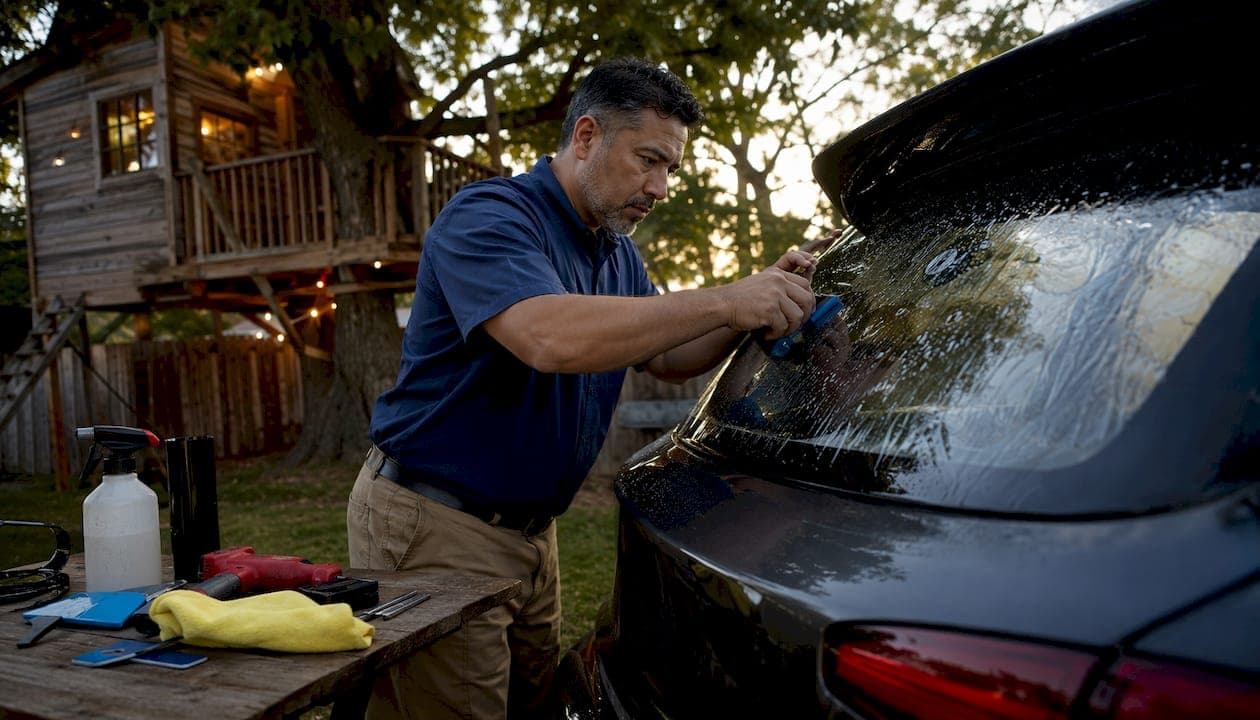
DIY vs. professional: DIY film kits exist and work for small, flat windows. The risk is in the execution: bubbles, edge lifting, and improper film selection for IGU compatibility are the most common failures. For vehicles with curved glass and for any double-pane residential window, professional installation is worth the cost. The warranty alone justifies it.
Pro Tip: Start with your west-facing windows. They absorb late-afternoon sun when outdoor temperatures peak and your AC is already working hardest. Four to six west-facing windows treated first will produce a noticeable comfort improvement before you commit to a whole-house project.
Key Takeaways
Ceramic or spectrally-selective film is the most effective thermal-reduction choice for U.S. car and home owners, with SHGC below 0.40 and IR rejection above 80% as the practical performance targets.
| Point | Details |
|---|---|
| SHGC is the primary home metric | Target SHGC below 0.40 on south- and west-facing windows for meaningful cooling savings. |
| IR rejection drives vehicle comfort | Ceramic films with 80–95% IR rejection cut cabin heat most effectively without signal interference. |
| Placement changes performance | Exterior film on double-pane glass drops SHGC significantly versus interior placement, per LBNL data. |
| Cure time is 7–30 days | Haze and water pockets during this period are normal; do not clean or manipulate blinds until cure is complete. |
| Southmiamitint mobile service | Carries 3M IR, 3M Color Stable, and Iviron Kollmax ceramic lines with on-site measurement and mobile install across Miami-Dade. |
What installers wish you knew before the appointment
Most installation problems start before the installer arrives. Glass that has not been cleaned in months, window seals that are already failing, or a vehicle with aftermarket trim that was never disclosed — these are the conditions that turn a straightforward job into a problem.
Curved vehicle glass is the most technically demanding surface in this trade. A film that fits perfectly on a flat residential pane needs to be heat-shrunk and shaped on a curved rear windshield. Rushing that step is what causes the finger-like distortions you sometimes see on poorly installed rear glass. Good workmanship on curved glass takes time, and any installer who quotes a full vehicle in under an hour is cutting corners somewhere.
On older residential windows, edge seals deserve close attention before film goes on. A seal that is 80% intact will not survive the thermal cycling that comes with a new absorbing film. The right call is to flag it before installation, not discover it six months later when the pane fogs up.
The ideal curing environment is dry, above 50°F, and out of direct sun for the first 48 hours. In South Florida, that means scheduling installs in the morning and keeping the vehicle or room shaded through the afternoon. Good warranty paperwork should arrive the same day as the install: film brand, product name, VLT and IR specs, labor coverage period, and the installer's contact information. If any of those are missing, ask before you sign off on the job.
Southmiamitint brings mobile tinting directly to your car or home
Skip the shop wait and the logistics. Southmiamitint's mobile service covers Miami-Dade for both automotive and residential tinting, which means a trained installer comes to your driveway or front door with the film, tools, and equipment already loaded.

The product lineup covers the full range of thermal-reduction options: 3M IR ceramic, 3M Color Stable, and Iviron Kollmax ceramic tint. Each film comes with manufacturer-backed performance specs and warranty documentation on the day of install. Ceramic window tinting starts at $249 for a standard vehicle, with residential pricing based on window count and film grade. On-site measurement is included, and sample patches are available before you commit to full coverage.
To get started, request an on-site measurement, ask for a sample patch on your highest-priority window, or book a mobile install directly. Visit Southmiamitint's mobile tinting page to check availability and get a quote for your vehicle or home.
Useful sources and where to learn more
The findings in this guide draw from the following primary sources. Each is worth bookmarking if you want to go deeper on any specific topic.
- GSA/LBNL Solar Control Films Report (GPG017): The most comprehensive U.S. government field study on solar-control film performance, covering HVAC energy savings, placement effects, and climate-specific outcomes for commercial and federal buildings.
- LBNL Full Report: Solar Control Window Coating Retrofit: The technical companion to the GSA findings, with detailed SHGC modeling data for interior vs. exterior film placement on single- and double-pane assemblies.
- ASHRAE Handbook of Fundamentals, Chapter 15: Fenestration: The authoritative North American standard for window thermal performance metrics, including SHGC, U-factor, emissivity, and spectrally-selective coating guidance.
- H2X Engineering: Solar Heat Gain in HVAC Design: Practical engineering guidance on SHGC, TSER, and seasonal trade-offs, including ASHRAE-aligned recommendations for mixed-climate film selection.
- Window Film Chicago: Installation, Cleanup, and Curing: Installer-level detail on cure timelines, cleaning protocols, and common post-installation issues.
- Southmiamitint: Thermal Performance of Window Films: Technical metric explainer covering SHGC, VLT, and IR rejection with application examples for Miami-Dade conditions.
- Southmiamitint: Miami Climate and Car Window Tinting: Regional guidance on film selection for hot-humid conditions, with product-specific recommendations.
This article is general information for educational purposes. Confirm current state tint laws, window manufacturer warranty terms, and building code requirements with the relevant authority or a qualified professional before purchasing or installing any film.