
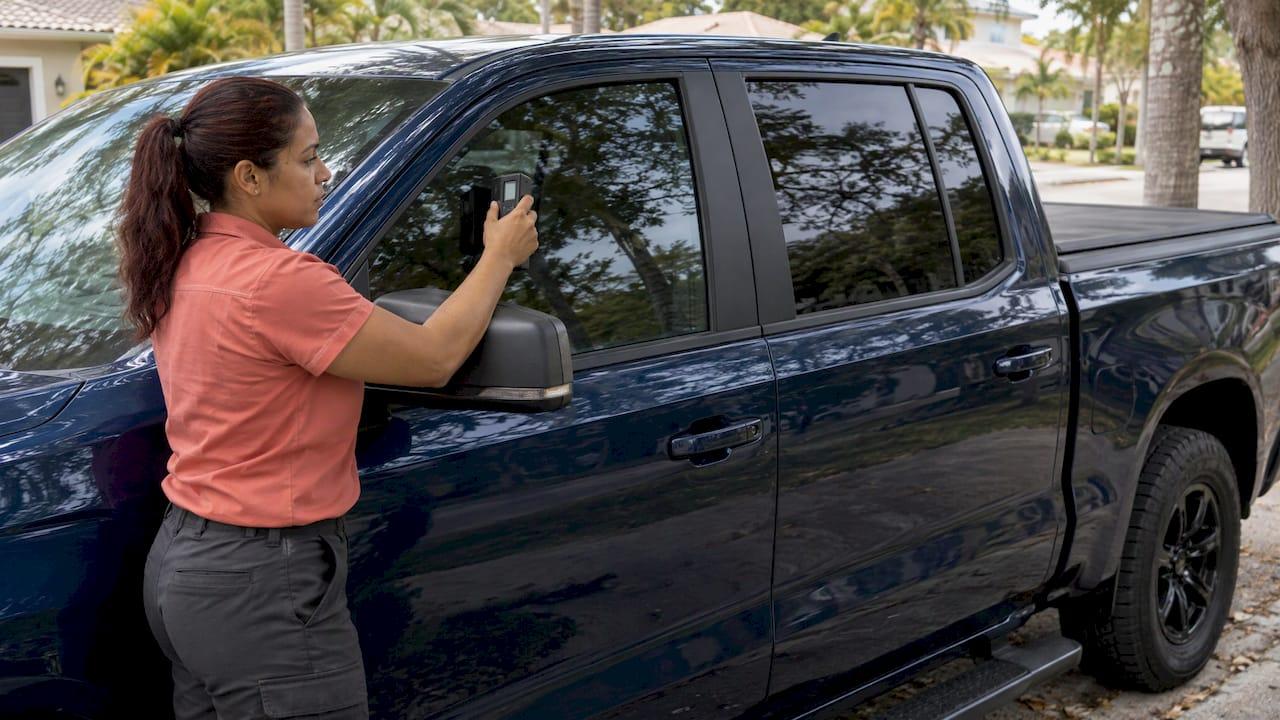
The best tint for a truck in Miami-Dade is a ceramic film in a shade that stays inside Florida's limits: at least 28% visible light on the front side windows, and a darker rear if your truck qualifies. Ceramic cuts the most heat, which matters most in a South Florida cab. A legal shade keeps you clear of a ticket. We install both at your home or office anywhere in Miami-Dade, so your truck never sits in a shop lot.
This guide covers the film types, how to choose a shade, what Florida allows on each window, what a full truck costs, how long it takes and how to care for new tint.
TL;DR
- Choose ceramic film for a truck that sits in the Miami sun: it rejects the most heat without a dark look and does not interfere with GPS or phone signals.
- Florida requires at least 28% VLT on front side windows. Rear side and back glass can go darker on multipurpose vehicles, which usually includes pickups and SUVs.
- Factory truck glass is already slightly tinted, so a 35% film reads lower on a meter than the number on the box.
- Our pricing starts at $200 for two front windows, $150 for a windshield and $450 for a full vehicle with windshield.
- We come to you, and the truck is usually drivable soon after install, with a short cure period.
Table of Contents
- Which tint film is best for a truck?
- Understanding the specs on the box
- What Florida allows on each truck window
- Why trucks get stopped for tint
- Is 30% tint a good choice for a truck?
- How to choose your shade
- What truck window tinting costs
- How a full truck is tinted, step by step
- Aftercare: the first days and weeks
- Our perspective
- Get your truck tinted where it is parked
- FAQ
- Sources
Which tint film is best for a truck?
Film type decides how hot the cab feels. Shade decides how dark it looks. Many buyers focus only on shade and end up with a dark truck that is still hot inside.
There are five common types:
- Dyed film: the cheapest. It absorbs heat, gives basic UV protection and can fade over time.
- Metalized film: better heat rejection and scratch resistance, but it can interfere with cell signals and GPS.
- Hybrid film: a balance of heat rejection and durability with less signal interference.
- Carbon film: blocks more heat and UV than dyed, cuts glare and does not fade.
- Ceramic film: non-metallic, high visibility and no electronics interference. Industry statistics put heat rejection at 50 to 70% for ceramic, 30 to 50% for metallic and 10 to 20% for dyed films.
For trucks, ceramic is the clear choice. Trucks have large, upright glass and long hours parked outdoors, and in Miami the sun is strong most of the year. Modern trucks also carry more electronics: navigation, satellite radio, toll transponders, phone mounts. A non-metallic film leaves those alone.
The manufacturer's own numbers show what a quality ceramic can do. 3M states that its Crystalline ceramic film rejects up to 64% of total solar energy and up to 68% of infrared energy, blocks up to 99.9% of UV light, is non-metallized and carries a limited lifetime warranty. Infrared is the part of sunlight you feel as heat on your arm through the window.
We install ceramic films only:
- 3M Ceramic IR: lifetime warranty.
- SunTek CIR: 5-year warranty.
- Uviron KoolMax: 3-year warranty.
If you want the detailed comparison of ceramic and carbon for Miami weather, read our ceramic vs. carbon breakdown or our guide to carbon vs. dyed tint. Our ceramic tint page shows the full range.
Understanding the specs on the box
Film labels use a few terms. Knowing them lets you compare any film on equal terms.
- VLT (visible light transmission): the percentage of visible light the glass lets through. Lower means darker. 35% VLT lets 35% of light in.
- TSER (total solar energy rejected): the share of all solar energy the film blocks. This is the heat number that matters most.
- IRER and IRR: how much infrared energy the film rejects, across a wide band or at a specific band.
- UV rejection: the share of ultraviolet light blocked. This protects your skin and your seats.
3M defines these metrics so buyers can compare films. Two films with the same VLT can reject very different amounts of heat. That is why a lighter ceramic can feel cooler than a darker dyed film. Our VLT guide and our list of tinting terms go further if you want them.
What Florida allows on each truck window
Florida sets minimums for how much light each window must let through. Break them and you risk a noncriminal traffic infraction, which is a ticket without a criminal charge, under chapter 318 of the state statutes.
| Window | Florida rule |
|---|---|
| Front side windows | At least 28% VLT, no more than 25% reflectance (Florida tint summary) |
| Rear side windows and back glass | At least 15% VLT and no more than 35% reflectance, or at least 6% VLT for multipurpose passenger vehicles (Florida Statute 316.2954) |
| Windshield | Only a transparent strip along the top, not reaching below the AS-1 line (Florida Statute 316.2952) |
The AS-1 line is a small marking printed on the upper edge of the windshield by the glass maker. Film is allowed above it and nowhere below it. Our guide to the Florida windshield tint rule explains how to confirm yours.
Whether your truck counts as a multipurpose passenger vehicle depends on how it is registered. Check your registration before choosing a rear shade darker than 15%.
How the 28% rule is measured
The limit applies to the glass with the film on it, not the film alone. Factory truck glass often lets through roughly 70 to 80% of light, so a 35% film measures closer to 26% on a meter. That is below Florida's 28% floor.

This is the most common mistake we see on front windows: buying by the number on the film. Choose the front film so the combined reading lands at or above 28%. Then the truck is legal as installed.
Medical exemptions
Florida allows a sunscreening medical exemption for certain conditions. The state's application form HSMV 83390 lists lupus, autoimmune diseases, dermatomyositis, albinism, total or facial vitiligo and xeroderma pigmentosum. It costs $6.55 per vehicle and needs certification from an authorized certifying authority. The certificate is non-transferable and becomes invalid if you sell or transfer the vehicle. If you have one of these conditions, talk to your physician first, since certification comes from them.
Why trucks get stopped for tint
An officer can only pull you over for tint with reasonable suspicion, meaning a specific reason to believe the tint is too dark. Under Florida Highway Patrol policy, officers measure with an approved tint meter that must be accurate within three percentage points and tested before each day's use. They also record the reading in the citation notes.
So the practical rule is simple. A film that reads 28% or higher on the finished front glass, with a rear shade that fits your vehicle class, gives an officer nothing to measure against you.
Is 30% tint a good choice for a truck?
For the front side windows, yes in most cases, with one check. A 30% film on glass that already carries a factory tint will read lower than 30%, and that may fall under Florida's 28% minimum. Because factory glass differs from truck to truck, the safe approach is a film chosen for your exact glass.
For the rear windows and back glass, 30% is lighter than many owners want. If privacy matters for tools, a toolbox of gear or a back seat, a darker rear shade is available within the limits above.
How to choose your shade
Start with how you use the truck.
- Daily commuter on I-95, the Palmetto or the Turnpike: pick a front shade that reads safely above 28% and add ceramic for heat. You get comfort without hurting night visibility.
- Work truck with tools in the cab: the rear side windows and back glass are where privacy pays off. Go darker there, within the limit for your vehicle class.
- Weekend or lifted truck: appearance often leads. A uniform shade across all windows looks cleaner, but the front windows must still meet 28%.
- Night driving and visibility: darker front glass hurts what you see at night, especially in the rain and on poorly lit roads in Kendall, Homestead or Cutler Bay. Ceramic helps because it rejects heat without needing a dark shade.
The short answer to the "best tint for trucks" question: ceramic on every window, a front shade that measures at or above 28% on your glass, and a rear shade that fits your vehicle class.
What truck window tinting costs
Our published starting prices are:
| Service | Price |
|---|---|
| 2 front windows | from $200 |
| Windshield tint | from $150 |
| Full car + windshield | from $450 |
Final pricing depends on your truck and the film you pick. Across the market, one 2026 guide puts professional full-truck installs at $200 to $500 and ceramic films at $400 to $600. Our request-a-quote path is the quickest way to get a number for your cab size and film.
Old tint on the truck can be removed before new film goes on. Removal is part of our services, so mention it when you ask for a quote.

How a full truck is tinted, step by step
Here is what happens, and where it can go wrong.
- Clean the glass. Dirt or grit trapped under film shows as bumps and specks. Every pane is cleaned inside and the edges are checked.
- Cut the film. Film is cut to the shape of each window. We use computer-cut patterns for an exact fit, which keeps edges tight and avoids trimming on your glass.
- Shape and apply. Film is heated and shaped for curved glass, then applied to the inside of the window. Large rear and windshield glass is the hard part. Our 60-inch rolls let us install a large windshield piece in one piece with no seam.
- Squeegee out moisture. Water and air are pushed out from the center. Missed pockets turn into bubbles and haze.
- Edge and final check. Edges are sealed and the film is inspected before we finish.
A full truck is typically a job of a few hours, with extra time if old film has to come off. Plan for the vehicle to be parked in one spot at your home or office for the duration. We bring the equipment to you, and with 28 years of experience and owner-installed work, you get the same installer from start to finish.
Aftercare: the first days and weeks
New film needs time to cure, meaning the moisture under it evaporates and the adhesive sets. Hazy spots in the first days are normal. Our guide on tint cure time explains how long it generally takes and what a pro can fix.
Two simple rules protect the install:
- Do not roll the windows down for the period your installer tells you.
- Hold off on washing and never use abrasive cleaners or scrapers on the inside of the glass.
Our wash rules after tint and window film care steps give the timelines. For more on how to protect new window film over the years, aftercare habits matter as much as the film itself.
Our perspective
Most of the trucks we see in Miami-Dade have the same problem: a hot cab and glass that is already part tinted from the factory. The answer is rarely a darker film. It is a better film.
We install ceramic only, because heat is the reason people tint in South Florida. 3M Ceramic IR carries a lifetime warranty, SunTek CIR carries 5 years and Uviron KoolMax carries 3 years.
The other half is the fit and the legal shade. Computer-cut patterns, 60-inch rolls for seamless windshields and 28 years of experience mean the work looks factory. We also help you pick a front shade that works on your glass, so you drive away legal.
We do all of it at your door, anywhere in Miami-Dade. You keep your day, and your truck does not wait in a shop.
Jose
Get your truck tinted where it is parked
We do mobile ceramic tinting for trucks, SUVs and cars across Miami-Dade, from Pinecrest and Kendall to Cutler Bay and Homestead. Pricing starts at $200 for two front windows, $150 for a windshield and $450 for a full vehicle with windshield. See our mobile window tinting page or request a quote and tell us your truck's make, year and the film you want.

We also tint homes and businesses, so one visit can cover your truck and your property.
FAQ
How dark can I tint my truck windows in Florida?
Front side windows must let through at least 28% of light. Rear side windows and back glass must allow at least 15%, or at least 6% on multipurpose passenger vehicles. Only a strip above the AS-1 line is allowed on the windshield.
How long does it take to tint a full truck?
A full truck usually takes a few hours, and removing old film adds time. We do the work at your home or office, so you can plan around the visit. Tell us about any old tint when you ask for a quote.
Is ceramic tint worth it on a truck?
Ceramic is our recommended film for trucks because it rejects the most heat without a dark shade and does not interfere with GPS or phone signals. It is the only type we install. 3M Ceramic IR comes with a lifetime warranty.
Can I drive the truck right after tinting?
Yes, in most cases you can drive it soon after. The film then needs days to weeks to cure fully, and small haze in that time is normal. Read our cure-time guide for the details.
Sources
- Window Tinting Industry Statistics
- 3M Automotive Window Film Crystalline Series
- Florida Window Tint Laws
- Florida Statute 316.2954
- Florida Statute 316.2952
- FLHSMV Form HSMV 83390
- Florida Highway Patrol Policy 17.27
- Truck Window Tint: Legal Limits, Costs and Best Films