
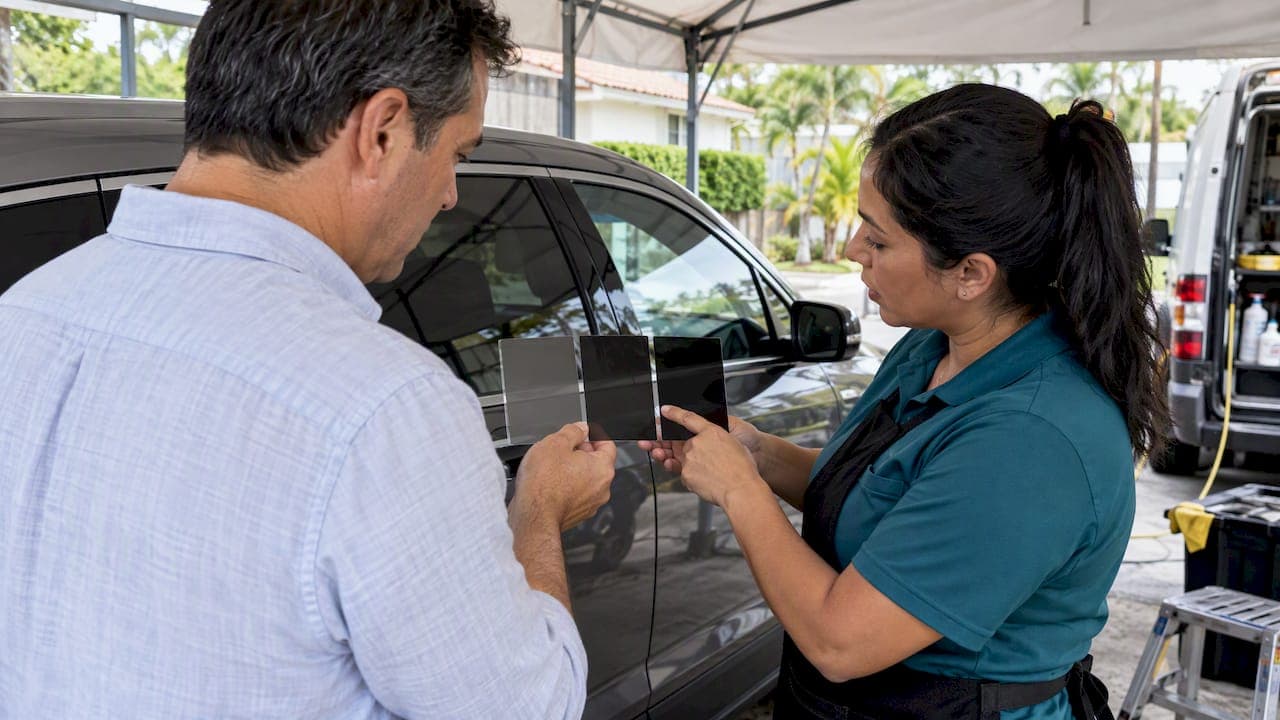
For most drivers, carbon tint is the best balance of performance and price, with ceramic worth the premium only when you want maximum infrared (IR) rejection. Dyed tint still makes sense if the lowest cost and a darker look matter most. The key considerations are heat rejection, durability, appearance, and cost. We install these films by mobile appointment at Southmiamitint, so we see how each one holds up.
TL;DR:
- 3M rates its Ceramic IR Series at up to 95% infrared rejection, a peak product figure rather than a guarantee for every shade.
- Dyed film costs least and suits a dark look, but it absorbs heat less efficiently and may fade or turn purple sooner.
- If electronics matter, ask whether the specific carbon or ceramic film is nonmetalized, and compare product specifications because construction and performance vary.
- Before paying, check local tint limits, request the exact film name and written warranty, and confirm the installer seals edges and uses patterns cut to fit each window.
Table of Contents
- How do dyed, carbon, and ceramic tint compare side by side?
- What is actually inside each type of window film?
- Which tint should you choose, and how do you book it?
- What do we check before a film goes on your glass?
- Why carbon is the smart default for most drivers
- Where can you get carbon or ceramic tint installed at your door?
- FAQ
- Sources
How do dyed, carbon, and ceramic tint compare side by side?
Start with heat. Dyed film controls heat mostly by absorbing it, which the IWFA Advanced Solar Control Education Guide describes as less efficient than reflective coatings. Carbon film also absorbs, but it does so with carbon particles that hold up better over time. Ceramic film adds IR-absorbing nanoparticles aimed squarely at the part of sunlight that makes a cabin feel hot.
The manufacturer numbers show how far ceramic can go. The 3M Ceramic IR Series brochure states up to 66% total solar energy rejection and up to 95% infrared rejection. Those are lab-rated peak values, so treat them as the ceiling for that product line, not a promise for every shade.
Here is how the three types line up on the points that matter:
- Heat and IR rejection: Performance depends on the specific film. Ceramic films can offer substantial IR rejection, as the cited 3M product figures show.
- UV protection: All three can block a large share of UV, but ratings vary by product. 3M Crystalline literature lists up to 99.9% UV blocked. That matters because the CDC treats UV radiation as a health hazard, and film can reduce your exposure inside the car.
- Durability: Durability varies by product. 3M describes its ceramic films as using technology intended to support color retention and fade resistance.
- Appearance: The look depends on the film and shade you choose.
- Signal interference: Nanoceramic films are non-metalized, according to the IWFA guide. Ask the installer about the construction of a specific film if signal interference is a concern.
- Cost: Dyed is the least expensive, carbon is mid-range, and ceramic costs the most.
Up to 95% infrared rejection, the figure 3M states for its Ceramic IR Series. It shows what ceramic can do at the top end, and it is the main reason some drivers pay more for it.
If you are weighing carbon against ceramic specifically, our posts on ceramic vs carbon tint cost and cooling and which suits Miami cars go deeper on price gaps and daily use.
What is actually inside each type of window film?
Knowing what the film is made of explains why it ages the way it does.
- Dyed film: A dye layer colors the film and absorbs sunlight. It is simple and cheap to make. Dyed film absorbs sunlight, and its performance and appearance over time depend on the product.
- Carbon film: Tiny carbon particles are spread through the film instead of relying on dye alone. Carbon films are an option to consider if you prefer their appearance. Ask the installer whether the specific carbon film is non-metalized and whether it may affect your electronics.
- Ceramic film: Nano-sized ceramic particles absorb IR energy while letting visible light through. 3M describes its ceramic films as pairing IR-rejecting nanotechnology with patented dye technology for color retention and fade resistance. The IWFA guide also notes that nanoceramic films are non-metalized.
One point is worth knowing before you buy. Dyed and carbon films are absorptive by design. A practitioner report from Vinyl Frog says carbon film can warm up and re-radiate some absorbed heat inward. The report also presents carbon as a better value than dyed film for daily drivers. Compare the specifications of the films you are considering.
Which tint should you choose, and how do you book it?
Match the film to what you care about most.
- Hot climate and long commutes: Consider ceramic if IR rejection is a priority, and compare the specifications of the products available.
- Everyday value: Consider carbon if its appearance and price suit your priorities, and check the product specifications with the installer.
- Tight budget or looks-only goals: Dyed film may suit your priorities. Ask the installer about the product's expected durability.
- Lots of electronics in the car: Ask whether the specific film is non-metalized and whether it may affect your electronics.
Whichever you pick, ask for the film by brand and product name. 3M's Obsidian Series, for example, is described as non-metalized with better color retention and fade resistance than many dyed films, and it lists up to 60% total solar energy rejection. A named film gives you a spec sheet to check against.
Here is a simple buying flow:
- Check your local VLT (visible light transmission) rules and pick a shade that fits them.
- Choose the film type: dyed, carbon, or ceramic.
- Ask the installer for the exact film name and its written warranty.
- Confirm the shop uses computer-cut patterns and seals the edges.
- Book a mobile install so the work happens at your home or office.
Pro Tip: Ask to see the film's spec sheet and warranty paperwork before you pay, so the brand and shade on the invoice match what goes on your glass.
For a longer walkthrough, see our guide on how to choose the right tint for your vehicle. Heat-focused drivers may also like our comparison of ceramic vs dyed tint for Miami cars. If you plan to tint during other work on your car, our partner's list of steps to prep before a wrap or dent repair shows how pros get a vehicle ready.
What do we check before a film goes on your glass?
Film choice is only half the result. The install affects how the film looks over time. Before we start, we confirm the VLT of the film against the shade you ordered, choose an adhesive that suits your glass, and strip any old film so it does not show through the new one.
Then we watch for the defects that ruin cheap jobs: bubbles, crooked trimming, dust trapped under the film, and edges that lift because they were never sealed. A mobile install helps here, because we work on one car at a time in a controlled spot instead of rushing through a queue.

You should expect genuine 3M and Iviron films and computer-cut patterns that fit your windows. If a shop cannot tell you the exact film name, that is a sign to look elsewhere.
Why carbon is the smart default for most drivers
Here is our honest read after years of watching films age on real cars. Most people overpay in one of two directions. Some buy the cheapest dyed film and pay again when it turns purple. Others buy top-tier ceramic when they mostly drive short trips and park in a garage.

Carbon fits the middle better than people expect. It holds its color, stays out of the way of your electronics, and costs less than ceramic. If you drive long distances in strong sun, or you want the coolest cabin you can get, ceramic earns its price. Everyone else should start with carbon and ignore the pressure to buy the biggest number on the brochure.
Pay attention to the installer before you obsess over film type. A great film on a sloppy install looks worse than a good film done right. Pick the person doing the work first, then the film.
— Jose
Where can you get carbon or ceramic tint installed at your door?
We bring the tint to you. Our mobile team installs premium films at your home or workplace, and you can get a quote quickly and schedule a time that suits you. Here is what we offer:
- Mobile window tinting at your location
- Ceramic tint and carbon tint
- 3M window tinting, including Ceramic IR and Color Stable films
- 2 Front Windows from $150, Windshield Tint from $150, and Full Car + Windshield from $500
- Old tint removal
Ready to pick a film? Check our ceramic window tint options and book your mobile install today.
FAQ
How long do carbon tints last?
Carbon tint is built to hold its color far longer than dyed film, because carbon particles do not break down the way dye does. Lifespan still depends on the product, the install, and how much sun your car sees. Ask for the warranty terms in writing.
Can you see through 20% ceramic tint at night?
Ceramic does not change a film’s VLT. Many drivers pick a lighter shade for the front windows and keep darker film for the rear. Always check your local VLT limits first.
What is the best window tint?
There is no single best film for everyone. Ceramic gives the strongest heat and IR rejection, 3M states up to 95% infrared rejection for its Ceramic IR Series. Carbon is the best value for most daily drivers, and dyed suits tight budgets.
Is dyed window tint good?
Dyed tint is a fair choice if price and a dark look are your top goals. It controls heat mainly by absorption, so it rejects less heat than carbon or ceramic. It can also fade or turn purple over time, which means earlier replacement.