
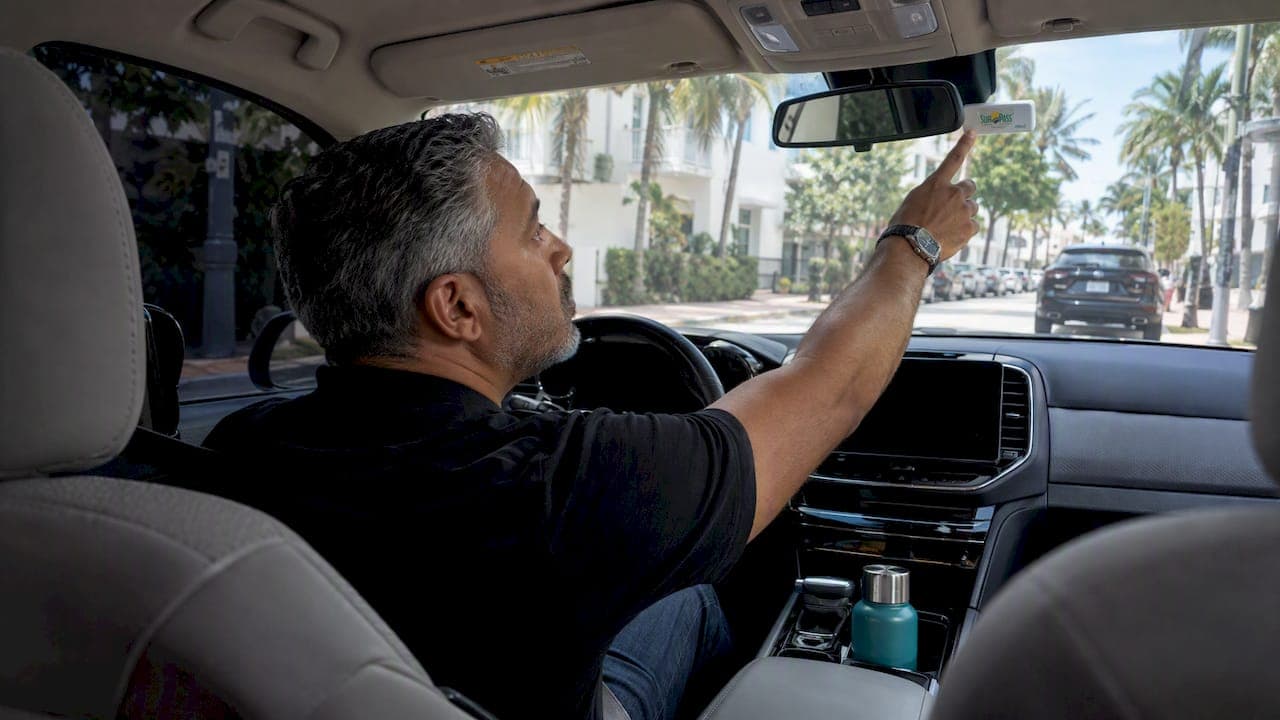
Tint and SunPass can work together without trouble. The tint on your side windows has no effect on a toll reader. The windshield is where problems come from: a transponder mounted too close to a tint strip, or on glass with a metallic heat-rejecting film, can fail to read at the gantry. Below you will find where to mount it, which films to ask about, and what Florida law says about how dark you can go.
TL;DR
- Mount your SunPass at least 2 inches below any tint strip on the windshield, according to SunPass.
- Side-window tint is not what blocks toll readers. Metal content in some high-performance films on the windshield can be.
- Florida requires at least 28% light transmittance on front side windows. A tint violation is a nonmoving infraction.
- A SunPass Mini sticker is permanent. If you switch cars or retint, a portable SunPass PRO is the safer choice.
- Test your transponder after any new windshield film, before you rely on it.
Table of Contents
- Why tint and SunPass get mentioned together
- Where to mount the transponder
- Mini or PRO: which one with tint
- Which films can cause trouble
- Tinting a windshield that already has a sticker
- What Florida law allows
- Medical exemptions
- Our perspective: plan the windshield first
- Getting it done without leaving your driveway
- Special cases to ask about
- FAQ
- Sources
Why tint and SunPass get mentioned together
SunPass runs on radio signals. A transponder on your windshield talks to the antenna on a toll gantry as you drive under it. Anything between the transponder and the sky can weaken that signal. Tint film is one of those things when it sits on the windshield, and it is the reason drivers in Miami-Dade ask about it after a new install.
The key point is where the film is. Most of what people tint is the side and rear glass, and those windows are nowhere near the transponder. The windshield is a different case, so it is worth knowing exactly what is on yours.

Where to mount the transponder
SunPass says both the SunPass Mini and the SunPass PRO are designed to sit on the windshield, just below the rearview mirror. Pricing as of October 2026: the SunPass Mini sticker is $4.99 plus tax and the SunPass PRO portable is $14.95 plus tax, per the same page.
If your windshield has a tint strip across the top, the rule is simple: the transponder goes at least 2 inches below the strip. That clearance matters because metallic particles in some films can disturb the signal, and the strip is the most common place for them.
A quick placement checklist
- Find the lowest edge of any tint or shade band on the windshield.
- Measure 2 inches down from that edge.
- Keep the transponder near the mirror, in the clear glass area.
- Avoid the dotted black border of the glass.
- Follow the instructions in the transponder package. SunPass notes that some vehicles have windshields that need special handling.
Mini or PRO: which one with tint
This choice matters more than it seems. A SunPass Mini is a sticker. According to the SunPass FAQ, once it is stuck down you cannot remove it and reapply it somewhere else. It breaks and stops working.
The SunPass PRO uses suction cups, so you can move it. That helps in two common situations:
- You are about to tint the windshield. Take the transponder off first, then place it again after the film is done and test it.
- You share one transponder between vehicles. The portable unit moves with you.
If your Mini is already stuck to a windshield you plan to replace or film, expect to buy a new one.
Which films can cause trouble
Plain dyed and most carbon films do not usually cause toll problems. The film type to watch is a high-performance ceramic or infrared-rejecting product on the windshield, because heat-blocking layers can contain metal oxides. The SunPass windshield guidance covers vehicles with heat-reflective glass, and in difficult cases points drivers to alternate mounting options.
It helps to separate two facts:
- Darkness (the tint percentage) is not the usual cause of a SunPass miss.
- Metal content and placement are.
Heat rejection comes from the film's technology, not its shade. If you want to understand why ceramic stays cooler without going dark, this explanation of how ceramic tint cuts heat is a good place to start. For most Miami drivers, ceramic on the side and rear glass gives the comfort benefit with no toll risk at all.
Tinting a windshield that already has a sticker
A common question is what to do when a car comes in with a SunPass or E-ZPass-style sticker on the windshield. Here is the practical path:
- Decide whether the windshield is being filmed at all. Side and rear windows do not touch the transponder.
- If the windshield is being filmed, remove or plan around the transponder. A Mini sticker will likely need replacing. A PRO can be taken off and put back.
- Keep the film out of the transponder zone. A clear spot below the mirror leaves the signal path open.
- Test it. Drive through a toll point and check your account the next day to confirm the toll posted correctly.
Windshield work also has its own legal side. Our guide on proving your Florida windshield tint is legal explains the 28% VLT and AS-1 markings in detail.
What Florida law allows
Since you are tinting anyway, make sure it is legal. Florida sets different limits by window position.
| Window | Minimum light transmittance | Maximum reflectance |
|---|---|---|
| Front side windows | 28% | 25% |
| Windows behind the driver, sedan | 15% | 35% |
| Windows behind the driver, SUV, van or truck (multipurpose) | 6% | 35% |
The front side numbers come from Florida Statute 316.2953. The rear numbers come from Florida Statute 316.2954.
Two details people miss:
- The law measures the whole window. The reading counts glass plus film, and some factory glass already blocks some light. As Recording Law notes, this is why a film that looks legal on paper can still read close to the limit.
- Percent means light let through. A lower number is darker. 20% is darker than 35%. If you want the basics, read what tint percentage means or our explainer on visible light transmission.
What happens if you get a tint ticket
A window tint violation in Florida is a noncriminal, nonmoving infraction, according to Recording Law. In practice that means it does not add points to your license the way a moving violation would. It can still mean a fine and a trip to fix the car, so it is cheaper to get the shade right the first time.
Officers use calibrated meters to check, and the same source describes the procedure they are expected to follow. For a local view on enforcement, see our post on window tinting laws in Miami and surrounding areas.
Medical exemptions
If you have a condition that requires limited light exposure, Florida offers a medical exemption. Section 316.29545 covers people with lupus, any autoimmune disease, or other medical conditions that call for limited exposure to light. You apply with Form HSMV 83390, which needs a physician's certification and carries a $6.45 fee per vehicle.
The certificate is tied to the vehicle, not to you. If you buy a different car, you need a new certificate for it. The physician's statement does not need to be resubmitted, per the same FLHSMV procedure page. Keep the certificate in the glove compartment. Your own doctor is the person to ask whether you qualify.

Our perspective: plan the windshield first
We have tinted vehicles in South Florida for more than 25 years, and the SunPass questions follow a pattern. Almost every complaint after a tint job traces back to the windshield, not to the side windows. Drivers assume the shade they chose is the issue, when the cause is the transponder sitting too close to a strip or on a film with metal in it.
Here is how we handle it when we come to your home or office:
- We ask what is on the windshield before we start, including any transponder.
- We recommend keeping the transponder in clear glass, away from the strip.
- For side and rear glass, we steer drivers toward 3M Ceramic IR, 3M Color Stable or Iviron KoolMax ceramic, because that is where heat rejection pays off in Miami summers, and none of it touches your toll signal.
- If you are choosing a front shade, 35 to 50% usually cuts heat without going dark. We wrote up the reasoning in our guide to front VLT for mobile tint.
Our advice is simple: tint the glass that is meant to be tinted, keep the transponder clear, and test after any windshield film. That order avoids nearly every issue.
— Jose
Getting it done without leaving your driveway
We are a mobile service, so the film is installed where your car is parked, in Miami, Kendall, Homestead, Cutler Bay, Pinecrest and across Miami-Dade County. Published starting prices are:
- 2 front windows: from $150
- Windshield tint: from $150
- Full car plus windshield: from $500
Ceramic, carbon, 3M and residential or commercial work are quoted individually. Tell us about your SunPass when you request a quote for mobile window tinting and we will plan the windshield around it. You can also see our 3M film options before you decide.
Special cases to ask about
Privacy glass. Many SUVs already have dark factory rear glass. Film on top of it changes the numbers, so read whether you can tint over privacy glass first.
Luxury and newer vehicles. Some have heat-rejecting or acoustic windshields that already weaken toll signals. SunPass lists alternate placement for those. Do not stack film on top without testing first.
Old tint. If the previous film is bubbling or purple, removal comes before anything else. A clean surface also makes it easier to read the true VLT.
Moving between cars. A PRO transponder is the better fit if you swap vehicles or plan to retint soon.
FAQ
Does window tint block SunPass?
Usually not. Side and rear tint is far from the transponder. The risk is on the windshield, where a strip or a metallic film can weaken the signal. Keep the transponder 2 inches below any strip and test it after any new film.
Can I put my SunPass on a tinted windshield?
Yes, if you place it in clear glass below the mirror and at least 2 inches below the tint strip. If the car has heat-rejecting glass, check the SunPass installation guidance for other mounting options.
Will a tint ticket put points on my license?
No. Florida treats a tint violation as a noncriminal, nonmoving infraction, per Recording Law. You may still owe a fine and need to correct the tint.
How dark can I tint in Florida?
Front side windows must let in at least 28% of light. Behind the driver, the minimum is 15% on sedans and 6% on SUVs, vans and trucks. The law counts the glass and film together.
Can I move a SunPass Mini to another car?
No. The Mini is a permanent sticker and stops working if removed. A portable SunPass PRO is made for moving between vehicles.
Sources
- SunPass: About SunPass
- SunPass: Windshield installation
- SunPass: FAQ
- Florida Statute 316.2953
- Florida Statute 316.2954
- Recording Law: Florida window tint laws
- FLHSMV: Application for sunscreening medical exemptions (HSMV 83390)
- FLHSMV: Sunscreening medical exemption certificate
- Do ceramic tints reduce heat in your vehicle?