
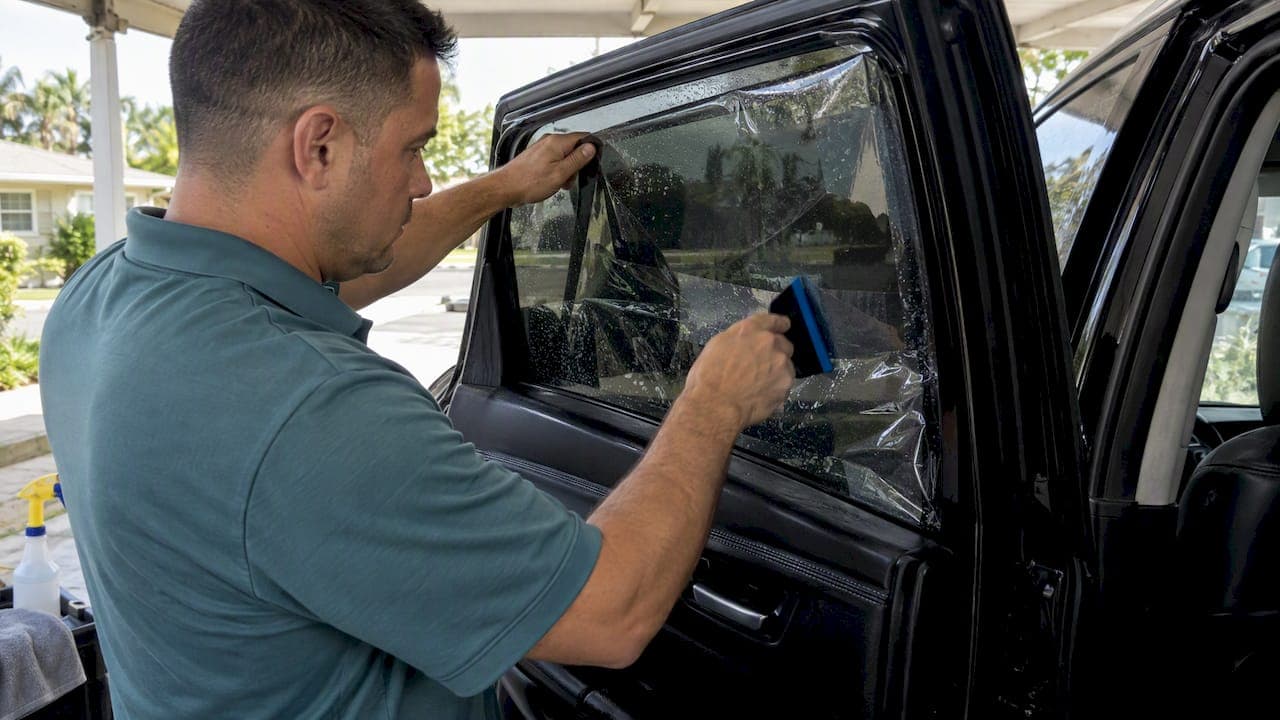
Yes, you can put window film over factory privacy glass. The film sticks to the glass fine. The real questions are how dark the result will be and whether it still passes in Florida. Privacy glass only darkens the view in. It does little for heat and UV. Film adds the protection, but the two layers stack, so the shade you pick has to be chosen with the factory glass in mind.
Below is how the math works, what Florida measures, which film makes sense, and when you should leave the glass alone.
TL;DR
- You can tint over privacy glass. Film adds UV and heat protection that the factory dark glass mostly lacks.
- The factory darkness and the film darkness multiply. A 35% film on glass that passes 70% of light gives about 24.5%, not 35%.
- Florida enforces the total light that gets through the glass, and troopers use tint meters. Have your glass measured before you choose a shade.
- Never stack new film over old aftermarket film. Remove it first.
- We tint mobile across Miami-Dade, so we can measure and install in your driveway.
Table of Contents
- What privacy glass actually is
- Can you tint over factory tint?
- How the darkness stacks
- What Florida measures
- Which glass to leave alone, and which to tint
- Matching the look: why people tint over privacy glass
- Choosing the film: ceramic, carbon, or color stable
- A step-by-step way to pick your shade
- Our view: don't guess, measure
- What it costs and how to book
- After the install
- When you should not tint over it
- FAQ
- Sources
What privacy glass actually is
Privacy glass is dark glass made that way at the factory. You see it most on the rear doors, rear quarter windows and back glass of SUVs, vans and pickups. It is not a film on the surface. The color is part of the glass itself, so you cannot peel it, scratch it or bubble it.
The common mistake is to assume dark means protected. Dark glass blocks visible light, which gives privacy. Heat and UV are different things. Owners on enthusiast forums describe privacy glass as not actually tinted in the film sense, so it offers little UV or heat protection. We cannot vouch for every vehicle, because glass differs by make and trim. That is why a measurement beats a guess.
We cover the difference in more detail in our guides on privacy glass vs tint and factory tint vs aftermarket film.
Can you tint over factory tint?
This is the other way people ask the same question, and the answer has two parts.
Factory privacy glass or factory tint in the glass: yes. Film bonds to the glass surface, and the glass color sits inside it. A professional can apply film over it.
Existing aftermarket film: no. Most professionals advise against applying new window tint over old aftermarket tint. The adhesive is designed to stick to glass, not to another film, so the new layer tends to fail early. Tint Wiz explains this reasoning. The right move is to strip the old film and start on bare glass. We offer old tint removal for that reason.

If you are not sure which one you have, here is a quick check. Look at the edge of the window. Film leaves a faint line or a slight color change near the edge or the dot band. Glass tint runs all the way to the edge. A tint shop can also tell you in seconds.
How the darkness stacks
Tint is rated by VLT, visible light transmission. It is the percentage of light that passes through. A lower number means a darker window.
When you add film to tinted glass, the percentages multiply. Take the glass VLT and the film VLT as decimals and multiply them.
| Factory glass VLT | Film VLT | Total VLT (approx.) |
|---|---|---|
| 70% | 35% | 24.5% |
| 70% | 50% | 35% |
| 30% | 50% | 15% |
| 30% | 35% | 10.5% |
| 20% | 35% | 7% |
| 20% | 50% | 10% |
These are worked examples, not readings from your car. Real numbers drift a little, because film and glass both add small variations, and the glass in many vehicles is not uniform.
Two things follow from the table:
- A film that looks mild on a sample card can look very dark on privacy glass.
- The lighter the film, the safer you are. Film at 50% over factory dark glass can still give you a big drop in heat without turning the rear into a black box at night.
Forum threads reflect this. Drivers often mention 50% over the rear privacy glass with a lighter front and windshield as a balanced setup. Treat these as personal preferences, not rules. What you can legally run depends on your vehicle type, which we cover next.
What Florida measures
Florida regulates window tint under state statutes, Sections 316.2951 through 316.2957. The key point for privacy glass is that the law looks at the glass as it is on your car now. The test is how much light passes through the full window, not which part came from the factory.
The Florida Highway Patrol has a written policy on using tint meters, so the number you end up with can be checked on the roadside. Your insurance, your inspection and your record are better off if you plan for that.
The usual limits are different for sedans and for multipurpose vehicles such as SUVs and vans. Rear windows on multipurpose vehicles are allowed to be darker than on sedans. That is why privacy glass is common on SUVs. The front side windows and the windshield have stricter rules. For the exact current limits and the windshield AS-1 line, check these guides:
- What makes window tint legal for Florida drivers
- Florida windshield tint law, 28% VLT and AS-1
- Miami's tinting laws explained
- VLT in window tinting
Florida also allows a medical exemption for people with lupus, other autoimmune diseases or conditions that require limited light exposure. The application form lists a $6.45 fee and requires a physician's statement. If you think you qualify, talk to your doctor first. Without that certificate, you must stay within the standard limits.
Which glass to leave alone, and which to tint
On a typical SUV or truck with privacy glass, the windows fall into three groups.
Front side windows and windshield
These are normally clear glass from the factory. They are also the windows where the law is strictest. If you want heat and UV protection here, a light, high-clarity film is the usual answer. A ceramic film can cut heat without making the window look dark.
Rear doors, quarter windows and back glass
These are often privacy glass. You have two options:
- Add a light film for UV and heat. The look barely changes, and the glass gains the protection it lacks.
- Add a darker film for a uniform look. This is useful when the privacy glass does not match the front windows. Remember to run the math from the table above, and stay within your vehicle's limits.
Sunroof or other special glass
Some vehicles have specialty glass that is not suitable for every film. Ask before assuming. 3M states that its Ceramic IR automotive films are intended for interior application on flat or curved glass, and the product bulletin lists the intended uses. Your installer should confirm fit for your exact glass.
Matching the look: why people tint over privacy glass
Four reasons come up most often with our customers in Miami, Kendall, Homestead, Cutler Bay and Pinecrest.
- Heat. Privacy glass makes the back seat look shaded, but the sun still heats leather and plastics. In South Florida that matters from spring through October.
- UV. Film is the layer that protects skin, upholstery and the dash. Window film manufacturers describe UV and heat rejection from a clear film as a way to improve the glass without changing how the vehicle looks.
- Color match. Factory glass often has a slight green or gray cast. A quality film can even out the shade between the front and the back.
- Glare and privacy at night. Some drivers want darker windows in the rear for kids' sleep or for valuables.
Choosing the film: ceramic, carbon, or color stable
We use 3M Ceramic IR and Crystalline, 3M Color Stable and Iviron KoolMax ceramic films. For privacy glass, the comparison looks like this.
| Film type | Best for | Why it helps on privacy glass |
|---|---|---|
| Ceramic (3M Ceramic IR, Iviron KoolMax) | Heat rejection and long-term clarity | Adds the heat control the glass lacks, with no signal-blocking metal layer. 3M describes Ceramic IR as non-metallized |
| Crystalline (3M) | A near-clear look with protection | Good on the front windows and windshield where you cannot go dark |
| 3M Color Stable | A steady dark color over years | Keeps the shade even when you are matching dark rear glass |
| Carbon | A matte dark look, good value | Works well when you want the darker rear and some heat reduction |
If heat is your main issue, ceramic is where we point most owners. See our ceramic window tint page for more.
A step-by-step way to pick your shade
- Find out what you have. Ask for a meter reading of each window, front and rear. Do not rely on the owner's manual or the window sticker.
- Know your vehicle class. Sedan, SUV, van and truck can have different legal limits for the rear.
- Set a target total VLT per window. Stay within the law with some margin, since meters can read slightly differently.
- Divide to find the film. Target total divided by glass VLT gives the film VLT. For example, a 15% target on 30% glass needs a 50% film.
- Choose film type for heat, color and budget.
- Check the result. Ask your installer to measure the finished windows.
This is the same logic we use when we quote. Call or send a photo and we will tell you what makes sense.
Our view: don't guess, measure
We have tinted vehicles in South Florida for over 25 years, and privacy glass is one of the most common sources of surprises. The owner picks a film from a sample card, and the result is darker than they expected. Sometimes the problem is the opposite: they skip film on the rear because it already looks dark, then wonder why the back seat is hot.

Our advice is simple. Treat privacy glass as a base shade, not as protection. Pick the film for the job you want it to do: heat, UV, color match or privacy. Then work backward to the VLT that keeps the total within the law. We use computer-cut patterns so the film fits your glass edge to edge, and we come to you, so you do not lose a day at a shop.
If you are unsure, go lighter. You can always add more darkness later, but you cannot take it out without removing the film.
— Jose
What it costs and how to book
Our published starting prices for cars are:
- 2 front windows: from $150
- Windshield tint: from $150
- Full car + windshield: from $500
Privacy glass jobs, ceramic films and larger vehicles are quoted individually. Residential, commercial and old tint removal work are also quoted on request. For a quote, see our mobile window tinting prices page, or book through our main page. We offer same-day availability and mobile installation anywhere in Miami-Dade. Get Quote or call now.
For a look at how mobile service works at your door, see our mobile car window tinting page.
After the install
Give the film time to cure. Windows may look slightly hazy or show small water pockets for a few days. That is normal. Keep the windows up for the period your installer tells you, and avoid scraping the inside glass.
If you are also planning paint protection film or a ceramic coating, the same patience applies to the schedule. This guide on ceramic coating over PPF and film compatibility explains why waiting and checking compatibility matter.
When you should not tint over it
- Old aftermarket film is on the glass. Remove it first.
- The windows are already at or near the legal limit. Any film will push you over.
- Your glass is damaged or has a cracked coating. Film will not hide it, and it can make it worse.
- You are planning to sell and the buyer will inspect. A modest film that keeps the total legal is a safer pick.
For local rules around Miami and neighboring cities, see local regulations on car window tinting in Miami and comparing tinting laws in Miami and surrounding areas.
FAQ
Can you put tint over privacy glass?
Yes. Film bonds to the glass surface, so it works over factory privacy glass. The film's darkness multiplies with the glass's darkness, so choose a lighter film than you would on clear glass.
Can you tint over factory tint?
Yes, if the tint is part of the glass. No, if it is an aftermarket film. Most professionals advise removing old film first, because the new film's adhesive is made for glass and will not hold well on another film.
What tint percentage should I put on privacy glass?
It depends on the glass and your vehicle class. Multiply the film VLT by the glass VLT to estimate the total. For example, a 50% film on 30% glass gives about 15%. Get your glass measured and check the Florida limits for your vehicle type before you choose.
Will Florida police check the total tint?
They can. The Florida Highway Patrol uses calibrated tint meters under a written policy, and the meter reads the whole window, glass and film together. Stay within the limit with some margin.
Does privacy glass block heat and UV?
Not reliably. It is mostly about reducing visible light, so you should not count on it for UV or heat. A ceramic film adds that protection.
Sources
- Is It Bad To Put Tint Over Tint? (Tint Wiz)
- Florida Highway Patrol policy on tint meters
- TL-55 Sunscreening Medical Exemption Certificate (FLHSMV)
- Application for Sunscreening Medical Exemptions (FLHSMV)
- 3M Ceramic IR product bulletin
- Clear Performance Film (LLumar)