
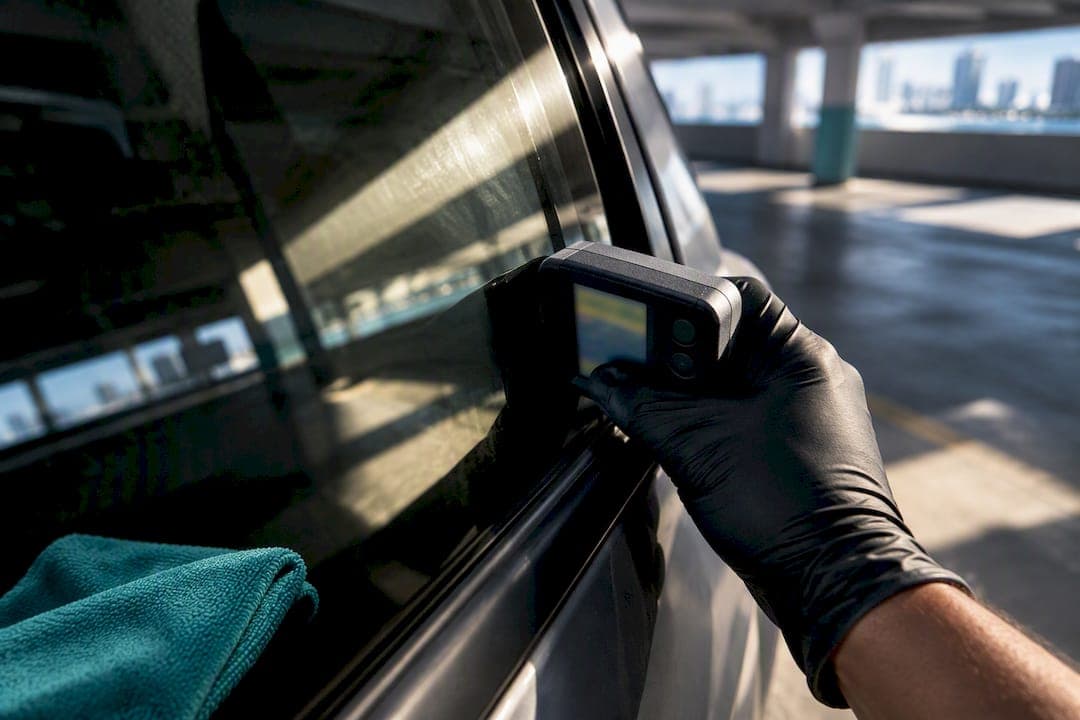
The darkest legal tint in Florida is 28% VLT for front side windows, 15% VLT for rear windows and rear side windows on sedans, and just 6% VLT on SUVs, vans, and trucks classified as multipurpose passenger vehicles. Windshields only get a transparent strip above the AS-1 line, never a full tint. Every one of these numbers gets checked with a calibrated tint meter, not a visual guess, so "it looks about right" is not a defense you want to test on the side of I95.
TL;DR:
- Florida law requires a minimum of 28% VLT on front side windows, with calibration tools used at traffic stops to enforce compliance within a ±3 percentage point margin.
- Rear windows on passenger cars need at least 15% VLT, while SUVs, vans, and trucks can go as dark as 6%, all with reflectance limits of 35%.
- Windshields are only allowed a transparent strip within the AS-1 line, with full tinting considered illegal regardless of film darkness.
- Drivers should demand documented VLT readings from installers and keep proof of compliance, as visual guesses can lead to unjust citations.
- Medical exemptions exist for certain conditions but are vehicle-specific, nontransferable, and require a physician’s certification to legally tint darker than the standard limits.
Table of Contents
- What Are Florida's Legal Tint Limits by Window?
- How Does Florida Enforce Tint Limits at Traffic Stops?
- Who Qualifies for a Medical Tint Exemption in Florida?
- How Can You Verify Your Tint Is Legal Before You Drive?
- What Southmiamitint Brings to Florida Tint Compliance
- The Real Problem Isn't the Law, It's How People Guess Around It
- Get Legally Compliant Tint Installed at Your Home or Office
- Sources
- FAQ
What Are Florida's Legal Tint Limits by Window?
Florida's tint law splits your vehicle into three zones, and each one has its own rulebook. Get one zone wrong and the whole car can fail inspection, even if the other windows are perfectly compliant.
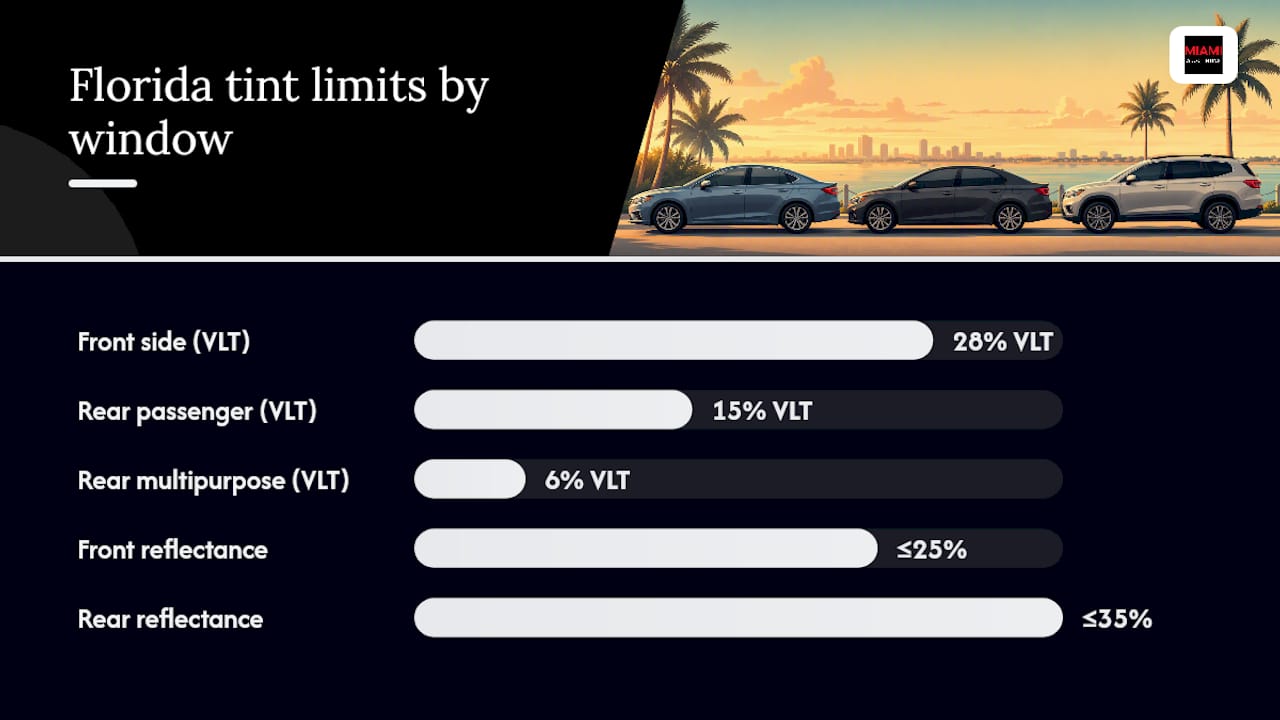
Front side windows (the ones forward of or next to the driver) must let in at least 28% VLT under Florida Statute 316.2953. That statute also caps total solar reflectance at 25% on the nonfilm side for any sunscreening material used there. VLT, or visible light transmission, measures the percentage of visible light that passes through the glass and film combined.
Rear side windows and the rear window follow a different standard, and the number depends entirely on what you drive. Florida Statute 316.2954 sets a 15% VLT minimum for passenger cars on those rear windows. Multipurpose passenger vehicles, meaning SUVs, minivans, and pickup trucks, get more room: as low as 6% VLT is allowed on the rear glass of those vehicles. Reflectance on rear glass cannot exceed 35% on the nonfilm side.
That sedan versus SUV split trips up a lot of new tint shoppers. The law defines multipurpose passenger vehicles by design and use, generally vehicles built for cargo or passenger transport off the standard sedan chassis, which is why trucks and most SUVs get the darker allowance.
Windshields get the strictest treatment of the three. Florida Statute 316.2952 permits sunscreening only within the AS-1 strip, the manufacturer-marked band at the top of the windshield. That strip cannot dip into your direct forward line of sight. A full-windshield tint job, however light, does not have a legal path in Florida, regardless of what a shop three states over might install.
Here's the full breakdown in one place:
- Front side windows (all vehicles): minimum 28% VLT, reflectance ≤25% on nonfilm side
- Rear side windows and rear window, passenger cars: minimum 15% VLT, reflectance ≤35%
- Rear side windows and rear window, multipurpose vehicles (SUVs, vans, trucks): minimum 6% VLT, reflectance ≤35%
- Windshield: transparent strip only, limited to the AS-1 area, no darkening below that line
One more term worth understanding: total solar reflectance. This measures how much light the film bounces back off its outer surface rather than absorbing or transmitting it. High-reflectance films create that mirror-like look you sometimes see on darker cars. Florida caps reflectance separately from VLT because a film can technically pass the light-transmission test while still creating a hazardous glare for other drivers. Our breakdown of VLT and what car owners need to know goes deeper into how labs actually generate these numbers if you want the full technical picture.
How Does Florida Enforce Tint Limits at Traffic Stops?
Florida polices tint with instruments, not eyeballs, and that distinction changes how you should think about compliance. An officer suspects a violation, pulls you over, and settles the question with a tint meter placed against the glass. No amount of "but it doesn't look that dark" changes what the meter reads.
The Florida Highway Patrol Policy Manual sets strict standards for the tools troopers use. Meters must stay accurate within ±3 percentage points of a known reference sample, and they need to be repeatable within ±1 percentage point across multiple readings on the same window. That is not a loose margin. A meter drifting outside those tolerances is considered unreliable and its readings can be challenged.
±3 percentage points is the accuracy tolerance FHP requires for every tint meter used in the field, checked against reference samples before the meter goes into service that day.
Here is what that policy actually requires before a trooper ever points a meter at your window:
- Daily accuracy checks. Troopers test their meters against reference samples of known VLT before relying on them for enforcement that shift.
- Documented test logs. Results get recorded on form HSMV 61037, creating a paper trail tied to that specific meter and date.
- Approved equipment only. FHP maintains a list of approved window tint meters, and readings from unapproved devices carry less weight.
- Reasonable suspicion first. An officer needs a lawful reason to stop you before tint even becomes part of the encounter. Tinted windows that look dark from the outside often serve as the basis, with the meter reading documenting the actual violation once you are stopped.
Here is the part most drivers never think about until it matters: your shop's meter and the trooper's meter can produce slightly different readings on the exact same window, simply because of that built-in tolerance range. That is precisely why documentation from your installer, matched against the officer's own logged calibration data, matters if a reading ever gets disputed.
Who Qualifies for a Medical Tint Exemption in Florida?
Florida allows darker-than-standard tint for drivers with specific medical needs, but the process is narrower than most people assume. Florida Statute 316.29545 covers medical exemption certificates for light-sensitive conditions, lupus being the most commonly cited example.
The exemption is not a blanket pass to tint however dark you like. A qualifying physician issues a certificate describing the condition, and the exemption attaches to one specific vehicle. It is nontransferable, meaning it does not follow you if you sell that car and buy another, and it does not cover a second vehicle in your household without its own paperwork.
A handful of other exceptions exist outside the medical category:
- Certain law enforcement vehicles used for undercover or canine work
- Process servers and private investigators operating under specific statutory allowances
- Vehicles with legally installed film that is later repaired or replaced under the same specifications, which does not trigger a new violation
Penalties for everyone else are straightforward but not trivial. Driving with illegal tint is a noncriminal traffic infraction under Florida Statute 316.2956, similar to a routine equipment ticket. Sellers and installers face steeper exposure. Knowingly selling or installing sunscreening material that violates these limits can be charged as a second-degree misdemeanor, which is a real criminal record, not just a fine.
How Can You Verify Your Tint Is Legal Before You Drive?
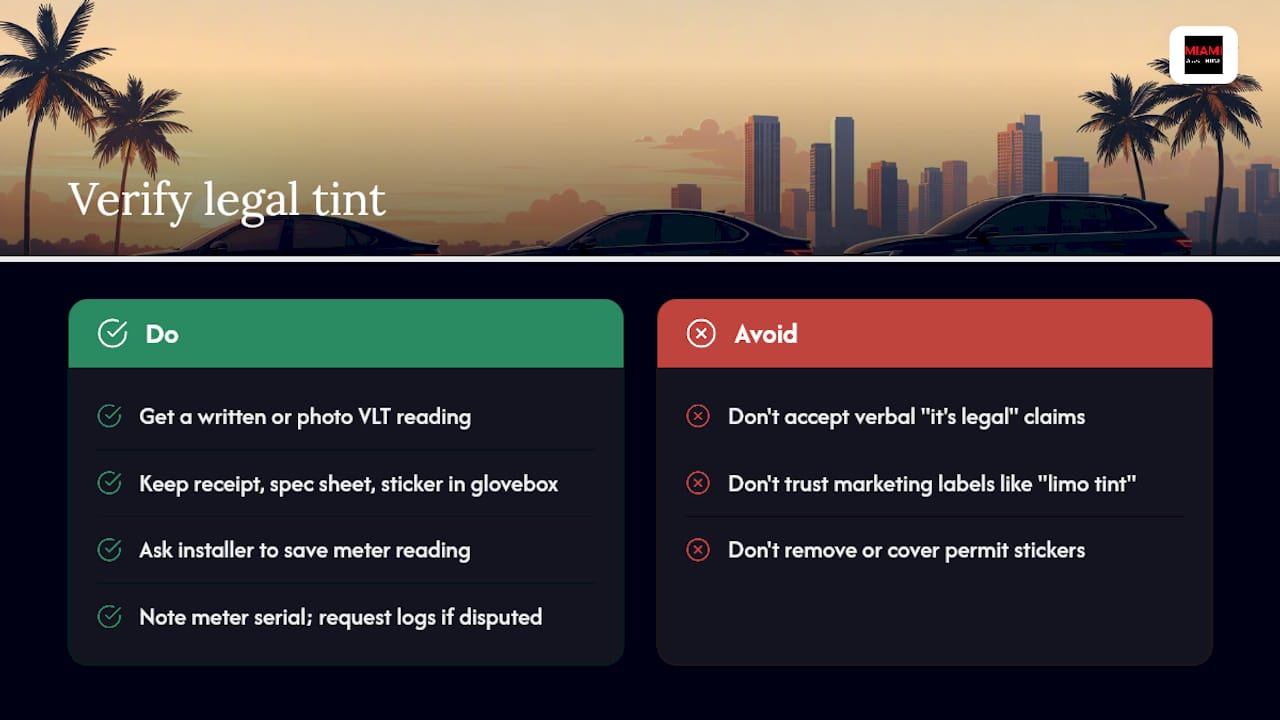
Ask your installer for a documented VLT reading at the time of installation, not just a verbal promise that "this is legal tint." A reputable shop uses an approved meter and can tell you the reference sample it was checked against that day. Get that reading in writing, or at minimum a photo of the meter display against your specific window.
Keep three things in your glove box after any tint job: the receipt, the manufacturer's product specification sheet showing VLT and reflectance numbers, and any film-identification sticker the installer applies to the glass. Some jurisdictions look for that sticker specifically as a first-pass compliance check. If your exemption decal or inspection sticker needs to stay put and legible over time, proper placement guidance for permits and stickers applies just as much to tint documentation as it does to other windshield paperwork.
If you get pulled over, stay calm and note two things: the meter's serial number and whether the officer shows you the reading. You are entitled to see the number the meter produces. If you later believe that reading was inaccurate, the FHP's own test-log requirement under policy 17.27 works in your favor. You can request the meter's calibration records from that date through a records request, since those logs are supposed to exist for every meter used in the field.
When shopping for film, look past marketing labels like "limo tint" and ask for the lab-tested VLT and total solar reflectance numbers directly. A legitimate product spec sheet will list both.
Pro Tip: Ask your installer to print or screenshot the meter reading and reference-sample log right after installation. That single piece of paper is the strongest evidence you have if a reading is ever questioned down the road.
Beyond the legal angle, staying within Florida's limits still gets you real heat and UV rejection. The Skin Cancer Foundation points to window film as a meaningful layer of UV protection for daily driving, on top of whatever legal VLT floor you're working within.
What Southmiamitint Brings to Florida Tint Compliance
The company installs mobile window tint using 3M Ceramic IR, 3M Crystalline, 3M Color Stable, and Iviron KoolMax ceramic films, each with published VLT specs that map cleanly to Florida's statutory floors. That matters because a film's marketing name tells you nothing about legality. Its lab-tested VLT number does.
A few resources worth bookmarking if you're still working through the details:
- How to prove your windshield tint sits within the AS-1 strip
- What actually makes a tint job legal for Florida drivers
- How Miami-area tint practices compare to statewide law
The company states extensive experience and uses computer-cut technology to fit film precisely to each vehicle's glass, including luxury and exotic models where factory curves make freehand cutting risky. That precision is part of how a documented, compliant install stays that way.
The Real Problem Isn't the Law, It's How People Guess Around It
The statutory limits themselves are not complicated. What trips up Florida drivers is treating tint darkness as a visual judgment call instead of a measured one. I've seen the same mistake repeated constantly: someone eyeballs a friend's SUV, assumes their own sedan can go just as dark, and ends up with a citation because sedans and multipurpose vehicles sit on entirely different rear-window standards.
The conventional advice, "get it as dark as you can without getting stopped," is backwards. Enforcement in Florida runs on calibrated meters with published tolerance ranges, not on how suspicious your windows look to a trooper driving past. That means the smarter strategy is picking a film with a verified lab VLT comfortably inside the legal range, not one sitting right at the edge where meter tolerance could tip you into a violation.
If you take one thing from this guide, prioritize documentation over darkness.
— Jose
Get Legally Compliant Tint Installed at Your Home or Office
Southmiamitint is the alternative to guessing your way through Florida's tint statutes: mobile installation means a technician brings calibrated, lab-specced 3M and Iviron KoolMax film directly to your driveway or office parking lot in Miami-Dade County, and you get documentation showing exactly where your VLT lands within the legal range.
Whether you need a straightforward 2 Front Windows job, a Windshield Tint AS-1 strip, or a Full Car + Windshield package, every install stays within the statutory VLT and reflectance caps covered above. For drivers who want the strongest heat rejection alongside legal compliance, the 3M Ceramic IR and Crystalline lineup delivers verified VLT specs you can hand to an officer or keep in your glove box.
Ready to get your windows done right the first time? Request a quote through Southmiamitint's site and get a same-day mobile appointment scheduled around your location.
This article is general information, not a substitute for advice from a qualified lawyer. Consult a qualified legal professional about your own circumstances before acting on anything here.
Sources
- Chapter 316 Section 2953 - 2024 Florida Statutes - The Florida Senate
- Florida Highway Patrol Policy Manual — 17.27: Use of tint meters
FAQ
Is 20% Window Tint Legal in Florida?
It depends on which window. Twenty percent VLT is illegal on front side windows, since Florida requires a minimum of 28% VLT there, but it is legal on the rear windows and rear side windows of a passenger car, which only require 15% VLT minimum, and well within range for multipurpose vehicles at 6%.
Is 20% or 35% Tint Darker?
Lower VLT percentages mean less visible light passes through the glass, so a film with lower VLT blocks more light and looks noticeably darker than one with higher VLT.
Will I Get Pulled Over for 5% Tint in Florida?
Officers use calibrated tint meters accurate within ±3 percentage points to confirm a violation once they stop a vehicle.
How Dark Is 15% Tint?
It's the exact statutory minimum for rear windows and rear side windows on passenger cars in Florida, making it common on sedans that want maximum legal privacy in back.
What Does Southmiamitint Charge for a Legal Tint Install?
Pricing starts at $150 for two front windows or a windshield AS-1 strip, and $500 for a full car plus windshield package, all through Southmiamitint's mobile service. Pricing for ceramic film, carbon film, and residential or commercial jobs is available on request through the site.