
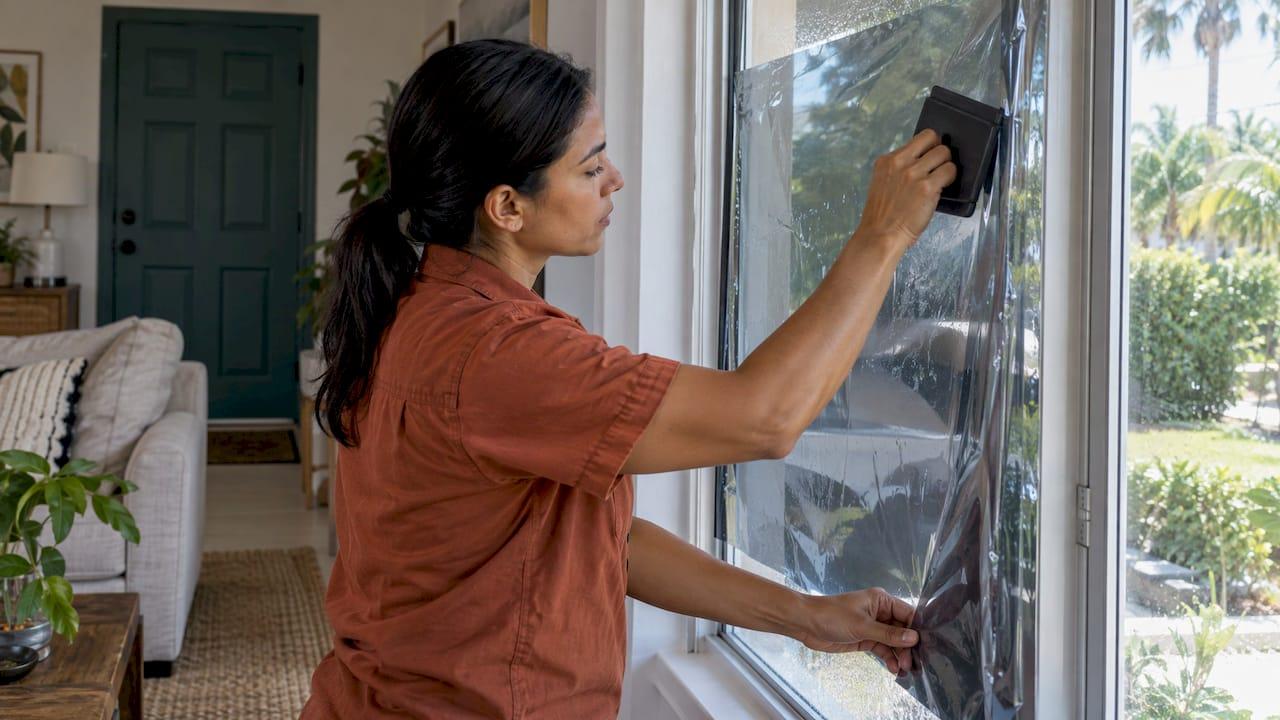
For most Miami-Dade homes, cars and offices, the faster and more affordable way to cut heat and UV is ceramic window film on the glass you already have. Low-E glass makes sense when the windows themselves are failing and need replacing anyway. Both use the same idea, a coating that filters the sun's energy, but film gets you there without tearing out windows, and we install it at your home or office.
Below you will find how the two differ, what each costs, where each fits, and what to check before you choose.
TL;DR
- Low-E glass has a coating built into new glass. Window film puts a similar kind of filter onto glass you already own.
- Replacement is the right call for fogged panes, failed seals, rotted frames or leaky windows. If your glass is sound, film is the retrofit.
- Commercial research puts film at roughly $4.50 to $7.75 per square foot installed, versus about $40 per square foot for full window replacement.
- Cars are a film job: our mobile installs start at $200 for two front windows and $450 for a full car plus windshield.
Table of Contents
- What low-E glass and window film actually do
- Why Miami-Dade is a solar-control climate
- When replacing glass is the right move
- Cost and payback: what the numbers say
- Cars: the film route
- Homes and businesses: film on the glass you have
- Film on double-pane or low-E glass: check the assembly first
- Book a mobile install
- Our view: fix the glass that is failing, film the rest
- FAQ
- Sources
What low-E glass and window film actually do
Low-E stands for low emissivity. Emissivity is how readily a surface gives off heat as infrared radiation. A low-E coating is a very thin layer that lets visible light through while reflecting much of the heat-carrying infrared. The U.S. Department of Energy's lab network describes spectrally selective glazings as screening out heat-generating ultraviolet and infrared radiation while letting most visible light pass. It adds that this selectivity can come from a low-E coating on glass or on a film applied to glass.
So the two are not opposites. Low-E glass is factory-coated glass. Window film is a coating on a polyester layer that bonds to the glass you have. A 2017 Lawrence Berkeley National Laboratory report for the U.S. General Services Administration notes that low-E applied film reflects long-wave infrared, and that applied films can also absorb and reflect visible and near-infrared solar radiation.
In practice, here is how the choice looks:
| Low-E glass | Window film on existing glass | |
|---|---|---|
| What it is | New glass with a coating added at the factory | A film applied to the inside (or outside) of your current glass |
| Work involved | Remove and replace windows or glass units | Installed in place, window by window |
| Typical use | New construction, or windows that need replacing | Retrofit of sound glass in homes, cars and offices |
| Cost range (commercial research) | About $40 per square foot for complete replacement | About $4.50 to $7.75 per square foot installed |
| Disruption | Higher | Can be done in stages, and after hours for offices |
The cost figures come from the LBNL report and describe typical commercial jobs. Your own price depends on window count, size and film, so treat them as a scale comparison, not a quote.
Why Miami-Dade is a solar-control climate
The heat load here comes mostly from sun beating through the glass, not from cold leaking in. That is why solar heat gain, the share of the sun's energy that passes through a window as heat, is the number to care about. The Whole Building Design Guide reports that different types of clear glass and window systems reject 13 to 29% of solar heat, while films can provide 80% solar heat rejection.

The General Services Administration modeled a Miami, Florida office that converted single clear glazing to a 35% visible-transmission low-E film. Its infographic estimates 33% perimeter HVAC savings. That is a modeled result for the zone next to the windows in a commercial building, not a whole-building or home figure. It does show that film on existing glass can make a real difference in a Miami cooling load.
Glare and UV matter too. The Efficient Window Coverings guide lists UV blocking of 95 to 99.9% as a benefit of applied films, depending on the product. That protects floors, furniture, dashboards and skin.
When replacing glass is the right move
Film works on glass that is in good shape. Replacement is for windows that are not. Building-industry guidance says replacement is needed when windows leak moisture or air, panes are fogged, or seals have failed. The Efficient Window Coverings overview adds rotted frames, broken or inoperable sashes and failed insulated-glass seals with fogging between panes to the list.

If you see any of those, fix the window first. Hurricane-season storms, salt air and age all take a toll on frames and seals in South Florida, so a quick walk around the house with that list is worthwhile.
If your windows pass that walk-around, film is the practical upgrade. GSA's research frames low-E film as a retrofit opportunity, especially for single glazing or low-performing glazing without an existing low-E coating. Many Miami homes, older condos and storefronts fit that description.
There is one more benefit that homeowners and office managers value. GSA says low-E film can be installed on existing windows in stages and after hours, without disrupting the people inside. A full replacement project cannot say the same.
Cost and payback: what the numbers say
The GSA infographic lists an installed cost of $7.75 per square foot and a 2 to 6 year payback for its single-pane case. Those are commercial study figures, so do not read them as a residential or car price.
A simple way to think about it:
- Measure the glass area you want to treat, in square feet.
- Multiply by the film range ($4.50 to $7.75) and by the replacement figure (about $40) from the research above.
- Compare the gap with what you would save on cooling and on replacement disruption.
A worked example: a 60-square-foot set of south and west windows costs about $270 to $465 to film at those commercial rates, against about $2,400 to replace at the commercial replacement figure. Real quotes for homes will differ, but the proportion shows why film is the first thing to price when the glass is sound.
For vehicles, our own published starting prices are simple: 2 front windows from $200, windshield from $150, and full car plus windshield from $450. Old tint removal runs $50 to $150, and we can take care of it before new film goes on.
Cars: the film route
A car's glass is not something you shop for in low-E versions, so for a vehicle the real question is which film. The science behind the benefit is well documented. A 2000 SAE technical paper found that solar-reflective glazing can lower parked-vehicle interior temperature by 9°C and reject more than 500 W. The same paper estimated that solar-reflective windshield glazing could improve compact-car fuel economy by about 0.7 mpg when the air conditioning is sized to match. That is a study of glazing, not a promise about any one film, but it shows why heat rejection on the windshield and side glass pays off in a Miami parking lot.
What matters is heat rejection, not darkness. A very dark film can look strong and still let heat through, while a ceramic film is built to reject infrared. Our thermal performance guide and windshield heat guide go deeper on that. If you wonder how film compares with what came on the car, see our page on factory tint versus aftermarket film.
Our work on cars starts with the glass. If there is old, bubbled or purple film, it comes off first. If you have ever dealt with leftover residue, the process of rainbow film removal on car glass shows why a clean surface matters before anything new is applied. We use computer-cut patterns for an exact fit, and 60-inch rolls let us install large windshields in one piece with no seam.
We offer ceramic films only: 3M Ceramic IR with a lifetime warranty, SunTek CIR with a 5-year warranty, and Uviron KoolMax with a 3-year warranty. Our 3M window tinting page explains the 3M options.
Homes and businesses: film on the glass you have
For a house, condo or office in Miami, Kendall, Pinecrest, Homestead or Cutler Bay, the starting point is the glass you already have. Film goes on in place, so there is no frame work, no new permits to chase for a window swap, and no waiting on custom glass orders.
Two specs help you compare films fairly. Both appear on the National Fenestration Rating Council label that comes with rated film-and-glass combinations:
- Solar heat gain coefficient (SHGC): the fraction of the sun's heat that gets through. Lower means less heat.
- Visible transmittance (VT): the fraction of visible light that gets through. Higher means a brighter room.
The Efficient Window Coverings guide notes that NFRC film labels report both figures, which is useful for comparing heat gain and daylight for a specific glass-and-film application. GSA's film comes in three visible-transmission grades, 35%, 50% and 70%, so you can balance daylight and appearance against solar control. A living room that you want bright may suit a lighter grade. A west-facing office with afternoon glare may suit a darker one.
We tint homes and offices across the county. See our pages for residential window tinting and commercial window tinting, and our ceramic tint page for the film types.
Film on double-pane or low-E glass: check the assembly first
A common question is whether you can put film on double-pane glass or glass that already has a low-E coating. Sometimes, yes, but it depends on the exact glass and film combination. The Florida Solar Energy Center's industry guide cautions that film can raise glass temperature and thermal stress, and it advises you to verify:
- the exact pane construction and whether a low-E coating is already on it,
- the film maker's compatibility guidance for that glass,
- the glass condition, including any shading that will cast shadows across the pane,
- and any glass or film warranty that could be affected.
The FSEC guide also says damaged glass or failed insulated-glass seals should be dealt with first, not assumed compatible. If your windows are newer double-pane units, check the manufacturer's paperwork before booking. Tell us the window type when you request a quote, and we will go through your project with you.
Book a mobile install
We are a mobile window tinting company serving all of Miami-Dade County. We come to your home or office, so you never wait at a shop. Our work is owner-installed, backed by 28 years of experience, and we have worked on Tesla, luxury and exotic vehicles. Prices start at $200 for 2 front windows, $150 for a windshield and $450 for a full car plus windshield.
See our mobile window tinting page, or get a quote from the Miami Auto Tinting site by phone or online form.

Our view: fix the glass that is failing, film the rest
We have tinted vehicles, homes and businesses across Miami-Dade for 28 years, and the question we hear is always some version of this: do I need new windows or can I just add film?
Our answer is simple. If a window leaks, fogs or has a broken seal, replace it. If the glass is sound, ceramic film is the direct way to cut the heat, UV and glare you feel. It goes on in a single visit, at your location, and the glass stays in place.
That is why we install ceramic films only. 3M Ceramic IR carries a lifetime warranty, SunTek CIR carries 5 years and Uviron KoolMax carries 3 years. Heat rejection is what you are paying for in Miami, and ceramic is built for it, not just for a darker look.
We cut patterns by computer for an exact fit, and our 60-inch rolls let us install large windshields in one piece with no seam. Our owner does the install, and we come to you.
Jose
FAQ
Is low-E glass better than double pane?
They are different things. Double pane means two sheets of glass with a sealed gap, and low-E is a coating that is often applied inside that gap. Many modern windows are both. If you already have sound double-pane windows and want less solar heat, film is the retrofit to compare, with the compatibility checks above.
Can I use window film on double-glazed windows?
In some cases, yes. Compatibility depends on the film and the exact glass assembly, including any existing low-E coating. Check the glass maker's guidance and your warranty, and make sure the seals are intact, then ask us about your windows before booking.
Which window film is best for Miami heat?
For heat, choose a film made to reject infrared, such as ceramic, and compare the SHGC and VT figures. We install 3M Ceramic IR, SunTek CIR and Uviron KoolMax, all ceramic. Our solar control guide for Miami vehicles and homes explains the trade-offs.
How much does film cost compared with replacing windows?
Commercial research gives film at about $4.50 to $7.75 per square foot, against about $40 per square foot for complete window replacement. For cars, our prices start at $200 for 2 front windows and $450 for a full car plus windshield.
Sources
- Spectrally Selective Glazings, Federal Energy Management Program
- Solar Control Window Coating Retrofit, LBNL 2017
- Applied Film, Efficient Window Coverings
- Deciding What to Do With Existing Windows, Efficient Window Coverings
- Low-E Film or Window Replacement, Buildings
- Low-E Window Film Findings, GSA
- Low-E Window Film Infographic, GSA
- Window Film Fundamentals, WBDG
- Industry Guide to Selecting the Right Window Film, FSEC
- Effect of Solar-Reflective Glazing on Fuel Economy, SAE