
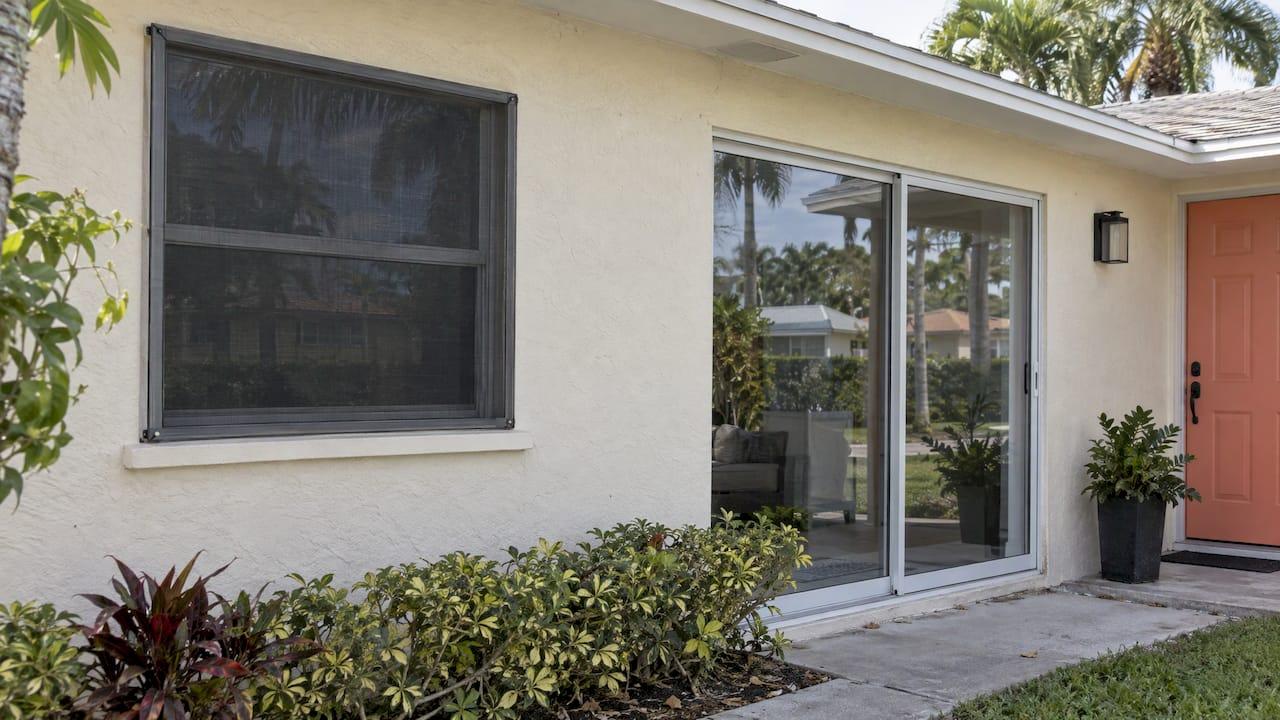
For most Miami-Dade homes, cars and offices, window film is the better all-round choice. It works on the glass itself, keeps the view and daylight, and fits every window, including fixed panes and car glass. Solar screens are a strong exterior option for standard residential windows when you want a removable layer and do not mind a dimmer, mesh-filtered view. Solar shades and roller shades are interior coverings that help only while they are drawn.
Below, we compare all four on heat, glare, UV, views, privacy and day-to-day use. We also cover the Florida rules that apply if the glass is on a vehicle.
TL;DR
- Window film stays on the glass, keeps the view and natural light, and suits cars, fixed windows, doors and commercial glass.
- Solar screens mount outside the window. They block heat before it reaches the glass, but they soften the view and can reduce airflow.
- Solar shades and roller shades are interior coverings. They work only when closed, and closing them costs you the view.
- Cars can only use film, and Florida limits how dark and reflective it can be.
- We install ceramic film at your home, office or driveway anywhere in Miami-Dade.
Table of Contents
- What each option actually is
- Heat: where each one stops the sun
- Glare, daylight and the view
- UV protection and fading
- Privacy, airflow and everyday use
- Side-by-side comparison
- Which one for a car, a home or a business
- Cost, upkeep and durability
- Our perspective
- Book mobile tinting anywhere in Miami-Dade
- FAQ
- Sources
What each option actually is
The names get mixed up, so here is the plain version.
- Window film (tint): a thin layer applied to the glass. Ceramic films are built to reject infrared heat and UV without needing a dark look.
- Solar screen: a woven mesh in a frame, mounted on the outside of the window. The U.S. Department of Energy-backed PNNL Building America Solution Center lists solar screens, roller shades, shutters and awnings as exterior attachments, and blinds, shades, drapes and surface-applied films as interior ones.
- Solar shade: an interior roller-style covering made of open-weave fabric. Hunter Douglas describes solar shades as filtering sunlight and providing UV protection while keeping the view outdoors.
- Roller shade: a continuous panel of fabric that rolls into a headrail. It comes in light-filtering or room-darkening versions.
The main difference is where each one sits. Film is part of the glass. A screen sits outside it. Shades sit inside, and you have to operate them.
Heat: where each one stops the sun
Heat is the reason most Miami readers ask this question, and it comes down to where the sun is stopped.
Exterior products block solar heat before it reaches the window. According to the PNNL Building America Solution Center, exterior attachments are typically more effective at reducing solar heat gain than interior ones. A U.S. Department of Energy study found that in cooling-dominated climates, all window attachments save energy by lowering the solar heat gain coefficient, with outdoor-mounted ones generally the most effective for cooling.
The numbers for solar screens bear this out. Efficient Window Coverings reports shading coefficients of 0.14 to 0.33 for exterior screens and 0.50 to 0.70 for interior ones, depending on openness and color. Lower is better, so mounting outside matters.
Film works differently. It stays on the glass and rejects infrared energy there. Solar Gard states that its film offers up to 84% heat rejection by blocking infrared radiation. That is one manufacturer's figure for its own product line, and results vary by film, so compare the specific film's rating rather than a category average.

Shades and roller shades are the weakest option on heat when you are not home to move them. Consumer Reports notes that shades are simple and effective when properly installed, but they need to be drawn all day to work.
Which windows get the most sun
Consumer Reports also says window film suits homes with long cooling seasons and that east- and west-facing windows benefit most, because they take the strongest sun at sunrise and sunset. In Miami, that means starting with your west-facing living room, your home office and any glass door.
Glare, daylight and the view
This is where the choice feels different day to day.
- Film reduces glare while letting daylight in. Solar Gard says its films can block anywhere from 5% to 95% of daylight, depending on the shade you choose. Avery Dennison states that its solar control film cuts glare by up to 93%.
- Solar screens keep the view through the mesh, but they dim the room. The tighter the weave, the darker the room and the softer the view.
- Solar shades keep an outward view, but with a filtered look.
- Roller shades that block light also block the view. When closed, the room goes dark and the window stops doing its job.
If you work from a laptop, watch TV in a bright room or want daylight without squinting, film is the simplest fix. You do nothing after the install.
UV protection and fading
UV is what fades floors, sofas, art and dashboards.
Exterior solar screens give strong UV protection, and Efficient Window Coverings puts it at 75% to 99%, depending on the screen. Quality film is designed to go higher. Solar Gard states its film blocks 99% of UV radiation, and Avery Dennison says its film can help protect interior finishes, skin and eyes from UV damage.

Film covers the entire pane edge to edge. A screen or shade can leave gaps at the frame, and a shade does nothing once it is open. For a car, that edge-to-edge coverage also protects the dashboard, seats and your skin on every drive.
Privacy, airflow and everyday use
- Privacy: reflective film gives one-way mirror privacy during the day, according to Avery Dennison. Solar screens give daytime privacy from the outside and let you see out. At night with the lights on, no daytime privacy product keeps you hidden, so you may still want a shade or curtain for bedrooms.
- Airflow: interior screens reduce breezes, per the PNNL shading guide. Film does not block openable windows from working, since it sits on the glass.
- Operation: film needs no daily effort. Shades need someone to open and close them. Screens go up and come down seasonally if you want them removed.
- Seasonal flexibility: a removable screen is its one real advantage. In a cooling-dominated climate like ours, that matters less, because you want heat control almost all year.
Side-by-side comparison
| Factor | Window film | Solar screen | Solar or roller shade |
|---|---|---|---|
| Where it sits | On the glass | Outside the window | Inside the window |
| Heat control | Works constantly, no action needed | Strong, blocks heat before the glass | Only when drawn |
| View and daylight | Clear view, natural light stays | Mesh view, dimmer room | Filtered, or blocked when closed |
| UV protection | High, edge to edge | High, depends on weave | Partial, depends on use |
| Works on cars | Yes | No | No |
| Fixed or odd-shaped glass | Yes | Needs a frame | Needs a mount |
| Daily effort | None | None, or seasonal removal | Open and close daily |
Which one for a car, a home or a business
Cars, SUVs and trucks
Only film is an option. A screen or shade cannot do the job on a moving vehicle's glass, and a sunshade only works while parked. Ceramic film is the usual choice in South Florida because it targets infrared heat without needing a very dark look. For more on this, see our guides on why Miami's climate makes tinting a must-have and how much heat windshield tint can cut.
Florida limits how dark and reflective film can be. Under Florida Statute 316.2954, windows behind the driver may carry film with no more than 35% reflectance and at least 15% light transmittance, or at least 6% for multi-purpose passenger vehicles. A violation is a noncriminal, nonmoving traffic infraction. Front side windows have stricter limits than the rear ones, and the windshield allows tint only above the AS-1 line. We install to Florida's limits, and we can tell you which film percentage fits each window on your vehicle.
Once the film is on, keep the glass itself clean and protected. A ceramic coating on glass is one way drivers keep the windscreen clear alongside their film.
Homes
For standard double-hung or sliding windows with room outside to mount a frame, solar screens are a reasonable exterior choice. Film wins when you have large fixed panes, sliding glass doors, skylights, a sunroom or a window where you do not want a frame on the outside. Our guide to sunroom window tint shows what cuts heat and glare there.
Before you decide on any residential product, check the glass first. Look at what type of glazing you have and whether your HOA or condo board has rules on exterior changes. The PNNL guide also advises comparing products by the AERC Warm Climate Rating and SHGC. The IWFA education guide adds that dividing VLT by SHGC gives light-to-solar-heat-gain, and a value above 1.00 is called spectrally selective: more light in, less heat.
The same guide notes that homeowners usually choose film for comfort, such as less fading, fewer hot spots and less glare on screens, rather than for a predicted dollar savings. That is the right expectation to bring.
Offices and storefronts
Businesses with large glass fronts usually cannot fit screens or shades across every pane, and shades block the view customers and staff rely on. Film keeps the storefront open and reduces glare on monitors and registers. Ask for a quote for your building on our commercial window tinting page.
Cost, upkeep and durability
We do not publish residential film prices, because they depend on the glass size, the number of panes and the film you choose. We quote after hearing about your windows. Our published automotive pricing is:
| Vehicle service | Price |
|---|---|
| 2 front windows | from $200 |
| Windshield tint | from $150 |
| Full car + windshield | from $450 |
| Old tint removal | $50 to $150 |
On upkeep, film needs only gentle cleaning with a soft cloth and a non-ammonia cleaner. Screens collect dust and debris, and shades need dusting and mechanical care. The warranty is the clearest durability marker we can speak to: 3M Ceramic IR carries a lifetime warranty, SunTek CIR carries 5 years and Uviron KoolMax carries 3 years. Screens and shades have no equivalent standard for film-style warranties that we can point to.
Our perspective
We have tinted glass in Miami-Dade for 28 years, and the same pattern repeats. People start by asking which product is cheapest, then realize their real problem is heat and glare they can feel every day.
Our view is simple: heat control should not depend on someone remembering to close a shade or hang a screen. Film is working at 3 p.m. when nobody is home, and it does not take away your view of the water, the palms or the street.
That is also why we only install ceramic film. 3M Ceramic IR, SunTek CIR and Uviron KoolMax are built for infrared heat rejection, and we go through the options with you so the shade level matches the room or the vehicle, not just a number on a box.
We also come to you. We install at your home, office or driveway, with computer-cut patterns for an exact fit, and 60-inch rolls let us install large windshields in one piece with no seam.
Jose
Book mobile tinting anywhere in Miami-Dade
We bring the film to your home, office or driveway, so you never sit in a shop waiting. Ceramic only, owner-installed, and experienced with Tesla, luxury and exotic vehicles. Windshield tint starts at $150, two front windows at $200, and a full car with windshield at $450. For homes and businesses, we quote by the window.

See mobile window tinting or residential window tinting, or request a quote and tell us what you need covered.
FAQ
Are solar screens better than window film?
It depends on the window. Exterior screens block heat well before it reaches the glass, but they dim the room and need a frame. Film works on any glass, keeps more natural light and works for cars as well. For fixed panes, doors, sunrooms and vehicles, film is the practical pick.
Does solar window film really work?
Yes, when you choose a film with a good rating. Look at the film's solar heat gain coefficient, visible light transmission and UV rejection rather than its darkness. A film that is not very dark can still reject a lot of infrared heat, which is how ceramic films are designed to work.
Can I use window film on my car in Florida?
Yes, within Florida's limits. The windshield allows tint only above the AS-1 line, and rear windows have their own reflectance and light-transmittance limits under Florida Statute 316.2954. We install to those rules, and we will recommend the right percentage for each window.
Do solar shades or roller shades beat film for heat?
Only while they are closed. Shades are interior coverings, and they cost you the view and daylight when drawn. Film keeps rejecting heat and glare all day without anyone touching it, which is why many Miami homeowners prefer it for the rooms they use most.
Sources
- PNNL Building America Solution Center: window attachments for solar control
- PNNL Building America Solution Center: shading and solar control
- Hunter Douglas: types of shades
- U.S. Department of Energy: energy savings from window attachments
- Efficient Window Coverings: exterior solar screen
- Solar Gard window film brochure
- Avery Dennison: solar control window films, residential
- Consumer Reports: lower your energy costs with window coverings
- Florida Statute 316.2954
- IWFA Advanced Solar Control Education Guide