
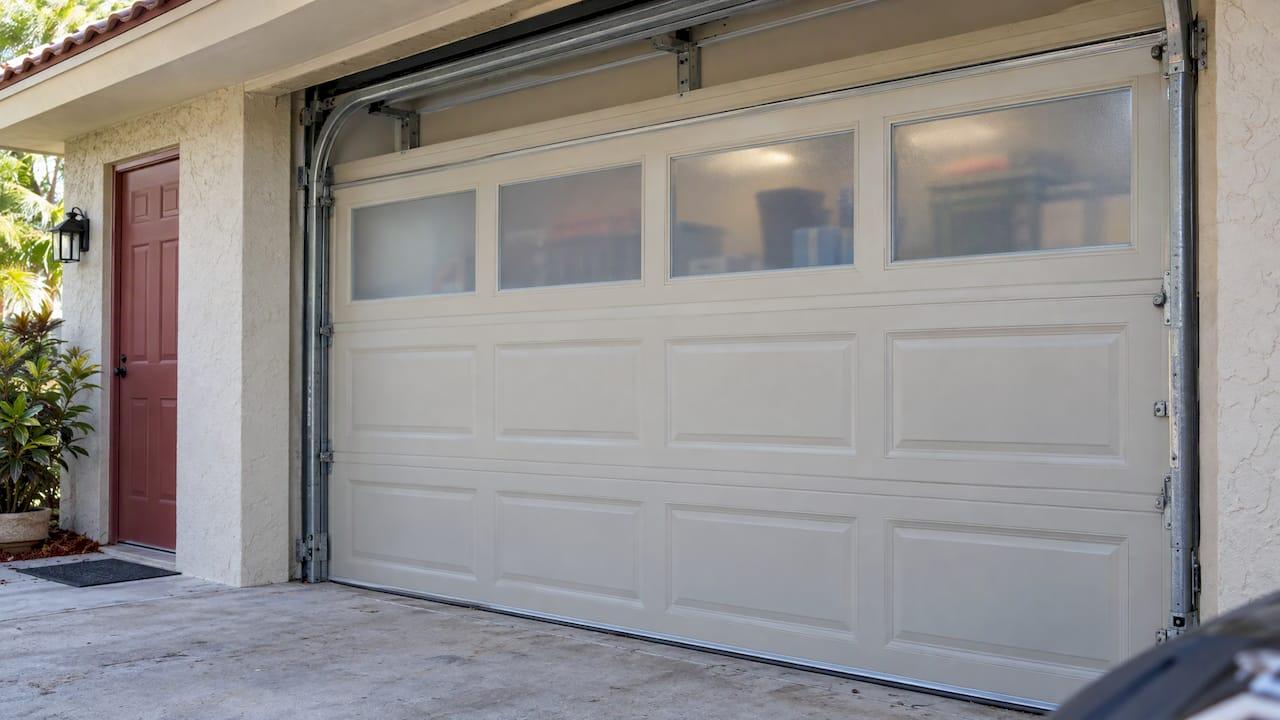
The fastest way to add privacy to garage door windows is a film or tint on the glass. It works because garage doors roll up, so blinds and shades don't fit. Daytime privacy is easy. Nighttime privacy depends on the type of film you choose. If your garage has glass panels, a side window or a glass entry door, a darker ceramic tint gives you daytime privacy and cuts heat at the same time. We install it at your home anywhere in Miami-Dade.
TL;DR
- Garage doors retract, so shades and blinds usually aren't practical. Tint or frost on the glass is the common fix.
- Mirror-style film gives daytime privacy only. When the garage is lit at night, people outside can see in.
- Frosted and opaque films work in both directions, day and night, because they diffuse light instead of reflecting it.
- Before applying anything to a garage door panel, confirm that the door and film makers allow that combination. Plastic glazing follows different rules than household glass.
- In Miami's sun, a ceramic film adds heat and UV control to the privacy. Our mobile crew comes to your driveway.
Table of Contents
- Why garage windows need more privacy than most windows
- The main ways to get garage door window privacy
- How privacy film actually works
- Can privacy film still let light in?
- Why heat matters in a Miami garage
- Check this before you put film on a garage door
- What about blinds, shutters and inserts?
- Which option fits which garage
- Our approach
- Get your garage glass tinted at home
- FAQ
- Sources
Why garage windows need more privacy than most windows
A garage holds tools, bikes, a car, sometimes a workshop or a freezer. A clear window facing a street or a shared driveway shows all of it to anyone walking by. That visibility is a privacy problem and also tells passersby what is worth looking at.
Garage door windows have a second problem. You can't hang a curtain on a door that travels up a track and folds overhead. Hardware that sticks out of the panel gets in the way of the rollers and the opener. That is why most homeowners texture or tint the glass instead. The same source notes the tint or frost can be added before or after the door is installed.
That leaves a few real choices. Here they are, in the order we'd consider them.
The main ways to get garage door window privacy
One regional garage door company lists five routes: factory obscured glazing, higher window placement, manufacturer-approved privacy film, approved opaque inserts, or a door with no windows. They fall into three groups.
| Approach | Daytime privacy | Night privacy | Notes |
|---|---|---|---|
| Dark ceramic tint on glass | Strong | Depends on the shade and lighting | Also cuts heat and UV. Best for glass windows and glass entry doors |
| Frosted or opaque film | Strong | Strong | Light comes in, shapes are hidden, both directions |
| Mirror (reflective) film | Strong | Weak, effect reverses when it is lit inside | Needs the outside to be brighter than the inside |
| Obscured glass or higher window placement | Strong | Strong | Chosen when buying the door; can't be added later |
| Door with no windows | Complete | Complete | Gives up natural light in the garage |
If your door is already installed, the practical options are film or tint, or swapping panels. Film is the simplest way to change what you have.
How privacy film actually works
Not all films protect privacy the same way. Three behaviors matter.

Blackout and dark films
Blackout films give nearly 100 percent privacy at all times. The trade-off is light. Your garage gets darker, which matters if you use it as a workshop or gym.
Translucent or frosted films
Translucent films obscure the shapes behind the window rather than blocking all light. Because they diffuse light instead of reflecting it, they work in both directions and at any hour. If you want daylight inside and nobody seeing your shelves, this is the type to look at.
Reflective (mirror) films
Mirror films reflect during the day and are transparent at night. The effect depends on the lighting difference across the pane. When the garage lights are on and it is dark outside, the effect reverses and people outside can see in. The same applies to a Home Depot mirror film whose own product page says it gives daytime privacy but not nighttime privacy.
That is a fact of how reflective film works, not a product defect. If you use the garage at night, plan for it: a darker ceramic shade, a frosted film, or keeping the garage lights off when you are not working. Our guide to reflective versus non-reflective tint goes through the specs.
Can privacy film still let light in?
Yes, depending on the film. Frosted films let daylight through while hiding what is behind the glass, and one UK film maker says most frosted films pass 70 to 90 percent of daylight. That figure comes from a manufacturer's general statement, so treat it as a rough range and check the visible light transmission listed for the exact film you pick.
For a sense of how film specs read, 3M's technical data for one silver sun-control film lists 17% visible light transmission on clear glass, 58% interior and 56% exterior visible light reflection, 77% total solar energy rejection and 99% UV blocked. Lower visible light transmission means a darker, more private window. The solar rejection number tells you how much heat the film keeps out. Those two numbers together are how you pick a film for a garage in Florida.
Why heat matters in a Miami garage
Garage windows face the sun for hours. Privacy is the reason you start looking, but heat is a daily annoyance: the garage, the car parked in it and any room that shares a wall all warm up. A film that handles both jobs is worth more than one that only hides the view.
The industry's own guidance supports this. The International Window Film Association says NFRC-certified film can cost about one-tenth of an average replacement window and last nearly as long, about 20 years. It also notes that the NFRC rates window film independently, so manufacturers have no say in how their products score. When you compare films, those independent ratings are the numbers to read.
For how Miami's climate changes the choice, see why Miami's climate makes window tinting a must-have and our guide to window tint for coastal areas.
Check this before you put film on a garage door
Garage door glass is not always glass. Many panels are plastic glazing, and instructions written for household windows do not carry over. The first question is whether the film maker and the door or glazing maker allow that combination, not how the film looks online. The Louisville garage door company that makes this point also advises using the current manufacturer documentation and a sample rather than trusting a general promise of one-way privacy.
Here is a short checklist for a safe result:
- Identify the glazing. Is it glass or plastic? Look in your door's manual or on the manufacturer's label.
- Read the door maker's guidance. Some doors carry warranty terms about what can be applied to the panels.
- Match the film to the lighting. If you use the garage at night, avoid relying on mirror film.
- Decide how much light you want inside. That sets how dark or how frosted the film should be.
- Check the rating. Use the film's published light transmission and solar energy numbers, not a marketing claim.
This is the step where telling us what you have saves you a wasted installation. When you request a quote, tell us what the garage windows are made of and where they face.
What about blinds, shutters and inserts?
For side windows that are fixed in the wall, blinds and shutters are an option. Moisture-resistant aluminum blinds don't warp with the humidity swings in an unheated garage, and wood composite shutters resist moisture and warping and can block sunlight so the garage heats up less.

In Miami's humidity, though, every covering that hangs in the window has moving parts and collects dust and moisture. A film is applied to the glass itself, has nothing to clean or replace, and works on windows where hardware can't go. For a comparison in a home setting, see solar shades versus window film and solar screens versus window film.
Similar questions come up for entry doors. Our guide to front door glass privacy covers film, glass and shade options for those panels, and much of it applies to a glass door between your garage and the house.
Which option fits which garage
- You rarely use the garage after dark, and heat bothers you: a dark ceramic film on the glass gives strong daytime privacy and cuts heat and UV.
- You work in the garage in the evening: choose a frosted or opaque film, which hides shapes in both directions with the lights on.
- You want light but no view in: a translucent film passes daylight and hides contents.
- Your door is new and you haven't picked panels yet: ask for obscured glazing or higher window placement from the door maker.
- The windows are plastic door panels: get the door maker's approval before any film goes on.
Our approach
We are a mobile window tinting company serving all of Miami-Dade County. We come to your home or office, so you don't drop anything off or wait at a shop. We install ceramic films only: 3M Ceramic IR with a lifetime warranty, SunTek CIR with a 5-year warranty and Uviron KoolMax with a 3-year warranty. Our owner has 28 years of experience, and patterns are cut by computer for an exact fit.
Perspective
A garage is the one part of the house where privacy, heat and security show up together. Most people start by asking how to stop neighbors from looking in. A week later they notice how hot the space is at 3 p.m., and the two problems turn out to have one answer: the right film on the glass.
That is why we only install ceramic films. A ceramic film is designed to reject heat and UV, and a darker shade also gives you daytime privacy. You get the privacy you asked for and a cooler space as well, without hanging anything in the window.
After 28 years of installing, our advice is simple. Decide when you use the garage, then choose the shade. If you work out there at night, tell us, and we will talk through the options for that glass before we start. Installing at your home means we see the actual window, the sun exposure and the lighting, and that tells us more than any photo does.
Jose
Get your garage glass tinted at home
Our residential window tinting service covers select home windows across Miami-Dade, and you can read how mobile window tinting works before you book. Our ceramic film options are described on the ceramic tint page. Tell us your area, whether the glass is on the door or in the wall, and when you use the space, and we will quote from there. Old film on the glass? We also remove old tint, with removal listed at 50-150.
If you are in Miami, Kendall, Homestead, Cutler Bay or Pinecrest, request your quote on our site.

FAQ
Does garage door window film work at night?
It depends on the type. Mirror film stops working when the garage is lit and it is dark outside, because the effect reverses. Frosted and opaque films hide what is inside in both directions, day and night, so they suit a garage you use after dark.
Can I put privacy film on plastic garage door windows?
Only after checking with the door and film makers. Instructions for household glass do not apply to plastic garage door glazing, so look at your door's documentation first. When you contact us, tell us what the panels are made of.
Will privacy film make my garage too dark?
A darker film lowers the light that comes through, and a frosted or translucent film passes more. Compare the visible light transmission figure on the film's data sheet. 3M's published sheet for one silver film, for example, lists 17% on clear glass, which is a dark choice.
How long does window film last?
The IWFA says NFRC-certified film can last about 20 years. Our films carry warranties of 3 years for Uviron KoolMax, 5 years for SunTek CIR and a lifetime warranty for 3M Ceramic IR.
Do I have to bring my car or door to a shop?
No. We are fully mobile and install at your home or office anywhere in Miami-Dade County.
Sources
- Garage Door Window Inserts: Everything You Need to Know, Today's Homeowner
- Garage Door Window Privacy: Choose Well 2026, Derby Strong Garage Doors
- The Best Window Films, Bob Vila
- 3M Sun Control Window Film Silver P18 Series data sheet
- Improving the performance of the windows you already have, IWFA
- Gila Mirror Privacy Window Film PRS361, The Home Depot
- Frosted Window Film, Purlfrost
- The Best Garage Door Window Covers To Increase Your Privacy, House Digest