
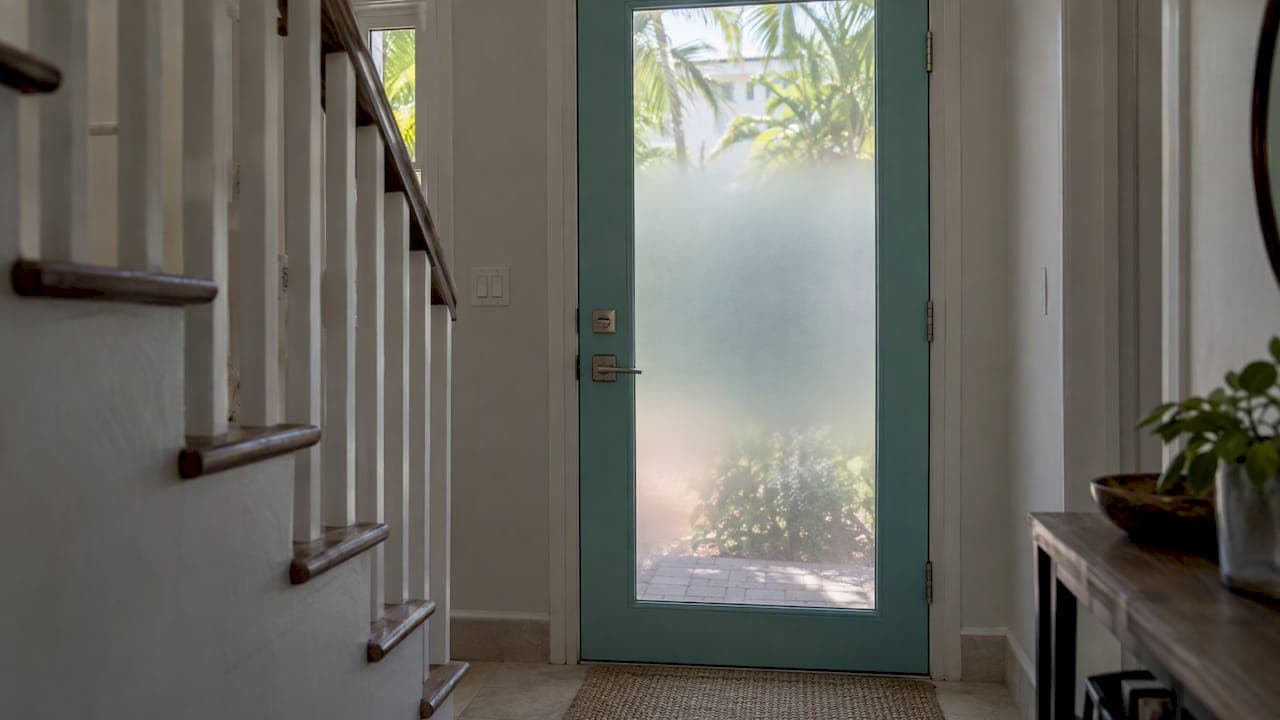
The fastest way to add privacy to a glass front door is frosted window film applied to the inside of the glass. It blocks the view in, keeps daylight coming through, and costs far less than replacing the door or its glass panels. Film is not the only answer, though. Textured glass, mirror film, blinds between the panes and cellular shades all work, and each fits a different door and a different kind of neighbor.
Below you will find how each option works, how to choose, how to install film without bubbles, and when to skip film completely. We tint glass in Miami-Dade every day, so we also cover what South Florida sun does to films on a door.
TL;DR
- Frosted film gives privacy day and night while letting light in. Mirror film gives daytime privacy and lets you see out, but it flips at night when the lights are on inside.
- Measure the glass, clean it well, apply on cool glass out of direct sun, and use a squeegee from the top down.
- Film is not right for every door. Cracked, etched, leaded, plastic or very old glass is a poor fit, and impact-rated doors should be checked with the door maker first.
- If you do not want to touch the glass, textured glass inserts, blinds between the panes or cellular shades are good alternatives.
- We tint glass on site across Miami-Dade. If you are not sure what suits your door, call or request a quote and we will talk it through.
Table of Contents
- What you are really choosing: privacy, light and view
- Frosted film: the default choice for a front door
- Mirror, matte and blackout films
- Glass built for privacy
- Is your door glass suitable for film?
- How to apply privacy film to a front door
- Alternatives that do not touch the glass
- Which option fits your door
- Our perspective
- Want a pro to handle your glass?
- FAQ
- Sources
What you are really choosing: privacy, light and view
Before you pick a product, decide which of three things matters most. Most disappointment with door privacy comes from not answering this first.
- Privacy at night. Anything that only reflects light works in daytime. Once you turn on a lamp in the hall, people outside can see in. Only frosted, textured, patterned or opaque treatments hold up after dark.
- Natural light. A dark entry hall feels smaller. Frosted and textured options scatter light instead of stopping it.
- Seeing out. If you want to check who is on the porch without opening the door, you need a partial-view pattern, a mirror-type film or a shade you can raise.
Lowe's installation guide draws the same line: privacy-control film restricts daytime views into a home, while frosted films improve privacy during both day and night. That one sentence settles most front door decisions. If the glass faces the street and your hallway is lit in the evening, you want frosted or patterned, not mirror.
Frosted film: the default choice for a front door
Frosted film gives glass the look of sandblasted or etched glass. It is the most common fix for good reason: it is inexpensive, it is easy to cut, and it stays put.
Store listings describe two types:
- Static cling film. No adhesive. It sticks with water or its own cling and can be peeled off and reused. Lowe's describes adhesive-free etched film as removable, trimmable and suitable for continued privacy while admitting natural light. Good for renters and for trying a look.
- Adhesive frosted film. It bonds to the glass and tends to last longer. Home Depot's listing for an adhesive frosted option positions it as a way to stop people seeing inside without blocking sunlight, installed as a weekend project.
If you want something more decorative, patterns help. Lowe's notes that frosted films obscure the view while letting light filter through, and that stained-glass films give a colorful alternative.
Gradient and partial patterns
Full frosting is not the only look. Professional-grade glass finishes come in gradations. 3M's FASARA Glass Finishes control light and privacy, and its gradation designs range from high transparency to high opacity. On a door with a tall panel, a gradient that is dense at eye level and clearer at the top keeps the room feeling open while still hiding your hallway from the walkway.
Mirror, matte and blackout films
If your goal is a view out with no view in, look at reflective films. 3M's privacy film range includes Matte, Blackout and Mirror options: White Matte offers subtle privacy, Blackout provides the ultimate in privacy, and Mirror has very high reflection.
The trade-offs are simple:
| Option | Daytime privacy | Night privacy | See out? | Light into the house |
|---|---|---|---|---|
| Frosted or etched film | Yes | Yes | Blurry shapes only | High |
| Gradient or patterned film | Partial to high | Partial to high | Depends on pattern | Medium to high |
| Mirror film | Yes | No, when lights are on inside | Yes | Medium |
| Blackout film | Yes | Yes | No | Very low |
We come at this from a tint shop, and the same physics applies to a car. A reflective film works because the outside is brighter than the inside. When that flips at night, so does the privacy. Lowe's agrees that mirrored films provide daytime privacy while allowing outside views, which is exactly why they pair best with a second layer such as a blind or curtain for evenings.
Our window tint clarity guide explains how clarity and darkness differ on glass in general, which helps when you compare samples.
Glass built for privacy
Sometimes the better fix is not a film at all. If you are buying or replacing a door, privacy can be built in.
- Textured privacy glass. ODL explains that textured privacy glass combines texture and partial opacity to admit natural light while making it hard to see into the home, on a scale from clear level 0 to high-privacy level 10.
- Patterned or decorative glass. Reeded, rain or beveled designs hide detail and add style.
- Blinds between the glass. ODL also lists enclosed blinds sealed between panes. You tilt or raise them, and there is nothing to clean or snag.
The door glazing options on a major retailer's qualification chart show the same range. Privacy or textured glass, frosted glass, miniblinds and opaque glass appear as separate door-glazing choices, so privacy can be specified at purchase.
The catch is cost. Homeowners in forums often report quotes in the hundreds of dollars per panel to swap glass, which is why film remains the budget route. If your door is in good shape, film gets you most of the result for a fraction of the price.
Is your door glass suitable for film?
This is the section most guides skip. Film does not suit every pane, and the manufacturers say so.
Gila's U.S. instructions say its architectural film goes on the inside surface of standard 1/8-inch glass, including removable storm panes and patio or French doors. The same document says not to apply it to:
- cracked, deeply scratched or flawed glass,
- frosted, etched or leaded glass,
- plastic or plexiglass,
- triple-pane windows,
- glass more than 40 years old.
That last list matters on a front door. Leaded or beveled decorative lites, old transom glass and plastic storm-door panels are all common.
Heat is the other concern, and it is a big one in South Florida. 3M's application bulletin says its FASARA films are for flat glass and generally for indoor use, and it warns that dark patterns on sun-exposed glass can risk breakage depending on the glass and conditions. A west-facing door in Kendall or Homestead gets hard afternoon sun. Choose lighter patterns there, or ask the film manufacturer whether your glass type and exposure are covered.
Impact-rated doors deserve a separate note. Many Miami-Dade homes have doors with laminated, impact-rated glass sold as a tested system. Before you apply anything, read the door maker's care and warranty information, or ask the installer who supplied it, so you do not void coverage by mistake.
How to apply privacy film to a front door
A wet application is forgiving and gives the cleanest result. The steps below follow Lowe's installation guide and the 3M bulletin, which both describe wet installation with a squeegee.
- Check compatibility. Confirm the film is made for your glass and read the instructions on the package.
- Measure twice. Measure the visible glass, not the frame. Lowe's also stresses accurate measuring before buying so the finished job fits neatly. Buy a sheet a bit larger and trim.
- Clean the glass thoroughly. Dust and grit under film leave bumps. Scrape any stickers and wipe the edges.
- Work out of the sun. Apply to cool glass in the shade. Lowe's recommends a helper for large sheets.
- Wet the glass and film. Use application solution or water with a few drops of mild detergent.
- Apply from the top down. Position the film, then squeegee from the center outward. A flat tool such as a credit card helps push out bubbles near the edges.
- Trim and let it cure. Cut a hair inside the frame edge. Avoid scrubbing the film for the first days.
If you want another walk-through of measuring and applying film on glass, this DIY windshield tint strip guide covers the same prep habits. Our own article on preparing your home before window tint lists how to clear the space ahead of a professional visit.
A tip from the shop: practice on a small scrap of glass or a spare picture frame first. Film that creases while you learn is cheaper than a ruined full sheet.
Alternatives that do not touch the glass
Not everyone wants film, and renters often cannot use it. These options leave the door as it is.
Curtains and shades
A sheer panel on a rod across the glass is the old reliable fix. For something more functional, the U.S. Department of Energy says cellular shades provide privacy and daylight control, with up to 20% heating-energy savings and up to 15% total heating and cooling energy savings compared with having no shades. Those figures are from a study of homes with a mix of climates, so treat cooling savings in Miami as a bonus rather than a promise. Door-mounted shades must be fixed at the top and bottom, or they swing every time the door opens.

Frosted spray or etching cream
If you want permanent frosting and you are sure, HGTV describes frosted-glass spray paint as a permanent solution and etching cream as permanent and irreversible. It also advises testing the cream on a sample piece of glass first. We would only recommend these on glass you are prepared to replace.
Switchable privacy film and smart glass
For privacy on demand, there is film that goes from frosted to clear with power. Home Depot's Smart Tint listing describes switchable film that is frosted and opaque when off and clear when on. It needs a wired power supply, which is a real consideration on a front door that opens and closes. At the larger scale, the U.S. Department of Energy notes that dynamic windows can change light and solar transmittance while maintaining natural light and views. It is a premium route, not a quick fix.

Which option fits your door
Use this quick guide.
| Your situation | Best fit |
|---|---|
| Street-facing door, lit hall at night | Frosted or patterned film |
| Want to see the porch from inside | Gradient film, or mirror film plus a blind |
| Renting | Static cling film or a curtain |
| Replacing the door soon | Textured glass or blinds between the glass |
| Old, leaded or cracked glass | Curtain, shade or glass replacement, not film |
| Hot west-facing door | Lighter patterns, and check the manufacturer's guidance |
Our perspective
We are a mobile tint shop, so most of our work is on cars, SUVs and trucks, plus select residential and commercial jobs across Miami-Dade. That means we spend our days with film, glass and South Florida sun, and a few lessons carry over to any glass, including a front door.
First, prep decides the result. Almost every bubble, speck or lifted edge we see traces back to dirty glass or a rushed install. Second, the sun here is strong. Film that looks fine in a cool garage behaves differently on glass that sits in direct light all afternoon, so matching the film to the exposure matters. Third, quality film matters more than a thicker price tag. We install 3M and Iviron KoolMax films, and we pick the film for the job rather than pushing the darkest one.
For your door, our advice is simple. If your glass is in good shape and you want an inexpensive result, a frosted film on the inside is a good start. If the glass is old, decorative or impact-rated, slow down and check first. And if you would rather have a professional handle residential glass, we are happy to look at it.
— Jose
Want a pro to handle your glass?
We come to you across Miami, Kendall, Homestead, Cutler Bay and Pinecrest. We offer residential window tinting as well as mobile tinting for cars, with 3M and Iviron KoolMax films and quick online quoting. Tell us about your glass and what you want to solve, and we will tell you what we can do. Get a quote from South Miami Tint or see the 3M films we install.
If your goal is privacy for a vehicle too, our guides on car privacy upgrades and SUV cargo privacy tint cover the same ideas for your SUV or truck.
FAQ
How do I make my front door glass not see through?
The simplest way is frosted window film on the inside of the glass. It blocks the view in while letting daylight through. Patterned film, textured glass inserts, blinds between the panes and curtains also work.
Can I see out but keep people from seeing in?
Yes, in daylight. Mirror-type films reflect light so people outside see a reflection while you see out. At night with lights on inside, the effect reverses, so add a blind or curtain for evenings, or choose a gradient film that keeps partial privacy after dark.
What type of glass is best for front door privacy?
Textured or patterned privacy glass is the most common built-in choice, since it admits light and obscures detail. ODL rates textured glass on a scale from 0 (clear) to 10 (high privacy), so compare levels in person. Blinds sealed between the glass are another option if you want adjustable privacy.
Will privacy film damage my door glass?
On standard, sound glass it generally will not, but manufacturers list exceptions: cracked, etched, leaded, plastic and very old glass, among others. Dark patterns in strong sun can also stress some glass. Read the film maker's instructions, and check with your door manufacturer if the glass is impact-rated.
Sources
- How to Apply Window Film, Lowe's
- Decorative Storm Doors Ideas, Lowe's
- Artscape Etched Glass privacy film, Lowe's
- Gila 4 ft. x 6.5 ft. Frosted Privacy Window Film, Home Depot
- Smart Tint switchable film, Home Depot
- 3M FASARA Glass Finishes Gradation
- 3M Privacy Film
- 3M FASARA Glass Decorative Film instruction bulletin
- Gila installation instructions
- Glass Front Door Privacy: Tips and Tricks, ODL
- 2020 Energy Star Qualification Chart
- How to Frost Glass, HGTV
- Interior Cellular Shades Boost Home Energy Performance, U.S. Department of Energy
- Better Windows, Better Outcomes: How Electrochromics, U.S. Department of Energy
- DIY Windshield Tint Strip guide