
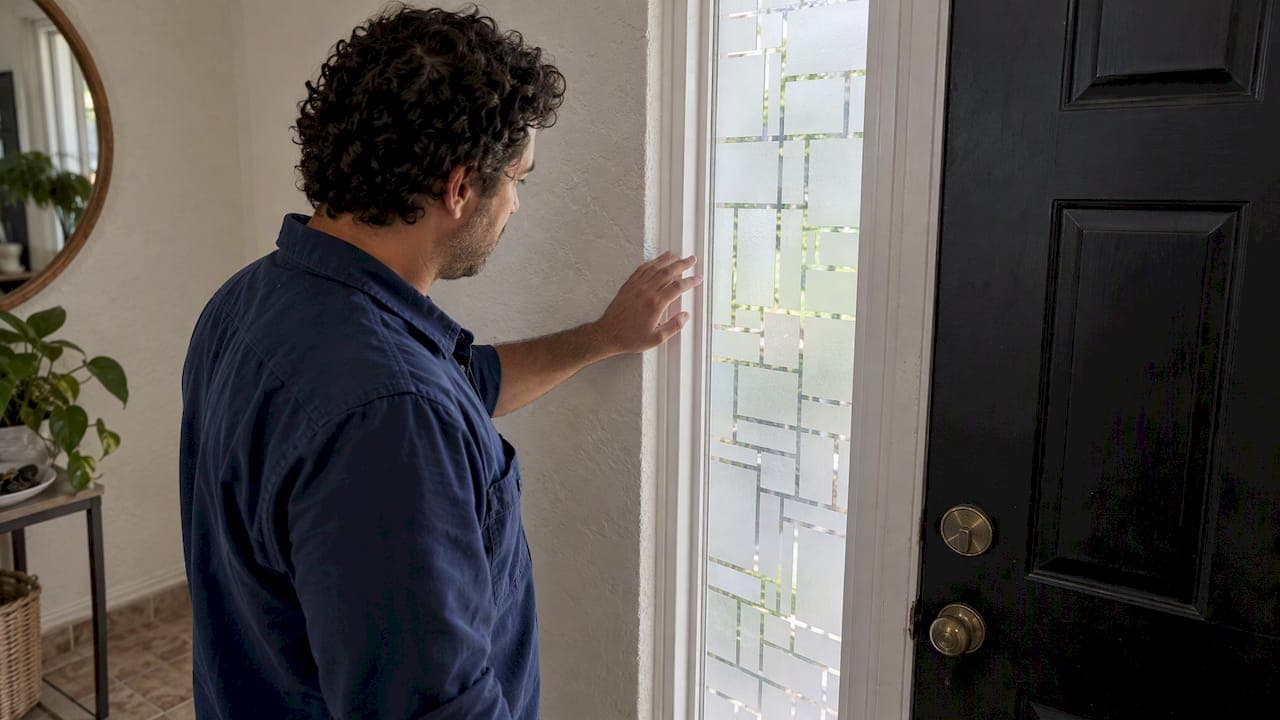
For most homeowners, a decorative frosted or embossed static-cling film is the best sidelight privacy film. It hides detail and keeps daylight flowing into your entry. Choose adhesive or performance-grade film when you want a permanent finish, firm edge adhesion, or glass-holding safety. Below, we cover styles, measuring, installation, and care.
TL;DR:
- Frosted and embossed films can reveal silhouettes after dark when interior lights are on; add a shade or use denser eye level coverage.
- Measure each sidelight at the top, middle, and bottom, use the smallest reading, and measure divided panes separately before cutting film.
- Decorative film does not hold broken glass together; choose safety film professionally anchored to the frame when impact protection is required.
- Static cling may not adhere to heavily textured glass, and some performance films can stress insulated units, so confirm glass type before buying.
- Heat rejecting film can improve comfort in a sunny south or west facing foyer, but sidelights alone will not transform energy bills.
Table of Contents
- Which decorative finish gives you the privacy you want?
- How do you measure sidelight glass for film?
- Static-cling, adhesive, or professional installation?
- Will you still have privacy at night?
- How do you match pattern and scale to your door?
- How do you clean and care for sidelight film?
- What does sidelight film cost: DIY kit or professional service?
- How durable and scratch resistant is sidelight film?
- Does sidelight film block UV and reject heat?
- Will film work on your glass and your door material?
- Can film lower your cooling costs?
- What do homeowners ask most about sidelight film?
- Installer perspective: when should you hire a pro?
- South Miami Tint brings sidelight film installation to your door
- FAQ
- Sources
Which decorative finish gives you the privacy you want?
Sidelights are narrow, so the finish you pick decides how bright your entry feels and how much passersby can see. Here is how the main styles compare:
- Frosted or etched: A smooth, milky look that blocks detail and passes most daylight. This is the usual semi-privacy choice and suits modern doors.
- Embossed or textured: A raised pattern that bends light and blurs shapes. It hides more than plain frost while still glowing in daylight.
- Patterned: Stripes, geometric lines, or floral motifs. Privacy depends on how dense the pattern is.
- Stained or leaded style: Colored or beveled looks that add character. They give strong privacy but let in less light.
By day, frosted and embossed films read as soft, bright glass from the street. At night, with your lights on, any finish shows more of the inside. Craftsman and traditional doors pair well with stained or leaded looks, while clean frosted film fits modern entries.
How do you measure sidelight glass for film?
Accurate measuring is the step most people rush, and it causes most wasted film. Narrow panels leave little room for error.
- Measure the visible glass left to right at the top, middle, and bottom, since frames are rarely perfectly square.
- Measure top to bottom on both edges of the glass.
- Subtract a small amount from each dimension so the film sits just inside the frame reveal.
- If your sidelight has muntins or divided panes, measure each pane on its own.
- Compare your numbers to common kit sizes before you buy or cut.
You will see off-the-shelf kits in sizes made for narrow sidelight windows. The Gila frosted sidelight film, for example, is a static-cling kit sold at 12" x 78" for narrow sidelights. Have a tape measure, a squeegee, a sharp utility knife, a straightedge, and a spray bottle ready.
Pro Tip: Use the smallest measurement you find, not the average, and cut the film slightly oversized only if you plan to trim in place.
Static-cling, adhesive, or professional installation?
Each method fits a different goal. Pick by how permanent you want the result and how much precision you need.
- Static-cling film: It needs no glue, so you can remove or reposition it, which makes it a good fit for renters. Most marketplace sidelight kits use this style in standard sizes and describe it as safe for homes with kids and pets. Expect the installation to take some time per sidelight, since you wet the glass, apply the film, and squeegee out the water.
- Adhesive film: It bonds to the glass, holds its edges better, and looks cleaner over the long run. It is the better choice for a permanent change.
- Professional installation: We computer-cut film to fit your glass, and an entry with sidelights can often be finished in a few hours. A pro install also makes sense when you want safety-grade film anchored to the frame.
That last point matters. Safety and security films can hold broken glass together on impact, which reduces dangerous shards. Decorative films do not make that promise. If glass-holding safety is on your list, choose a performance-grade film and have it installed properly.
Will you still have privacy at night?
Privacy from a film depends on lighting. During the day, a bright exterior makes the glass hard to see through. After dark, the situation flips: lights inside can make a frosted panel glow, and shapes may show from the street.
Finishes behave differently:
- Frosted and embossed: They keep rooms bright while hiding detail, but they offer limited protection when your interior lights are on.
- Dense patterns and stained looks: They block more light and more view, which helps at night but darkens the entry.
- Layered solutions: Pair film with an interior shade or sheer panel for evenings.
- Lower-panel privacy: Choose denser coverage at eye level and lighter coverage above.
Light matters more than the film itself. Eye-level views through a sidelight happen when you are lit and the street is dark, so plan for the evening, not just the afternoon. Safety and performance films can add privacy while staying visually subtle, which suits homeowners who want a clear-looking pane with a quiet benefit. Our thermal reduction tinting guide explains how film choices affect light and comfort.
How do you match pattern and scale to your door?
Start with your door. A smooth, painted modern door looks best with simple frosted film. A traditional or craftsman door can carry a leaded or stained style.
- Keep patterns simple on narrow panels. Dense, busy designs can look crowded on a 7- or 12-inch sidelight.
- Prefer vertical motifs so the pattern follows the shape of the glass.
- Try privacy zoning: an opaque lower section and a lighter upper section keep daylight high and nighttime views limited.
- Order custom-sized or custom-printed film when your sidelight is an unusual size or you want a pattern to line up across panels.
Pro Tip: Tape a printed sample or a sheet of plain paper to the glass first, and look at it from the street before you commit.
How do you clean and care for sidelight film?
Use mild soap, water, and a soft cloth and follow streak-free method for UK owners to keep your glass clean and clear. Skip abrasive cleaners, scrub pads, and razor blades, which scratch film and lift adhesive. A soft squeegee or microfiber cloth handles most streaks.

If a static-cling film forms bubbles, lift a corner, re-wet, and smooth it out with the squeegee. Never scrape adhesive film. Check edges regularly, and replace or reseal film if corners curl. Store leftover film flat, rolled loosely, in a cool, dry place.
What does sidelight film cost: DIY kit or professional service?
The price shape is simple. A DIY static-cling kit costs the least up front and asks for your time. A professional service costs more but includes measuring, cutting, and a clean finish.
With a DIY kit, you pay for the film and a basic tool set. If you measure wrong or a bubble ruins a sheet, you may buy a second kit. Adhesive and performance-grade films cost more per square foot, and the higher-grade versions add the glass-holding benefit discussed above.
With professional installation, you pay for labor and precision. That covers on-site measuring, computer-cut fitting, and application that avoids dust, creases, and gaps at the edges. It also means you skip the learning curve on your front entry, the most visible glass on your home.
Weigh three things: how permanent you want the change, how visible your mistakes would be, and how much your time is worth. For a quick, removable fix on one panel, a kit is hard to beat. For a lasting result across multiple sidelights, a pro job often costs less than redoing a ruined film. We publish pricing for our vehicle packages, such as 2 front windows from $150, but residential pricing is available on request after we see your glass.

Our post on DIY versus professional tinting walks through the same trade-offs for car glass, and the logic carries over to your door.
How durable and scratch resistant is sidelight film?
Durability depends on the type of film. Static-cling film is the gentlest and the most temporary. It can show wear sooner, especially near edges, and it may peel if the glass is not clean when you apply it.
Adhesive film lasts longer. Because it bonds to the glass, it resists lifting and stays put through regular door traffic. Sidelights sit close to the door, so they take bumps from bags, pets, and cleaning more often than a window across the room.
Scratch resistance varies by product. Textured and embossed finishes tend to hide fine marks better than a smooth frosted surface, where a scratch can show as a bright line. Performance-grade films often include tougher surface layers, which is one reason they suit high-traffic entries.
A few habits extend the life of any film:
- Clean with a soft cloth and mild soap only.
- Keep keys, rings, and sharp objects away from the glass.
- Do not use blades or scrubbing pads near the film.
- Inspect edges regularly and fix small lifts early.
With normal care, a well-installed adhesive film keeps its look for a long time, and a static-cling film gives you easy replacement when you want a new style.
Does sidelight film block UV and reject heat?
Sidelights face the weather head-on, so sun exposure is a real concern. Direct light fades floors, rugs, and furniture near your entry, and glass can make the foyer feel warm.
Decorative frosted film softens glare, but it is not designed as a heat-control product. Performance films are. Ceramic films, for example, are built to cut UV and reject heat while staying clear or lightly toned. That is the material difference between a pattern for looks and a film for comfort.
Which should you pick? If your sidelights get hard afternoon sun, a performance film can protect what is inside and cut the heat you feel near the door. If your main goal is privacy and soft light, decorative film does the job.
We work with premium films for this reason, including 3M Ceramic IR, 3M Color Stable, and Iviron KoolMax ceramic tints. You can read about 3M ceramic film and how it performs, and our thermal reduction guide explains heat-control choices in plain terms. Ask us which film fits the exposure on your entry, and we will point you to the right one.
Will film work on your glass and your door material?
Most films work on standard clear glass, which is what you find in most sidelights. Clean, flat glass gives the best bond for both static-cling and adhesive films.
Check a few things before you buy:
- Textured or patterned glass: Static-cling needs a smooth surface, so it may not hold on heavily textured panes. Adhesive film may behave differently on uneven glass, so ask before you commit.
- Double-pane and insulated units: Some performance films can add heat stress to certain glass. Confirm the glass type and the film's guidance first.
- Decorative or beveled glass: Film can cover it, but it hides the detail you paid for.
- Door and frame material: Wood, fiberglass, and steel frames all work. Film touches only the glass, but trimming near painted or stained frames needs a steady hand so you do not mark the finish.
If you are unsure about your glass, take a photo and a measurement and bring it to a pro. We look at the glass on site, which removes the guesswork and protects both your glass and your door.
Can film lower your cooling costs?
It can help, but the effect depends on the film. A frosted decorative film mostly changes how your entry looks. A heat-rejecting performance film changes how much solar heat passes through the glass.
For sidelights, the gain is real but modest, because these panels are small compared with large windows. You will feel the difference most in a sunny foyer where the door faces south or west. Cutting heat and glare near the entry can make that space more comfortable and ease the load on your cooling system a little.
Keep expectations honest. A sidelight film will not transform your energy bill on its own. Treat it as one small piece of a plan that includes shades, weatherstripping, and window film on larger glass. If energy savings matter most to you, look at a ceramic film and consider the other windows facing the sun.
We install residential film across a range of glass, and we can tell you whether sidelights alone are worth treating or whether larger windows should come first. Our ceramic window tint page shows a premium option for mobile residential installs.
What do homeowners ask most about sidelight film?
A few questions come up on nearly every project.
Can I take the film off later? Static-cling film peels off cleanly. Adhesive film can be removed, but it takes more effort and care, and we also handle old tint removal.
Will it make my entry dark? Frosted and embossed films keep most daylight. Stained and dense patterns darken the space more.
Is it safe around kids and pets? Many sidelight kits describe themselves as family-friendly, and film leaves no loose parts on the glass.
Can I do it myself? Yes, for a single panel with simple glass and a patient hand. Complex layouts and safety film go better with a pro.
Will it change how my door looks from the street? Yes, and that is the point. Check a sample from the curb before you commit.
How long does it take? Plan for some time per sidelight for DIY and a few hours for a professional entry install.
Installer perspective: when should you hire a pro?
Failed DIY jobs often come from habits such as inaccurate measuring, rushing the squeegee step, and ignoring the frame. Hire a pro for safety film, divided panes, permanent adhesive installs, or any job where you want a flawless finish. On a mobile visit, we measure on site, cut to fit, and apply, so you see the result before we leave. We stand behind this view because it comes from the work, not from a sales script.
— Jose
South Miami Tint brings sidelight film installation to your door
When you want a perfect fit without the guesswork, we come to you. South Miami Tint offers mobile residential window-film installation with premium films, including 3M Ceramic IR, 3M Color Stable, and Iviron KoolMax. Choose us when you want a permanent result or clean alignment across tricky sidelights.
- On-site measuring, so nothing is ordered to the wrong size
- Computer-cut fitting for tight, even edges
- Premium film options for privacy, heat, and UV
- A clear timeline before we start
Visit our 3M window tinting page to see the films, then request a quote and we will schedule a visit at your home.
FAQ
How do you cover sidelights for privacy?
The simplest way is a frosted or embossed static-cling film that you apply yourself. It hides detail while letting daylight through. For a permanent result or added safety, an adhesive film installed by a pro works better.
What is the best sidelight window film?
For most homes, a frosted or embossed sidelight film in a size made for narrow panels is the best fit. Choose a performance-grade adhesive film when you also want heat control, UV protection, or glass-holding safety.
What is the best privacy film that still lets in light?
Frosted and embossed films keep the most daylight while hiding views. Dense patterns and stained styles give more privacy but let in less light, so match the finish to how bright you want your entry.
What are the disadvantages of window privacy film?
Privacy film can reduce visibility at night when your lights are on, and static-cling film is less permanent than adhesive film. Check your glass type and plan evening privacy with a shade if needed.