
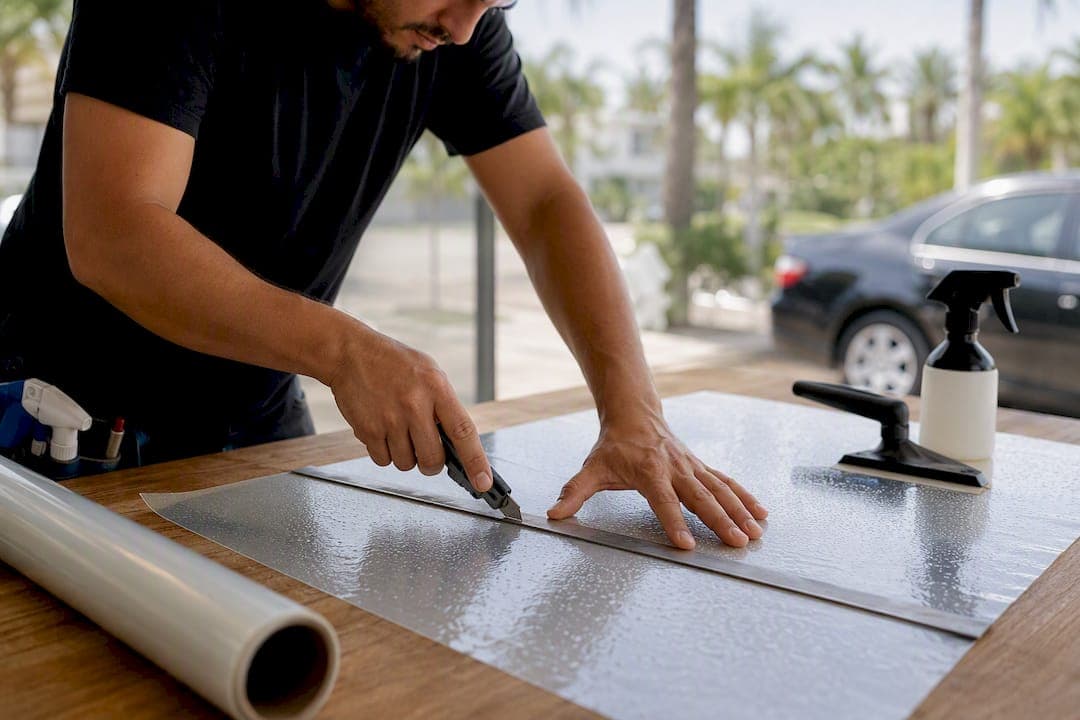
Privacy window film is a thin adhesive layer applied to glass that blocks, blurs, or reflects the view through a window while still letting daylight into the room. That's the core function, but the detail most people miss is timing. Reflective films work by relying on a light differential, meaning the daytime privacy you love can flip at night once your interior lights are brighter than the daylight outside.
Beyond privacy, most films add a few practical perks:
- UV reduction, which protects skin and furniture from sun damage
- Glare and heat control, which can ease strain on your AC
- Decorative options that dress up plain glass without full-time coverage
Pro Tip: If you need privacy around the clock, don't rely on a transparent reflective film alone. Pair it with blinds, curtains, or an opaque film for the hours after dark.
Key Takeaways
Privacy window film works by manipulating VLT and external reflectance, which is why daytime privacy from reflective films can reverse once interior lights outshine the sun.
| Point | Details |
|---|---|
| Definition matters | Privacy film is a thin adhesive layer that blocks or reflects views while still admitting daylight. |
| Day and night differ | Reflective films rely on a light differential, so privacy often flips once interior lights turn on at night. |
| Match type to need | Frosted suits daylight privacy, blackout suits 24/7 privacy, and ceramic balances heat control with clarity. |
| Ask for the specs | Request VLT, external reflectance, and SHGC figures instead of trusting a marketing name. |
| Installation affects results | Professional installation avoids common DIY defects and unlocks higher-performance ceramic films. |
Table of Contents
- Privacy Window Film Types and When Each One Makes Sense
- The Optics Behind Privacy: VLT, Reflectance, and SHGC
- Benefits and Downsides You Should Weigh Before Buying
- How to Choose the Right Privacy Film for Your Windows
- Installation and Upkeep: What Actually Affects Longevity
- Why Metrics Beat Marketing Names When Picking Privacy Film
- Frequently Asked Questions
- Sources
Privacy Window Film Types and When Each One Makes Sense
Not every window has the same job to do, and film type should follow function. Here's how the main categories break down.
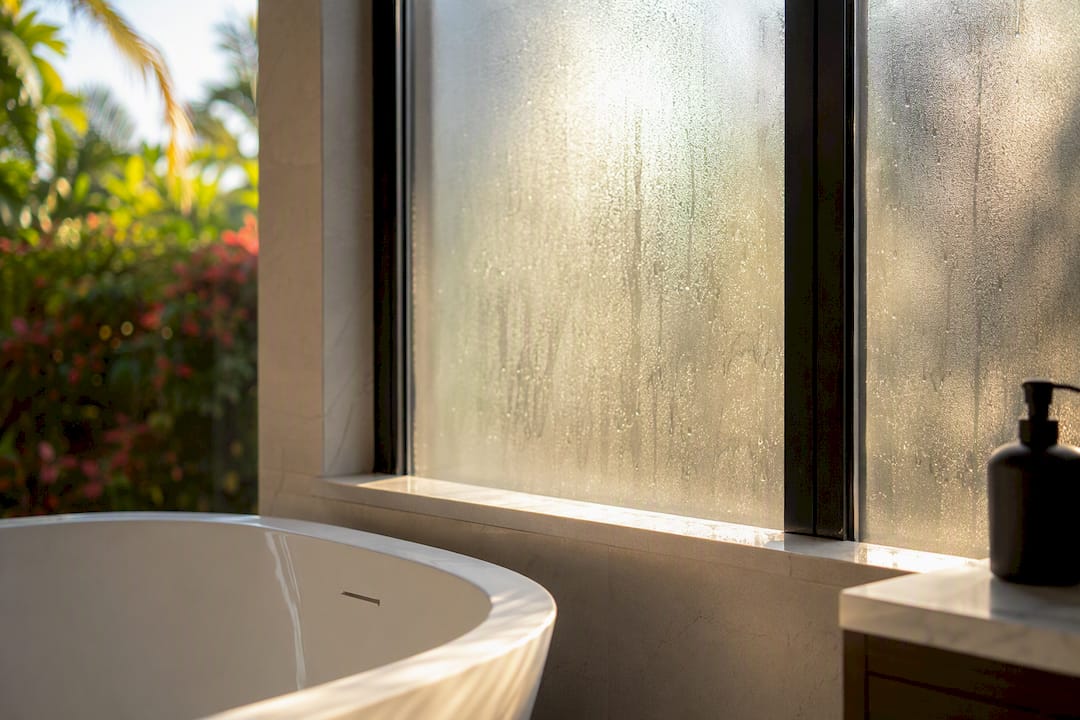
Frosted or translucent film works well for bathrooms, home offices, and street-facing doors where you want daylight but zero clear sightline. It scatters light rather than blocking it, so the room still feels bright, and it looks the same day or night since it doesn't depend on a light differential.
Tinted films, whether dyed or ceramic, add a layer of shading that softens glare and cuts interior heat while still allowing a partial view. Ceramic versions in particular manage heat rejection without the signal interference that older metallized films sometimes caused with cell phones, GPS units, or garage door remotes.
Reflective or one-way mirror films are the classic choice for street-level windows and storefronts. During the day, they turn glass into a mirror from the outside, but that effect reverses once darkness falls and interior lights turn on. Treat these as a daytime tool, not a 24-hour solution.

Blackout or opaque films deliver full privacy at any hour because they don't depend on light levels at all. The trade-off is real: you give up any outward view, which makes them better suited to storage rooms, conference rooms, or windows you never need to look through.
Decorative and specialty films, including micro-perforated and patterned designs, sit somewhere between function and design. Micro-perforated versions let you see out while the outside view in is broken up, and patterned films soften a window's look without going fully opaque.
Window film construction generally falls into dyed, metallized, ceramic, or nano categories, and that base material determines how much heat, UV, and visibility each type actually controls.
The Optics Behind Privacy: VLT, Reflectance, and SHGC
Three numbers explain almost everything about how a film behaves, and asking for them beats trusting a marketing name.
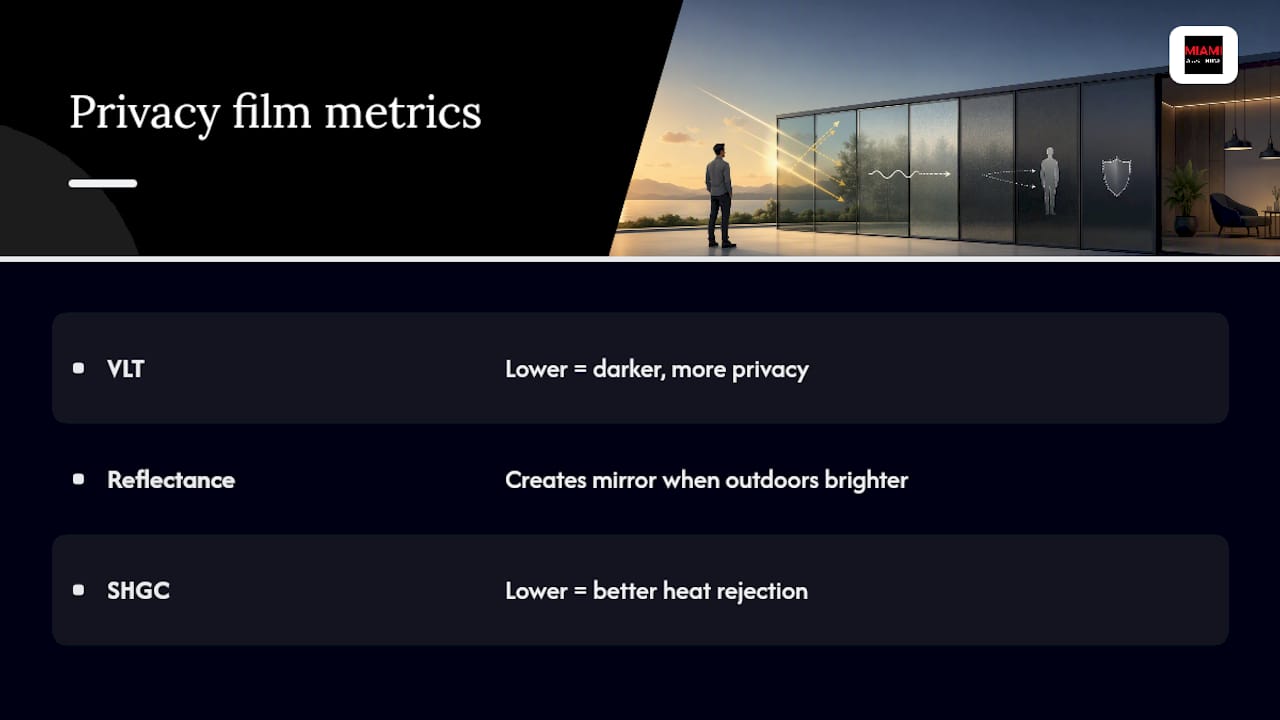
Visible Light Transmission (VLT) measures the percentage of visible light that passes through the film. A lower VLT generally means a darker interior and stronger privacy, since less light gets through for someone outside to see by. Very low VLT films can make rooms feel noticeably dimmer, so there's a real trade-off between privacy and natural light.
External reflectance is what creates the mirror effect on metallized and reflective films. A thin metallic layer bounces sunlight back outward, which is exactly the mechanism behind daytime one-way privacy. The catch is that reflectance only wins when outdoor light is stronger than indoor light. Once the sun goes down and your lamps come on, the balance tips and the glass turns transparent from outside looking in.
Solar Heat Gain Coefficient (SHGC) measures how much solar heat passes through the glass and film combined. A lower SHGC means better heat rejection, which matters if you're choosing film partly to ease your cooling bill.
Picture a ground-floor office with reflective film and no blinds. At 2 PM, anyone walking by sees only their own reflection. At 9 PM, with the desk lamp on and the parking lot dark, that same window shows the whole room clearly from outside. Same glass, same film, opposite result, purely because the light differential flipped.
Benefits and Downsides You Should Weigh Before Buying
Privacy film earns its reputation for good reason, but it isn't the right fix for every window.
What it does well:
- Delivers strong daytime privacy without curtains or blinds
- Cuts UV exposure and reduces glare on screens and furniture
- Can lower solar heat gain, trimming cooling costs in sunny rooms
- Comes in decorative patterns that double as design elements
Where it falls short:
- Reflective films lose their privacy effect at night, as covered above
- Opaque and blackout films sacrifice any outward view permanently
- Cheap films can bubble, fade, or peel well before quality ceramic options
- Older metallized films occasionally interfere with radio or GPS signals
Blinds and smart glass still make sense for rooms needing total light control or flexible on/off privacy. Film wins when you want a permanent, maintenance-free layer that works without anyone touching a switch or cord.
How to Choose the Right Privacy Film for Your Windows
Start with one question: do you need privacy during daylight hours only, or all day and night? That single answer eliminates half the options immediately.
- Decide your privacy window. Daytime-only needs open the door to reflective or tinted film; round-the-clock needs point toward frosted, blackout, or a film-plus-blinds combo.
- Set a target VLT. Lower numbers mean more privacy but a dimmer room, so match it to how much natural light you're willing to trade.
- Ask about external reflectance. This tells you how strong the mirror effect will look from the street or yard.
- Request SHGC or total solar energy rejection figures if lowering your cooling load matters as much as privacy.
- Pick your material family. Ceramic film costs more upfront but resists fading and avoids signal interference; dyed film is budget-friendly but shorter-lived.
- Check HOA rules and get a warranty in writing before committing, especially for street-facing or commercial glass.
Pro Tip: Bring these six answers to any installer quote. A supplier who can't give you VLT and SHGC numbers on request usually isn't working with lab-tested film.
If you want a walkthrough of matching film type to a specific room, the privacy film selection workflow breaks the process down room by room.
Installation and Upkeep: What Actually Affects Longevity
DIY film kits exist, and they're fine for a short-term decorative project on a budget. But bubbles, trapped dust, and creases are common outcomes when film goes on without the right tools or a dust-free workspace, and those flaws don't smooth out over time.
Professional installation solves that, and it typically unlocks access to higher-performance ceramic and multi-layer films that aren't practical to self-apply. A pro handles proper glass prep, matches film to your specific window type, and backs the job with a manufacturer warranty.
Once installed, upkeep is simple: clean with a soft cloth and mild, ammonia-free solution, and skip abrasive scrubbers. Quality film can last well over a decade with basic care. Price mostly comes down to window count, film performance tier, and labor, so a single bathroom window costs far less than tinting an entire storefront.
- Bubbles and creases are the most common DIY failure points
- Ceramic and multi-layer films are generally professionally installed
- Ammonia-free cleaners protect the film's coating over time
- Cost scales with window count and performance tier, not a flat rate
Why Metrics Beat Marketing Names When Picking Privacy Film
Most film shopping goes wrong at the naming stage. Terms like "mirror tint" or "one-way glass" sound like guarantees, but they describe an optical effect that depends entirely on light conditions, not a fixed property of the glass. That's the biggest gap between what marketing implies and what physics delivers.
The smarter approach treats VLT, external reflectance, and SHGC as the real product spec, the same way you'd check horsepower on a car instead of trusting a trim name. A film labeled "premium mirror" with mediocre reflectance numbers will underperform a plainer-sounding film with better specs. Ask for the data sheet before you ask for a sample.
The other place conventional advice falls short is treating film as a one-and-done privacy fix. Reflective film handles daylight hours well, but anyone who needs privacy after sunset should plan for a second layer, whether that's blinds, interior shades, or an opaque film on specific windows. Pretending otherwise sets up a disappointing surprise the first night the lights go on.
For window tinting matched to your exact privacy and heat rejection goals, Southmiamitint installs 3M Ceramic IR, 3M Crystalline, 3M Color Stable, and Iviron KoolMax ceramic films on-site across Miami-Dade, for vehicles as well as select residential and commercial glass. Ceramic construction avoids the signal interference issues of older metallized films while still delivering strong daytime privacy and heat control, and mobile installation means you get a professional result without hauling your car or scheduling a shop visit. Ceramic mobile tint installations start from $249, and every job comes with proper prep and manufacturer-backed film, so you skip the bubbles and creases that come with a DIY kit.
Frequently Asked Questions
What does privacy window film mean exactly? It refers to any adhesive film applied to glass that obscures, diffuses, or reflects the view through the window, ranging from frosted diffusion to full blackout opacity.
Does privacy window film work at night? It depends on the type. Frosted and blackout films work the same day or night, while reflective one-way films lose their mirror effect once interior light exceeds exterior light, a limitation tied directly to how one-way privacy film is built.
Can I install privacy film myself? Basic decorative film is DIY friendly for short-term use, but bubbles and creases are common without a controlled, dust-free installation, and higher-performance ceramic films are typically installed professionally.
Will privacy film block heat as well as light? Yes, to a degree that depends on the SHGC rating. Tinted and ceramic films generally offer stronger heat rejection than basic frosted film, since heat control and light diffusion are separate properties of the same product.
How long does privacy window film last? Quality ceramic or multi-layer film can last well over a decade with gentle, ammonia-free cleaning, while cheaper dyed films are more prone to fading or peeling sooner.
Sources
- A Complete Guide to Privacy Window Film
- Window film — Wikipedia
- Efficient Window Coverings (PDF) — window film installation and performance guidance