
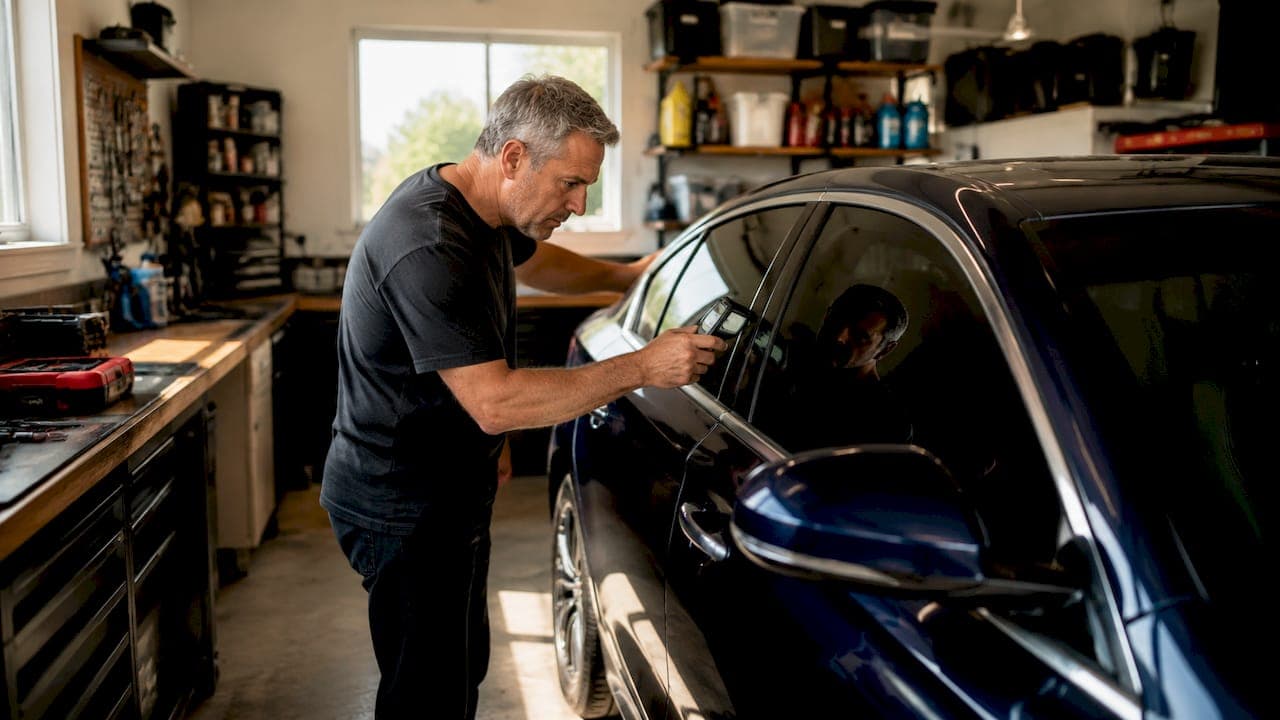
Window tint clarity defined is the optical quality of a tint film, meaning how sharply and cleanly you can see through it without distortion, haze, or blur. Most car owners focus on VLT percentage when shopping for tint, but that number only tells you how dark the film is. It says nothing about whether the film will distort your view, create halos around headlights, or look cloudy after six months. Brands like 3M, Llumar, and XPEL engineer their films specifically for optical clarity, and understanding why that matters will change how you evaluate every tint option.
What is window tint clarity defined in technical terms?
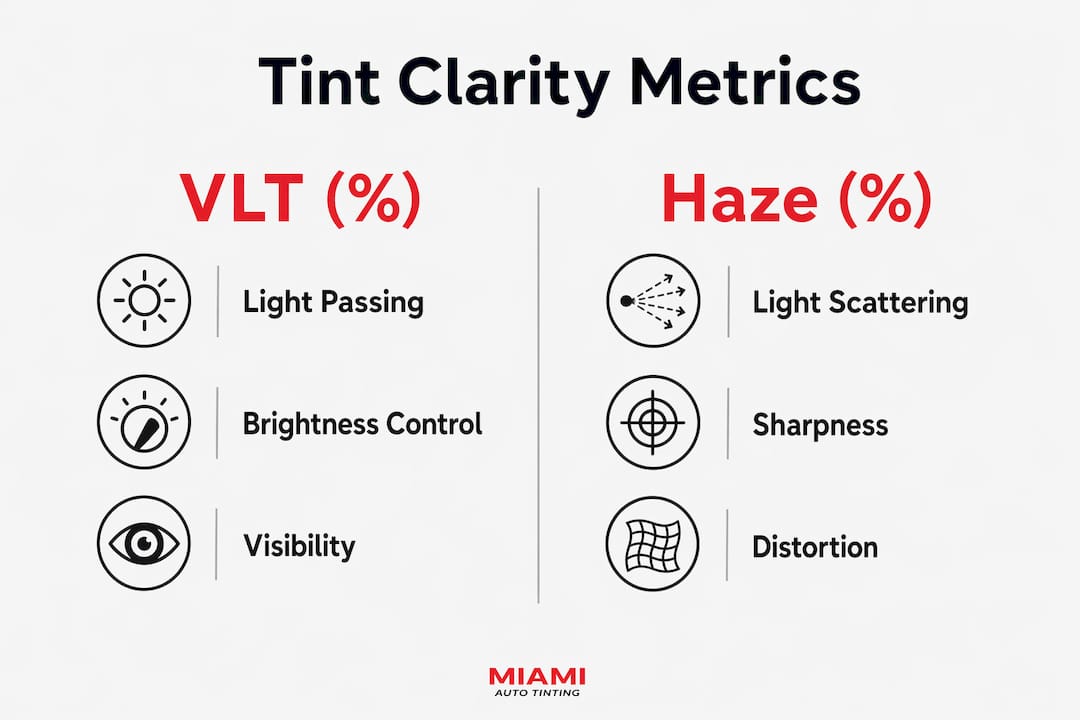
Window tint clarity is the ability to see through a film without blur, distortion, or haziness, assessed by checking for a uniform, smooth surface with no cloudiness or patchiness. The industry uses two primary metrics to quantify this: Visible Light Transmission (VLT) and optical haze. Most people know VLT. Far fewer understand haze, and that gap is where poor buying decisions happen.
VLT is the percentage of visible light that passes through a tinted window. A 5% VLT film is very dark, letting through only 5% of light. A 70% VLT film is nearly clear. Lower VLT means darker tint, but darkness and clarity are not the same thing.
Haze is a separate metric that measures the percentage of transmitted light deviating more than 2.5 degrees from its original path. High haze causes a milky, washed-out appearance and reduces the sharpness of what you see through the glass. Two films can share an identical VLT and still look completely different because one scatters light internally while the other does not.
Here is how the two metrics compare:
| Metric | What It Measures | Impact on Clarity |
|---|---|---|
| VLT (%) | Total light passing through | Controls darkness, not sharpness |
| Haze (%) | Light scattered beyond 2.5 degrees | Directly causes blur and milky look |
| Net VLT | Glass + film combined transmittance | Actual legal and visual outcome |
Pro Tip: Ask your installer for both the VLT and haze rating of any film you consider. A film with 35% VLT and low haze will look sharper than a 35% VLT film with high haze, even though they appear equally dark on paper.
Does installation quality affect window tint clarity?
A high-quality installation preserves film clarity as much as the quality of the tint product itself. You can buy the best ceramic film on the market and still end up with distorted, hazy windows if the installation is sloppy. Poor installation causes blurred spots, waviness, bubbles, and uneven shading, all of which directly impair optical clarity.
A properly installed film shows these characteristics:
- Uniform color with no patchiness or shading differences across the pane
- No bubbles trapped under the film surface
- Flat, smooth contact between film and glass with zero lifting at edges
- Clean, precise edges with no gaps or peeling
- No debris such as dust or lint particles visible under the film
Debris under the film is one of the most common clarity killers. Even a single piece of lint creates a distortion point that catches light and scatters it. Professional installers work in controlled environments specifically to prevent this.
Inspecting your tint after installation takes less than five minutes and catches problems early. View the window from inside the car under bright daylight. Then walk outside and look through the glass at a slight angle. Waviness, cloudiness, or color inconsistency shows up clearly under these conditions. Check the edges for lifting and look for any trapped particles.
The difference between professional and DIY installation is significant for long-term clarity. Professional installers use proper squeegees, heat guns, and cutting tools that produce flat, bubble-free results. DIY kits rarely achieve the same surface contact, and any air pocket becomes a permanent distortion point. For a direct comparison of both approaches, the DIY vs professional tinting breakdown covers the real-world tradeoffs in detail.
Ceramic vs. dyed vs. metallic: which film has the best clarity?
Ceramic window tint delivers superior optical clarity, heat rejection, and near-complete UVA and UVB blocking compared to dyed or metallic films. The technology uses ceramic particles that do not conduct electricity and do not interfere with GPS, radio, or cell signals. That combination of performance and clarity is why ceramic is the standard for serious car owners.
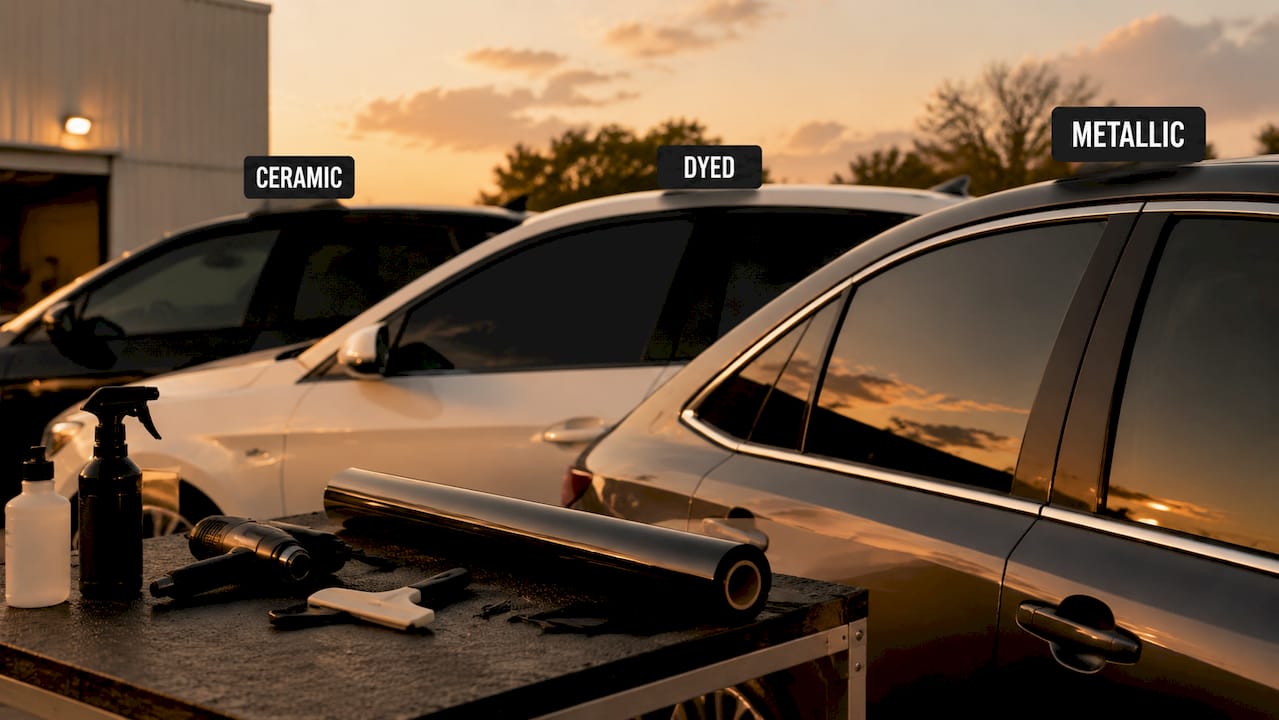
Here is how the main film types compare across clarity and performance:
| Film Type | Optical Clarity | Heat Rejection | Night Visibility | Signal Interference |
|---|---|---|---|---|
| Ceramic | Excellent | High | Excellent | None |
| Nano-ceramic | Excellent | Very High | Excellent | None |
| Metallic | Moderate | High | Moderate | Yes |
| Dyed | Fair (fades) | Low | Poor over time | None |
| Carbon | Good | Moderate | Good | None |
Dyed films absorb heat rather than reject it, and the dye degrades over time. That degradation shows up as fading, purple discoloration, and increased haze. What starts as a reasonably clear film becomes noticeably cloudy within a few years.
Metallic films reflect heat effectively but create radio frequency interference. They also produce a mirror-like reflectivity that can reduce outward visibility in certain light conditions. The reflective surface scatters incoming light differently than ceramic, which affects perceived sharpness at night.
Nano-ceramic technology takes standard ceramic performance further by using smaller particles for more uniform light transmission. Films like 3M Ceramic IR and Iviron Kollmax ceramic tint use this approach to balance heat rejection with maximum optical clarity. The result is a film that performs at the top of every category without sacrificing the view.
How does window tint clarity affect night driving?
Night driving clarity depends more on internal haze and light scattering than on the raw VLT percentage. This surprises most car owners. They assume a lighter tint automatically means better night visibility. In reality, a low-haze 35% VLT ceramic film can outperform a high-haze 50% VLT dyed film after dark.
High haze creates halos and starbursts around oncoming headlights. Those visual artifacts reduce contrast and make it harder to judge distance and edges at night. High-clarity films reduce these halos and preserve the sharpness of light sources, which directly improves your ability to read the road.
Key factors for night driving visibility:
- Low haze rating is the single most important spec for night clarity
- Higher VLT (50% or above) is preferable for night-only driving concerns
- Ceramic construction avoids the light scatter that plagues dyed films
- Professional installation eliminates bubbles and debris that create additional scatter points
Reduced eye strain is a real benefit of high-clarity tint at night. When your eyes are not constantly adjusting to halos and scattered light, fatigue sets in more slowly on long drives. This is a practical safety benefit, not just a comfort preference. For a broader look at how visibility factors interact, the car visibility checklist covers multiple elements that affect how clearly you see through glass under different conditions.
Pro Tip: If you drive frequently at night, prioritize haze rating over VLT when comparing films. A ceramic film rated at 35% VLT with near-zero haze will give you a cleaner, sharper view than a 50% dyed film with measurable haze.
How to evaluate window tint clarity before you buy
Inspecting tint clarity before purchase means viewing film samples on glass at multiple angles under direct sunlight to identify waviness, cloudiness, and distortions. Most shops have demo windows or sample panels. Use them. Do not evaluate tint under fluorescent indoor lighting, which hides haze that sunlight reveals immediately.
Follow these steps when evaluating any film:
- View the sample in direct sunlight from both inside and outside the glass
- Check at a 45-degree angle to spot waviness or surface distortion
- Ask for the haze rating in addition to the VLT percentage
- Request the manufacturer spec sheet showing UV and IR rejection data
- Confirm the net VLT after accounting for your factory glass transmittance
- Ask about warranty coverage specifically for clarity, fading, and bubbling
Net VLT depends on the combination of your factory glass transmittance and the film VLT, calculated by multiplying the two percentages. A film labeled 35% VLT installed on glass with 90% transmittance produces a net VLT of about 31.5%. That number is what law enforcement measures and what you actually experience. Always ask your installer to provide this figure.
Understanding window tint transparency levels before you commit to a shade prevents the common mistake of choosing a film that is too dark for your state's legal limit. Florida law requires a minimum of 28% VLT on front side windows, so knowing your net VLT matters for both compliance and visibility.
Pro Tip: Ask your installer to measure the net VLT with a photometer after installation. Photometers clamp over the window and compare input light to received light, giving you the actual combined reading of glass plus film.
Key takeaways
Optical clarity in window tinting requires evaluating haze and light scatter alongside VLT, because two films with identical darkness ratings can deliver completely different visibility and night driving performance.
| Point | Details |
|---|---|
| Clarity goes beyond VLT | Haze rating determines sharpness; two films with the same VLT can look very different. |
| Installation quality matters | Bubbles, debris, and uneven application destroy clarity regardless of film quality. |
| Ceramic films lead on clarity | Ceramic and nano-ceramic films deliver the lowest haze and best night visibility. |
| Night driving needs low haze | Haze causes halos around headlights; prioritize haze rating for night driving safety. |
| Always verify net VLT | Multiply film VLT by glass transmittance to get the actual post-install reading. |
What i've learned after years of tinting cars in miami
Most car owners walk in asking for the darkest legal tint they can get. That is the wrong starting question. Darkness is a preference. Clarity is a performance spec. After years of working with 3M Ceramic IR and Iviron Kollmax ceramic films at Southmiamitint, the pattern is clear: the customers who are happiest long-term are the ones who prioritized optical quality over shade number.
Here is what I tell every customer who asks about tint: hold a sample up to sunlight and look through it at an angle. If you see any waviness or milky quality, put it down. That haze will not improve after installation. It will get worse as the film ages.
The biggest misconception I encounter is that a lighter tint is always clearer. That is not true. A premium 20% ceramic film will outperform a budget 50% dyed film on every clarity metric. The ceramic construction eliminates the internal scatter that makes cheap films look foggy within a year. Dyed films absorb heat and degrade. Ceramic films do not.
My honest recommendation is to invest in ceramic technology from a proven manufacturer and have it installed by someone who works in a clean environment. The film is only half the equation. I have seen excellent films ruined by installations done in dusty garages. The combination of quality film and professional installation is what produces clarity that lasts.
If you are comparing options, look at the right tint for your vehicle before making a final decision. Shade, film type, and legal compliance all interact in ways that are worth understanding before you commit.
— Jose
Get crystal-clear tint installed at your location
Southmiamitint specializes in mobile window tinting across Miami-Dade, bringing professional-grade installation directly to you. The film lineup includes 3M Ceramic IR tint, 3M Color Stable, and Iviron Kollmax ceramic, all selected for their optical clarity, heat rejection, and long-term performance. These are not budget films. They are the same products used by detail shops and dealerships that care about results.
Every installation is done by trained technicians in controlled conditions, which means no debris, no bubbles, and no clarity-killing shortcuts. If you want ceramic tint with verified net VLT and a warranty that covers clarity and fading, contact Southmiamitint for a free consultation. You can also explore ceramic tint options and pricing directly on the site.
FAQ
What does window tint clarity mean?
Window tint clarity refers to the optical quality of a tint film, specifically how clearly you can see through it without distortion, haze, or blur. It is measured by both VLT percentage and haze rating, with haze being the more direct indicator of sharpness.
How is window tint clarity measured?
Installers use photometers to measure VLT by comparing input light to received light through the glass. Haze is measured separately using ASTM D1003 testing, which quantifies the percentage of light scattered beyond 2.5 degrees from its original path.
Does a darker tint always mean worse clarity?
No. A dark ceramic film with a low haze rating will appear sharper than a lighter dyed film with high haze. Darkness and clarity are independent properties controlled by different aspects of the film's construction.
Which tint type has the best optical clarity?
Ceramic and nano-ceramic films deliver the best optical clarity. Products like 3M Ceramic IR and Iviron Kollmax ceramic tint use ceramic particle technology that minimizes light scatter and maintains clarity without signal interference.
What is net VLT and why does it matter?
Net VLT is the combined transmittance of your factory glass and the tint film together, calculated by multiplying their individual percentages. This is the number that determines legal compliance and the actual visibility level you experience after installation.