
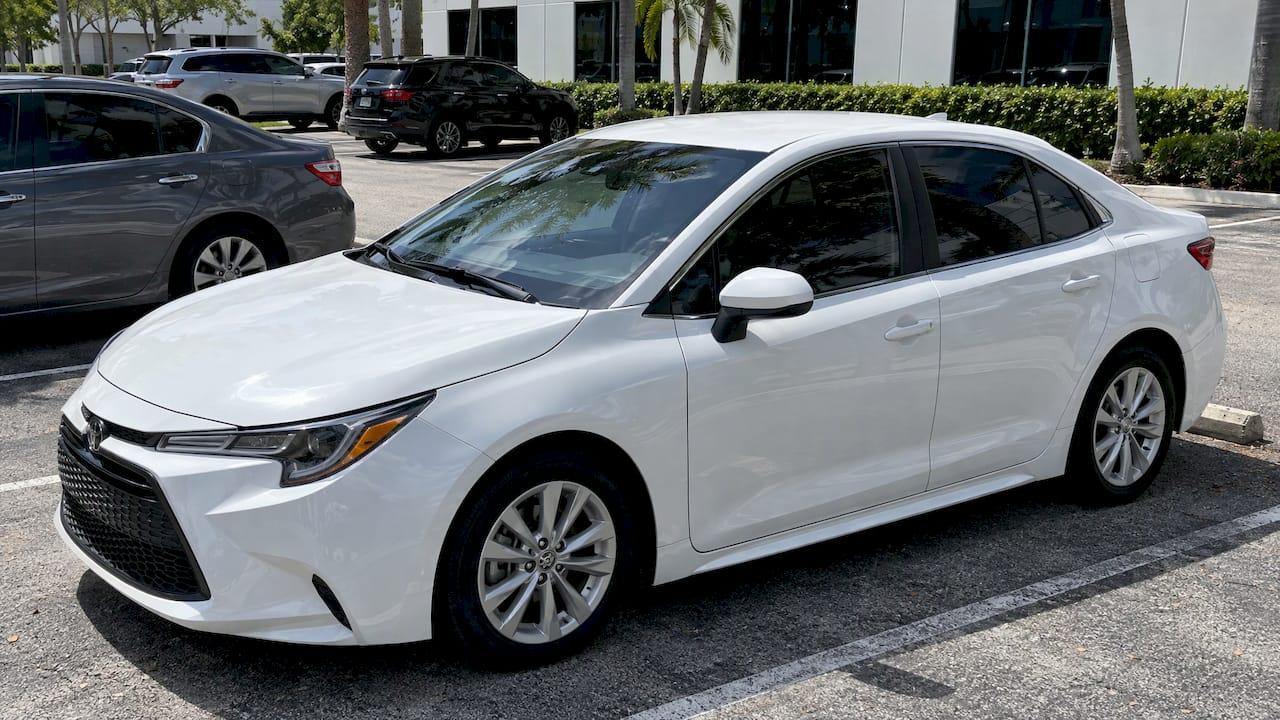
The best window tint for a white car is a neutral black or charcoal ceramic film in a shade that is legal in Florida. White paint pairs well with dark glass, and ceramic film handles the heat and UV. No automotive film gives a car window a white or frosted look. That kind of film is made for bathrooms and offices, not for driving.
Below, we cover shades, film types, Florida limits, and what tint can and cannot do for glare, migraines and sensitive skin. We are Miami Auto Tinting, a mobile installer, and we come to your home or office anywhere in Miami-Dade.
TL;DR
- Black or charcoal tint gives a white car the sharpest contrast. Pick the darkness by Florida law and how much privacy and heat control you want.
- White or frosted film is not for car windows. It cuts visibility and reflects headlights at night.
- Ceramic film is our focus because it targets heat and UV without needing a very dark shade.
- Florida sets separate limits for the windshield, front sides and rear windows, and offers medical exemptions through the state.
- We install on site: 2 front windows from $200, windshield from $150, full car plus windshield from $450.
Table of Contents
- What "white car window tint" really means
- The best tint shades for a white car
- Why we install ceramic film on white cars
- Florida tint limits for a white car
- Window tint for migraines and light sensitivity
- Window tint for sensitive skin and UV
- What to check before you choose film
- Book mobile tint for your white car
- FAQ
- Sources
What "white car window tint" really means
People searching this phrase usually mean one of two things. Some want the best tint to put on a white car. Others have seen a white or frosted look on a window and want it on their own car.
The second idea does not work. Frosted or patterned films should not go on car windows because they block visibility, reflect headlights at night and conflict with laws that require a clear view out. Frosted film is meant for bathrooms, entryways and offices. If you saw a white frosted look on a luxury model, it was most likely a factory feature or a different product, not tint film.
So the real question is how to pair a white body with the right film. That is a choice about shade, film type and legal limits.
The best tint shades for a white car
White paint reflects sunlight, which helps keep a car cooler in sunny climates, and it creates a strong contrast with dark glass. Black and charcoal tints give the most striking look.
Shade is measured as visible light transmission (VLT): the percentage of light that passes through the glass and film. A lower number means a darker window. A 70 percent film looks nearly clear from outside, while a 15 percent film looks nearly black.
Here is how that plays out on a white car:
| Goal | Direction | What to expect on white paint |
|---|---|---|
| Clean, classic contrast | Black or charcoal in a mid-range shade | Dark glass frames the body and keeps the car looking sharp |
| Maximum privacy | Darker shade, within the legal limit for that window | Strong contrast, with a dark cabin from outside |
| Heat and UV without changing the look | Light or near-clear ceramic | Windows look close to factory, with heat control in the film |
| Frosted or white glass | Not available for cars | Not legal or safe for driving |
Our advice: choose the shade for legality and night visibility first, then for looks. The film technology does more for heat than darkness does, which is why we install ceramic only.
For a deeper look at shade numbers, see our guide to tint opacity for Miami-Dade drivers and how to choose the right tint for your vehicle.
Does the white exterior change the film you need?
It changes the look more than the film. White paint reflects heat on the outside of the car, but your cabin still heats up through the glass. The windows, especially the windshield and rear glass, are where the sun comes in. A white car in Miami still needs heat rejection on the glass.
Why we install ceramic film on white cars
We install ceramic films only. Ceramic film is built to reject heat and UV, so you can choose a shade for looks and legality without giving up comfort. The three films we use are:
- 3M Ceramic IR, with a lifetime warranty
- SunTek CIR, with a 5-year warranty
- Uviron KoolMax, with a 3-year warranty
You can read more on our ceramic tint page and our 3M window tinting page. For more on how film helps with sun in South Florida, see how tinted windows reduce glare and boost comfort in Miami.
Our installs use computer-cut patterns for an exact fit. We work from 60-inch rolls, so a large windshield goes on in one piece with no seam. We also have experience with Tesla, luxury and exotic vehicles, which often have large curved glass.
Florida tint limits for a white car
The law applies the same way to a white car as to any other. Your shade has to fit the window it goes on.
- Behind the driver: Florida allows film with no more than 35% reflectance and at least 15% visible light transmittance. Multipurpose passenger vehicles such as SUVs and vans may use film with at least 6% transmittance, with the same reflectance cap.
- Windshield: Florida permits a transparent strip at the top that does not reach below the AS-1 line. Many guides quote a 70% figure for it, but the statute itself gives no specific number, only that the strip be transparent and non-reflective.
- Front side windows: these have their own limit. We cover it in our guides on what makes window tint legal for Florida drivers and the 28% VLT and AS-1 windshield rule.
For a statewide view of the rules, this page on Florida tint law requirements is a handy reference. For Miami-specific questions, read local regulations on car window tinting in Miami and Florida's AS-1 line rule. Rules differ between states, so these figures apply to Florida only. Check the current statute if you plan to drive elsewhere.
Medical exemptions
If a medical condition requires limited light exposure, Florida has a process. Florida Statute 316.29545 lets the state highway safety department issue medical exemption certificates for people with lupus, any autoimmune disease, or other conditions requiring limited exposure to light. The TL-55 form requires certification by a physician, physician assistant, dermatologist or advanced practice registered nurse practitioner, among others, and the certificate is non-transferable and ends when you sell the vehicle. Talk to your doctor first, then apply before you order a darker shade.
Window tint for migraines and light sensitivity
Many drivers with migraines search for tint because sun glare is a trigger. Tint reduces the total light that enters a vehicle. It can meaningfully reduce daytime glare in high-sun conditions, which is the main way it helps.
Migraine light sensitivity is neurological, though. The same source explains that the brain's processing of light signals is disrupted, and that FL-41 tinted lenses, which filter the wavelengths most likely to trigger a response, are the intervention it names. The research on filtered eyewear is small. A 2022 study of 10 migraine patients wearing blue-cut glasses at night for four weeks found headache days fell from 8.7 to 7.0. An earlier crossover study found 45% of migraine-with-aura patients had a 50% or greater drop in headache frequency on days with precision spectral filters, though the sample was small and the results suggestive.
Practical takeaway: tint is a good way to cut sun glare in the car, and eyewear is a separate tool. Ask your neurologist or eye doctor what fits your triggers. If your doctor advises limited light exposure, ask about the Florida exemption above before choosing a darker film.

Window tint for sensitive skin and UV
If you burn easily or have a skin condition, your car windows matter. Most side and rear windows and sunroofs block only UVB, leaving skin exposed to UVA. Clear UV-blocking film can block 99 percent of UV light and is allowed in almost every state.
A few points that help you choose:
- Darker is not more UV protection. Darker tints do not block UV any better than clear UV-protective film. The UV-blocking layer does that work, so a lighter film can be a good fit.
- Visible light matters too. The same source notes tinted film helps if the goal is protection from visible light, which can cause skin issues such as hyperpigmentation.
- Conditions differ. Tinted windows may suit dermatoses induced by visible light, such as polymorphic light eruption and solar urticaria, but are not photoprotective for dermatoses triggered by UV, including lupus. The same paper notes that film blocking up to 99% of UV comes in nearly clear shades and needs no prescription.
- Glass type changes exposure. In a Newcastle University study, nonlaminated clear glass let through 62.8% of UVA, while grey laminated glass let through 0.9%.
If you have lupus, polymorphic light eruption or another photosensitivity condition, ask your dermatologist which protection fits you, including a medical exemption if you need a darker shade than the standard limit.
What to check before you choose film
Whatever your car color, use this checklist:
- Film type. Ceramic targets heat and UV. Ask which brand and what warranty comes with it.
- Shade by window. Match the VLT to the Florida limit for the windshield, front sides and rear glass.
- UV rating. Look for film that blocks up to 99% of UV.
- Fit. Computer-cut patterns give an exact edge. A single-piece windshield avoids a seam.
- Warranty. Ours range from 3 years to lifetime depending on the film.
- Old tint. If your car has faded or bubbling film, it needs to come off first.
- Your vehicle. Large curved glass on Tesla, luxury and exotic models calls for an installer who has done them.
Our view on tint for white cars
We have tinted cars in Miami-Dade for 28 years, and white cars are some of our favorites. The paint is bright and clean, and dark glass finishes the look. When customers ask for something unusual, like a white or frosted window, we explain that it is not made for cars and steer them to a shade that looks great and keeps them legal.
We only install ceramic film because the heat here is the real reason people tint. Genuine 3M Ceramic IR carries a lifetime warranty, SunTek CIR carries 5 years and Uviron KoolMax carries 3 years. I install every job myself, with computer-cut patterns and 60-inch rolls so windshields go on without a seam.
The best part for you is that we come to your home or office. You do not sit in a waiting room.
Jose
Book mobile tint for your white car
We install at your home or office anywhere in Miami-Dade, including Kendall, Homestead, Cutler Bay and Pinecrest. Published starting prices are $200 for 2 front windows, $150 for a windshield and $450 for a full car plus windshield. Your final quote depends on your vehicle and film.

See how our mobile window tinting works, check our service areas, or get a quote today.
FAQ
Can I get white or frosted tint on my car windows?
No. Frosted and patterned films reduce visibility and reflect headlights at night, and they conflict with laws requiring a clear view out. Choose a neutral black or charcoal ceramic film in a legal shade instead.
What is the best tint shade for a white car?
Black or charcoal gives the strongest contrast. Pick the VLT that fits Florida's limit for each window and your night driving comfort. Darker films of 5 to 20 percent can reduce night visibility, while 35 to 70 percent keeps the view clearer.
Will tint help with migraines?
Tint cuts total light and daytime glare in the car, which can help if bright sun is a trigger. Migraine light sensitivity is neurological, so ask your doctor about other options such as FL-41 lenses. If your doctor advises limited light exposure, ask about a Florida medical exemption.
Does tint protect a baby or sensitive skin in the car?
Clear UV-blocking film can block 99 percent of UV light, and darker film does not add UV protection. For a baby or a skin condition, ask your pediatrician or dermatologist what sun protection fits your situation.
Does the white paint mean I need less heat protection?
No. White paint reflects some sunlight, but heat still comes through the glass. Ceramic film on the windows is what rejects heat inside the cabin.
Sources
- Can This Window Film Be Applied on a Car Window
- Best Tint for White Cars
- Automotive window film facts (IWFA)
- 6 Types of Window Tint to Consider for Your Car (AAA)
- Florida Statute 316.2954
- Florida Statute 316.29545
- TL-55 Sunscreening Medical Exemption Certificate
- Florida Window Tint Laws (2026)
- Florida Window Tint Law: Legal Limits, Tickets & Exemptions
- Florida tint law requirements
- Managing Light Sensitivity While Driving
- Prophylactic Treatment for Patients with Migraine (PMC)
- Prevention of Visual Stress and Migraine With Precision Spectral Filters (PMC)
- Ask the Expert: Car Window Tint for UV Protection (Skin Cancer Foundation)
- International Journal of Dermatology on photodermatoses and tinted windows
- Implication for photosensitive patients of ultraviolet A exposure in vehicles (Newcastle University)