
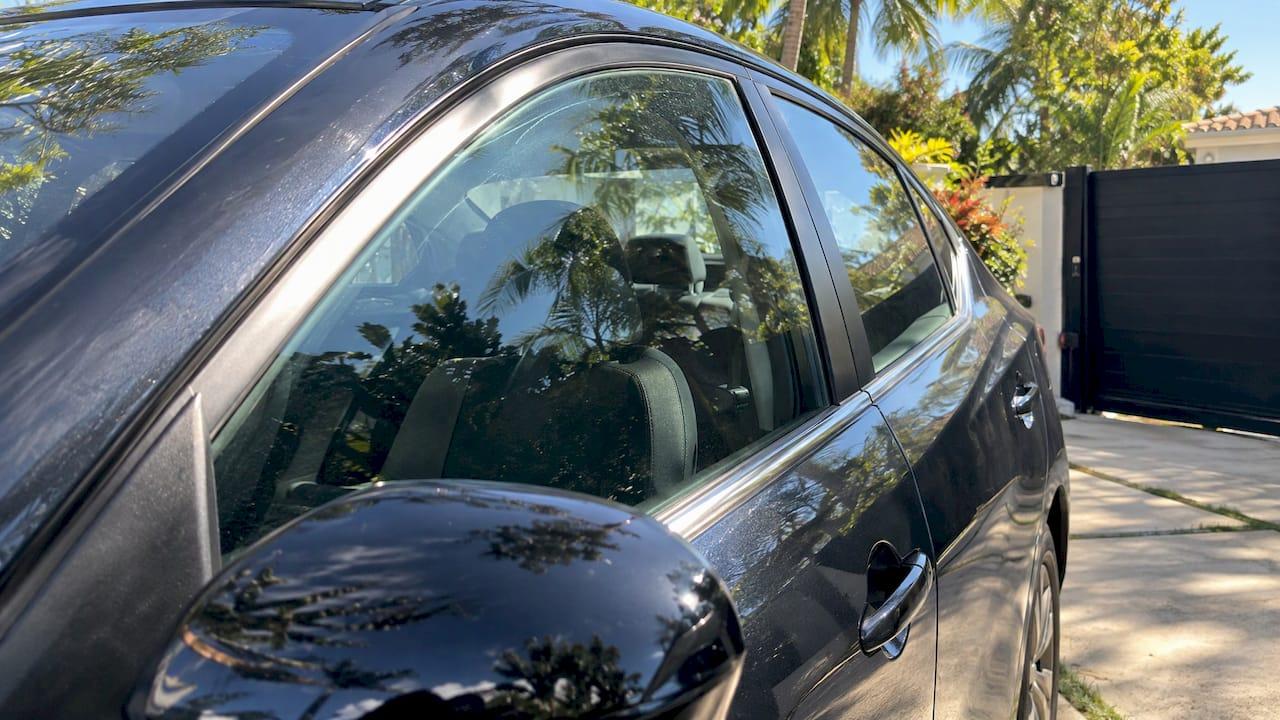
Yes, UV rays get through car windows, and how much depends on which window. Your windshield stops most UVA. Your side windows, rear window and sunroof let far more in. In Miami-Dade, where many of us spend an hour or more behind the wheel every day, that adds up on your left arm, hand and face. UV-blocking ceramic tint on the side and rear glass closes that gap. We install it at your home or office anywhere in Miami-Dade, so you never wait at a shop.
TL;DR
- Car glass blocks nearly all UVB, but UVA is the problem. Windshields are laminated and block most of it. Side and rear windows are usually tempered glass and block much less.
- In one 2016 study of 29 cars, front windshields blocked an average of 96% of UVA, while side windows averaged 71%, with a range from 44% to 96%.
- Skin cancers show up more often on the driver's side of the body, which researchers link to driving exposure.
- Quality UV window film can block more than 99% of UVA and UVB. Sunscreen, sunglasses and sleeves still help on top of it.
- We install ceramic film at your location, with a lifetime warranty on 3M Ceramic IR.
Table of Contents
- Do car windows block UV?
- Windshield versus side windows
- Can you get sunburned in the car?
- UV protection while driving: what to do every day
- How much UV does window film block?
- Why ceramic film suits Miami-Dade
- Staying legal in Florida
- What about your home or business?
- Perspective
- Get UV-blocking ceramic tint at your door
- FAQ
- Sources
Do car windows block UV?
Sunlight reaches us as two kinds of UV that matter here. About 95% of the UV that reaches Earth's surface is UVA, and about 5% is UVB, according to a 2025 explainer by a physiology professor. UVB is the main cause of sunburn. UVA penetrates deeper, drives skin aging and contributes to skin cancer.
Standard window glass absorbs UVB but not UVA, and what passes through a car's glass depends on the glass type and tint, as the American Academy of Pediatrics notes. So the answer to "do car windows block UV" is: they block UVB very well, and UVA only partly.
A 2025 study in Archives of Dermatological Research measured 34 vehicles, model years 2015 to 2025, including gas, hybrid and electric cars. Every window blocked 100% of UVB except one outlier rear window. UVA was a different story, and it depended on the window.
Windshield versus side windows

The difference comes from how the glass is built. The Skin Cancer Foundation explains that windshields are laminated and shield drivers from some UVA, while side, back and sunroof windows are tempered glass that does not block UVA effectively. A laminated windshield is two panes with a clear plastic layer between them. A side window is a single pane.
Here is what the measurements show:
| Study | Windshield | Side window |
|---|---|---|
| 2016, JAMA Ophthalmology, 29 cars | 96% of UVA blocked on average | 71% on average (range 44% to 96%) |
| 2025, Archives of Dermatological Research, 34 cars | 99.25% on average | 88.78% on average (driver's window) |
In the 2016 study, only 4 of the 29 cars had side windows blocking more than 90% of UVA. A 2013 review in Photodermatology, Photoimmunology & Photomedicine reported that tempered side and back glass blocks only about 21% of UVA, while laminated windshields block the majority.
Two more findings are worth knowing:
- Newer does not mean safer. The 2025 study found that mileage, not model year, predicted driver's-side UVA blocking. The 2025 explainer adds that protection depends on glass type, color and tint rather than a car's age or price.
- Luxury badges do not guarantee a fix. Protection varies by vehicle, and the only way to know what your side glass does is to treat it as the weak point and cover it.
Can you get sunburned in the car?
UVB is almost fully blocked, so classic sunburn through a closed window is rare. The bigger concern is cumulative UVA exposure, which is quiet. You do not feel it, and it still accumulates.
The average American spends over an hour in a vehicle every day, according to a 2024 study in the Journal of the American Academy of Dermatology (JAAD). In Miami, with a high sun angle most of the year, much of that driving happens in strong light, on your commute, on I-95, the Palmetto, the Turnpike or US-1.
Where that exposure lands is the telling part. A 2011 analysis of a national cancer registry covering 82,587 melanomas and 2,384 Merkel cell carcinomas found both cancers significantly more common on the left side of the body than the right. The authors attributed the excess on the arm to driver-side UV exposure, which they estimated at about 20 times stronger on the left arm than the right. A separate study of 890 skin-cancer patients found more cancers on the left (52.6%) than the right (47.4%), with the left-side skew strongest in men.
In countries that drive on the right, the driver's left side faces the window. That is your left arm resting by the door, your left hand on the wheel and the left side of your face.
This does not mean driving is dangerous. It means the window next to you is the one worth upgrading.
UV protection while driving: what to do every day
Skin protection in the car works in layers. Start with the basics, then add film.
- Sunscreen. The American Academy of Dermatology advises broad-spectrum, water-resistant SPF 30 or higher every morning, covering the face, neck, ears and the tops of the hands, which are especially exposed while driving. Reapply every two hours when you are outdoors.
- Sunglasses. UV-protective lenses protect your eyes. The 2016 study authors linked the weak side-window protection to more left-eye cataracts.
- Clothing. A light long-sleeved shirt covers the arm closest to the window.
- UV-blocking window film. The Skin Cancer Foundation lists UV-protective window film among its daily protection options for side, back and sunroof glass.
The difference with film is that it works without you doing anything. You cannot forget to reapply it.
If you have a photosensitive condition such as lupus, a porphyria, xeroderma pigmentosum or polymorphous light eruption, talk to your dermatologist about protection. A 2024 JAAD letter notes these qualify for vehicle tint medical exemptions, and states set their own rules.
How much UV does window film block?
A 2024 JAAD study tested the driver's-side front window of 15 cars with a UV radiometer. Cars with solid tempered glass let through 3.34% of UV on average, versus 0.005% for factory laminated glass. After film was applied, crystalline, carbon and nanoceramic films blocked over 99.9% of UV. Hybrid and dyed films blocked 99.5%.

The Skin Cancer Foundation says UV window film on vehicles can block more than 99% of UVA and UVB. It advises installing it on the driver and passenger side windows and the sunroof. A JAAD editorial in October 2026 cites an in vitro study in which car glass alone reduced UV-induced cell death by 29%, versus 93% protection from tinted car glass.
The Foundation describes UV film as a thin polyester film with UV inhibitors added during manufacturing. It advises looking for film sold as UV window film or solar window tint, and not film made only for looks or darkness.
Darkness is not the same as UV protection
This point trips up many drivers. A very dark film is not automatically a better UV blocker, and a light film can block nearly all UV. UV blocking and visible darkness are separate properties. This is also why a legal, lighter ceramic film in Florida can do the job. The JAAD editorial notes that there is no standard metric for tint UV protection comparable to SPF, so the film type and its documented UV rejection matter more than shade.
Our UV spectrum guide goes deeper on UVA, UVB and what each film does. You can also read how tint protects against Miami's UV rays.
Why ceramic film suits Miami-Dade
UV is only part of the story here. Miami heat is the other part. Ceramic film is built to reject heat as well as UV, so your cabin stays more comfortable, your AC works less, and your dashboard, seats and trim see less sun. That is why we install ceramic films only.
The films we use:
- 3M Ceramic IR, with a lifetime warranty
- SunTek CIR, with a 5-year warranty
- Uviron KoolMax, with a 3-year warranty
If you drive a car with leather seats, sun is also what fades and dries them. Our guide to car tint for leather seats covers it. Owners of older vehicles can read about classic car window tint that blocks 99% UV. For paint, trim and glass care between visits, this guide to summer UV car care is a good companion.
Staying legal in Florida
Pick a film for UV and heat first, then pick a shade that is legal. Federal rules require most motor-vehicle glass to allow at least 70% of light through as the glass is made, with an exception for glass behind the driver in trucks, buses and multipurpose vehicles. There are no federal standards for aftermarket films, so states set their own limits.
Florida sets limits by window and vehicle type. Read what makes window tint legal for Florida drivers and the darkest legal tint in Florida before you choose a shade. For the windshield, our clear windshield tint checklist walks through the rules.
We install a legal shade for your vehicle, so the film that protects you also keeps you ticket-free.
What about your home or business?
The same physics applies to your house and office. Ordinary glass lets UVA in, and the sun fades floors, furniture and art, and warms the room. Our homeowner's guide to UV-blocking window film explains how film helps. We also offer residential window tinting and commercial window tinting in Miami-Dade.
Perspective
We have been tinting for 28 years, and the same question comes up in nearly every driveway: "Doesn't my glass already block the sun?" The honest answer is that it blocks part of it. Your windshield is laminated and does most of the work. Your side windows are a single pane, and they are the ones next to your arm, your face and your passengers.
That is why we only install ceramic film. It is built for Miami's heat and UV, and genuine 3M Ceramic IR comes with a lifetime warranty. Our computer-cut patterns give an exact fit on each window, and with 60-inch rolls we can put a large windshield on in one piece, with no seam.
We do the work ourselves, and we come to you. Whether you park in Kendall, Pinecrest, Homestead, Cutler Bay or downtown, we set up where you are, so a good UV upgrade does not cost you half a day in a waiting room. We also have experience with Tesla, luxury and exotic vehicles.
Jose
The signature above is the owner's own. The pricing and film details below are what we publish.
Get UV-blocking ceramic tint at your door
We come to your home or office anywhere in Miami-Dade. Our published prices:
- 2 front windows: from $200
- Windshield tint: from $150
- Full car plus windshield: from $450
- Old tint removal: $50 to $150
See mobile window tinting, ceramic tint options or 3M window tinting. When you are ready, request your quote here, or start at southmiamitint.com.

If you want the driver's side covered first, start with the two front windows. If you want it all done, choose the full car with windshield.
FAQ
Do car windows block UV?
They block almost all UVB, but only part of UVA. Windshields are laminated and block most UVA, averaging 96% in a 2016 study of 29 cars. Side windows averaged 71%, and some blocked far less. Film on the side and rear glass fills that gap.
Can you get sunburned through a car window?
UVB, the main cause of sunburn, is largely blocked by glass, so a quick burn is unlikely. UVA still passes through side windows, and over years of driving it adds up. Research on left-sided skin cancers points to driver-side exposure.
Should you wear sunscreen in the car?
Yes. The American Academy of Dermatology advises broad-spectrum, water-resistant SPF 30 or higher every morning, covering the face, neck, ears and tops of the hands. Reapply every two hours if you are outdoors. UV-blocking film on the side windows adds protection that is always on.
Does window tint protect your skin while driving?
UV-blocking film can. A 2024 JAAD study found crystalline, carbon and nanoceramic films blocked over 99.9% of UV on the driver's side window. Choose a legal shade for your vehicle in Florida. We install ceramic film at your location in Miami-Dade.
Sources
- UV Window Film & Tint, Skin Cancer Foundation
- Evaluation of UV-A and UV-B transmission through the windows of vehicles, Archives of Dermatological Research, 2025
- Assessment of Levels of Ultraviolet A Light Protection in Automobile Windows, JAMA Ophthalmology, 2016
- Current status of photoprotection by window glass, Photodermatology, Photoimmunology & Photomedicine, 2013
- Ultraviolet Radiation: A Hazard to Children and Adolescents, American Academy of Pediatrics
- Asymmetric lateral distribution of melanoma and Merkel cell carcinoma, JAAD, 2011
- Can you get sunburnt or UV skin damage through car or home windows?, The Conversation, 2025
- American Academy of Dermatology sunscreen survey and guidance, 2025
- Your Daily Sun Protection Guide, Skin Cancer Foundation, 2025
- Automobile Window Film as a Dermatologic Intervention, JAAD, 2024
- Beyond JAAD, October 2026, Journal of the American Academy of Dermatology
- Window tinting regulations and medical exemptions, JAAD, 2024
- Effects of Motor Vehicle Tinting on Traffic Safety and Enforcement, 2024