
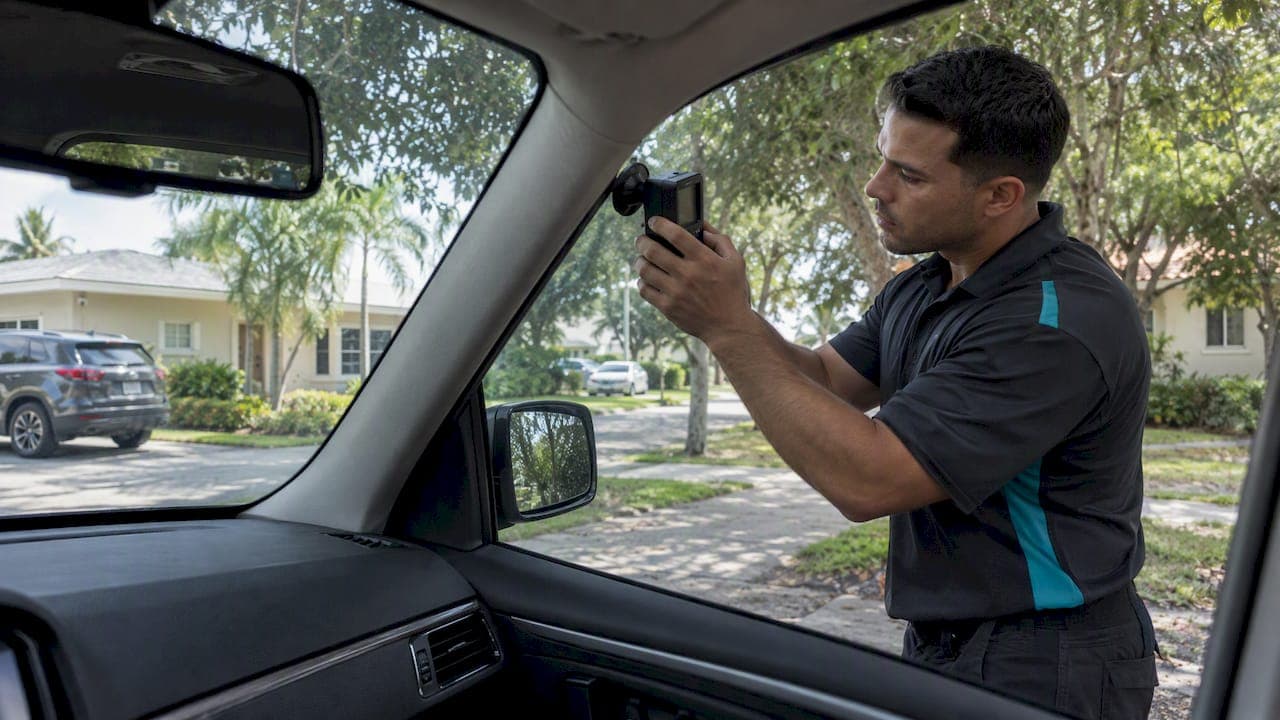
Clear windshield tint can be legal, but there is no single nationwide answer. Federal rule FMVSS 205 sets a 70% light transmittance benchmark for glazing used in driving visibility, while your state decides how that standard applies on the road. The real answer depends on two things: the federal AS-1 line and VLT percentage, and your specific state's statute.
TL;DR:
- Federal law requires at least 70% light transmittance only for glazing installed by manufacturers and shops, but each state sets its own legal limits for driving.
- The AS-1 line marks where factory-certified glass meets safety standards, and VLT readings measure the combined light that passes through the glass and film.
- States vary widely, with some allowing tint strips above the AS-1 line, others permitting full windshield UV films, and some restricting aftermarket tint entirely.
- Confirm your state's specific regulations and ask installers for the actual combined VLT measurement and proper documentation before and after tinting.
- Medical exemptions are vehicle-specific, requiring certification from a licensed physician, but do not override typical state tint laws.
Table of Contents
- Federal vs. state rules: what FMVSS 205 actually controls
- What the AS-1 line and VLT percentage really mean
- How states regulate windshields: patterns and examples
- Medical exemptions and other special cases
- How to verify your windshield tint is actually compliant
- A mobile installer's take on windshield tint compliance
- How we help you stay legal and protected
- FAQ
- Sources
Federal vs. state rules: what FMVSS 205 actually controls
Federal law does not tell you what you can drive with. It tells manufacturers and repair businesses what they can install. FMVSS 205 requires at least 70% light transmittance for glazing areas required for driving visibility, and it ties that number to the AS-1 line marked on the glass.
At least 70% is the federal floor for driving-visibility glazing, according to NHTSA's interpretation, but that number only binds the shops and manufacturers who install or build the glass.
Once your vehicle is on the road, your state takes over:
- Federal standards limit what manufacturers and tint shops can legally install on a vehicle.
- States regulate how you operate and register that vehicle after the sale, according to NHTSA's interpretation on preemption.
- A film that is federally compliant is not automatically legal to drive in every state.
This split explains why you'll see conflicting answers online. Check federal guidance for the technical threshold, then check your state's statute or DMV page for the operating rule that actually applies to you.
What the AS-1 line and VLT percentage really mean
Two terms decide almost every windshield tint question: AS-1 and VLT. The AS-1 line is etched or printed on the glass near the top of the windshield, and it marks where manufacturers certify the glazing meets automotive safety glass standards. Below that line, federal and most state rules expect full visibility. Above it, in the shade band, states allow a strip of tint, typically a defined number of inches.
VLT (visible light transmittance) is the percentage of light that passes through glass and film combined, not the film alone. This is the detail most drivers miss: a film advertised as "clear" or "nearly invisible" still reduces light transmittance, and factory glass varies by vehicle model. NHTSA's interpretation notes the installer must measure the actual glass-plus-film result on your specific vehicle, because that combined number, not the film's label, determines compliance.
Before trusting any tint job as street-legal, confirm these points:
- Locate the actual AS-1 marking on your glass rather than assuming a generic five-inch strip.
- Ask for the combined glass+film VLT reading, not just the film's rated percentage.
- Confirm your state's measurement tolerance, since several states allow a small margin of error.
Pro Tip: Ask your installer to show you the meter reading on the glass after installation, not just the film packaging.
How states regulate windshields: patterns and examples
State rules generally fall into three patterns, and recognizing which one your state follows makes the rest of this easier to navigate.
- Shade-band states. Many states limit tint to a strip above the AS-1 line or a fixed measurement, commonly four to five inches, leaving the rest of the windshield clear.
- Conditional clear-film states. Some states permit clear UV-blocking film across the entire windshield as long as it meets color and reflectance limits. Texas DPS allows clear UV film anywhere on the front windshield, while colored sunscreening devices must sit above the AS-1 line and meet separate VLT and reflectance thresholds.
- Restrictive states. A smaller group effectively disallows aftermarket windshield tint outside narrow exceptions. Rhode Island's DMV guidance prohibits nontransparent or sunscreen material on the front windshield, noting that factory glass already sits near 70% transmittance, so adding film often pushes a vehicle out of compliance.
Florida illustrates how detailed these rules get. Florida Statutes §316.2953 requires a minimum of 28% VLT for qualifying sunscreening material on front side windows, caps luminous reflectance at 25%, and allows a plus or minus 3% measurement tolerance. It also requires a compliance label on the inside left door jamb, confirming the installation meets the standard. Our guide on proving your Florida windshield tint is legal walks through what that label should show.
California and Ohio are often cited in tint discussions too, since both combine shade-band rules with VLT thresholds that vary by window position. Because every state writes its own numbers, verify the current statute or DMV page before booking any installation rather than relying on what a neighboring state allows.

Medical exemptions and other special cases
Several states allow medically necessary tint beyond the normal limit, but the process is specific and the exemption does not travel with you automatically. A licensed physician typically certifies a condition, such as light sensitivity, and you submit that certification through a state form.
Florida's process is a useful example. The HSMV 83390 application lists qualifying medical conditions and confirms the exemption is tied to a specific vehicle and cannot be transferred to another car or driver.
Beyond medical cases, a few other groups commonly operate outside standard tint limits:
- Law enforcement and certain government vehicles, which often follow separate equipment rules.
- Specific passenger-transport vehicles permitted darker limits under state statute.
- Drivers holding an approved medical exemption permit for a particular vehicle.
None of these exemptions override a state's underlying statute. They simply carve out a documented, vehicle-specific allowance within it.
How to verify your windshield tint is actually compliant
Checking compliance takes a few minutes and saves you a ticket. Walk through it in order, before you ever sit in the chair at a tint shop.
- Confirm your state's rule first. Pull up your state DMV or statute page and note whether it regulates placement (a shade band) or a measured VLT percentage, or both.
- Ask the installer how they measure. A reputable shop measures the finished glass-plus-film VLT on your specific vehicle and shares that number with you in writing.
- Request the compliance label. States like Florida require a label on the inside left door jamb confirming the installation meets the legal standard.
- Document everything after installation. Photograph the label, the AS-1 marking, and the written VLT reading for your glove box, in case an officer asks.
If you're ever stopped and questioned, your documentation is your defense. Our breakdown of the tint installation inspection process covers what an inspector typically checks.
Pro Tip: Keep a photo of your compliance label and VLT reading saved on your phone, separate from the glove box copy, in case paperwork gets lost.
A mobile installer's take on windshield tint compliance
After years of measuring glass on driveways and parking lots across South Florida, the biggest mistake we see is trust without verification. Choose installers who hand you a written reading and a label you can't peel off by accident, then keep that paperwork where you can grab it fast.
— Jose
How we help you stay legal and protected
We offer mobile windshield tinting with on-site installation at your home or office rather than at a fixed location. We work with 3M Ceramic IR, 3M Crystalline, and 3M Color Stable films, along with Iviron KoolMax ceramic tint, and every install includes the measurement and documentation that keeps you covered if a question ever comes up.
- Mobile installation at your location, with no shop visit required.
- On-site VLT measurement of your actual glass and film combination.
- Installer compliance labeling and a written reading you can keep on file.
Our Windshield Tint service starts from $150, and a Full Car + Windshield package starts from $500. Request a quote and we'll confirm what's legal for your vehicle before we ever pick up a tool.
FAQ
In what states is windshield tint legal?
Windshield tint is allowed in some form in most states, but the extent varies widely: some permit only a narrow shade band above the AS-1 line, others allow clear UV film across the full windshield, and a few restrict aftermarket tint almost entirely. Check your specific state's DMV or statute page, since the rule depends on placement, VLT percentage, or both.
Is 70% windshield tint legal in California?
California follows a shade-band approach for the windshield, allowing tint only above the AS-1 line or within a set strip near the top, rather than a blanket percentage across the glass. For the exact current measurement and placement rule, confirm with California's vehicle code or DMV guidance directly.
Is 70% windshield tint legal in Texas?
Texas allows clear UV-blocking film across the entire front windshield, but colored sunscreening devices must sit above the AS-1 line, or within five inches of the top if no AS-1 line exists, and meet separate reflectance and color limits according to Texas DPS.
Can windshields be tinted in North Carolina?
Most states, including those with strict front-glass rules, allow a tinted strip at the top of the windshield within the AS-1 line or a defined inch measurement rather than full-windshield tint. Confirm North Carolina's current statute or DMV guidance for the exact shade-band measurement before installation.
How do I know if my windshield tint will pass inspection?
Ask your installer for a written VLT reading of the combined glass and film, not just the film's advertised percentage, since factory glass varies by vehicle. Request any compliance label your state requires, such as Florida's door-jamb label, and keep a photo of both on hand.
Sources
- 11-000697_Trooper_Kile_205 | NHTSA
- Florida Statutes §316.2953 and related sections
- Texas DPS: Window tinting standards
- Rhode Island DMV — window tint guidance