
Yes, tinting a classic car's windows is a smart move, as long as you treat preservation as the goal, not darkness. The right choice is a light, non-metalized ceramic or Crystalline UV film applied by a professional who inspects your glass and seals first. Skip the darkest films if you care about originality, and check your state's rules before you book anything.
TL;DR:
- Choose light, non-metalized ceramic or Crystalline UV films to maximize interior preservation and avoid darkening the appearance excessively.
- Prioritize UV rejection over total solar-energy rejection if preventing dashboard fading is your main concern, and verify actual test conditions with the installer.
- Use films with higher VLT percentages, such as 50%, on side windows to maintain a close-to-original look, and keep tint darker than 35% only if it suits concours standards.
- Ensure the installer inspects and preps vintage glass properly, especially curved or brittle windows, and ask about hand-trimming or custom fitting for curved surfaces.
- Be aware that legal window tint limits vary by state and window position, requiring you to verify current laws and keep proper documentation for resale or compliance investigations.
Table of Contents
- Classic Car Window Tint: What It Actually Protects
- Picking the Right Film: VLT, Ceramic, and What Numbers to Trust
- Installing Tint on Vintage Glass Without Damaging It
- Can Tint Be Removed Without Hurting Originality?
- Is Classic Car Window Tint Legal in Your State?
- What to Expect After Installation: Curing, Haze, and Care
- An Installer's Checklist for Getting This Right
- Does Tint Affect Visibility and Safety Behind the Wheel?
- Will Tint Hurt Your Car's Restoration or Originality Value?
- Author Perspective: Balancing Preservation and Driver Comfort
- Get a Preservation-Minded Tint Quote for Your Classic
- Sources
- FAQ
Classic Car Window Tint: What It Actually Protects
The case for tint on a vintage car has almost nothing to do with looking cool behind the wheel. It has everything to do with keeping the interior you already have from falling apart faster than it needs to.
Sunlight attacks a classic car on two fronts. Ultraviolet rays break down dye molecules in upholstery and dashboards, which is why a 1967 Mustang's back seat often looks sun bleached while the front stayed shaded under a garage roof. Infrared heat works differently. It bakes leather, dries out vinyl, and accelerates the cracking you see on original dash pads that were never replaced.
A properly documented UV window film can block more than 99% of UVA and UVB rays, according to the Skin Cancer Foundation. That number matters more for a 1965 interior than for a 2026 daily driver, because original vintage materials rarely get a second chance once they fade or crack.
Three separate metrics describe what a film actually does, and they are not interchangeable:
- UV rejection measures how much ultraviolet light the film blocks, the number tied most directly to fading and cracking.
- Total solar-energy rejection measures the full spectrum of heat energy the film keeps out, which affects cabin temperature and interior stress.
- Infrared rejection measures the specific heat wavelength that makes leather seats and dash pads feel hot to the touch.
Pro Tip: If your main worry is a fading dashboard rather than cabin heat on a summer drive, prioritize UV rejection numbers over total solar-energy rejection when comparing film spec sheets.
Picking the Right Film: VLT, Ceramic, and What Numbers to Trust
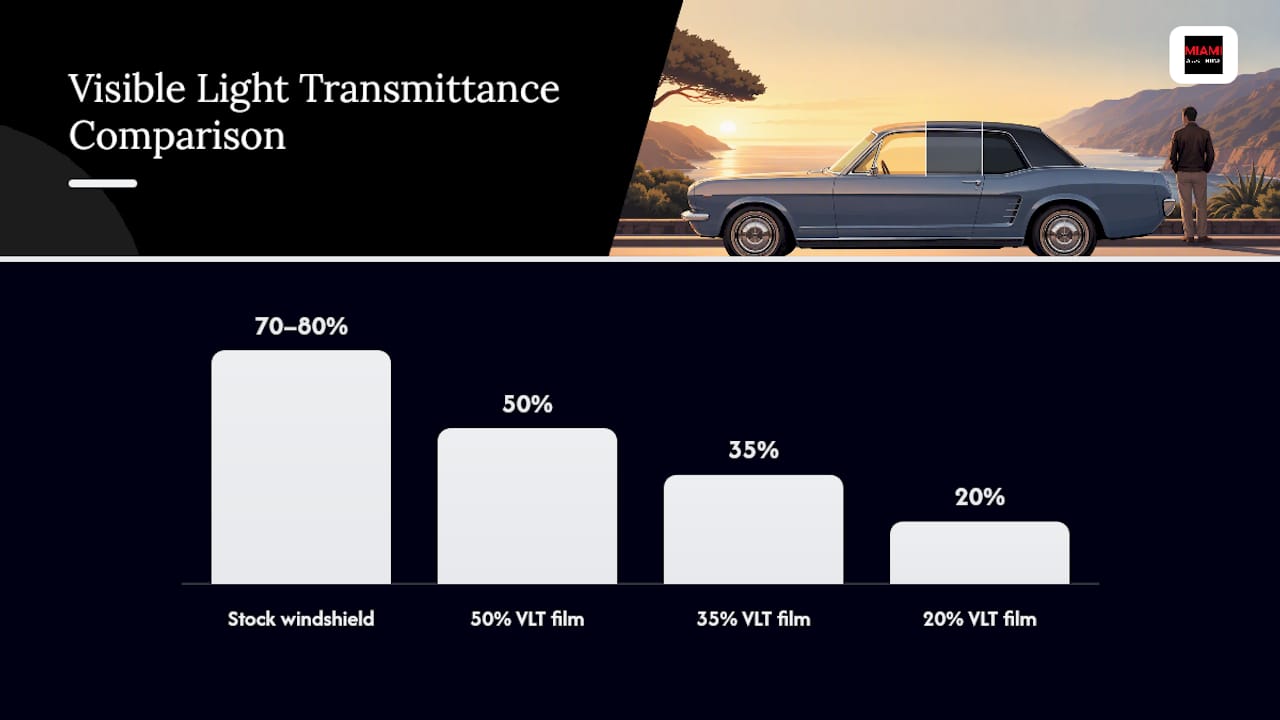
Visible light transmittance, or VLT, tells you how much light passes through a window after film is applied. A stock windshield typically runs near 70 to 80% VLT, and that number drops fast once film goes on. A 50% VLT film on a classic's side glass looks close to factory clear from a distance. Drop to 35%, and most people notice the shade, though the car still reads as original at a car show. Go to 20%, and you start changing the car's visual character in a way concours judges and purists will flag immediately.
For a vintage vehicle, the film family matters as much as the VLT number:
- Crystalline films use a non-metallic multilayer construction built for flat and complex curved glass, and 3M's own technical materials report up to roughly 64 to 66% total solar-energy rejection and up to 99% UV rejection under specific lab conditions.
- Dyed films are the cheapest option and can fade or turn purple within a few years, a poor match for a car you plan to keep for decades.
- Metalized films reject heat well but can interfere with older radios, and some vintage owners simply don't want a metallic sheen on glass that was never meant to have one.
Before you commit to any product, ask the installer for the actual test conditions behind the numbers. As 3M's own Crystalline technical materials point out, "heat rejection" isn't one fixed figure. It depends on which metric is quoted and what glass type the lab used to measure it. A vendor citing 90% heat rejection without specifying total solar-energy rejection versus IR rejection is giving you a number that sounds bigger than it is.
Installing Tint on Vintage Glass Without Damaging It
Vintage glass rarely behaves like the flat, standardized windows on a modern car, and that changes how a good installer approaches the job.
Curved rear windows on cars like a 1970s Corvette or a curved-glass Bentley often need heat shrinking to conform the film without wrinkles, a step software-cut templates designed for modern vehicles simply don't account for. Brittle rubber seals, decades-old chrome trim, and non-standard window mechanisms all raise the stakes if the installer rushes.
A competent pre-installation inspection covers:
- Seal and gasket condition — brittle rubber can crack further under the pressure of film application.
- Existing chips or cracks — film can sometimes stress fragile glass further if applied without noting pre-existing damage.
- Trim and molding fit — original trim pieces often need careful removal and reinstallation rather than force.
- Window operation — crank mechanisms on hand-operated classic windows need to move freely before film goes anywhere near the glass.
The IWFA's documented installation process calls for inspecting and cleaning the glass, wet-applying the film, squeegeeing out the water, heat-shrinking where the glass curves, then trimming and allowing the film to cure. On a vintage car, every one of those steps takes longer and demands more hand judgment than on a mass-produced daily driver.
Pro Tip: Ask any installer bidding on your classic whether they hand-trim curved glass or rely only on pre-cut patterns. Pre-cut patterns are built for current production vehicles, not a car built decades before those templates existed.
Can Tint Be Removed Without Hurting Originality?
Reversibility deserves real thought before installation day, not after. Removing film later can leave adhesive residue, stress aging rubber seals, and in worst cases lift trim that was never designed to be pried at twice.
The IWFA's own visual inspection guidelines note that installers should leave a small top edge gap, typically 1 to 2 millimeters, on moving windows specifically to prevent edge lift as the glass travels up and down. That tiny gap is not a mistake. It is deliberate engineering to protect the film and the glass channel over years of use.
If removal ever becomes necessary, tell your installer that upfront. Removing film from aged seals or brittle trim sometimes requires heat-assisted de-adhesion and professional-grade solvents, and it can still leave residue that needs further cleanup.
Protect yourself with a few simple habits before any film touches the glass:
- Take dated photos of every window, seal, and trim piece before installation begins.
- Ask for reversibility language in the written quote, not just a verbal promise.
- Choose lighter, clear, or ceramic UV films over dark metalized options if you expect to sell or show the car and want maximum flexibility later.
Is Classic Car Window Tint Legal in Your State?
Federal rules and state rules do different jobs here, and mixing them up is the most common mistake owners make.
The FMVSS 205 standard sets a minimum 70% light-transmittance requirement for new vehicle glazing, and it primarily constrains commercial installers rather than individual owners modifying their own vehicles. States then layer their own VLT limits on top, and those limits usually differ by window position, meaning your windshield, front side windows, and rear windows can each carry separate legal minimums.
That patchwork means a film that's perfectly legal on a rear window in one state could put you at risk of a citation on a front window in another. A few practical steps keep you covered:
- Check your state DMV's current tint law before booking any installation, not after.
- Ask your installer for documented VLT measurements on the finished film, not just the film's advertised rating.
- Keep the manufacturer's spec sheet for the film installed, since some states require proof of compliance if you're ever stopped.
- Use the IWFA's laws resource as a starting reference point for how state rules are typically structured.
What to Expect After Installation: Curing, Haze, and Care
Freshly installed film almost always looks a little off in the first few days, and that's normal, not a defect. Water used during application needs time to evaporate fully, and 3M's own technical sheets list a final adhesion period of roughly 15 to 20 days under specific lab conditions, including a stated temperature around 18°C in dry air. Cold or humid climates can stretch that timeline further.
Light haze or small pockets of moisture during that window are expected. What isn't normal:
- Bubbles that persist well past the manufacturer's stated cure period.
- Visible creases that don't smooth out as the film settles.
- Edge lift beyond the small intentional gap installers leave near moving glass.
- Optical distortion that makes straight lines look wavy through the window.
Any of those after the cure period has passed is worth a call back to your installer.
Ongoing care is simple. Clean tinted glass with a soft microfiber cloth and a mild, ammonia-free cleaner, and avoid razor blades or abrasive pads anywhere near the film's edge. A streak-free glass cleaning method works just as well on tinted glass as untinted, provided you skip anything abrasive.
Pro Tip: Do a visual check of your tint and seals every few months, the same way you'd check tire pressure. Catching a small edge lift early is a five-minute fix. Catching it a year later can mean a full reinstall.
An Installer's Checklist for Getting This Right
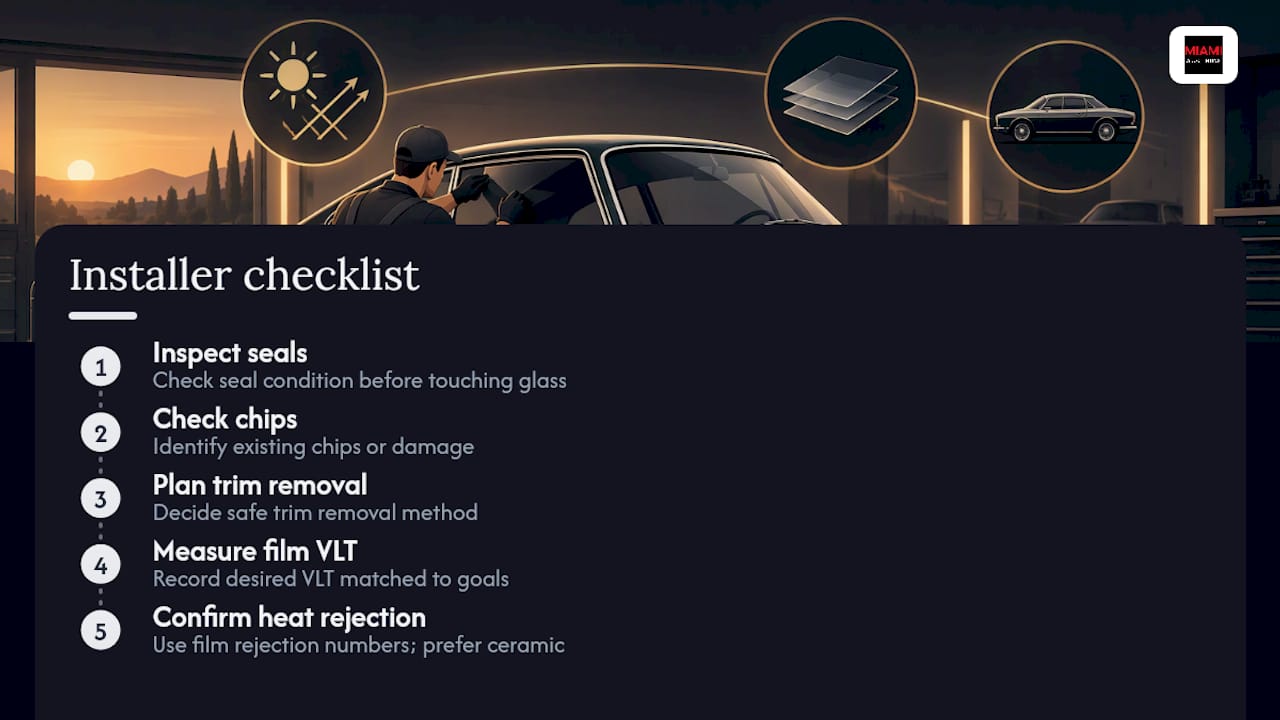
A shop that understands vintage vehicles will walk through a short list before ever touching your glass: seal condition, existing chips, trim removal method, and the film's specific VLT and rejection numbers matched to your goals. If an installer can't answer those questions clearly, that's worth noting before you book.
Mobile installation has a real advantage for fragile classics: your car never leaves its garage or driveway, which eliminates the towing and highway-mile risk that comes with hauling a decades-old vehicle to a shop. Films like 3M Ceramic IR and Crystalline get recommended often for this exact reason. They're non-metalized, hold up well on curved glass, and don't interfere with older electronics.
For deeper reading on how ceramic technology compares to older dyed films, South Miami Tint's ceramic versus dyed comparison breaks down the trade-offs in plain terms, and the blog's tint film clarity guide explains what to expect from your car's finished look.
Does Tint Affect Visibility and Safety Behind the Wheel?
Any film reduces the amount of light reaching your eyes, and that trade-off matters more on a classic than on a modern car with LED headlights and backup cameras to compensate.
Original headlights on most vintage vehicles were designed decades before today's brighter lighting standards existed. Stack a dark film on top of already dim factory headlights, and night driving visibility drops in a way that daytime test drives won't reveal.
Rear visibility deserves separate attention. Classic cars often have smaller rear windows and no backup camera, so tint on the rear glass has an outsized effect on what you can see while reversing or checking blind spots. A detailed look at how VLT affects nighttime visibility covers the specific shade ranges that keep night driving safe without sacrificing all the heat and UV protection you're after.
Windshield tint carries its own separate legal and safety logic in nearly every state, since it sits directly in the driver's forward field of view. Most states either ban visible tint on the windshield entirely or restrict it to a narrow strip along the top edge, which is worth confirming before assuming any film belongs there at all.
If you drive your classic at dusk or after dark with any regularity, err toward the lighter end of the VLT scale. The visibility trade-off does not.
Will Tint Hurt Your Car's Restoration or Originality Value?
Concours judging and restoration authenticity standards generally focus on what's visible and original to the factory build, which raises a fair question: does adding modern film compromise a car's judged value?
In most cases, the answer is no, provided the film is chosen carefully. Judges scrutinize paint, chrome, upholstery, and factory-correct components. A light, optically clear or near-clear film applied cleanly to the interior surface of the glass typically doesn't register as a deduction, because it doesn't alter the visible glass tint the way factory tint bands or aftermarket dark film would.
The risk comes from choosing film that visibly changes the character of the glass. Dot-matrix or ceramic frit borders, the small dotted patterns often printed around the edge of windshields and rear windows, can look different once film is applied over them, an appearance shift that documented IWFA inspection standards specifically call out as something to expect and evaluate before final approval.
If you're planning to show the car competitively, ask your installer to keep documentation of exactly what film went on, its VLT rating, and photos of the glass before and after. That paperwork does double duty: it protects your resale value story and gives judges or future buyers a clear record that nothing structural or factory-original was altered, only protected.
Author Perspective: Balancing Preservation and Driver Comfort
If you're chasing concours points and rarely drive the car, skip tint altogether or use the lightest clear UV film available. Judges notice glass that reads differently than stock, and the interior isn't baking under daily sun exposure anyway.
It protects the interior without changing how the car reads from the outside. Document your glass condition and keep every receipt. That paperwork protects your car's story as much as any film protects its dashboard.
— Jose
Get a Preservation-Minded Tint Quote for Your Classic
This service offers mobile window tinting for classic cars, including pre-inspection of seals and glass, and custom fitting for curved or irregular windows rather than relying solely on modern templates.
When you request a quote, ask for the film's technical spec sheet, a realistic cure timeline, and a clear removal policy in writing. We'll also take pre-install photos of your glass and trim so you have documentation if you ever need it for resale or provenance. Options like 3M Color Stable and Ceramic IR are built for exactly this kind of careful, preservation-first job. Ready to see what your classic needs? Request an online quote and we'll schedule an on-site inspection around your car, not a shop's calendar.
Sources
FAQ
Should You Tint Windows on a Classic Car?
Yes, tinting is worth considering if the goal is protecting the interior rather than darkening the car's look. Choose a light, non-metalized ceramic or Crystalline film, and have a professional inspect your seals and glass first.
Is 70% Tint Legal in California?
Rear windows and the windshield carry separate limits, so check your state DMV directly rather than assuming one number covers the whole car.
Is 35% or 20% Tint Darker?
Lower VLT numbers always mean less light passes through, so a 20% film blocks more visible light and changes a car's appearance more noticeably than a 35% film.
What Is the Difference Between Ceramic and Classic Tint?
Ceramic film uses nano-ceramic particles for heat rejection instead of dye or metal, which avoids the radio interference risk that metalized films can cause on classics with original antennas. Traditional dyed film is cheaper but tends to fade or shift color over the years, a poor fit for a car meant to last decades. Products like 3M Ceramic IR are built specifically to avoid that long-term fading problem.
How Long Does Classic Car Window Tint Take to Cure?
Manufacturer technical sheets list a final adhesion period of roughly 15 to 20 days under specific lab conditions, though real-world timelines shift with local temperature and humidity. Light haze during that window is normal and should clear as the film fully cures.