
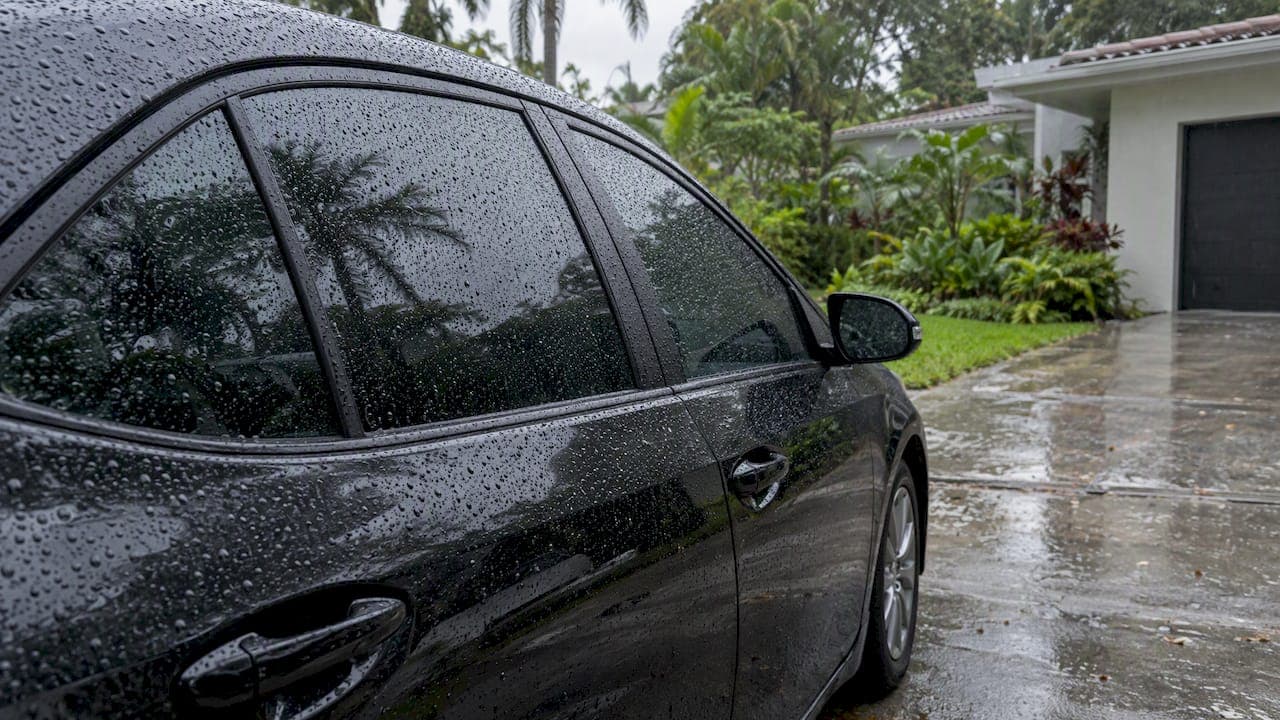
Rain does not ruin window tint that is already on your car. Film goes on the inside of the glass, so rain on the outside never touches it. Rain during the install is the real risk. Active rain, wind-blown water and dirty air can all get into the film while it is being applied. In Miami, where afternoon storms are normal for part of the year, the answer is to plan around the weather, not to avoid tinting for months.
Below, we cover what rain does before, during and after an install, how a mobile installer handles a wet forecast, and what to do with your car in the first days.
TL;DR
- Rain on the outside of your glass does not damage tint that has been installed. The film sits on the inside.
- Installing in active rain is risky. Moisture and debris can end up under the film, so a good installer moves the job to cover or reschedules.
- Keep your windows closed for the first 72 hours, rain or shine. Rolling them down is a leading cause of peeling and edge lifting.
- Humid, wet weather can stretch out the hazy, bubbly look while the film cures. It is normal and usually clears on its own.
- If rain is in your forecast, call us. We will tell you honestly whether to keep the appointment or move it.
Table of Contents
- Does rain hurt window tint?
- Why this matters more in Miami
- What a good mobile installer does when rain is forecast
- A Miami storm hits right after your tint: what to do
- Bubbles, haze and "water spots" after tinting
- Does tint change how you see in the rain?
- Our view: plan for the weather, not around the season
- Before you book: questions to ask any mobile installer
- Book mobile tinting in Miami-Dade
- FAQ
- Sources
Does rain hurt window tint?
It depends on when the rain falls.
Rain after the tint is installed. Auto window film is applied to the inside of the glass with a water-activated adhesive, as this aftercare guide explains. Water running down the outside of the window does not reach the film. A storm the day after your install will not peel, bubble or discolor it, as long as the windows stay closed and the film is sealed at the edges.
Rain during the install. This is where trouble starts. Tint is applied wet. The installer sprays a slip solution on the glass, positions the film and squeegees the water out so the adhesive can bond. One installer's breakdown of mobile versus in-shop work notes how sensitive the film is to its surroundings during those minutes. The adhesive side is exposed, and anything in the air can land on it.
Rain adds three problems:
- Extra moisture. Water that is not part of the slip solution can get under the film or into the edges.
- Wind-driven spray and debris. Storms move dirt, leaves and grit around, and a speck under the film becomes a bump you will see every day.
- A wet working area. Wet door seals, dripping glass and damp hands make a clean, precise install harder.
Some installers do work outdoors, and the industry's view is that what matters is how well the process is controlled, not just where the car sits. Still, working in active precipitation is technically risky. A car under a roof or in a closed garage is a different situation from a car in an open driveway during a downpour.
Why this matters more in Miami
South Florida is wet and humid. Miami gets roughly 57 inches of precipitation a year, with the wet season running from late spring through early fall. Storms here tend to arrive fast, and the air stays humid even on dry days.
That has two effects on tint:
- Scheduling. A clear morning can turn into a downpour by mid-afternoon. Booking earlier in the day often helps.
- Curing. Humidity slows the evaporation of the moisture trapped under the film. In drier climates, film can clear in a few days. In humid weather, the hazy phase can run longer. We go deeper on this in our guide to humidity and tinting for Miami drivers, and in how Miami weather affects your tint needs.
What a good mobile installer does when rain is forecast
Mobile tinting means the work happens where your car is, so the installer has to manage the environment. A mobile tint guide makes the point that a professional process needs to mimic a shop bay, with a plan for dust, wind and direct sun. Installers without one risk trapped debris, bubbles or edge failure.
Before you book anyone, ask how they handle weather. Good answers sound like this:
- They ask where the car will be parked and whether there is a garage, carport or covered parking.
- They check the forecast and tell you if the timing looks risky.
- They offer to move the appointment instead of pushing ahead in a storm.
- They control wind and sun, not only rain.
Your options on a rainy day
| Situation | What usually works best |
|---|---|
| You have a garage or covered parking | Keep the appointment. The car stays out of the rain and away from wind. |
| Light drizzle, open driveway | Talk to your installer. It may be better to move the job or relocate the car. |
| Heavy rain or storm warnings | Reschedule. Water and debris are too hard to control. |
| Rain expected after the install | Fine. Keep the windows closed and let the film cure. |
| Complex curved glass or a premium ceramic install | Choose the cleanest conditions you can get. Finish quality matters most here. |
The same mobile tint guide says shop-style conditions are the safer call for complex curved glass, dusty driveways and premium ceramic installs where finish matters most. We would rather tell you to wait a day than put film on in conditions that will cost you a redo.
A Miami storm hits right after your tint: what to do
Stay calm. The film is on the inside, and the rain is on the outside. Here is how to protect the install over the next few days.
- Keep every window closed. The first 72 hours after installation are the most critical, and rolling windows down during that time is a leading cause of peeling, bubbling and edge separation. 3M's own care card is shorter and tells you not to open, close or clean windows for at least 48 hours. Our advice is to go with the longer number, especially in humid weather.
- Do not use rain as an excuse to roll down a window. If water gets in through an open sunroof or door, deal with it, but do not run the windows up and down to dry the seals.
- Skip the car wash. Your installer will give you a wash timeline. Our post on wash rules after tint explains the range, and 3M's care page suggests waiting 30 days before cleaning the windows so cleaners do not interfere with the edge adhesive.
- Park somewhere sensible if you can. Covered parking is not required, but a garage keeps the car cooler, which helps the film settle.
- Leave the bubbles alone. If you see tiny bubbles or haze, do not poke them.
Bubbles, haze and "water spots" after tinting
Many people see small bubbles or a cloudy patch a day or two after an install and assume rain got under the film. Usually it did not. Small bubbles and haze are a normal part of curing with 3M and other quality films. They come from leftover mounting solution under the film. They typically disappear within 2 to 14 days, though they can last up to 30 days or more in cooler, humid conditions.

Never pierce them. Piercing causes permanent damage that a warranty will not cover.
In Miami's wet season, expect the longer end of that range. Here is how to tell normal curing from a real problem:
| What you see | Likely cause | What to do |
|---|---|---|
| Tiny water bubbles or haze, mostly in the middle of the glass | Normal curing, moisture still evaporating | Wait. Do not touch it. |
| Edges lifting or peeling | Window operated too soon, or poor edge sealing | Call your installer right away. |
| Hard bumps with a speck inside | Dust or debris trapped during install | Contact your installer. Do not try to fix it yourself. |
| Cloudy patches that are not shrinking after several weeks | Could be more than curing | Have it inspected. |
A hard speck under the film, unlike a soft water bubble, will not go away. That is why clean working conditions matter so much, and why installing in rain is not worth the risk.
Does tint change how you see in the rain?
It can, and Florida law sets the floor. Darker film lets less light through, which matters at night and in heavy rain when visibility is already poor. Under Florida Statute 316.2953, side windows forward of the driver must allow at least 28 percent of visible light, with a 3 percent tolerance. Rear windows must allow at least 15 percent (6 percent for multipurpose passenger vehicles), according to the same 2026 statutes summary. The installer must also label the film in the driver's side door jamb.

If you drive a lot at night or in storms, a lighter shade or a clear, heat-rejecting ceramic film can give you heat and UV protection without cutting visibility as much as a dark film. Our guides on Miami tint regulations and what makes tint legal in Florida walk through the details. If you are tinting a windshield, read our post on proving your windshield tint is legal.
Our view: plan for the weather, not around the season
We tint cars, SUVs and trucks at the customer's location across Miami-Dade, and we also do select residential and commercial work. Weather is part of every schedule we build. Here is how we think about rain.
The forecast is a conversation, not a cancellation. A cloudy day is not a problem. A thunderstorm over your driveway is. We would rather call you in the morning and move your slot than finish a job we are not proud of.
Where the car sits matters more than the sky. A garage, carport or covered lot makes a rainy day workable in many cases. If you tell us where you park when you book, we can plan around it.
Moisture is the thing we protect against. Whether it is rain, a wet driveway or a humid afternoon, our goal is a clean, controlled install. We use computer-cut film patterns for a precise fit and work with 3M Ceramic IR, 3M Color Stable and Iviron KoolMax ceramic films, so the film should be given the best chance to go on right.
Aftercare is half the job. Most complaints we hear about tint are about the first few days: a window rolled down too soon, a quick wash, a poked bubble. If you keep the windows up and wait, the film does the rest.
Do not rush a bad day. If you need to tint before a trip or a deadline, tell us. We will tell you honestly whether the weather allows it.
— Jose
Before you book: questions to ask any mobile installer
Whether you choose us or someone else, ask these before you hand over your keys:
- Where will you do the work if it rains, and can you move the date?
- What film brand and type are you installing, and what is the warranty?
- How do you control dust and wind on site?
- Will the film be labeled in the door jamb to meet Florida rules?
- How long should I keep the windows up, and when can I wash the car?
If you are weighing a professional against a DIY kit, our post on DIY vs. professional tinting in Miami covers the trade-offs. For more to think about first, see things to consider before tinting your car windows. When it is time for the film to settle, step by step window film care gives you a routine.
Book mobile tinting in Miami-Dade
We come to you in Miami, Kendall, Homestead, Cutler Bay and Pinecrest. Published starting prices:
- 2 front windows: from $150
- Windshield tint: from $150
- Full car plus windshield: from $500
Ceramic, carbon, 3M, residential, commercial and old tint removal are quoted individually. See our mobile car window tinting page or our 3M window tinting options, then request a quote. Mention the forecast and where you park, and we will help you pick the best time.
FAQ
Is it okay to get tint done in the rain?
It is not ideal. Rain, wind and debris can get under the film while it is wet and exposed, which can cause bubbles, specks and weak edges. If the car is in a garage or covered spot, the job may be fine. In an open driveway during a storm, reschedule.
What happens if it rains after tinting windows?
Nothing harmful. The film is on the inside of the glass, so rain on the outside does not affect it. Keep the windows closed for at least 72 hours and avoid washing the car until your installer says it is safe.
Can newly tinted windows get wet?
The outside can, yes. The inside should stay dry and untouched while the film cures. Do not clean the glass early, and follow the film maker's care guidance, including pH-neutral cleaner and soft microfiber cloths later on.
Why does my new tint look hazy after a rainy week?
Haze is usually leftover mounting solution, not rain. Humid weather slows its evaporation, so it can take longer than 2 to 14 days to clear. Do not pierce any bubbles, and call your installer if the film is still cloudy after several weeks.
Sources
- Chapter 316.2953, 2026 Florida Statutes: side windows
- Chapter 316.2955, 2026 Florida Statutes: compliance labeling
- 3M product care guide for window tint
- 3M product care guide card (PDF)
- Car window tint aftercare guide
- Mobile vs. in-shop window tinting
- Mobile window tint: what to know before you book
- Miami, FL climate: monthly averages