
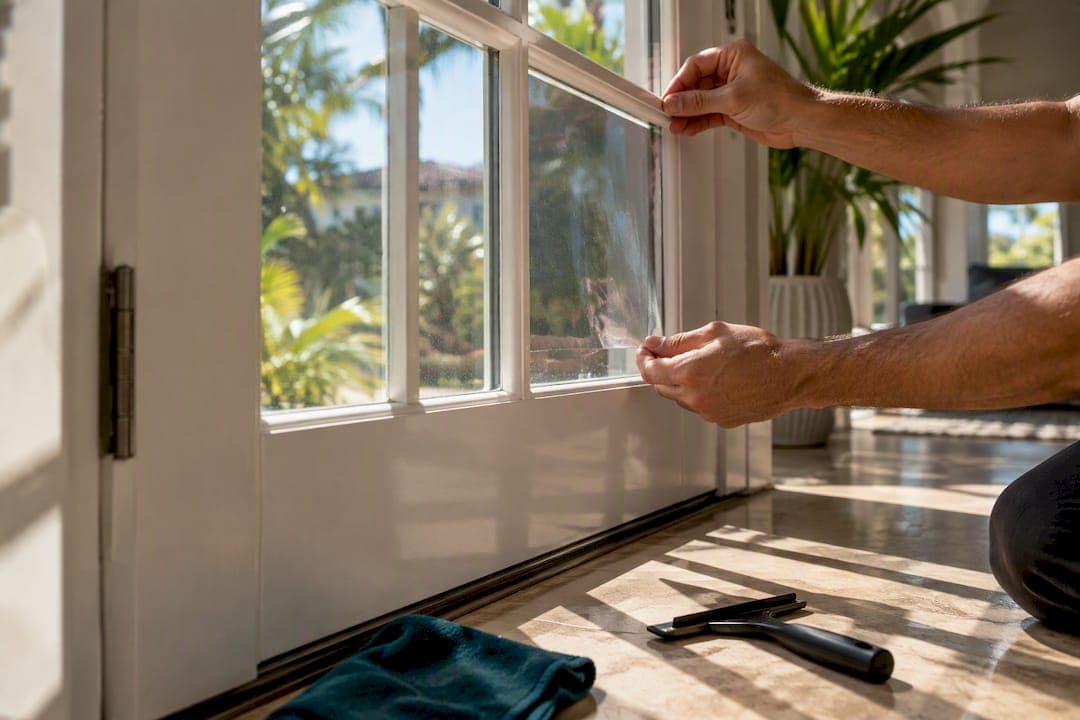
For privacy without losing daylight, frosted or etched decorative film is your best bet. For heat and glare, ceramic solar-control film wins, though it trades some visibility for performance. Simple peel-and-stick kits are fine DIY projects, but multi-pane French doors with lots of small panes usually need professional installation to avoid seam lines and bubbling. Budget $8 to $12 per square foot DIY, more with a pro.
TL;DR:
- Frosted or etched films are ideal for privacy on French doors, as they diffuse light while maintaining brightness and are available in removable and permanent options.
- Ceramic and solar-control films provide high heat and UV rejection without sacrificing visibility, making them suitable for west-facing doors that cause interior greenhouse effects.
- Made-to-size or professional cutting services are recommended for complex pane layouts, especially in older or irregularly measured doors, to ensure a clean, seam-free appearance.
- DIY installation is feasible for simple, two-pane doors using basic tools, but multi-pane or high-performance films benefit from professional, heat-cured application for durability.
- Most films last several years with proper care, but installation technique primarily determines longevity; professional installation reduces risks of bubbling, lifting, or early failure.
Table of Contents
- What Type of Window Film Works Best for French Doors?
- Should You Buy a Precut Kit or Get Custom-Cut Film?
- Can You Install Window Tint on French Doors Yourself?
- How Much Does It Cost to Tint French Doors?
- How Do You Choose the Right Film for Your French Doors?
- Southmiamitint: What We Install and When to Call a Pro
- Does Window Film Void Your Door's Warranty?
- Will Tint Work on Your Door's Specific Glass Type?
- How Do You Measure French Doors for Window Film?
- Are There Eco-Friendly Window Film Options?
- Does DIY Film Last as Long as a Professional Install?
- What Should You Expect From a Professional Installer?
- What a Homeowner Should Actually Do Right Now
- Ready to Book a Professional French Door Tint Install?
- Helpful Resources for French Door Film Shoppers
- Sources
- FAQ
What Type of Window Film Works Best for French Doors?
French doors present a different challenge than a single flat picture window. Multiple small panes, thin muntins, and glass that sits right at eye level mean the film you choose has to look good up close, not just from across the yard. Four film families dominate the market for this application, and each solves a different problem.
Frosted and etched films are the default choice for privacy on French doors. They diffuse light instead of blocking it, so your entryway or patio door still feels bright while blocking a clear line of sight. Removable versions use a static-cling or low-tack adhesive, which makes them popular with renters and anyone who wants to swap looks seasonally. Permanent adhesive versions last longer but require more careful installation. Decorative films come in dozens of finishes, from a simple sandblasted look to rice-paper and linen textures that mimic old-world glass.
Decorative and stained-glass style films go a step further, adding pattern, color, or a leaded-glass look to French doors that face a street or a neighbor's window. These are less about blocking a view and more about turning a plain glass door into a design feature. A detailed guide on decorative tint film breaks down the style options if you're trying to match an existing interior look, and the choice between frosted glass and clear glass often comes down to how much privacy you actually need in that specific room.
Solar-control and ceramic films are built for heat and UV rejection rather than privacy. Nano-ceramic products marketed for door-sized panels claim infrared rejection near 95 percent and UV blocking up to very high percentages while staying nearly clear. That clarity is the appeal: you get the heat and fade protection of a dark tint without darkening the glass. If your French doors face west and turn your living room into a greenhouse every afternoon, this is the category to shop.
Mirrored and opaque films sit at the far end of the privacy spectrum. Mirrored film gives you one-way daytime privacy, meaning outsiders see a reflection while you see out normally, but that effect reverses at night once your interior lights are on. Opaque vinyl blocks sight completely in both directions and works well for a bathroom-adjacent French door, though it also blocks nearly all the view.
Here's how the four families stack up against what most homeowners actually care about:
- Frosted/etched: high privacy, high light retention, minimal heat control, low to moderate cost.
- Decorative/stained-glass: moderate to high privacy, high light retention, minimal heat control, moderate cost.
- Solar-control/ceramic: low added privacy, high light retention, high heat and UV control, higher cost.
- Mirrored/opaque: high daytime privacy (mirrored) or total privacy (opaque), low light retention, moderate heat control, low to moderate cost.
Retail listings from marketplaces like Wayfair show real consumer demand for films that combine privacy styling with UV protection, which is why several manufacturers now blend a light frost pattern into their solar-control lines.
Should You Buy a Precut Kit or Get Custom-Cut Film?
Made-to-size services now let you order film cut to match your exact door layout before it ever arrives at your house. Vendors offering trim-to-size service for multi-light French doors ship pre-cut pieces sized to your panes, which cuts down on the in-home cutting time that trips up most first-time DIYers.
Standard precut kits, by contrast, come in fixed sizes you trim yourself. Retail listings for French door decals and film kits show these are usually removable, water-applied, and squeegee-ready right out of the box.
- Precut kits fit best on standard single-pane doors or simple grid patterns where every pane is roughly the same size.
- Made-to-size services work best on irregular pane layouts, colonial-style muntins, or doors where a consistent seam line matters for the finished look.
- Professional custom-cutting with computer templates gives the tightest fit of all three, since the installer measures each pane individually rather than relying on a published standard size.
Precut kits are a solid fit for renters who want a quick, removable upgrade, but their seams and edge fit often show on small multi-pane doors. A made-to-measure or professional cut usually delivers a cleaner result on that kind of door.
Pro Tip: If your French door has more than six small panes, measure two or three of them separately before ordering. Older doors settle over time, and panes that look identical from across the room are often off by a quarter inch or more.
Can You Install Window Tint on French Doors Yourself?
DIY installation on French doors is doable, but it demands more patience than a flat window because you're repeating the same careful process across many small panes instead of one large sheet.
Tools and materials you'll need:
- Spray bottle with slip solution (water plus a few drops of baby shampoo)
- A hard squeegee and a smaller detail squeegee for corners
- A sharp utility knife with extra blades
- Heat gun (for adhesive-backed, non-removable films)
- Lint-free microfiber cloths
The basic workflow:
- Measure each pane individually and add a small overlap margin.
- Cut the film with clean, straight edges, slightly larger than the pane.
- Spray the glass thoroughly with slip solution and lay the film in place.
- Squeegee outward from the center to push out water and air bubbles.
- Trim the excess flush against the muntin with a fresh blade.
- Heat-cure the edges with a heat gun if you're using a permanent adhesive film, encouraging the film to bond tightly against the muntin edge.
Work pane by pane rather than trying to cover the whole door at once. On colonial or muntin-style doors, align your first cut against a straight reference edge, then use that piece as your template for matching seams across the rest of the grid. Installer blogs note that French doors take noticeably longer to tint than single-pane windows precisely because of this repeated measuring and cutting.
Statistic Callout: Installers who work on French doors regularly point to one factor above all others: dust and surface prep predict whether an install lasts. A single speck of dust under the film shows up as a permanent bump.
Common mistakes include cutting film too small and having to patch a gap, using ammonia-based glass cleaner that clouds certain films, and skipping the heat-cure step on adhesive films, which leads to lifted edges within weeks. If you catch a bubble early, you can often lift the edge and re-squeegee before the adhesive fully sets. If it's already cured, you're usually looking at a redo of that pane.
How Much Does It Cost to Tint French Doors?
DIY materials typically run $8 to $12 per square foot, mostly driven by the film itself since tools are a one-time purchase. A pro-installed job costs more per square foot because you're paying for labor on top of material, and French doors carry a labor premium over flat windows due to the extra cutting and fitting time.
- Expect a moderate amount of time per pane for a careful DIY install, longer for your first attempt.
- A full French door with 6 to 15 panes can take several hours for a first-time DIYer.
- Professional installers typically finish a full multi-pane French door in 1 to 3 hours thanks to template-cutting and experience.
- Adhesive films need 24 to 48 hours to fully cure before you wash the glass or apply pressure to the seams.
Decorative and frosted films generally hold up for several years with reasonable care. Ceramic and solar-control films, built with more UV-stable components, often carry manufacturer warranties in a similar range, sometimes longer, and resist yellowing better over time.
Statistic Callout: Ceramic films marketed for door-sized glass claim UV blocking as high as very high percentages, which is a major factor in how long the film itself stays clear rather than yellowing prematurely.
To avoid bubbling or early failure, clean the film with a soft cloth and mild soap only, skip abrasive tools near the edges, and avoid pressing sharp objects (like a broom handle) against the film surface. UV exposure fades furniture faster than most people expect, and a UV-blocking film addresses that same problem the film protects against on the glass itself.
How Do You Choose the Right Film for Your French Doors?
Start with your primary goal, because trying to solve for privacy, heat, and decoration all at once usually means compromising on all three. Pick one lead priority, then use the film families above to narrow your options.
Once you've settled on a category, compare products using the same checklist:
- VLT (visible light transmission): how much light passes through; lower means darker and more private.
- UV block percentage: look for very high percentages block on any film marketed for fade protection.
- IR/heat rejection claim: compare stated percentages, but treat marketing numbers as a starting point, not a guarantee.
- Scratch resistance: matters more on doors, since they get bumped and cleaned more often than fixed windows.
- Adhesive permanence: removable vs. permanent changes both the look and your ability to reposition it later.
- Warranty length and terms: what's covered, and whether it requires professional installation to stay valid.
If you're talking to an installer, ask these questions directly:
- How many French doors have you installed film on, and can you show examples?
- What brand and model of film do you recommend for my glass and sun exposure?
- Do you use computer-cut templates or hand-cut on site?
- What does the warranty cover, and does DIY removal void it?
- What's your policy if the film needs to be removed and reapplied?
Pro Tip: Be wary of any installer or online seller who won't name the specific film brand they're using. "Premium ceramic film" with no brand attached is a red flag. Reputable installers name their film line because they stand behind it.
Southmiamitint: What We Install and When to Call a Pro
Southmiamitint installs premium film lines built for South Florida's heat and humidity, including 3M Ceramic IR and 3M Crystalline, 3M Color Stable, and Iviron KoolMax ceramic tint. Each targets a slightly different priority: 3M Ceramic IR leans into heat rejection, 3M Color Stable focuses on long-term fade resistance without darkening over time, and Iviron KoolMax offers a ceramic option built for tough climates.
We recommend professional installation on French doors with multiple small panes, since measuring and fitting each pane individually takes real time and skill, and a rushed cut shows immediately on glass that sits at eye level. High-performance adhesive films also benefit from professional heat-curing, which locks the edges down against the muntin and prevents the lifting that shows up months later on a DIY job.
Experienced installers with computer-cut template technology are familiar with the specific quirks of French door glazing in Miami-Dade homes, from older single-pane originals to newer double-pane replacements.
Does Window Film Void Your Door's Warranty?
It depends entirely on the door manufacturer, and this is the one detail buyers skip most often. Some glass and door manufacturers explicitly exclude film-related damage from their warranty, especially on tempered or Low-E coated glass, because certain film adhesives can trap heat against specialty coatings and cause thermal stress cracking in rare cases.
Before you apply any film, check your door's warranty documentation for language about "aftermarket films" or "glass modifications." If you can't find it, call the manufacturer directly and ask. Many standard clear tempered glass doors have no such restriction, but Low-E and other specialty coated glass sometimes does.
This isn't about the film damaging the glass under normal circumstances. Professionally installed film, correctly matched to your glass type, does not compromise structural integrity. The risk shows up when a film with the wrong heat-absorption profile is applied to glass that wasn't designed for it, or when a DIY install traps moisture between the film and glass due to poor application technique.
If your French doors are still under a manufacturer warranty, this is one of the strongest arguments for professional installation. A reputable installer will know which film types are safe for your specific glass, and many will tell you upfront if a particular door isn't a good candidate for tint at all.
Will Tint Work on Your Door's Specific Glass Type?
Most residential French doors use one of three glass types, and film compatibility differs across all three.
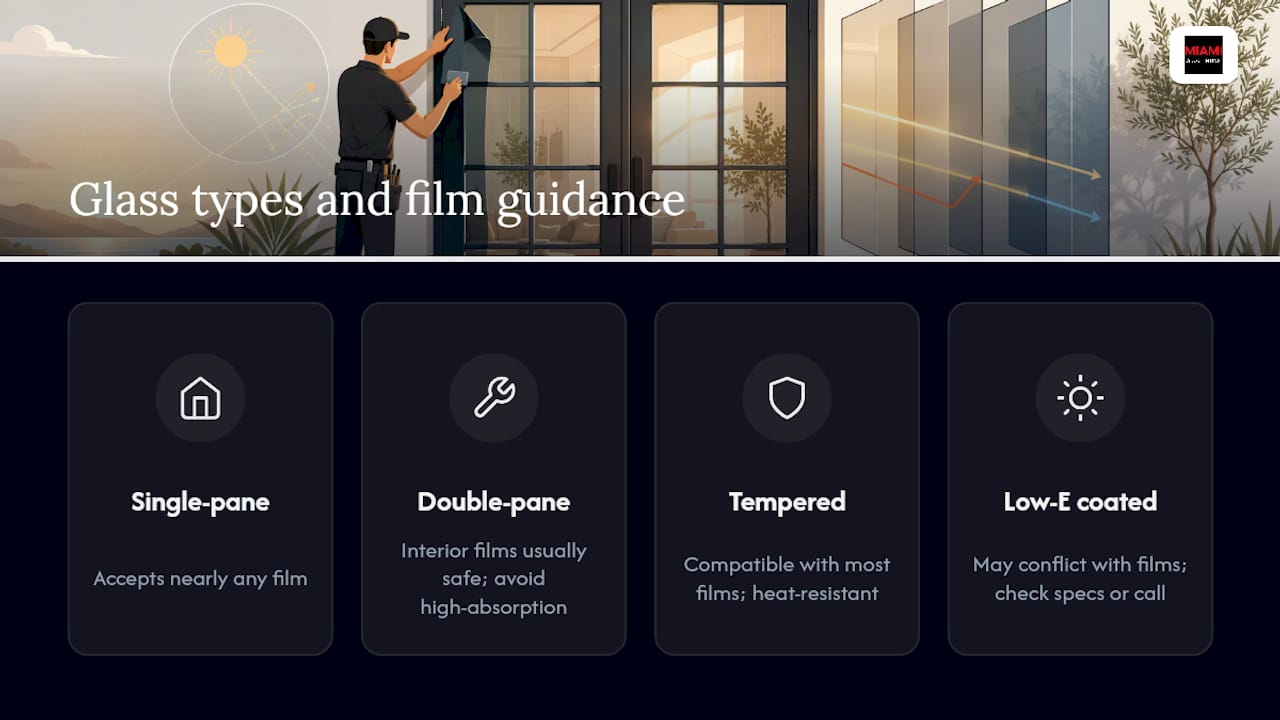
Single-pane glass, common in older homes, accepts nearly any film without complication. It's the simplest surface to work with and rarely has coating restrictions.
Double-pane (insulated) glass is now standard in new construction and replacement doors. Film applied to the interior surface of double-pane glass is generally safe, but avoid films with very high heat-absorption ratings unless the manufacturer confirms compatibility, since trapped heat between the panes can stress the seal over time.
Tempered glass, required by code on most French doors for safety reasons, is compatible with the vast majority of films on the market. Tempered glass is actually more heat-resistant than standard annealed glass, which makes it a forgiving surface for solar-control films.
The complication comes with Low-E (low-emissivity) coated glass, increasingly common on energy-efficient doors. Some films can interfere with the coating's reflective properties or create unusual heat patterns near the edges. If your doors are newer, check the glass specs before buying film, and mention the Low-E coating to any installer or manufacturer you contact. When in doubt, a quick call to your glass or door manufacturer settles the question faster than guessing.
How Do You Measure French Doors for Window Film?
Accurate measuring is where most DIY installs go wrong before the film ever touches the glass. French doors rarely have perfectly uniform panes, especially in older homes, so measuring once for the whole door and cutting identical pieces is a common and costly mistake.
Measure each pane individually, width and height, using a steel tape measure rather than a fabric one for precision. Record every measurement on a simple diagram of the door, numbering each pane so you don't mix them up later. Add a small overlap margin, roughly a quarter inch on each side, to account for minor measuring error. You'll trim the excess after application rather than trying to cut an exact fit upfront.
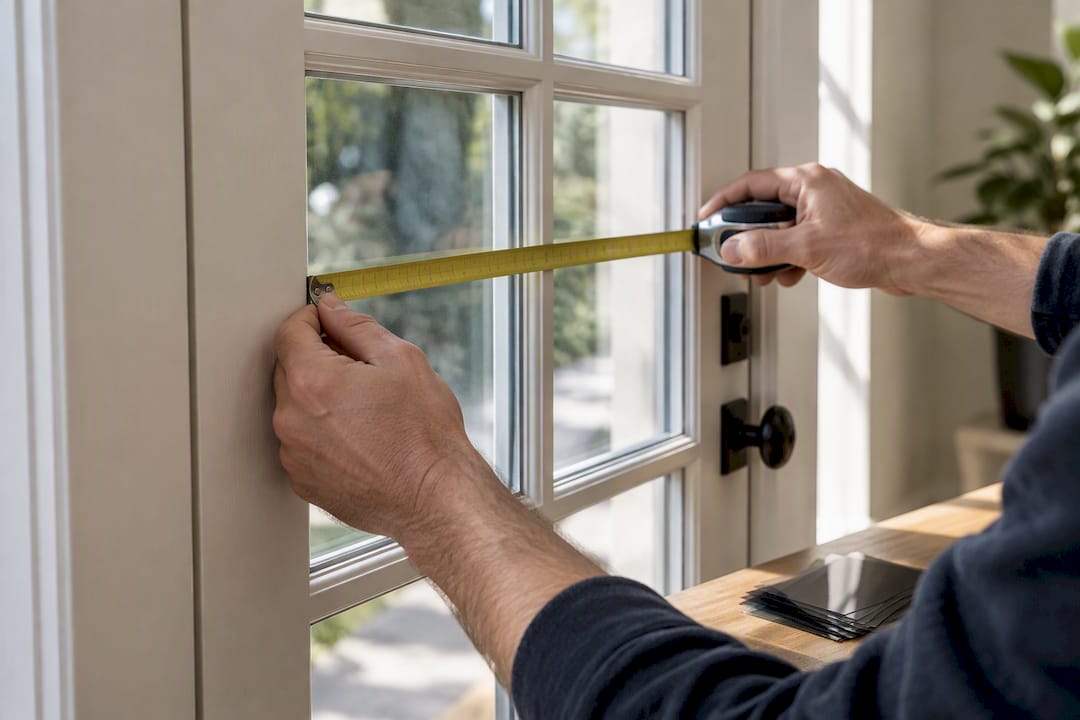
Measure twice if the door is more than a few years old. Wood doors especially can warp slightly with humidity, which means panes that were once identical sizes may no longer match. If you're ordering a made-to-size kit rather than cutting your own film, this same pane-by-pane measurement is exactly what the service will ask you to provide, so it's worth doing carefully regardless of which route you choose.
Are There Eco-Friendly Window Film Options?
Window film doesn't get talked about much in sustainability terms, but it has a real environmental angle worth knowing before you buy. Solar-control films reduce the heat load on your air conditioning system, which lowers energy use over the life of the film, a meaningful factor if your French doors face direct afternoon sun.
On the materials side, most window films are PET (polyester) based, and PET is technically recyclable, though most curbside programs aren't set up to accept it because of the adhesive backing. A few specialty recyclers do accept clean film scraps, so check locally before assuming it goes straight to a landfill.
If sustainability is a priority, look for films with longer rated lifespans first. A film that lasts 10 years instead of 5 cuts your material waste in half over time, regardless of what it's made from. Some manufacturers have also started offering PVC-free formulations, which avoid the chlorine-based byproducts associated with PVC production and disposal. Ask about this specifically if it matters to you, since it's rarely advertised prominently on packaging.
Does DIY Film Last as Long as a Professional Install?
Not usually, and the gap comes down to prep and technique rather than the film itself. The same roll of film installed by a careful DIYer and a trained professional will perform identically in terms of UV block and heat rejection. What differs is how long the installation holds up.
Professional installs benefit from consistent, controlled technique: proper heat-curing on every edge, thorough dust removal before application, and precise trimming that leaves no gaps for moisture or dust to work into. Surface prep is the single biggest factor installers point to when predicting whether a film install lasts years or fails within months.
DIY installs can absolutely match that durability, but the margin for error is smaller on French doors than on a flat window. A missed dust particle, an incomplete heat-cure, or a slightly short cut at the muntin edge won't ruin the film's function, but it often shortens its usable life by causing edge lift or bubbling well before the film's rated lifespan. First-time DIYers should expect a learning curve, and it's common for an early pane or two to need a redo once technique improves partway through the job.
What Should You Expect From a Professional Installer?
A professional install starts with an on-site assessment of your glass type, pane count, and sun exposure, followed by a quote that accounts for the extra labor multi-pane doors require. Reputable installers use computer-cut templates or precise hand-measuring for each pane rather than a single generic cut, which is the main reason professional work looks cleaner up close than most DIY jobs.
Look for installers who can name the specific film brand and line they're using, similar to how Southmiamitint installs named products like 3M Ceramic IR and Iviron KoolMax rather than generic unbranded film. Ask about warranty terms up front. Most legitimate installers back their work with a warranty covering bubbling, peeling, or discoloration under normal conditions, separate from the film manufacturer's own product warranty.
Expect the installer to walk you through removal policy too, particularly if you're renting or might sell the property. Some films remove cleanly with heat and patience; others leave adhesive residue that requires additional cleanup. A straightforward answer to that question, before you book, tells you a lot about how the company handles the parts of the job that aren't visible on install day.
What a Homeowner Should Actually Do Right Now
Hire a professional for any French door with more than six small panes or if you want ceramic film with heat rejection above 90 percent, since that combination punishes a DIY mistake more than it rewards a savings. For a simple removable frosted film on a straightforward two-pane door, DIY is a reasonable weekend project.
The pattern that keeps showing up across installer feedback and product reviews is that film performance rarely fails. Installation technique does. That's worth remembering before you decide where to spend your effort.
— Jose
Ready to Book a Professional French Door Tint Install?
The installation service comes to your driveway, performing the whole install on site, using named, premium film lines rather than unbranded generic stock.
For French doors specifically, that means:
- Mobile residential tinting scheduled around your day, on site in Miami-Dade
- Premium film lines including 3M Ceramic IR, 3M Crystalline, and 3M Color Stable, plus Iviron KoolMax ceramic
- Computer-cut templates for a clean fit across multi-pane layouts
- Old tint removal if you're replacing a failed DIY job or outdated film
If your French doors have more panes than you want to measure yourself, or you want ceramic-level heat rejection without guessing at technique, get a quote through Southmiamitint and schedule your install at your own address.
Helpful Resources for French Door Film Shoppers
Further reading on related topics: privacy levels in window film, UV-blocking film benefits, decorative tint film styles, and why homeowners tint sliding glass doors.
Sources
- Amazon
- Made To Size Service, French Paned Doors - Wallpaper For Windows
- 8in x 10in Nano Ceramic Window Tint Film– Snapguard Solutions
- Installing Window Film on French Doors And Windows - Sundown Window Tinting
- French Door Window Film - Wayfair
FAQ
What's the Best Tint for French Doors With Multiple Panes?
Frosted or etched decorative film works best for privacy on multi-pane French doors since it preserves light while blocking sightlines. For heat control on the same doors, ceramic film is the stronger pick, though multi-pane doors generally need professional cutting and fitting to look clean.
Can You Tint French Doors Yourself?
Yes, DIY is realistic for simple, removable frosted films on doors with a small number of panes. Complex layouts with many small panes, or high-performance adhesive films that need heat-curing, are better suited to professional installation.
How Much Does It Cost to Tint French Doors?
DIY materials typically run $8 to $12 per square foot, while professional installation costs more due to the added labor of cutting and fitting multiple panes. Southmiamitint's residential window tinting pricing is available directly through Southmiamitint.
Does Tinted Film Block UV Rays on Glass Doors?
Yes, many solar-control and ceramic films block up to very high percentages of UV rays while still allowing visible light through. This helps protect flooring and furniture near French doors from sun fading.
Will Window Film Damage My French Door Glass?
Properly matched film applied by an experienced installer does not damage standard tempered or double-pane glass. Problems mainly arise with Low-E coated glass or when a film with the wrong heat-absorption profile is applied without checking manufacturer compatibility first.