
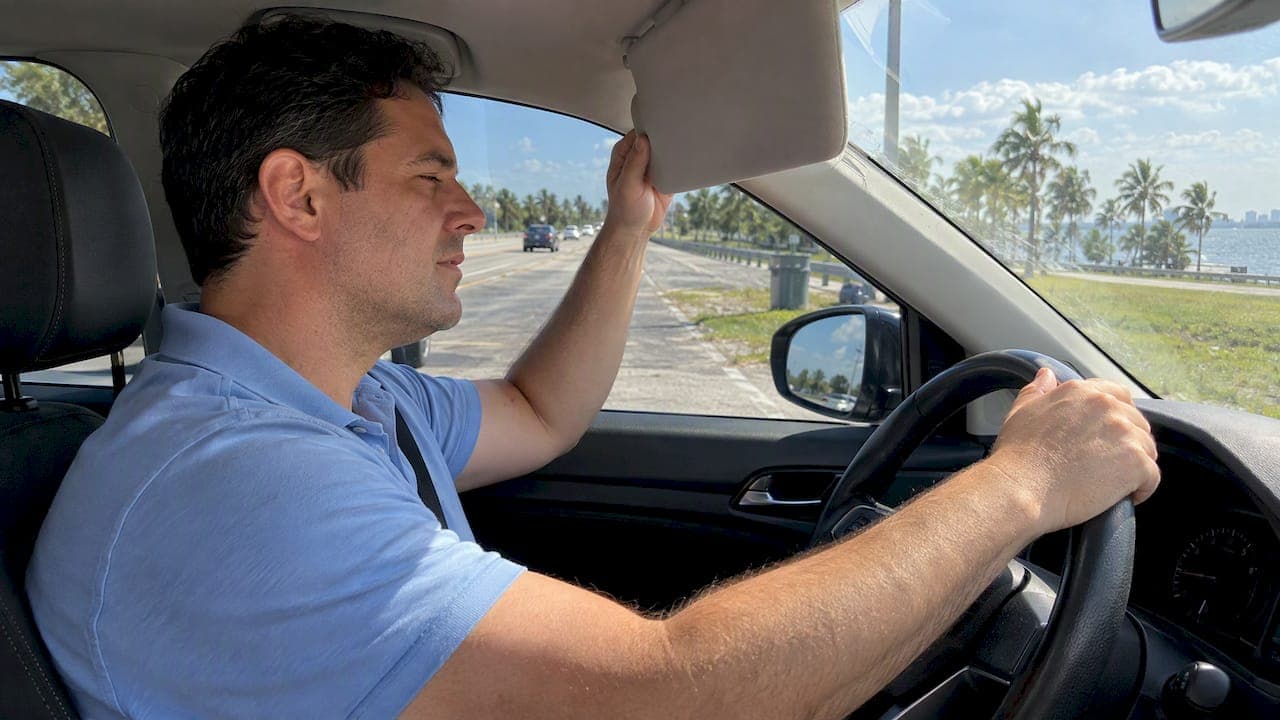
Yes, sun glare can trigger migraine attacks in people who are sensitive to light, and the first priority is always safety behind the wheel. If glare starts pulling at your vision or a headache builds while driving, pull over when it's safe, drop your visor, and put on sunglasses until the symptoms ease. Once you're stopped safely, the right eyewear, window film, and driving habits can cut your exposure the next time.
TL;DR:
- A case series of 16 patients found sunlight triggered attacks after 5 to 10 minutes in summer, while winter onset could take up to 60 minutes.
- Polarized sunglasses cut reflected glare from roads and hoods, while an optometrist can assess precision ophthalmic tints for light sensitivity associated with migraine.
- An fMRI study found precision ophthalmic tints reduced cortical hyperactivation and visual discomfort more than standard gray lenses for people with migraine.
- Ceramic and crystalline films can reduce heat and glare while preserving visibility at lighter levels, but tint laws differ by state and window position.
- Sudden, fixed vision loss in one eye requires urgent medical evaluation, unlike shimmering or shifting aura; do not wait to see whether it passes.
Table of Contents
- What Is Photophobia and How Does It Connect to Migraine?
- How Sun Glare Can Trigger a Migraine Attack
- Immediate Steps to Stay Safe When Light Triggers Symptoms While Driving
- Eyewear Options for Drivers With Light-Triggered Migraines
- Car Adaptations: Visors, Window Film, and Dashboard Changes
- A Mobile Installer's View on Glare and Film Choice
- Comparing Window Tint Types for Glare-Related Migraine Relief
- Professional Mobile Installation Versus DIY Film Kits
- 3M Ceramic IR, 3M Color Stable, and Iviron KoolMax: What Each Offers
- Does Window Tint Reduce Migraine Frequency Over Time?
- Balancing Medical Caution With Practical Vehicle Fixes
- Reduce Glare With Mobile Tinting From South Miami Tint
- FAQ
- Sources
What Is Photophobia and How Does It Connect to Migraine?
Photophobia is the medical term for light sensitivity, and it's one of the most common experiences reported by people with migraine. According to the American Migraine Foundation, a large majority of people with migraine report sensitivity to light, and it can show up before, during, or after a headache.
Not every visual symptom behind the wheel means the same thing, though. Visual aura, the shimmering or zig-zag patterns some migraine sufferers see, starts in the brain and usually affects both eyes, even when it feels like it's only in one. A true one-sided, mono-ocular vision change is rarer and points to an eye or vascular issue instead, which is a different safety concern entirely.
Common light triggers reported by migraine patients while driving include:
- Direct sun glare through the windshield or side windows
- Flickering light from trees, overpasses, or oncoming headlights
- High-contrast patterns like sun-dappled pavement or reflective road signs
How Sun Glare Can Trigger a Migraine Attack
The visual cortex, located at the back of the brain, becomes hyperexcitable in people prone to migraine, and bright, high-contrast light can push that excitability past a tipping point. That's the mechanism researchers point to when explaining why sunlight sets off attacks in susceptible drivers.
A case series published in European Neurology documented 16 patients whose migraines were triggered specifically by sunlight, with onset typically 5 to 10 minutes after exposure in summer and up to 60 minutes in winter. That timing pattern matters for drivers: a headache that builds gradually during a sunny commute may be doing exactly what the research describes.

One warning sign deserves immediate attention rather than home management. Sudden, static, one-sided vision loss, especially when it doesn't shift or shimmer the way aura does, needs urgent medical evaluation rather than a wait-and-see approach.
Immediate Steps to Stay Safe When Light Triggers Symptoms While Driving
If glare starts affecting your vision or a headache builds while you're behind the wheel, act quickly and deliberately.
- Signal early and move toward the shoulder or the nearest safe exit, checking mirrors and blind spots before you slow down.
- Choose a flat, visible stretch to stop rather than a curve or a spot with poor sightlines for other drivers.
- Turn on hazard lights once stopped, then adjust your visor and put on sunglasses before continuing.
- Dim your dashboard display and close window shades if your vehicle has them. This gives your eyes a lower-contrast environment.
- Sip water and rest for a few minutes before deciding whether you're fit to keep driving.
Pro Tip: Keep a wrap-style pair of sunglasses in your glove compartment specifically for glare episodes, separate from your everyday pair, so you're never caught without one.
Any medication you carry for migraine should be something your clinician has already discussed with you. This isn't the moment to start a new treatment; it's the moment to use what's already been planned for this exact situation.
Eyewear Options for Drivers With Light-Triggered Migraines
Not all sunglasses solve the same problem, and the right choice depends on what's actually triggering your symptoms.
- Polarized lenses cut reflected glare off hoods, wet roads, and water, which helps with surface glare but doesn't address every type of light sensitivity.
- Precision ophthalmic tints (POTs) are specialized lens colors developed specifically for migraine-related photosensitivity.
- Yellow and orange lens tints filter blue light and are worth trying for overcast or dusk driving when polarized lenses feel too dark.
- A proper wrap fit, ideally from an optometrist, blocks peripheral light leakage that straight-frame sunglasses let through.
A peer-reviewed fMRI study found that precision ophthalmic tints reduced cortical hyperactivation in migraine patients and lowered self-reported visual discomfort significantly more than gray or standard colored lenses. That's a meaningful data point if polarized sunglasses alone haven't been enough: an optometrist can test POTs against your specific sensitivity before you invest in a pair.
Car Adaptations: Visors, Window Film, and Dashboard Changes
Eyewear handles what reaches your eyes, but the car itself can reduce how much glare gets in before it ever reaches your sunglasses.
Short-term, no-cost fixes include repositioning your visor earlier in a turn, adding a dark dashboard mat to cut reflected glare off the windshield, and using a fold-out sunshade when parked so the cabin starts cooler and less glare-soaked.

Window film is the longer-term fix, and choosing the safest visible light transmission (VLT) level for night driving can preserve your visibility while reducing glare with the right film as explained in this tint for night driving guide. Manufacturer documentation for 3M Automotive Window Film describes glare reduction alongside infrared and UV rejection, with some ceramic films reducing visible glare substantially according to the product specs. Terms like IRR (infrared rejection) and glare reduction percentage describe how much heat and brightness a film blocks before it reaches the cabin, and our glossary of tinting terms breaks those down further if you want to compare films before choosing one.
One thing worth checking before any windshield or window film goes on: local tint laws vary by state and by window position, so confirm the legal VLT limits for your vehicle using our windshield tint compliance checklist before scheduling an install.
A Mobile Installer's View on Glare and Film Choice
After years of mobile installs across Miami-Dade, we've noticed a consistent pattern: customers who mention afternoon headaches or eye strain on their commute tend to gravitate toward ceramic films specifically for the glare reduction, not just the heat control. The computer-cut templates we use matter here, since a film that fits precisely avoids the bubbling or peeling that can distort clarity over time. Correct film selection, matched to your vehicle's glass and your actual driving conditions, makes a bigger difference than most drivers expect.
Comparing Window Tint Types for Glare-Related Migraine Relief
Dyed film is the most affordable option but fades over time and offers the least glare and heat control of the common tint types. Carbon film holds up better against fading and blocks a meaningful share of infrared heat, making it a solid mid-range choice for drivers who want more than dyed film without the cost of ceramic.
Ceramic film sits at the top for glare-sensitive drivers specifically because it doesn't rely on metal particles or dark dye to cut brightness. Instead, it uses ceramic particles that block infrared and UV light while keeping visibility clear, which is the combination that matters most for someone whose migraines are triggered by harsh contrast and heat buildup rather than darkness alone. Crystalline-style films take this further, offering high heat rejection even at lighter VLT levels, which matters if your state's tint laws restrict how dark your windows can legally go.
For a driver managing light-triggered migraines, the practical difference shows up on the drive home: a dyed film might reduce brightness, but a ceramic or crystalline film reduces the harsh heat and contrast that tend to escalate a headache, without sacrificing the visibility you need after dark. Our VLT guide walks through how to pick a legal VLT range that still delivers meaningful glare control.
Professional Mobile Installation Versus DIY Film Kits
DIY tint kits are inexpensive upfront, but they ask an untrained installer to achieve the same seamless, bubble-free fit that affects both appearance and optical clarity. A film applied with trapped air or uneven edges doesn't just look imperfect, it can distort light passing through it, which works against the very glare reduction you're trying to achieve.
Professional mobile installation removes that risk by bringing computer-cut, vehicle-specific templates directly to your home or office. That precision matters more for migraine-prone drivers than it does for someone tinting purely for privacy, since any distortion or inconsistency in the film can reintroduce the contrast and glare patterns you're trying to eliminate. Scheduling also plays a role: a mobile appointment fits around your day instead of requiring a drop-off and a wait at a shop, and most installs are completed on-site in a matter of hours.
3M Ceramic IR, 3M Color Stable, and Iviron KoolMax: What Each Offers
3M Ceramic IR film is built around infrared rejection, which directly addresses the heat buildup that intensifies glare-related discomfort on long, sunny drives. Its ceramic composition avoids the metallic interference that older films caused with GPS and phone signals, while still delivering the IR and glare reduction performance detailed in 3M's technical specifications.
3M Color Stable film is formulated to resist the purple or blue fading that cheaper films develop over time, which keeps its glare-reducing properties consistent for years rather than degrading after a season or two of sun exposure.
Iviron KoolMax ceramic tint rounds out the ceramic category with heat and glare rejection aimed at the same goal: lower cabin brightness and reduced infrared transfer without the dark, legally restricted VLT levels that older tint technology required. For a driver whose migraines respond to contrast and heat rather than darkness alone, any of these three ceramic options addresses the underlying trigger more directly than a standard dyed film.
Does Window Tint Reduce Migraine Frequency Over Time?
Window film can't change your underlying migraine condition, but reducing a known trigger consistently tends to matter more than any single drive. If sun glare is one of your reliable triggers, cutting your daily exposure to it, trip after trip, removes a repeated stressor on a visual system that's already prone to overreacting.
Drivers who've made the switch to ceramic or crystalline film often describe fewer afternoon headaches tied to their commute, though film alone won't address triggers unrelated to light, like stress, sleep, or dietary factors. Tracking whether your light-triggered episodes become less frequent after a film upgrade is worth doing over a few months, since migraine patterns can take time to shift even when a trigger is reduced.
Balancing Medical Caution With Practical Vehicle Fixes
Window film and the right sunglasses genuinely reduce a real trigger, but they're not a substitute for medical evaluation when symptoms are new, worsening, or paired with one-sided vision changes. Keep a simple log of when visual symptoms happen and what the light looked like, then bring it to your clinician.
— Jose
Reduce Glare With Mobile Tinting From South Miami Tint
If sun glare is part of your daily drive, our mobile team installs premium films, including 3M Ceramic IR, Crystalline, and Color Stable, directly at your home or office.
We provide quick quotes and mobile installation to help you get relief from a trigger you already know about without long waits. Check your state's tint limits with our compliance checklist, then get a quote to book your install.
FAQ
Can sun glare actually cause a migraine attack?
Yes, sun glare is a documented migraine trigger in people with light sensitivity, and a case series of 16 patients found attacks typically began 5 to 10 minutes after sun exposure in summer. The underlying mechanism involves heightened activity in the brain's visual cortex, which bright, high-contrast light can push past a threshold.
What is the 5 4 3 2 1 rule for migraines?
This isn't a recognized clinical migraine protocol; it more commonly refers to a general grounding or anxiety-management technique using the five senses. For migraine-specific guidance on triggers and management, the American Migraine Foundation is a more reliable resource than informal rules.
Is an ocular migraine the same as a mini stroke?
No, an ocular or retinal migraine is a distinct condition from a stroke, though the visual symptoms can feel alarming. Sudden, one-sided vision loss should still be evaluated urgently, since distinguishing a retinal migraine from a vascular event requires a medical exam rather than self-diagnosis.
What autoimmune conditions are linked to migraines?
Research has explored links between migraine and certain autoimmune conditions, but this connection is still being studied and isn't fully established as a direct cause-and-effect relationship. If you have both a diagnosed autoimmune condition and frequent migraines, your physician is best positioned to evaluate whether the two are related in your specific case.
What eyewear helps most with glare-triggered migraines while driving?
Polarized sunglasses reduce reflected glare from roads and hoods, while precision ophthalmic tints have shown in an fMRI study that they reduce cortical hyperactivation and visual discomfort more than standard gray lenses. An optometrist can help determine which option fits your specific light sensitivity before you commit to a pair.
Sources
- Photophobia (Light Sensitivity) and Migraine | American Migraine Foundation
- fMRI study on precision ophthalmic tints and migraine (PubMed ID 21622479)
- Migraine Headache Triggered Specifically by Sunlight: Report of 16 Cases | European Neurology (Karger)
- 3M Automotive Window Film Ceramic IR Series Brochure (3M)