
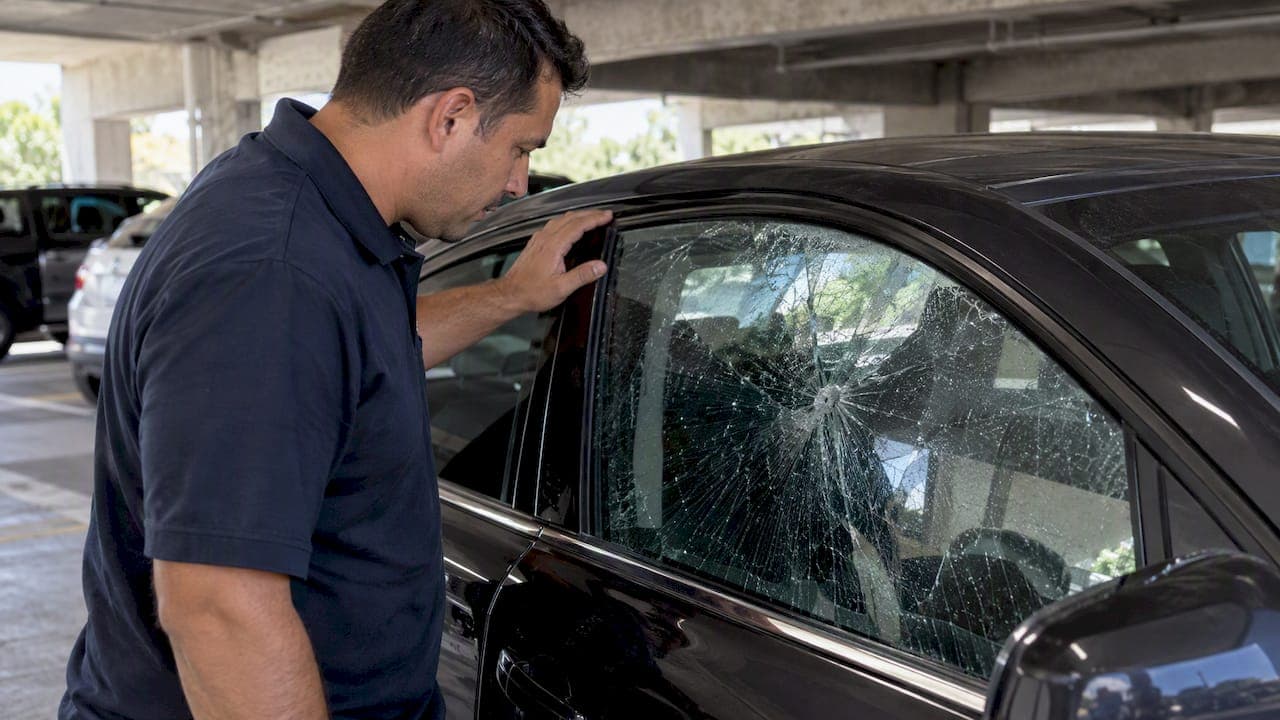
Tint and security film are not the same product. Tint is built to cut heat, glare and UV and to give you privacy. Security film is thicker and built to hold broken glass together. For most Miami drivers, a quality ceramic tint solves the daily problem, which is heat. Security film solves a different problem: smash-and-grab break-ins and flying glass.
Below, we explain how each one works, where they overlap, what Florida law says, and how to decide.
TL;DR
- Tint reduces heat, glare and UV and adds privacy. Security film is thicker and keeps shattered glass in one piece.
- Neither makes glass unbreakable or bulletproof. Security film delays entry and holds fragments, nothing more.
- In Florida, front side windows must allow at least 28% visible light, so a dark tint is not legal there whatever film you pick.
- If your main complaint is a hot cabin, choose ceramic tint first. If your main worry is theft, ask about security film as well.
- Use auto film on cars only. Home and business glass needs architectural film.
Table of Contents
- What is the difference between security film and tint?
- What each one actually does for your car
- Florida tint law: what you can and cannot install
- Which one should you choose?
- Our perspective: heat is the daily problem in Miami
- Cars, homes and businesses use different films
- How installation works
- Care for glass after tinting
- What our mobile tinting costs
- Ready to cool your car down?
- FAQ
- Sources
What is the difference between security film and tint?
Both are polyester films applied to glass. The difference is the job each one is engineered for.
Standard window tint is made for heat rejection, UV protection and privacy. Security film often offers some of the same benefits, but it is physically thicker and uses heavy-duty polyester to hold broken glass together. That is how it deters smash-and-grab theft and reduces injury from flying shards in a crash.
Thickness is the easiest way to see it. Automotive security films are typically 4 mil to 8 mil, which is thicker than standard solar-control tint. Tint is much thinner, so it does little to hold glass once it breaks.
Here is the side-by-side view:
| Window tint | Security film | |
|---|---|---|
| Main job | Heat, glare, UV, privacy | Hold broken glass together, slow entry |
| Thickness | Thin | Typically 4 to 8 mil for vehicles |
| Look | Dark to light, many shades | Usually clear or very light |
| Daily comfort in Miami | High with ceramic or carbon | Depends on the film, often modest |
| Break-in resistance | Minimal | Delays entry, adds noise and effort |
| Typical buyer | Nearly every driver | Owners worried about theft |
The last two rows matter most. Tint is a comfort product that nearly every driver here benefits from. Security film is a protection product you buy for a specific risk.
What each one actually does for your car
Tint: the daily benefit
In South Florida, the car sits in the sun for hours. A tint that blocks infrared heat changes how the cabin feels when you get in and how hard the A/C works. Industry sources note tint can reject up to 99% of UV rays and help prevent interior fading. Less glare also means less eye fatigue on long drives, and experts point to this as a real comfort and safety gain in hot climates like ours.
The type of film decides how much heat you stop. Dyed film mostly darkens. Carbon does better. Ceramic does the most for heat without needing a very dark shade. If you want the details, our guide on what ceramic window tint is covers it, and infrared vs. ceramic tinting compares the two film families we install.
Security film: the protection benefit
When a window is struck, security film keeps the glass bonded to it instead of letting it fall into pieces. That slows down a thief, makes more noise and keeps shards off you in an impact.
Be realistic about it. No window film makes a vehicle window unbreakable or bulletproof. The aim is to delay entry and discourage casual thieves. Installation also matters: the film has to be applied correctly, and in some cases an attachment sealant is needed for best performance, according to the same 3M data sheet.
Does factory privacy glass count?
No. Factory "privacy glass" is often just dyed glass made for looks, with minimal heat or UV rejection. Many SUV owners assume the back windows are already protected. They usually are not, at least not against heat. A ceramic film on top of factory privacy glass is how you get real heat rejection.
Florida tint law: what you can and cannot install
Security film is often sold as clear, so people assume it avoids tint rules. Still check the numbers before you buy any film, because the law looks at light transmission, not the product name.
Under Florida Statute 316.2953:
- Side windows forward of or adjacent to the driver must allow at least 28% of light in (VLT).
- Windows behind the driver must allow at least 15% VLT.
- On multipurpose passenger vehicles, the rear window can go as low as 6%.
- Reflectance cannot exceed 25% on front side windows or 35% behind the driver.
Installing material that breaks these rules is a noncriminal traffic infraction for the driver, and the statute allows misdemeanor charges for the installer or seller. That is why we do not install film that puts you outside the limits. Two companion reads: our page on Florida windshield tint law and why 35% to 50% VLT keeps tinted windows safe at night. Limited evidence links standard tinting to daytime crashes, but visibility can suffer in low light if transmittance is too low, so a lighter ceramic is often the smarter choice anyway.
The Florida Statutes also have a separate section for windows behind the driver, if you want to read the exact wording for your vehicle type.

Which one should you choose?
Start with the problem you want to fix.
Choose tint if...
- Your car gets hot and the A/C struggles.
- Glare bothers you on I-95, the Turnpike or US-1.
- You want privacy for bags, a laptop or kids' seats.
- You want to protect leather and the dashboard from UV fading.
For most people in Kendall, Pinecrest, Homestead and Cutler Bay, this is the answer. Read why Miami-Dade drivers prefer ceramic tint and how the local climate makes tint a must-have.
Consider security film if...
- You park on the street or in busy lots and have had a break-in or near miss.
- You regularly leave valuables in the vehicle.
- You want glass to stay in one piece in a collision.
You can also combine them. Some films pair solar control with a heavier construction, and a thick clear film can sit under or alongside a tint layer. Ask about this before you book, and make sure the finished window still meets the Florida limits above.
Budget reality
Security film costs more than standard tint because it is thicker and harder to install. Tint is the better value per dollar for daily comfort. If you can only do one thing, do the tint, and choose ceramic if heat is your main complaint.
Our perspective: heat is the daily problem in Miami
We tint cars, SUVs and trucks at your home or work across Miami-Dade, and the same request comes up all the time: "My car is an oven." Very few customers call because of a break-in. Heat, glare and fading are what people live with every day.
So our advice is simple. Pick the film for the problem you have. A real ceramic film, such as the 3M Ceramic IR and Crystalline films or Iviron KoolMax ceramic, gives strong heat rejection while staying inside Florida's 28% front-window rule. A darker, cheaper film may look better in the first week, but it does less against the sun and can put you at risk of a ticket.

We also see people confuse "clear" with "legal." Clear and light films still count toward your VLT, and many cars already have factory glass that is not 100% clear. Have the numbers checked before you commit.
If theft protection is on your mind, tell us when you call. Explain how you park and what you carry, and we will tell you plainly what tint can and cannot do for you.
— Jose
Cars, homes and businesses use different films
Do not take auto tint home. Automotive film absorbs solar heat while the car is parked, then sheds it through airflow as the vehicle moves. Architectural film reflects energy away from stationary glass to prevent thermal stress and breakage. Putting auto film on a building is the wrong tool for the job.
The same logic applies to security film. Home security and hurricane-related films are rated and installed differently from the car versions. If you want residential or commercial glass done, tell us the building type and glass size so the right film is quoted.
How installation works
A professional car tint job typically takes 1.5 to 2.5 hours. The film pattern is cut for precision, then applied to the interior surface of the glass. Installers also have to follow rules such as Federal Motor Vehicle Safety Standard No. 205.
We do it at your location, so you do not need to drop the car off. Our process:
- You request a quote online or by phone with your vehicle and the windows you want done.
- We confirm the film and a legal shade for your car.
- We come to your home, office or parking spot.
- We cut the film to fit with computer-cut patterns and install it.
- You get care instructions so the film cures properly.
If you have old, purple or bubbling tint, we also handle old tint removal before the new film goes on.
Care for glass after tinting
After tinting, keep the inside glass clean with a soft cloth and ammonia-free cleaner. For the outside, a ceramic coating on glass can keep water beading on the windshield. That page is written for UK drivers, so check the product suits your local conditions and climate. It is a separate product from tint and only affects the outside surface.
Wait a few days before rolling the windows down, and expect a slight haze as the film cures.
What our mobile tinting costs
These are the published starting prices for vehicles:
- 2 Front Windows: from $150
- Windshield Tint: from $150
- Full Car + Windshield: from $500
The final price depends on the vehicle and film type. For ceramic, carbon and 3M options, request a quote. Our mobile tinting prices page has more detail, and the ceramic tint page shows what that film offers.
Ready to cool your car down?
We bring premium 3M and Iviron KoolMax films to your door anywhere in Miami-Dade, with same-day availability. See our services and get a quote or learn how mobile car window tinting in Miami works. Call now or fill out the online form.
FAQ
Does window safety film work?
Yes, within limits. It holds broken glass together, which delays entry and reduces injury from shards. It does not make glass unbreakable, and it has to be installed correctly to perform as intended.
Is security film the same as tint?
No. Tint is thin and built for heat, UV, glare and privacy. Security film is thicker, often 4 to 8 mil on vehicles, and built to hold glass in place. Some products blend features, so ask for the specs.
Is ceramic tint worth it over regular tint?
For Miami heat, usually yes. Ceramic rejects more heat than dyed film without needing a dark shade, which helps you stay within Florida's 28% front-window limit. Our guide on why ceramic tint suits Miami drivers goes deeper.
Can I get 5% tint in Florida?
Not on the front side windows, which must allow at least 28% light. Behind the driver the minimum is 15% on most vehicles, and as low as 6% on the rear window of multipurpose vehicles like SUVs and vans, per the Florida statute.
Can I use the same film on my house and my car?
No. Auto film and architectural film are engineered differently, so use the one made for your glass.
Sources
- Florida Statute 316.2953, side windows
- Florida Statute 316.2954, windows behind the driver
- Madico automotive window film
- 3M Scotchshield Auto Security Film technical data sheet
- Johnson Window Films FAQs
- U.S. DOT research on window tint and safety