
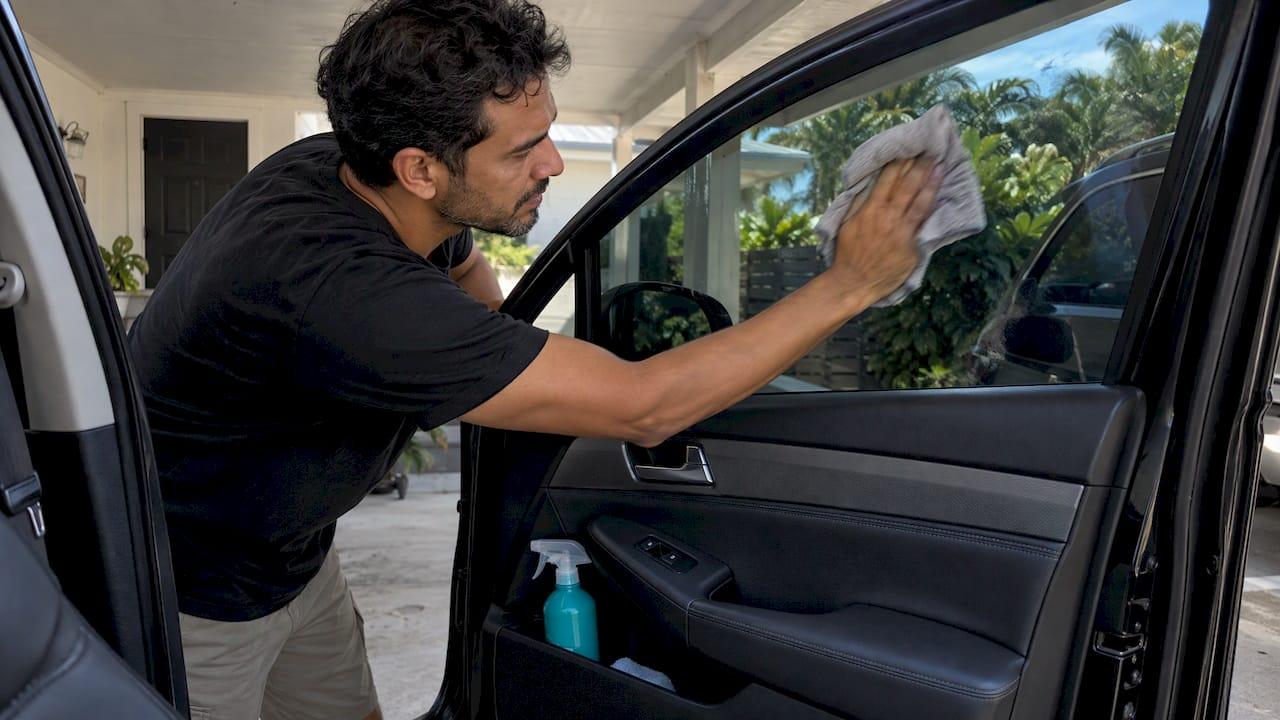
The safest cleaner for tinted windows is an ammonia-free glass cleaner or a few drops of mild dish soap in clean water, applied with a soft microfiber cloth. Skip ammonia, vinegar, abrasive pads and paper towels. Wait at least 48 hours after a new install before you clean at all. In Miami-Dade, where salt air, sun and dust hit the glass every day, a gentle routine keeps ceramic film clear and bonded for years.
TL;DR
- Use an ammonia-free glass cleaner, or mild dish soap mixed with clean water. Both are gentle on car, home and office film.
- Windex is not one single formula. Ammonia-containing window cleaners can make auto tint fade, bubble and peel, so read the label first.
- Spray the cleaner on a microfiber cloth, not on the glass, and dry with a second clean towel.
- Wait at least 48 hours after installation before the first cleaning, and clean in the shade.
- Avoid ammonia, acids, abrasives, paper towels and soaking the edges of the film.
Table of Contents
- Why the cleaner matters for tint
- Can you use Windex on tinted windows?
- What to use on tinted windows
- What not to use on tinted windows
- How to clean tinted car windows step by step
- Interior and exterior: where is the film?
- Cleaning for Miami conditions
- Your cleaning kit
- Quick answers by situation
- Perspective
- Getting the film right from the start
- FAQ
- Sources
Why the cleaner matters for tint
Window film is a thin layered product. On a car, the film is bonded to the inside of the glass with an adhesive. A harsh chemical or a rough tool does not just leave a smear. It can haze the surface, scratch it, or work into the edges and loosen the bond.
That is why a cleaner that is perfect for a bare bathroom mirror is not always right for tint. The good news is that the safe option is cheap and simple. You do not need a special product, only the right ingredients and the right technique.
This guide is for drivers, homeowners and business owners in Miami, Kendall, Homestead, Cutler Bay, Pinecrest and the rest of Miami-Dade who want clear glass without damaging the film they paid for.
Can you use Windex on tinted windows?
It depends on the bottle. Windex is a brand with several formulas, and they do not all contain the same ingredients. The one that matters is ammonia. Poison Control warns that ammonia-containing glass cleaners can cause auto window-tint film to fade, bubble and peel.
So the practical rules are:
- Check the label for ammonia. If it lists ammonia, keep it away from tinted car windows.
- If the label says ammonia-free, it is a better candidate, but you still apply it with a microfiber cloth rather than spraying the glass.
- If you are unsure, use mild soap and water. It costs almost nothing and works for fingerprints, dust and light film.
The same caution shows up outside the auto world. The National Glass Association's 2023 cleaning bulletin says ammonia-containing cleaners may not suit all films and suggests checking with the film supplier. If your film was installed by us, you can ask us what to use on it.
What to use on tinted windows
The options below are the ones film makers and glass-industry guidance point to.
| Cleaner | Good for | Notes |
|---|---|---|
| Mild dish soap in clean water | Routine cleaning, fingerprints, dust | A few drops in a bucket or spray bottle is enough |
| Ammonia-free glass cleaner | Streak-free finish on interior glass | Check that the label says ammonia-free |
| pH-neutral commercial cleaner without abrasives | Regular car window care | This is the type 3M names for its automotive films |
| Plain clean water | Light dust | Follow with a dry microfiber towel |
3M's U.S. care guidance says to use a soft sponge or cloth, clean water and a neutral-pH commercial cleaner without abrasives. For commercial film, XPEL's care guide recommends a glass cleaner or mild dishwashing detergent mixed with water, with soft microfiber cloths.
You will also see store-bought automotive glass sprays marketed as tint-safe. Those are fine when the label confirms they are ammonia-free and you use them on a cloth. Brand does not matter as much as the ingredient list.
A simple homemade mix
Fill a clean spray bottle with water and add two or three drops of mild dish soap. Shake gently. That is all. Too much soap leaves a residue that streaks, so keep it light. If you want a method from a mobile detailer's side, this tint-safe soap mix guide covers a soap-based approach to tinted glass.
What not to use on tinted windows
The list is short, and every item has a reason.
- Ammonia-based cleaners. Simple Green's tinted-window instructions say to avoid them, and Poison Control describes the fading, bubbling and peeling they can cause.
- Abrasive tools. The same guide says to avoid paper towels, scouring pads and newspaper. They can leave fine scratches in the film surface.
- Acidic or harsh cleaners. The glass association's bulletin says glass cleaners should not contain acids, especially hydrochloric or hydrofluoric acid.
- Razor blades and scrapers on the film. They cut it. Leave them for bare glass, and never on the tinted side.
- Dirty water or a dirty cloth. 3M points out that sand or dust in dirty water can scratch film, so clean water and a clean cloth matter as much as the cleaner.
What about vinegar and water?
Vinegar and water is a popular home recipe, but it is an acid, and acid is on the list of things glass guidance says to keep away from. For tint, we suggest sticking with soap and water or an ammonia-free cleaner. They do the same job without the question mark.
How to clean tinted car windows step by step
1. Wait for the film to cure
Do not clean a new install right away. 3M's guidance is to wait at least 48 hours after installation before cleaning. Small hazy spots or moisture pockets can show up in the first days. Wiping them early is how film gets pushed out of place. Our guides on wash timing after tint and when to roll windows down cover the waiting periods in more detail.
2. Work in the shade
The National Glass Association advises against cleaning tinted or reflective glass in direct sun because the surface can get too hot for good results. In Miami that matters most. Hot glass dries the cleaner before you wipe, which is what causes streaks. Park in a garage, under a carport or in the shade of a building.
3. Spray the cloth, not the glass
Simple Green's guide recommends spraying the cleaner onto a microfiber cloth instead of the window. This keeps liquid from running down into the door seals and the edges of the film. Liquid sitting under the edge of film can weaken the adhesion.
4. Wipe in one direction, then the other
Wipe the window vertically, then go over it horizontally. If a streak appears later, you can tell from the direction which pass left it. Use light pressure. Dried-on spots usually come off with a second damp pass, not with force.
5. Dry with a second towel
Finish with a clean, dry microfiber towel. 3M's care guidance calls for a soft microfiber towel to dry. Keep one towel for wet work and one for drying, and wash them without fabric softener, which leaves a greasy film that smears glass.
6. Take care at the edges
Do not saturate the edges of the film or the area near the window gaskets. Wipe the edge with a barely damp cloth, and dry it right away.
Interior and exterior: where is the film?
On a car, tint is on the inside of the glass. That means your cleaning with a cloth and a gentle spray happens inside the cabin, and the outside of the window is plain glass. The outside faces road grime, salt and sun, and ordinary car-wash soap works there.

On homes and commercial buildings, film can be applied inside or outside depending on the type. Interior film is cleaned the way described above. Exterior architectural film is a different case: XPEL's commercial care guide notes that exterior films are typically handled by professional window cleaners. If you manage an office building with film on large outside windows, schedule cleaning with a crew that knows film, and tell them what product is on the glass.
Cleaning for Miami conditions
Miami-Dade adds its own challenges:
- Salt and humidity. Near Biscayne Bay and the coast, a salty haze builds up on glass. Soap and clean water remove it better than a fast spray-and-wipe.
- Pollen and dust. Wipe with a damp microfiber before you use any dry cloth, so grit does not drag across the surface.
- Heat. Glass in a parked car can get very hot. Let it cool in the shade before you clean.
- Sunscreen and hand oils. Interior glass collects fingerprints and lotion smears. A cloth with a little ammonia-free cleaner handles them.
For more local care habits, see our post on tint maintenance in Miami and our step-by-step film care guide. Coastal homeowners can also read about UV and heat for coastal tint.
Your cleaning kit
You can build a complete kit for a few dollars:
- Two or three clean microfiber cloths, one for washing and one for drying.
- A spray bottle of clean water with two or three drops of mild dish soap, or an ammonia-free glass cleaner.
- A soft sponge for exterior glass only.
- A small detailing brush or cotton swab for corners, used dry.
Keep the cloths in a sealed bag in the car so they stay free of grit. A cloth that fell on the garage floor is a scratch waiting to happen, so replace it with a clean one.
Quick answers by situation
- Fingerprints on the interior glass: damp microfiber with a drop of soap, then dry.
- Dusty film in a home window: dry microfiber first, then a lightly damp one.
- Sticky residue or a spill: soft cloth with soap and water, held on the spot for a few seconds so it loosens, then wipe. Do not scrape.
- Streaks that will not go: the cause is usually too much product or glass that was hot. Wipe with clean damp water, then dry.
- Old, peeling or purple film: cleaning will not fix it. It needs removal and a fresh install.
Perspective
After 28 years of tinting cars in Miami, we know most film problems start with a bottle under the sink, not with the film. A customer pays for a good ceramic film, then cleans it with an ammonia spray and a paper towel. The film is built to reject heat and UV, but it still sits on glass with an adhesive, and it still has a surface you can scratch.
That is why we install ceramic films only, such as 3M Ceramic IR with a lifetime warranty, SunTek CIR with a 5-year warranty and Uviron KoolMax with a 3-year warranty. A film made to last is worth a few minutes of gentle care. Our own advice is the simple routine in this guide: soap and water or an ammonia-free cleaner, microfiber, shade, and patience in the first 48 hours.
We also cut each pattern by computer for an exact fit, and our 60-inch rolls let us install large windshields in one piece with no seam. A clean, even edge is easier to care for, because there are no gaps for moisture to find.
Jose
Getting the film right from the start
Cleaning is easy when the film is well installed. We come to your home or office anywhere in Miami-Dade, so your car is tinted where it is parked and you do not wait at a shop. Our work is owner-installed, and we have experience with Tesla, luxury and exotic vehicles.
Pricing starts from $200 for 2 front windows, from $150 for a windshield, and from $450 for a full car plus windshield. Removal of old tint is $50-150. If your current film is bubbling, purple or peeling, get a quote for mobile window tinting and we can replace it with ceramic film. You can also read about our ceramic tint and 3M film options. Homes and offices are covered too, through our residential and commercial window tinting.

Your film care instructions come with the job, and your warranty terms depend on the film you choose. Our post on keeping your warranty after tinting explains how to protect it.
FAQ
Is it safe to use glass cleaner on tinted windows?
Yes, if it is ammonia-free and you apply it with a soft microfiber cloth. Ammonia-containing cleaners can fade, bubble and peel auto tint film. Always read the label before you spray.
Is Windex safe on tinted windows?
It depends on the formula. Windex has multiple versions, and any ammonia-containing glass cleaner is a risk to car tint. Choose an ammonia-free product, or mild soap and water, if you are not sure.
What do I use to clean the inside of my tinted car windows?
Use a microfiber cloth lightly dampened with an ammonia-free glass cleaner or soapy water, then dry with a second clean towel. Clean in the shade and avoid soaking the edges of the film.
How long should I wait to clean new tint?
Wait at least 48 hours after installation, per 3M's U.S. care guidance. Some cars need longer before you roll the windows down, so follow the instructions you get from your installer.
Sources
- Is Windex toxic? | Poison Control
- Proper Procedures for Cleaning Architectural Glass Products (National Glass Association, 2023)
- 3M | How To Protect Your Vehicle after Tinting
- Commercial Care & Maintenance (XPEL)
- How to Clean Tinted Windows | Simple Green