
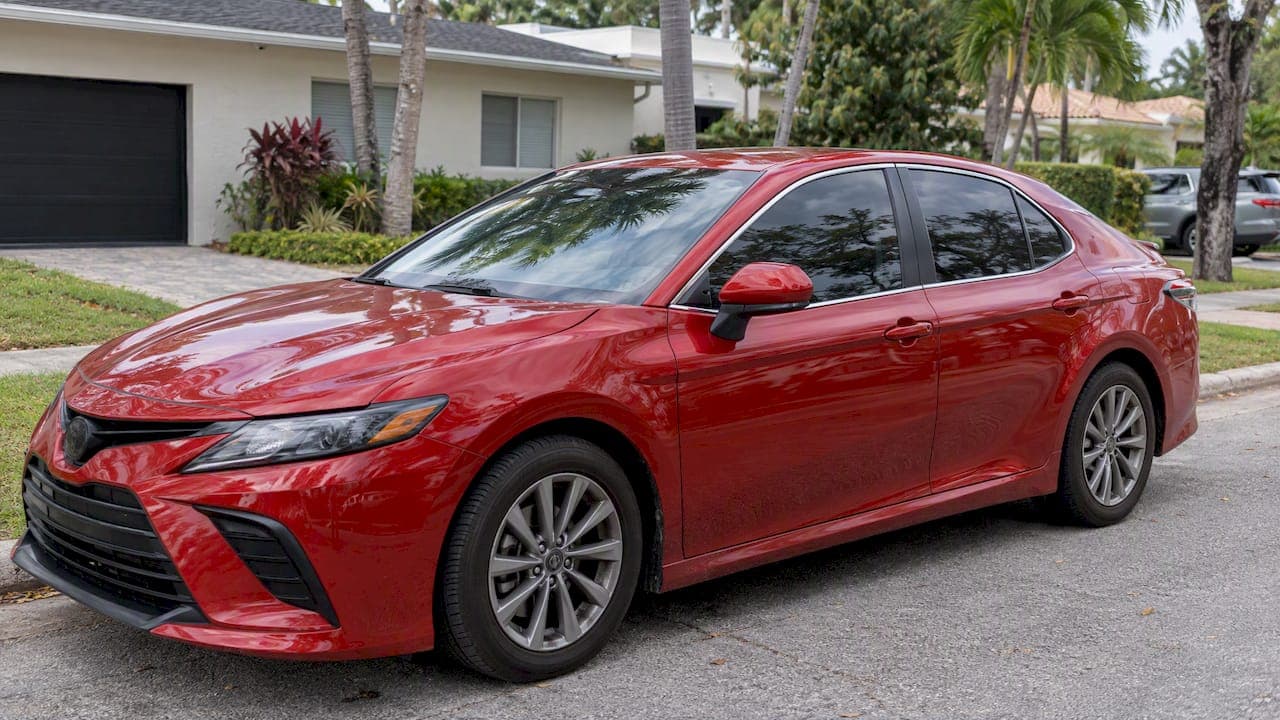
When people search "red car window tint," they mean one of two things. Some own a red car and want the best tint to go with the paint. Others want red-colored film on the glass itself, usually for a show car. The answer for a red car on Miami streets is a neutral charcoal ceramic or color-stable film. Red-colored film on the glass is a show-car choice, and in Florida it runs into the tint law.
We tint cars at your home or work across Miami-Dade, so this guide covers both questions: the look, the film, the law and the care.
TL;DR
- For a red car, pick neutral charcoal or black film. It matches the black trim, wheels and mirrors most red cars already have, and it keeps the paint as the color that stands out.
- Red or color-shifting film is a show-car option. Florida law restricts any front side window tint that alters the window's color, so it is not a safe daily-driver choice.
- In Florida, front side windows must let in at least 28% of visible light. Heat rejection comes from the film technology, not from darkness.
- Ceramic and color-stable films are made to resist fading and purple shift, which matters in South Florida sun.
- We install on site in Miami-Dade. Pricing starts from $150 for two front windows.
Table of Contents
- Tint for a red car vs. red-colored tint
- What shade works best on a red car
- Is red window tint legal in Florida?
- Which film holds up best in Miami sun
- Protecting red paint and glass together
- How installation and aftercare work
- What the choice costs
- Our perspective
- Get a quote for your red car
- FAQ
- Sources
Tint for a red car vs. red-colored tint
These are two different products, and the search results mix them together.
Tint for a car with red paint. This is ordinary window film in a neutral shade. Nobody sees "red tint" because the film is not red. The question is only which shade and which film type look right and perform well.
Red window film. This is dyed or optical film that makes the glass look red. Retailers sell it for show cars, and one product listing describes its Vulcan Red film as a 5% VLT, short-term-use option for shows. We are not linking a seller here, but the point matters: even the sellers position it for shows, not daily driving.
What does it look like? Red film on glass reads as a flat red or pinkish wash from outside and tints your view of the road from inside. Color-shifting (chameleon) film behaves differently. Multi-layer optical film changes hue with viewing angle and lighting, so a window can look red from one angle and another color from the next. The same manufacturer lists a wide range of light transmission across its colors, from 22% to 81% VLT, so the shade you see on a sample may not be legal on your glass.

What shade works best on a red car
Red is a strong, saturated color. The tint should frame it, not compete with it. Here is how the options compare.
| Option | Look next to red paint | Daily-driver use in Florida |
|---|---|---|
| Neutral charcoal or black ceramic | Clean, high contrast, factory-like | Yes, if it meets the legal VLT |
| Carbon film | Flat black, matte-leaning | Yes, if it meets the legal VLT |
| Color-stable charcoal | Deep charcoal that holds its tone | Yes, if it meets the legal VLT |
| Red or color-shifting film | Loud, a deliberate show look | Not recommended on front side windows |
Enthusiast forums point the same way. In one owner discussion about a red sports car, many owners prefer black wheels and black exterior accents for a high-contrast look. That is opinion, not a rule, but it matches what we see: a red car with black trim looks best with a dark, neutral window.
Two practical tips:
- Look at the trim first. If your mirrors, grille, roof or wheels are black, charcoal film will tie them together.
- Do not chase darkness. The legal limit decides your darkest option, and a lighter ceramic film often cools the cabin better than a darker basic film.
Is red window tint legal in Florida?
In short, not on the front side windows. Under section 316.2953 of the Florida Statutes, sunscreening material on side windows forward of or adjacent to the driver's seat is prohibited if it alters the window's color, unless the law expressly permits it. Permitted material has to let in at least 28% of visible light and reflect no more than 25% of visible light, measured on the vehicle's glass.

That means a red film on your driver and front passenger windows is a problem whatever its darkness. Other states are stricter still on specific colors. For example, Texas bars red, amber or blue on the windshield. If you ever move or drive out of state, check the rules there.
Florida also allows medical exemptions. The state issues medical exemption certificates to people with lupus or another condition requiring limited light exposure, which allows noncompliant film. That is a medical process, so talk to your physician and the state before you tint for it.
For the details on every window, see our guides on what makes window tint legal for Florida drivers and how tint laws compare across Miami and nearby areas. For the front glass, read how to prove your windshield tint is legal.
Show cars
A show car that is trailered or only driven short distances is a different case from a daily driver. If you want a red look for an event, ask us about options that can come off. We also remove old tint. Whatever you choose, the film that goes on a car driven on public roads should stay within the statute.
Which film holds up best in Miami sun
If you are tinting a red car, you also care about how the film ages. Cheap dyed film can fade and turn purple. Better films are built against that.
- 3M Color Stable. 3M's May 2024 data sheet describes a charcoal, non-metalized film with up to 99.9% UV blocking and up to 64% infrared-energy rejection. It uses ceramic nanotechnology and dye technology for color retention and fade resistance, and because it is non-metalized it avoids interference with electronics.
- 3M Ceramic IR and Crystalline. Ceramic films use nanoparticles to reject heat. 3M describes its Color Stable series as designed not to turn purple.
- Iviron KoolMax ceramic. A ceramic option we install for drivers who want strong heat reduction.
- Carbon. A stable, dark, matte-looking film at a lower cost than ceramic.
Warranty terms depend on the film and the brand, so ask for the terms on the exact film we quote. Some manufacturers do offer long coverage: for instance, Avery Dennison's NR Nano Ceramic IR line lists a lifetime warranty limited to the original owner. That is a different brand from the ones we install, so it is an example of what to ask about, not a promise about our films.
Our 3M window tinting page shows the 3M lines we offer, and our guide on 3M ceramic film goes deeper into the heat side.
Heat matters more than darkness
A lot of drivers assume a darker window is a cooler window. Infrared rejection is what drives comfort. We wrote about this for truck cabins and for the windshield, where ceramic films can reject up to 95% of infrared. The same logic applies to a red car with a legal 28% film: choose ceramic for the heat, and keep the shade within the law.
Protecting red paint and glass together
Red paint is known to show sun wear, and window film does not protect paint. If you want to keep paint glossy as well as glass, it helps to understand the difference between ceramic coating versus PPF for the body. Film protects the interior and glass side, and coatings or paint protection film protect the exterior. They work together.
How installation and aftercare work
Professionally installed film goes on the inside of the glass. Manufacturers describe a wet application: Avery Dennison, for example, specifies the wet method on the inside of automotive glass. We cut film by computer so it fits your glass without hand-cutting on your paint or trim.
What to expect with a mobile visit:
- You request a quote online or by phone and tell us the car and the look you want.
- We confirm the film, the shade and the price.
- We come to your home or workplace in Miami-Dade, and the car needs a shaded or covered spot if possible.
- We remove old tint if there is any, clean the glass and install.
- You leave the windows up and let the film cure.
On cleaning, one 3M data sheet says automotive film generally should not be cleaned for 30 days so the adhesive can cure, after which neutral, non-abrasive glass cleaners are fine. Our own guide on washing your car after tint covers outside washing and inside cleaning windows. Small hazy spots in the first days are normal as the film dries.
What the choice costs
Our published starting prices:
| Service | Price |
|---|---|
| 2 front windows | from $150 |
| Windshield tint | from $150 |
| Full car + windshield | from $500 |
Final pricing depends on the vehicle and the film. Ceramic, 3M and Iviron options are quoted individually. Our mobile tinting price page explains what changes the number.
Our perspective
We have tinted cars in South Florida for 25+ years, and red cars come up often. Owners ask for something that makes the car stand out, and the best answer is nearly always a clean one. A red car already has the attention. A well-fit charcoal ceramic film makes it look finished and keeps the cabin livable in July.
We steer people away from red film on road cars for two reasons. First, Florida law targets color-altering film on front side windows, so you risk a ticket and a redo. Second, red film changes how you see the road through that glass. We would rather install something you keep for years.
If you want a show look, tell us at the start and we will talk through what can be done and what is meant for events only. We bring the work to you, use genuine 3M and Iviron films, and fit exotic and luxury vehicles with the same care as a daily driver.
— Jose
Get a quote for your red car
We come to you anywhere in Miami, Kendall, Homestead, Cutler Bay and Pinecrest. Tell us your car and the shade you are considering, and we will quote a film that looks right and stays legal. See our services and starting prices, or call now for same-day availability.
FAQ
What is the best tint for a red car?
A neutral charcoal or black ceramic film that meets Florida's 28% rule on the front side windows. It matches the black trim most red cars have and rejects heat well. The exact shade is your call, as long as it stays legal.
Can I put red tint on my car windows in Florida?
Not on the front side windows. Florida's statute prohibits material there that alters the window's color unless expressly permitted. Red film is better kept for a show car, and you should confirm the rules for each window with an installer.
Is 15% or 30% tint darker?
15% is darker. The number is the percentage of visible light the film lets through, so a lower number means a darker window. On Florida front side windows, the legal minimum is 28%.
How long will tint last on a car?
Quality ceramic and color-stable films are designed to resist fading and purple shift, and some brands carry long warranties. Lifespan depends on the film, the installation and how much sun the car sees. Ask for the warranty terms on the film you choose.
Sources
- Florida Statutes 316.2953
- Florida Statutes 316.29545
- Texas DPS window tinting standards
- 3M Color Stable data sheet, May 2024
- 3M Colour Stable Series product page
- YUNNIAN Chameleon Aurora window film
- Avery Dennison NR Nano Ceramic IR data sheet
- Audi R8 Forums: window tint on a red car