
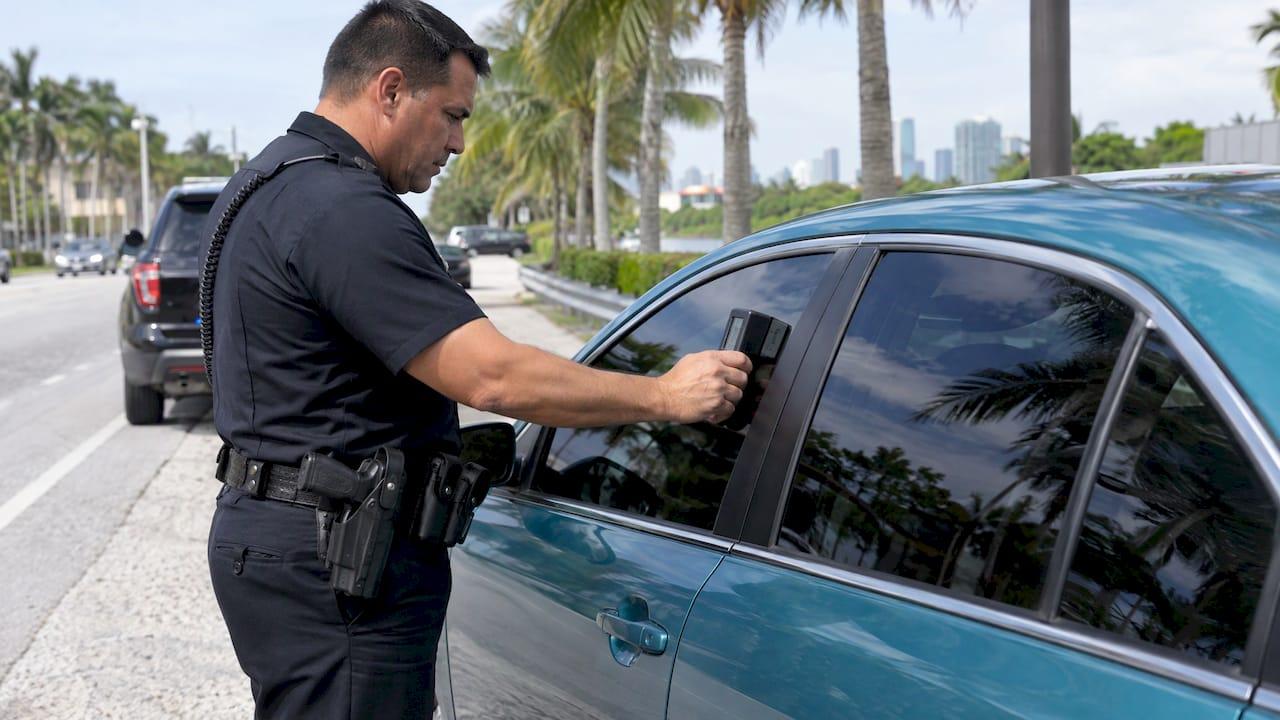
A police tint meter measures how much visible light passes through your window and shows it as a percentage. In Florida, the front side windows must let through at least 28% of light. A meter that is approved, tested daily and used correctly will read a legally installed film as legal. The best protection is a tint installed to the legal limit the first time, with the factory glass counted in.
This guide explains what the meter measures, how an officer uses it, how accurate it is, and what the Florida numbers mean for your car in Miami-Dade.
TL;DR
- A tint meter reads visible light transmission (VLT): the percentage of light that gets through the glass and film together.
- Florida requires at least 28% VLT on front side windows, 15% on sedan rear windows and 6% on SUV and van rear windows.
- Meters are accurate to about 2 percentage points, and Florida law adds a 3-point tolerance, so a correctly installed legal tint should pass.
- Factory glass already blocks some light, so a film's label number is not the number the meter shows.
- We tint at your home or office in Miami-Dade with ceramic films chosen to stay within Florida's limits.
Table of Contents
- What a police tint meter measures
- How an officer tests your window
- How accurate is a tint meter?
- What the Florida limits mean for your car
- Why the film number is not the meter number
- How to keep your tint safely within the limit
- Our tinting service in Miami-Dade
- Our view on tint meters
- FAQ
- Sources
What a police tint meter measures
A tint meter measures visible light transmission, or VLT. VLT is the share of visible light that makes it through the window. A reading of 35% means 35% of the light gets through and 65% is blocked.
According to a Will County Sheriff training document, the meter measures light at a wavelength of 550 nanometers, which is green light, the center of what the human eye sees best. The meter takes a reading of the light with nothing in the way, then a reading with the window in between, and divides one by the other to show a percentage. The same document notes that even clear float glass reads about 92%, because some light bounces off the surface.
Florida law uses the same idea. Florida Statute 316.2951 defines transmittance as the ratio of light allowed through a material to the light falling on it, and reflectance as the ratio of light reflected outward. Both can matter on a front window, as the limits below show.

How an officer tests your window
There are two common meter styles, and the Will County document describes both.
- One-piece meter (Enforcer II style): The officer asks you to lower the window about halfway. If the glass is very dirty, the officer wipes it. The meter is pressed down until the glass touches the top of the foam slot, and the percentage shows on the display.
- Two-piece meter (Inspector II style): One unit goes on each side of the glass. Magnets pull the units into alignment. On a rear window the officer avoids the defroster lines.
The same document says an officer's eye cannot reliably tell small differences in tint, which is why the meter is used. It also says the officer should have the doors opened when testing, because approaching a car with dark windows is a known risk during traffic stops.
If you are asked to lower the window, do it slowly and keep your hands visible. The test takes a minute or two.
Which meters Florida allows
Florida Highway Patrol Policy 17.27 says meters used by troopers must comply with Florida Administrative Code Chapter 15B-14 and be approved by the state, and no other meter is authorized. The state publishes an approved window tint meter list. It includes the Laser Lab 100-200-400, the Monroe PMP Pocket Detective, the New World Instruments Pocket Detective 2.1, and the Tint Meter Model 1000 (Enforcer II) and Model 2000 (Inspector II).
Can police stop you just for tint?
Under the same FHP policy, a tint-related stop requires reasonable suspicion, which means the officer must be able to point to facts suggesting the tint is illegal. During the stop, the officer may use the meter. The citation should record the display reading, and the meter's serial number and accuracy tests go in a separate test log.
The policy also requires the officer to test the meter for accuracy before use each day and to log those tests on form HSMV 61037.
How accurate is a tint meter?
Very accurate, but not exact. Three numbers matter.
- Meter accuracy of about 2 points. The Will County document says the Laser Labs meter is accurate to plus or minus 2 percentage points. A reading of 32% means the true value could be anywhere from 30% to 34%. The manufacturer EDTM gives the same figure for its Tint-Chek meters: plus or minus 2 points, with 1 point of repeatability. On its meters a 35% reading corresponds to a true value between 33% and 37%.
- FHP's own standard of 3 points. Under Policy 17.27, each meter needs its own reference sample, the sample must be replaced at least once a year by a qualified laboratory, and the meter must stay within 3 points of that sample, with readings repeating within 1 point.
- A legal tolerance of 3 points. Florida Statute 316.2955 says every percentage measurement in the tint law carries a tolerance of plus or minus 3 percent. It also says a reading from an approved device is presumed accurate and can be admitted as evidence.
In plain terms: if your front windows really measure 28% or higher, a working meter will not turn that into a violation in any normal case. If your tint sits right at the edge, you have little margin for glass variation or an unlucky reading.
Accuracy versus display detail
Some meters display tenths of a percent. EDTM explains that the finer display shows more detail but does not make the meter more accurate: its TC1800 shows whole numbers, its TC2800 and TC3800 show tenths, and all share the same 2-point accuracy. A reading of 28.4% is not proof of anything finer than a reading of 28%.
What can change a reading
The EDTM TC1800 user manual lists the practical field factors. The glass should be perpendicular to the sensor, not tilted. Fingerprints, dirt and defects can affect the value. The meter should slide fully onto the glass to the stop so the edge of the glass does not block the sensor. Film that does not cover the window all the way to the edge can also throw the reading off, according to the manual.
This is one reason a clean, edge-to-edge installation matters. Our patterns are computer cut for an exact fit, so the film covers the glass the way it should, and the reading reflects the film, not a gap at the edge.
What the Florida limits mean for your car
Florida sets different limits by window position. These come from the state statutes, not from the meter.
| Window | Minimum VLT | Maximum reflectance | Source |
|---|---|---|---|
| Front side windows (all vehicles) | 28% | 25% | Statute 316.2953 |
| Rear side and back windows, sedans | 15% | 35% | Statute 316.2954 |
| Rear side and back windows, SUVs and vans (multipurpose vehicles) | 6% | 35% | Statute 316.2954 |
If the back window is covered by a nontransparent film, side mirrors on both sides must be present, per the same statute. Violations are noncriminal traffic infractions.
Florida also requires the installer or seller to provide a nonremovable compliance label on the inside of the left door jamb, with the film's trade name and the installer's business name. Factory glass that meets the federal standard needs no label, per Statute 316.2955.
For the windshield, Florida uses a different rule based on the AS-1 line, the small marking near the top of the glass. Our guide to the 28% VLT and AS-1 windshield rules covers it. If you are weighing a strip at the top of the windshield, this explanation of the windshield tint strip and the 70% rule shows how that area is treated.
Why the film number is not the meter number
This is where most drivers get caught. The meter measures the window as a whole: the glass plus the film. It does not read the film's label.
The Will County document says factory auto glass typically measures 70% to 80%, and the federal standard (FMVSS 205) sets a 70% minimum. So a film does not start from 100%.
Here is a simple worked example. Take a front window whose factory glass measures about 75%. Put a 35% film on it. The light that gets through is roughly 75% of 35%, or about 26%. That is under Florida's 28% minimum, even though 35% sounds like a safe number. A 50% film on the same glass lands near 37%, which is comfortably legal. This is an estimate for illustration. Your glass may read differently, and the meter is the final word.

So choosing a film by its label alone is a common cause of tickets. The right approach is to choose the film with the glass in mind and leave a little margin above the limit.
Our VLT guide explains how to pick a percentage, and our article on the darkest legal tint in Florida lists the numbers by window.
How to keep your tint safely within the limit
Use this routine before and after any tint job.
- Know your vehicle type. Sedans and SUVs have different rear-window limits (15% versus 6%). Check which category your vehicle falls in before choosing rear film.
- Plan for the glass. Choose the film so that glass and film together land above 28% in front, with a margin.
- Choose by performance, not only darkness. Ceramic film blocks heat without needing a very dark shade. In Miami's sun, a lighter ceramic film can cut more heat than a darker dyed film. All the films we install are ceramic: 3M Ceramic IR with a lifetime warranty, SunTek CIR with a 5-year warranty and Uviron KoolMax with a 3-year warranty.
- Keep glass clean and film complete. Dirt and edge gaps can affect a reading, as the meter manual notes.
- Keep the compliance label in the door jamb. Florida requires it for installed film, so leave it in place.
- Replace old, peeling or purple film. Aged film can look worse and read differently from new. We remove old tint as part of a job.
If you are stopped
Be polite and follow the officer's instructions. If you get a ticket and think the reading was wrong, the citation should show the reading, and the meter's serial number and test records exist in the officer's log. For a legal question about a specific citation, talk to a traffic attorney. Court procedures for an infraction in Miami-Dade are handled by the clerk of courts.
Our tinting service in Miami-Dade
We are a mobile window tinting company serving all of Miami-Dade County, including Miami, Kendall, Homestead, Cutler Bay and Pinecrest. We come to your home or office, so you do not wait at a shop. The owner installs, with 28 years of experience, and the 60-inch rolls let us install large windshields in one piece with no seam. We also work on Tesla, luxury and exotic vehicles.
Published starting prices:
- 2 front windows: from $200
- Windshield tint: from $150
- Full car plus windshield: from $450
See the Miami Auto Tinting home page for the full list, or read about our mobile window tinting and ceramic tint options. We also tint homes and commercial properties.

To get a quote for your car, use our mobile tinting quote page.
Our view on tint meters
We have tinted cars in Miami-Dade for 28 years, and the meter is the part of the tint law drivers ask about most.
Our advice is simple: do not shop by the percentage on the box. Think about the whole window. Factory glass already holds back some light, and the meter reads glass and film together. We choose films with that in mind so your front windows stay above Florida's minimum.
We install ceramic films only, because ceramic gives strong heat rejection and UV protection without making the glass extremely dark. That matters in South Florida, where most drivers want comfort first and privacy second.
A clean, exact fit also helps. Our computer-cut patterns cover the glass edge to edge, and we install at your home or office so the car stays clean and the work is not rushed.
Jose
FAQ
What does a police tint meter measure?
It measures visible light transmission, the percentage of light that passes through the window and film. The meter compares a reading with the window in place against a reading without it and shows the result as a percentage. A lower number means a darker window.
Is 35% or 20% tint darker?
A 20% tint is darker. It lets 20% of light through, while 35% lets 35% through. In Florida, neither passes on front side windows when applied over factory glass, because the front minimum is 28% measured on the finished window.
Is 20% tint legal in Florida?
Not on the front side windows, where the minimum is 28%. On sedan rear windows the minimum is 15%, so 20% film can be within the limit there, though the glass counts toward the reading. On SUV and van rear windows the minimum is 6%. See the Florida statute for rear windows.
How accurate is a police tint meter?
Published accuracy is about plus or minus 2 percentage points, and Florida law applies a tolerance of plus or minus 3 percent. Troopers must test the meter for accuracy each day it is used, and the meter's reference sample is replaced at least once a year.
Can a police officer stop me only for dark tint?
In Florida, FHP policy requires reasonable suspicion for a tint-related stop. If the officer stops you, the meter can be used during the stop and the reading is recorded on the citation.
Sources
- Will County Sheriff: Tint Meters training document
- Florida Highway Patrol Policy 17.27
- Florida HSMV approved window tint meters
- EDTM: How window tint is measured
- EDTM TC1800 user manual
- Florida Statute 316.2951
- Florida Statute 316.2953
- Florida Statute 316.2954
- Florida Statute 316.2955 (2025)
- Florida Statute 316.2955, compliance label
- Windshield tint strip and the 70% rule