
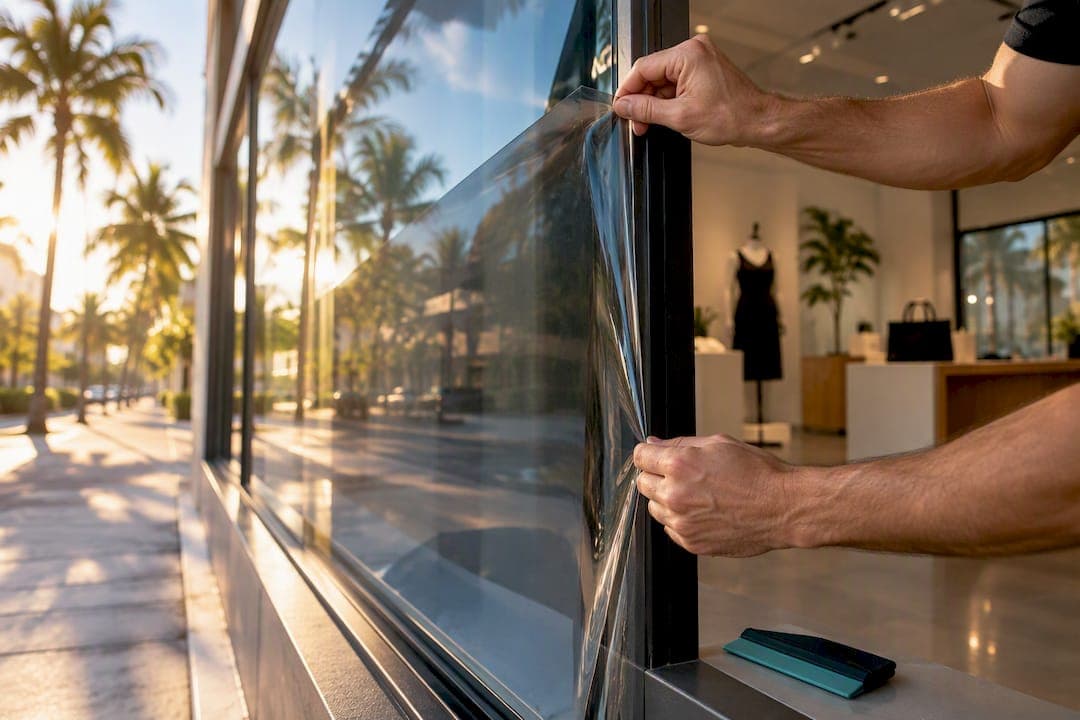
Yes, the right retail UV protection film blocks nearly all harmful UV rays, typically around 99% according to manufacturer testing, and it materially slows merchandise fading, cuts glare, and reduces heat while keeping your storefront visible day and night. It won't stop fading completely since visible light still contributes to gradual color shift, but for most stores it's the single biggest upgrade you can make to protect displays and improve customer comfort.
TL;DR:
- Retail UV protection films block nearly 99% of UV rays, significantly slowing merchandise fading but not preventing it entirely due to visible light exposure.
- Choosing spectrally-selective or ceramic film offers near-invisible UV and heat rejection with 50-70% VLT, maintaining store visibility during the day and at night.
- Proper installation is critical; verify installer credentials, request detailed spec sheets, and ensure clear warranties to avoid subpar results or early film failure.
- Films with higher TSER values provide better heat rejection but tend to be darker, so balance energy savings with desired storefront appearance.
- UV protection film reduces cooling costs by limiting solar heat gain, especially effective for large, sun-facing storefronts in hot climates.
Table of Contents
- Why Retail UV Protection Film Matters for Merchandise and Customers
- Which Film Type Fits Your Storefront?
- What Do UV, VLT, and TSER Numbers Actually Mean?
- Installation Timelines, Maintenance, and Costs
- How to Vet an Installer Before You Sign a Quote
- Notes From the Field: What Installers See on Retail Jobs
- Do Building Codes Affect Your Window Film Choice?
- How Much Can UV Film Lower Your Cooling Costs?
- How Long Does Retail Window Film Actually Last?
- Film vs. Blinds and Curtains: Which Actually Protects Merchandise?
- What Retailers Get Wrong About Window Film Specs
- Get a Retail-Grade UV Film Quote From Southmiamitint
- Sources
- FAQ
Why Retail UV Protection Film Matters for Merchandise and Customers
Ultraviolet light is the primary driver of fading in retail environments. Fabrics, printed signage, wood finishes, and even packaging can lose color within months under direct sun exposure through untreated glass. That's a real cost when you're rotating seasonal displays or holding inventory that sits in a window for weeks.
Retail film addresses this in two ways at once: it screens out the UV wavelengths responsible for most fading, and it cuts the glare and heat that make browsing uncomfortable on sunny afternoons. Customers linger longer in a cooler, glare-free storefront. That matters more than it sounds. A shopper who isn't squinting or sweating near the window spends more time near your displays, not less.
There's a tradeoff worth planning for, especially since storefront lighting interacts with film appearance and brand visibility as noted in high-visibility custom LED options for car enthusiasts. Films that look nearly invisible during the day can reduce how bright your interior lighting reads from outside at night, so if nighttime window visibility matters to your brand, that's a conversation to have with your installer before you pick a product.
Installer sources report that properly specified retail film removes approximately 99% of incoming ultraviolet light, though visible light still contributes to slow, long-term color shift in merchandise near the glass.
Key benefits stores see after installation:
- Slower fading on apparel, signage, and printed materials near windows
- Reduced glare that makes screens, mirrors, and glass cases easier to view
- Lower surface heat near the storefront, improving comfort for browsing customers
- Preserved daytime visibility into the store from the sidewalk
Which Film Type Fits Your Storefront?
Not every retail film looks or performs the same way, and picking the wrong category can undercut your branding goals even if the UV protection is solid.
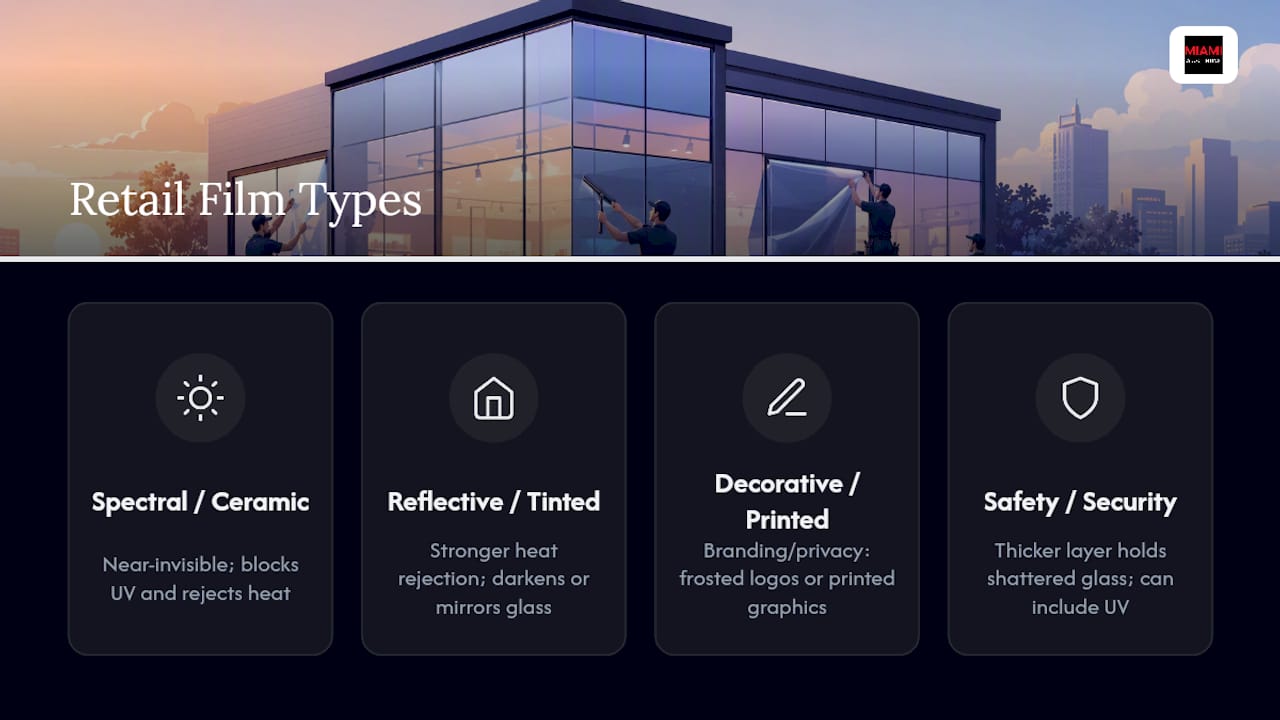
Spectrally-selective or ceramic film is the closest thing to invisible. It blocks UV and rejects heat without a noticeable tint, which is why it's the default choice for stores that want protection without changing how the storefront looks from the street. PureVue Ceramic is a good example of this category: strong heat and glare rejection with low reflectivity, so the glass still reads clear.
Reflective or tinted film rejects more heat and adds daytime privacy, but it visibly darkens or mirrors the glass. That works for storage areas or offices behind the sales floor, less so for a window you want customers to see into.
Decorative or printed film serves branding and privacy rather than climate control. Frosted logos, patterned bands, or printed graphics on lower panes are common, and reputable installers typically provide mock-ups so you can approve the look before anything goes on the glass, as noted by All Film Solutions.
Safety and security film adds a thicker polyester layer that holds shattered glass together during break-ins or storms. Some stores combine it with UV protection in a single product for storefronts in high-risk areas.
Pro Tip: Many installers mix specs pane by pane. Main display windows get near-invisible spectrally-selective film, while side or storage panes get reflective or decorative film. It's a practical way to balance daylighting with privacy without redoing the whole facade in one product.
What Do UV, VLT, and TSER Numbers Actually Mean?
Manufacturer spec sheets throw a lot of acronyms at you, and reading them wrong is how stores end up with a film that looks nothing like the sample.
UV blocking is usually listed as a percentage of ultraviolet wavelengths filtered out. 3M's Sun Control and Prestige series films advertise UV block up to 99.9%, and Solar Gard's Sentinel Plus line lists UV blocking above 99% across its variants. At this range, differences between products matter less than whether the film is genuine and correctly installed.
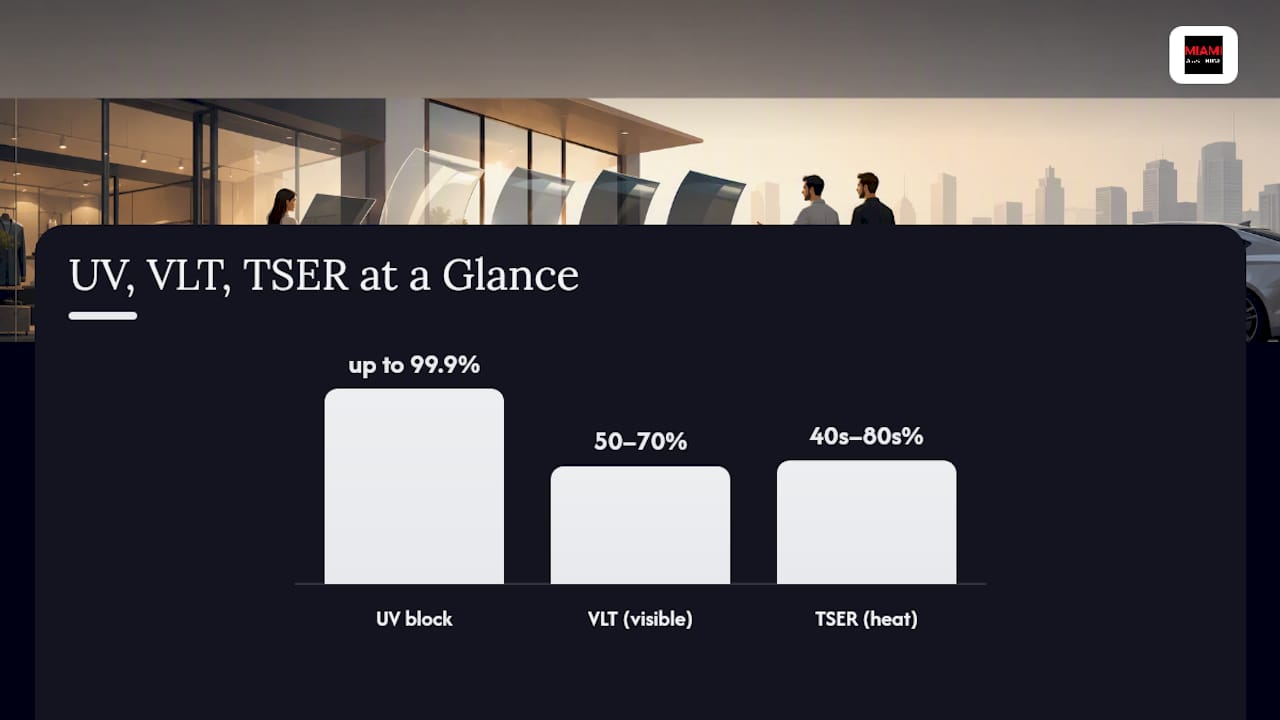
Visible Light Transmission (VLT) tells you how much daylight passes through. This is the number that determines how your storefront actually looks. Lighter commercial films typically run 50% to 70% VLT, which keeps the glass looking close to untreated while still cutting UV and heat. Drop below that range and the glass starts reading as visibly tinted.
Total Solar Energy Rejected (TSER) measures heat rejection, and it varies widely by product. Solar Gard's own Sentinel Plus spec tables show TSER figures ranging broadly, from the low 40s up into the mid 80s percent, depending on the exact variant. Higher TSER means more cooling benefit, but it often comes paired with darker tint, so compare TSER and VLT together, not one in isolation.
- UV block: look for 99% or higher on any film marketed for retail or display protection
- VLT: 50 to 70% for storefronts that want to stay visually open
- TSER: compare across products, since a higher number usually trades off against clarity
Installation Timelines, Maintenance, and Costs
Most retail film goes on the interior side of the glass, which protects the film itself from weather and makes it easier to service. Exterior application shows up mainly on specialty security films or where interior access is restricted.
- Single-pane storefronts typically finish in a few hours, often within a single afternoon, according to installers who handle this work regularly, as described by Tint Force.
- Larger facades with multiple panes or two-story glass often require overnight or weekend scheduling to avoid disrupting business hours.
- Maintenance is minimal: avoid ammonia-based cleaners, use a soft cloth, and let the film cure fully before the first wash, usually a matter of days.
- Lifespan and warranty vary by product grade, but professionally installed commercial films from major manufacturers commonly carry multi-year warranties.
Cost depends on square footage, film grade, and whether you're adding security laminate on top of UV protection. Expect ceramic and spectrally-selective films to cost more per square foot than basic dyed film, but they hold their appearance and performance longer, which matters if you're not planning to redo the storefront in three years.
How to Vet an Installer Before You Sign a Quote
The film's specs only matter if the installation is done correctly. A poorly applied film bubbles, peels at the edges, or fails early, no matter how good the manufacturer's numbers looked on paper.
Before you commit, ask for the following:
- Proof of authorized dealer or certified installer status with the film manufacturer, not just a claim of experience
- Sample spec sheets for the exact film being quoted, including UV block, VLT, and TSER figures
- Before-and-after photos from prior storefront installs, ideally in a similar retail setting
- A written workmanship warranty separate from the manufacturer's product warranty
- Clarity on how the manufacturer warranty is passed through to you as the customer. Some 3M commercial films carry warranties in the 10 to 15 year range when professionally installed, so ask which tier applies to your quote.
Pro Tip: If an installer can't produce a written warranty or gets vague when you ask for exact spec numbers, treat that as a red flag. Pressure to pick the cheapest film on the lot, without discussing VLT or TSER at all, is usually a sign the quote skipped the parts that actually protect your investment.
Notes From the Field: What Installers See on Retail Jobs
Jose and the Southmiamitint team have worked with film families including 3M Ceramic IR, 3M Color Stable, and Iviron KoolMax ceramic tint across commercial and residential glass in Miami-Dade. On storefronts specifically, the pattern is consistent: owners ask for near-invisible protection on the main display glass and a heavier option, reflective or security laminate, on side or storage panes.
South Florida sun makes UV exposure a daily issue rather than a seasonal one, so film that holds its color and clarity under sustained heat tends to outperform cheaper dyed alternatives within the first year or two. For a closer look at how installers sequence a job to protect merchandise from day one, the fading prevention workflow breaks down the steps used on commercial sites. Stores working with high-value or light-sensitive inventory may also want to review UV thresholds for sensitive items before choosing a film grade.
Do Building Codes Affect Your Window Film Choice?
Most standard UV and heat-rejection films don't trigger special permitting, since they're an added layer on existing glass rather than a structural change. That said, retail spaces carry a few code-adjacent considerations worth checking before installation.
Fire-rated glass in certain commercial occupancies may have restrictions on what can be applied to its surface, so confirm with your installer whether your storefront glass falls into that category. Egress windows, meaning any glass that serves as a required exit path, generally can't be darkened enough to obscure visibility from either side, which is one more reason spectrally-selective films are popular for retail: they meet visibility expectations while still delivering protection.
If you're adding safety or security film rather than standard UV film, some jurisdictions treat it differently for insurance and code purposes because it changes how the glass behaves in an impact event. A licensed installer familiar with local commercial codes should flag any permit requirements specific to your municipality rather than assuming a residential job and a storefront job follow identical rules. When in doubt, ask your installer to confirm code compliance in writing as part of the quote, the same way you'd confirm a warranty.
How Much Can UV Film Lower Your Cooling Costs?
Heat gain through storefront glass is a major driver of cooling costs, especially for stores with large display windows facing direct sun for much of the day. Film with strong Total Solar Energy Rejected performance reduces how much of that solar heat makes it into the building in the first place, which takes some of the load off your HVAC system during peak hours.
The effect scales with your glass area and orientation. A small boutique with one modest window won't see the same impact as a big-box store with a glass facade running the length of the building. Stores in hot, sun-heavy climates tend to notice the difference fastest, particularly during summer afternoons when cooling systems are already working hardest.
Film won't replace a well-maintained HVAC system, but it reduces the amount of heat that system has to fight in the first place. Pairing a high-TSER film on sun-facing glass with your existing cooling setup is one of the more cost-effective retrofits available for an older storefront that wasn't built with energy efficiency in mind.
How Long Does Retail Window Film Actually Last?
Film lifespan depends heavily on product grade, installation quality, and how much direct sun the glass gets daily. Ceramic and spectrally-selective films generally hold their clarity and performance longer than basic dyed films, since they're built to resist the heat and UV exposure that cause cheaper films to bubble or discolor.
Professionally installed commercial films from established manufacturers often carry multi-year warranties, with some 3M commercial and residential configurations reaching the 10 to 15 year range when installed by an authorized dealer. That warranty window is a reasonable proxy for expected service life under normal conditions, though a storefront with unusually intense sun exposure may see gradual performance decline sooner.
Peeling edges, visible bubbling, or a shift toward purple or brown discoloration are the usual signs a film has reached the end of its useful life. Catching those early matters, since a degraded film can actually let more heat and glare through than a fresh installation, undercutting the reason you installed it in the first place.
Film vs. Blinds and Curtains: Which Actually Protects Merchandise?
Blinds and curtains block UV effectively when closed, but that's the catch: they only work when they're closed, which defeats the point of a storefront designed to show off merchandise. Keep them open during business hours, which most retailers do, and you get essentially no UV protection during the exact hours your display windows are doing their job.
Window film works continuously regardless of whether anyone remembers to adjust it. It doesn't need daily management, doesn't wear out from being raised and lowered, and doesn't block the view into your store the way even open blinds partially do. For a retailer whose entire storefront strategy depends on visibility, that's a meaningful practical difference, not just a convenience upgrade.
Blinds and curtains still have a place, mainly for stockrooms, offices, or areas where you actively want to control visibility at certain times of day. But as a primary UV strategy for a sales floor, film solves the core problem that fabric window treatments can't: protection that doesn't require the window to be covered.
What Retailers Get Wrong About Window Film Specs
Most retail buying guides treat UV blocking as the only number that matters, and that's a mistake. The decision actually turns on VLT and TSER, since those two specs determine what your storefront looks like and how much heat you're actually rejecting, and plenty of stores skip that comparison entirely.
The bigger gap I see in conventional advice is treating film selection like a single decision for the whole storefront. Real retail glass isn't uniform. A jewelry display window has different priorities than a stockroom side pane, and pane-by-pane specification, near-invisible ceramic up front, something heavier elsewhere, tends to serve stores better than a one-size film order.
If you're prioritizing anything first, prioritize VLT alignment with your brand's daytime and nighttime visibility needs before you shop on UV percentage or price. A film that protects merchandise but makes your window look flat or overly dark at night has solved one problem and created another. Get the installer to walk the storefront with you, pane by pane, before finalizing the quote.
— Jose
Get a Retail-Grade UV Film Quote From Southmiamitint
A professional installer can provide premium film installation directly at your storefront, avoiding shop drop-off, early closing, and long waits for contractor appointments. The crew works with genuine 3M Ceramic IR, 3M Crystalline, and 3M Color Stable, plus Iviron KoolMax ceramic tint, on commercial storefronts across Miami-Dade.
When you request a quote, come prepared with three things: your target VLT range for daytime visibility, whether you need a workmanship warranty in writing alongside the manufacturer warranty, and your preferred installation window if you need overnight or weekend scheduling to avoid disrupting business hours. That gives Southmiamitint everything needed to match a film to your storefront instead of guessing at specs over the phone.
Commercial window tinting projects get scheduled directly through the Southmiamitint site, where you can also review ceramic tint pricing starting from $249 for mobile installs. Reach out with your square footage and glass layout, and get a same-day quote back.
Sources
Verify UV, VLT, and TSER figures directly against manufacturer spec sheets before buying: 3M's UV protection page, Solar Gard's Sentinel Plus specs, and the Retail Industry Leaders Association for broader retail retrofit context.
FAQ
Does UV Film Really Work?
Yes. Manufacturer testing on premium films shows UV block rates as high as 99.9%, and installers report similarly strong results in real retail installs. It won't stop fading entirely since visible light still plays a role, but it slows the process significantly.
Is UV Film Worth the Cost for a Retail Store?
For stores with merchandise, signage, or fixtures near sun-facing glass, most retailers find the fading prevention and comfort improvement worth the upfront cost. It's a one-time investment that keeps paying off every season you don't have to replace faded display materials.
How Much Does UV Film Cost?
Cost varies by film grade, square footage, and whether you add security laminate. Southmiamitint lists ceramic mobile tint starting from $249, with commercial storefront pricing available on request through a direct quote.
What Kind of Window Film Should I Use to Reduce UV Rays?
Spectrally-selective or ceramic film is the standard choice for retail storefronts because it blocks UV and rejects heat without visibly darkening the glass. Products in this category typically run 50% to 70% VLT, which keeps your display windows looking close to untreated glass.