
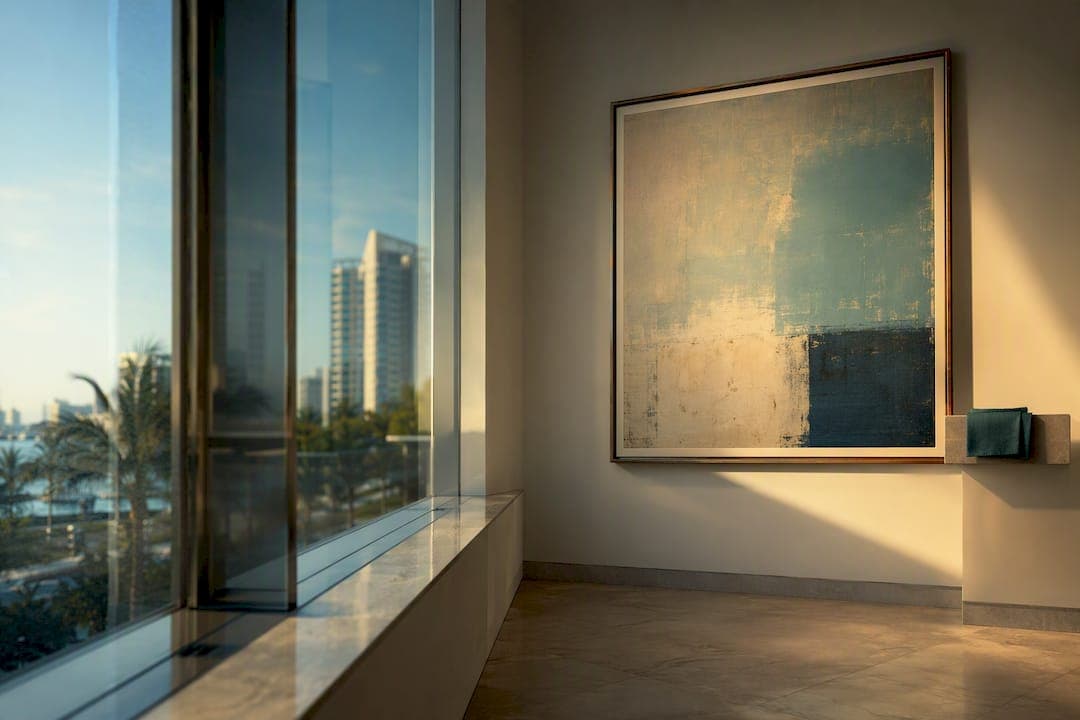
Professional window film blocks most UV radiation reported in the common 325 to 380 nanometer range, and premium ceramic films push that filtering closer to 400 nanometers, where fading damage actually happens. For homeowners, business owners, and collectors, that means a properly specified film like 3M Ceramic IR, 3M Color Stable, or Iviron KoolMax can meaningfully slow fading in paintings, prints, and furnishings. Start by asking for an on-site UV assessment before you assume any film will do the job.
TL;DR:
- UV rejection should be specified up to 400 nanometers, not just the industry standard of 380 nanometers, to effectively protect high-value art.
- Aiming for a UV rejection level of 50 microwatts per lumen is recommended to minimize fading damage for valuable paintings and textiles.
- Installing films with minimal color shift and high UV rejection, such as ceramic or spectrally selective types, preserves both appearance and protection over time.
- On-site testing and detailed documentation from installers ensure that you receive the actual performance level and avoid underperforming products.
- Protecting artwork also benefits from layered measures like UV glazing and shading, which extend the life of collections beyond window film coverage alone.
Table of Contents
- How Window Film Blocks UV and Why the Wavelength Matters
- Which Film Specs to Require for Artwork Protection
- What a Professional Installer Should Check and Test On-Site
- How Long Protection Lasts and How to Care for It
- Installed Cost Ranges and How to Judge the ROI
- Common Installer Pitfalls to Watch For
- Combining Film With Other Protective Measures
- A Practical Checklist Before You Book an Assessment
- Get a Mobile UV Assessment From Southmiamitint
- Sources
How Window Film Blocks UV and Why the Wavelength Matters
UV-blocking film works by absorbing or reflecting the ultraviolet band before it passes through the glass and hits your walls, frames, and canvases. That sounds simple, but the detail that trips up most buyers is where the filtering actually stops. Most standard architectural films report UV rejection up to roughly 380 nanometers, while specialty films built for higher-stakes display work extend that cutoff closer to 400 nanometers, the point where UV blends into visible light.
That gap matters because a lot of the fading damage sits right at the edge of that range. A film advertised as blocking "98% of UV" is telling the truth, but only for the band it measured. If nobody tells you which band, you cannot compare products fairly.
Fading is not caused by UV alone. Three forces work together on your art and furnishings:
- UV radiation, which breaks down pigments and dyes at the molecular level.
- Cumulative visible light exposure, which fades color over months and years even without UV present.
- Heat, which accelerates chemical breakdown in paper, canvas, and textile fibers.
Museum conservation guidance uses a stricter benchmark than "percent UV blocked." The National Park Service's guidance on UV-filtering window films recommends testing to a 50 microwatts-per-lumen threshold, and notes that modern filtration on high-performing films can reach 5 to 10 microwatts per lumen. That single number tells you more about real-world protection than any percentage claim printed on a box.
Which Film Specs to Require for Artwork Protection
Do not accept a verbal "it blocks UV" from any installer. Ask for the paperwork, and ask specific questions before you sign anything.
- Request UV rejection data reported to 400 nanometers, not just the industry-standard 380 nanometer cutoff. If a spec sheet does not state the wavelength range, ask directly. This is the single most-overlooked detail buyers protecting valuable art get wrong.
- Ask for an on-site meter reading in microwatts per lumen, not just a manufacturer percentage. For high-value pieces, aim for 50 microwatts per lumen or lower, per the museum-conservation standard referenced above.
- Check the VLT (visible light transmission) trade-off. Blocking more UV sometimes means darkening the room more than you want for a gallery wall or display case. A good installer balances UV rejection with enough visible light to actually see the piece.
- Ask about color shift, sometimes listed as CCT (correlated color temperature) data. Cheaper films can introduce a visible tint that changes how colors in a painting or textile actually look under daylight.
- Favor ceramic or spectrally selective films. These tend to deliver high UV rejection with minimal color distortion, unlike some older metallic films that can cast a visible haze. Manufacturer spec sheets for Sunscape advanced ceramic films list UV rejection at 99% or higher alongside VLT and total solar energy rejection (TSER) figures, which lets you compare products on paper before anyone touches your windows.
Film types like 3M Ceramic IR, 3M Color Stable, and Iviron KoolMax are ceramic-based options built to hit these marks while keeping the glass looking close to clear.
Pro Tip: Bring a sample swatch of your most valuable piece's fabric or print stock, if practical, and ask the installer to test film samples over a UV lamp before you commit to a full job. A five-minute test can save years of slow fading.
What a Professional Installer Should Check and Test On-Site
A rushed installer skips the inspection and goes straight to the squeegee. That is where problems start.
Before any film touches your glass, a qualified installer should evaluate:
- Window orientation and current sun exposure, since a south or west-facing wall behind a painting needs a different priority level than a shaded north window.
- Glass type, including whether you have single-pane, dual-pane, or Low-E coated glass, because film chosen for the wrong glass type can cause thermal stress or seal failure.
- Existing glass damage, such as scratches, chips, or failed dual-pane seals that film cannot fix and may worsen.
Installation itself follows a sequence that affects both appearance and performance: cleaning the glass thoroughly, applying a slip solution, cutting the film precisely to the pane, squeegeeing out moisture and air, and finishing the edges cleanly. Manufacturer installation guidance from Avery Dennison details adhesive types and curing steps that directly affect how long a film performs at its rated level.
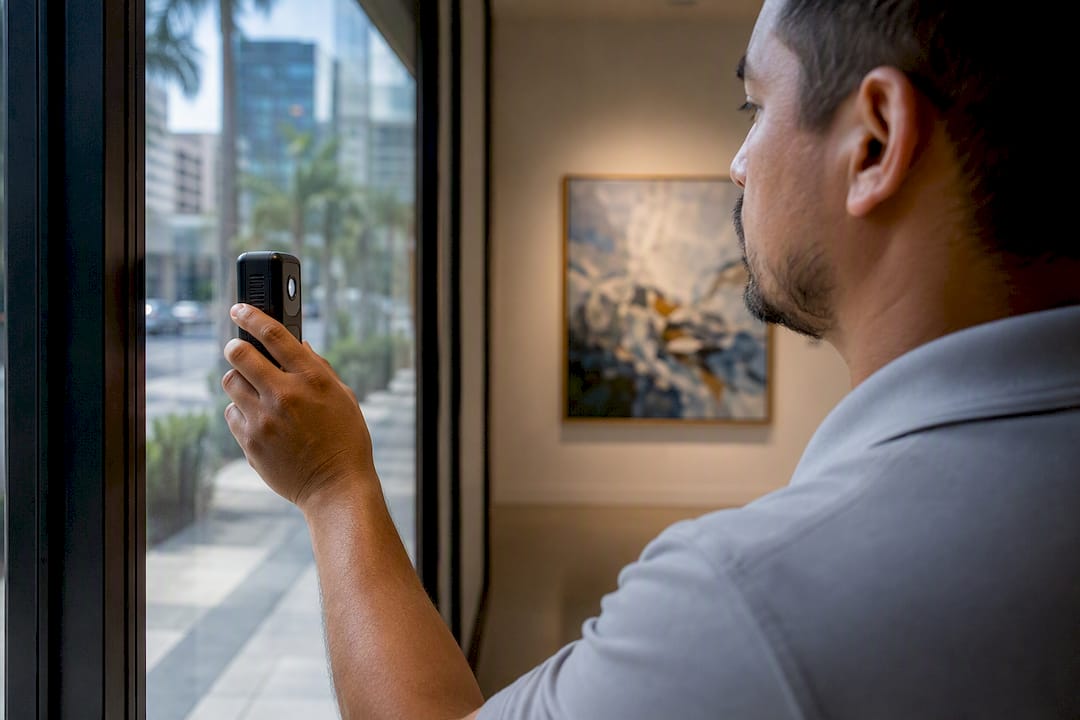
For valuable collections, ask for an actual UV meter reading after installation, not just a verbal assurance. A saved report gives you a baseline if you ever need to file an insurance claim over fading damage. And be direct about your glass: applying the wrong film to Low-E or tempered dual-pane glass can trap heat between layers and crack the seal, according to installer guidance on the commercial tinting process. Ask any installer how many years they have worked with your specific glass type before you book.
How Long Protection Lasts and How to Care for It
Premium architectural film typically performs effectively for 8 to 15 years, depending on sun exposure and glass orientation, according to National Park Service conservation guidance. UV and heat rejection begin working the moment the film is installed, but optical clarity keeps improving during a curing period that can run several days to a few weeks depending on climate and film type.
Care for the film properly during that window and afterward:
- Avoid cleaning the film for the first several days after install, or follow whatever cure timeline your installer specifies.
- Use ammonia-free cleaners and a soft cloth once cured; ammonia degrades the film's coating over time.
- Watch for bubbling, edge lifting, or haze, and report it immediately. These are typically covered under a manufacturer warranty if the film was installed correctly.
Pro Tip: Keep your installer's written warranty and the original spec sheet in a folder with your art insurance documents. If a fading dispute ever comes up, that paperwork proves you took reasonable protective steps.
Installed Cost Ranges and How to Judge the ROI
Film pricing depends on several factors, and understanding them helps you avoid overpaying or underbuying protection for a valuable collection.
- Film grade drives most of the cost gap. Standard dyed films sit at the low end, while premium ceramic films like 3M Ceramic IR or Iviron KoolMax cost more per square foot but deliver better UV rejection and less color shift.
- Square footage and window complexity affect labor time, especially with oddly shaped panes, high windows, or multiple stories.
- Mobile versus shop installation changes convenience but not necessarily film performance, since a qualified mobile installer follows the same prep and curing steps as a fixed location.
- Warranty length varies by film tier, with premium ceramic products often carrying longer manufacturer backing than entry-level films.
Small residential projects protecting a single room or gallery wall typically land at the lower end of the pricing spectrum, while larger commercial storefronts or galleries with extensive glass exposure sit higher due to square footage alone. Rather than quoting a single number that varies wildly by project, ask any installer for a written estimate broken down by film type and square footage so you can compare it against the cost of what you are protecting.
Run the math simply: compare the one-time installed cost against the replacement or restoration cost of the art, textiles, or merchandise sitting in that sun exposure. For a retail showroom with rotating high-value inventory, or a home with an original painting, the film cost is usually a fraction of what a single faded piece would cost to repair or replace.
Common Installer Pitfalls to Watch For
The window film industry has plenty of qualified professionals, but a few red flags separate careful installers from ones who will cost you money and protection later.
Vague UV claims without a wavelength range top the list. If an installer says "blocks 99% of UV" but cannot tell you whether that is measured to 380 or 400 nanometers, you cannot verify whether the film actually protects the wavelengths that matter for your art.
Skipping the on-site meter test is another common shortcut. Industry guidance from the International Window Film Association stresses matching film to your specific protection goal and verifying performance, not just installing whatever is in stock that week.
Ignoring glass type before quoting a price causes real damage. An installer who does not ask about Low-E coatings or dual-pane seals before recommending a film is skipping a step that protects both your windows and your investment.
No written warranty or spec sheet should be a dealbreaker. A legitimate installer hands you documentation naming the exact film model, not a generic promise.
Underpricing to win the job often means corners get cut on prep, cleaning, or film grade. If a quote seems far below others for comparable square footage, ask what film model is actually being used before assuming it is a good deal.
Combining Film With Other Protective Measures
Window film handles the glass, but a complete fading-protection plan for valuable art layers multiple defenses together.
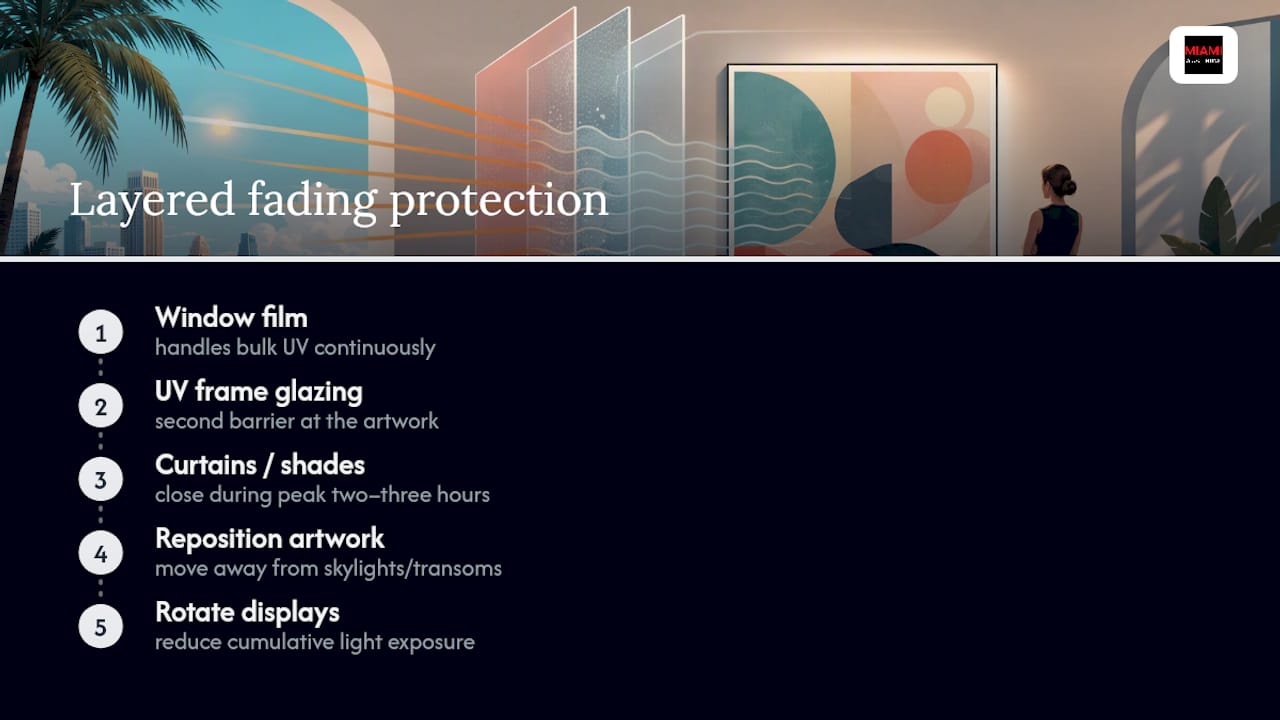
UV-filtering glazing on frames adds a second barrier directly at the artwork, which matters most for pieces displayed near the brightest exposure in a room. Film on the window and UV glazing on the frame work at different points in the light's path, so they are not redundant.
Curtains, blinds, or UV-filtering shades give you control during peak sun hours, especially useful for west-facing rooms where afternoon light is most intense even with film installed. Closing a curtain during the harshest two or three hours of the day extends the effective life of both the film and the piece behind it.
Repositioning valuable pieces away from direct sightlines to unfiltered skylights or transom windows, where film coverage may be incomplete, closes a gap film alone cannot solve.
Rotating displayed items with pieces kept in storage reduces cumulative light exposure on any single work, which matters because visible light damage accumulates independently of UV.
None of these replace film. A quality ceramic film handles the bulk of the UV load continuously, while curtains and glazing catch the exposure windows film cannot fully close. Ask your installer which zones in your home or gallery get the harshest exposure, then layer your defenses there first.
A Practical Checklist Before You Book an Assessment
Coastal Miami sun is unforgiving on interior finishes, and the films that hold up here tend to be ceramic and spectrally selective rather than older dyed or metallic options. When protecting real artwork, I lean toward 3M Ceramic IR or Iviron KoolMax for their combination of high UV rejection and minimal color shift, since a tinted haze over a painting defeats the purpose of protecting it.
Before you call anyone for an assessment, have these five questions ready: What film model are you quoting, and what is its UV rejection to 400 nanometers? Will you take an on-site meter reading in microwatts per lumen? What warranty comes with this film? What is the cure timeline before I can clean the glass? Have you worked with my specific glass type before?
Mobile installation works well for vehicles, in-place residential art walls, and offices where moving furniture or artwork off-site is impractical or risky.
— Jose
Get a Mobile UV Assessment From Southmiamitint
Southmiamitint brings the assessment, the sample testing, and the installation to your driveway, living room, or storefront instead of asking you to haul artwork or furniture anywhere. We install 3M Ceramic IR, 3M Color Stable, and Iviron KoolMax, the same ceramic-grade films discussed throughout this guide, with an on-site crew that tests your actual glass before recommending a product.
Your first call gets you an on-site assessment, a sample film test where you can see the clarity and color shift for yourself, and a written quote listing the exact film model along with its tested UV performance. Nothing gets installed until you know what you are paying for.
If you are ready to stop guessing and get real numbers for your windows, check ceramic window tint pricing in Miami or explore the 3M film options we install to see which spec fits your home, office, or gallery wall.
Sources
- Choosing UV-Filtering Window Films (NPS Conserve O Gram)
- Sunscape Advanced Ceramic Window Film (Madico)
- Installation and Maintenance of Avery Dennison Architectural Window Film (Instructional bulletin)