
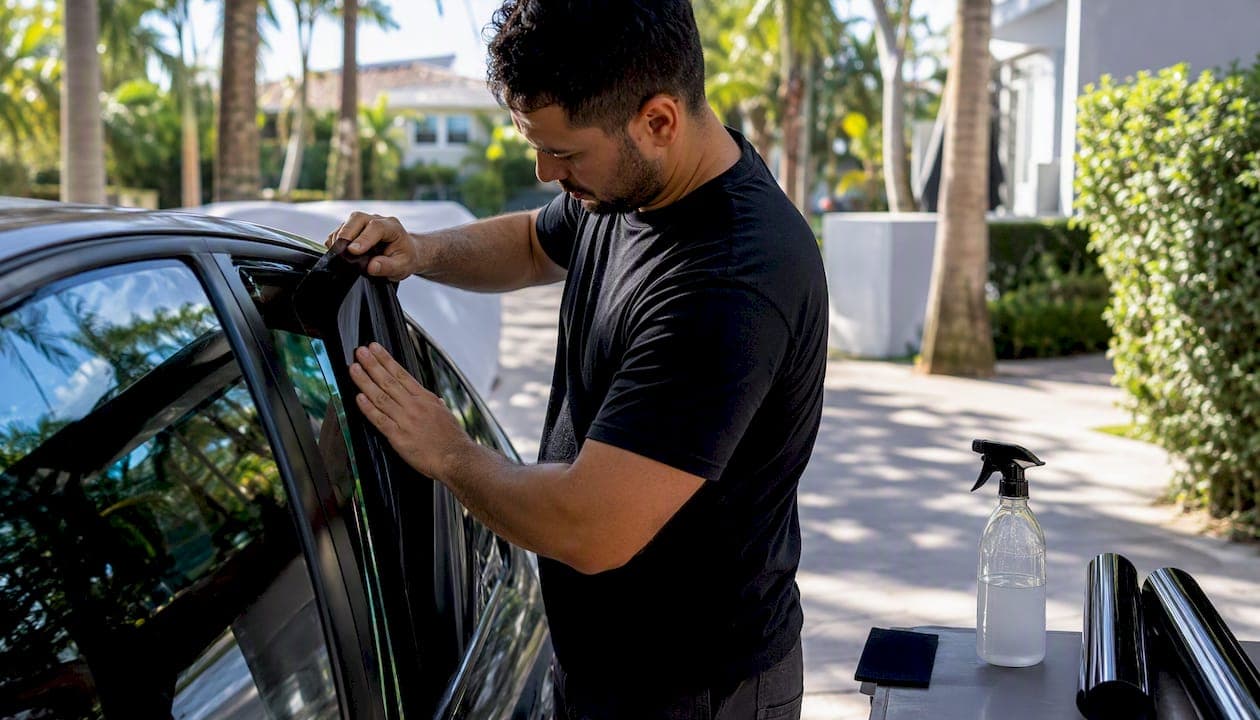
Color stable tint is a fade-resistant window film built to hold its original color for years instead of fading purple or bubbling like older dyed films do. It's the practical middle ground for car owners who want long-term looks and heat protection without paying premium ceramic prices or risking cell signal interference from metalized film.
The bottom-line verdict: if you want a tint that still looks brand-new in five years, doesn't mess with your phone's GPS or radio signal, and comes with a real warranty behind it, color stable tint usually beats basic dyed film every time. Manufacturers back this up with hard numbers. 3M's Color Stable Series claims up to 64% total solar energy rejection and uses non-metallic, patented infusion technology specifically to resist fading and avoid interference with electronics. That's not marketing fluff, it's a published spec you can check against any product data sheet before you buy.
Here's what separates color stable tint from the rest of the market:
- Fade resistance: engineered to resist the purpling and color shift that plagues basic dyed film after two or three years of sun exposure.
- Non-metallic construction: won't interfere with radio, GPS, or cell signals, unlike older metalized films.
- Heat rejection: infused or extruded manufacturing gives it solar energy rejection numbers that rival some ceramic products.
- Warranty-backed durability: reputable brands like 3M stand behind color stable film with longer warranties than they offer on entry-level dyed tint.
Key Takeaways
Color stable tint is a non-metallic, fade-resistant window film built through extrusion or infusion manufacturing that resists purpling and holds its solar performance for years longer than basic dyed film.
| Point | Details |
|---|---|
| Definition | Color stable tint uses infused or extruded dye and UV blockers to prevent purpling and fading over time. |
| Check the tech sheet | Compare VLT, TSER, and UV block percentages directly from the manufacturer's published data sheet. |
| Confirm non-metallic construction | Non-metallic films protect GPS, radio, and cell signal performance, unlike older metalized tints. |
| Verify installer and warranty | Ask for authorized-installer status and written warranty terms before the job starts. |
| Southmiamitint offers it locally | Southmiamitint installs 3M Color Stable, 3M Ceramic IR, and Iviron KoolMax ceramic film via mobile service across Miami-Dade County. |
Table of Contents
- What Is Color Stability in Tint, and How Does It Compare to Other Film Types?
- Why Doesn't Color Stable Tint Fade Like Regular Dyed Film?
- What Are the Real Benefits of Color Stable Window Tint?
- Why Do Cheaper Dyed Tints Turn Purple and Peel?
- What Technical Specs Should You Check Before Buying?
- Is Color Stable Tint the Right Choice for Your Car?
- What Should You Ask Your Installer Before the Job Starts?
- A Straight Answer on Color Stable Tint
- Ready to Get Color Stable Tint Installed the Right Way?
- Where to Verify These Claims Yourself
- Frequently Asked Questions
- Sources
What Is Color Stability in Tint, and How Does It Compare to Other Film Types?
Window film falls into a handful of broad categories, and color stability is really a manufacturing upgrade that can apply within several of them rather than a completely separate product line.
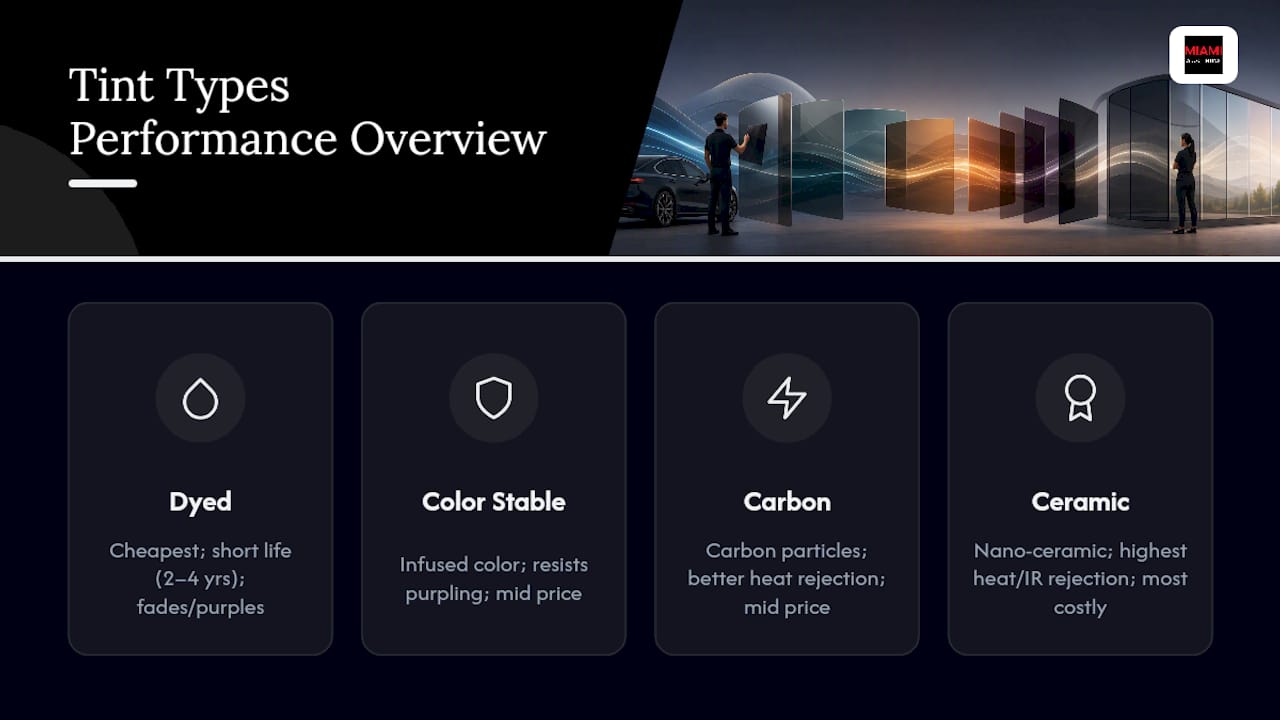
Dyed film is the cheapest option on the market. A layer of dye gets applied to a polyester base, and it does an okay job blocking glare and cutting visible light. The problem is that basic dyed film absorbs UV energy chemically, and that process breaks down the dye over time, which is exactly why so many older cars have that telltale purple or brownish tint on the rear window.
Color stable film (sometimes called color stable dyed or infused film) fixes that weak point. Instead of a thin surface-applied dye layer, manufacturers extrude or infuse the color and UV blockers directly into the film itself, according to CeramicPro's explainer on color stable window tint. That construction difference is the whole reason it resists purpling.
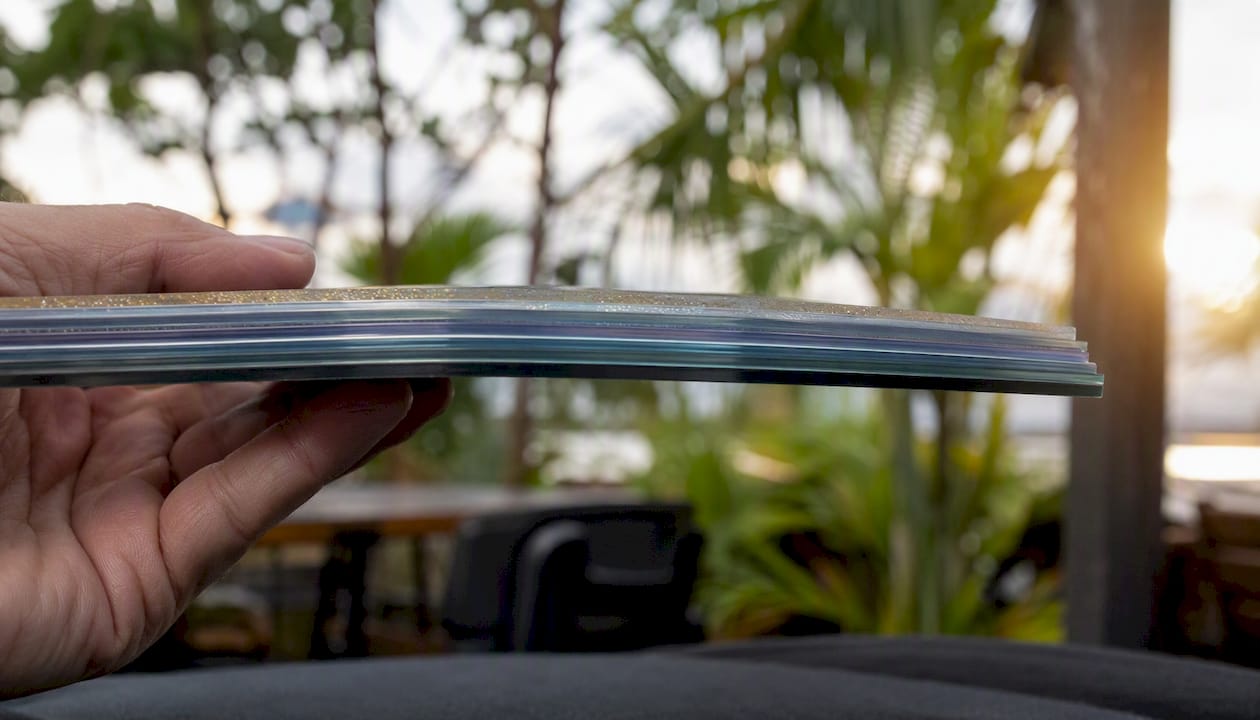
Carbon film adds a layer of carbon particles for better heat rejection and a flat, non-shiny black finish. It's a step up from dyed film in durability but generally doesn't match color stable or ceramic film on heat performance.
Metalized film uses tiny metal particles to reflect heat and light, which gives strong solar rejection but comes with a real downside: it can interfere with radio reception, GPS signals, and even toll transponders.
Ceramic film uses nano-ceramic particles instead of metal or dye alone, delivering the highest heat and IR rejection numbers on the market along with excellent clarity. It's also the most expensive tier.
Hybrid and crystalline films blend approaches, sometimes combining dye, carbon, and ceramic elements to balance cost against performance.
In terms of expected lifespan and cost, dyed film is the cheapest but shortest-lived (often two to four years before visible fading), color stable and carbon films run a middle price range with a much longer usable life, and ceramic sits at the top of both cost and performance.
Why Doesn't Color Stable Tint Fade Like Regular Dyed Film?
The short answer comes down to a property called lightfastness, which is a colorant's ability to resist fading when it's exposed to light over time. Lightfastness testing uses standardized scales like the Blue Wool scale and ASTM ratings from I to V, and inorganic pigments consistently outperform organic dyes on these scales because they resist the photodegradation that UV light causes.
That's the science behind why your old dyed tint turned purple. Ultraviolet light, especially the UVA band, breaks down the chemical bonds holding organic dye molecules together. Once those bonds start breaking, the dye shifts color and the film's ability to block light and heat degrades right along with it.
Color stable manufacturing tackles the problem at the source in a few ways:
- Extrusion or infusion builds the color and UV blockers into the film material itself rather than coating it on the surface, according to Atomic Auto Salon's breakdown of color stable film.
- Nano-ceramic or carbon additives physically scatter infrared and UV energy instead of absorbing it chemically, which sidesteps the dye-breakdown problem entirely.
- UV-blocking layers shield the color layer underneath from the exact wavelengths that cause purpling in the first place.
That physical scattering approach is a meaningful shift from how basic dyed film works. Protector Automotive's research on modern film technology notes that films using nano-ceramic particles can hold stable total solar energy rejection (TSER) and visible light transmittance (VLT) numbers for a decade or more in field conditions, because the particles aren't degrading the same way dye molecules do.
When you're comparing products, look for lab metrics like VLT, TSER or IR rejection percentages, and ASTM abrasion or Taber testing results on the tech sheet. Those numbers tell you what the film actually does, not just what the marketing copy promises.
What Are the Real Benefits of Color Stable Window Tint?
The biggest benefit is straightforward: your tint still looks like tint five or ten years from now instead of turning into a purple-brown eyesore. But fade resistance is just the start.
Pro Tip: Ask any installer for the specific TSER percentage on the product they're quoting you, not just a generic "premium heat rejection" claim. Real numbers separate real products from upsells.
- No purpling, ever: color stability is the entire point of this film category, and it's the number one reason owners choose it over dyed tint.
- Strong solar energy rejection: 3M states its Color Stable Series rejects up to 64% of total solar energy, a real trust signal backed by a published manufacturer data sheet.
- UV protection for your interior: blocking UV rays helps prevent dashboard cracking and leather fading, an issue Southmiamitint has covered in detail for Miami's harsh sun exposure.
- Glare reduction and privacy: choosing the right VLT percentage cuts glare on the road while giving you the privacy level you want.
- Zero electronics interference: because it's non-metallic, color stable film won't degrade your phone signal, GPS accuracy, or key fob range.
- Better warranty terms: manufacturers typically back color stable film with longer coverage than they offer on entry-level dyed products.
Color stability as a broader material concept means the product holds a consistent appearance across its entire working life, a distinction HunterLab draws clearly when explaining why manufacturers test for it separately from batch-to-batch color matching. That's exactly the standard a good automotive film needs to meet.
Why Do Cheaper Dyed Tints Turn Purple and Peel?
If you've ever noticed a car with a rear window that looks brownish-purple instead of black, you're looking at classic dyed film failure. The dye sits on the surface of the film rather than being built into it, so UV exposure attacks it directly and continuously.
The timeline is fairly predictable. Basic dyed film often starts showing visible color shift within two to three years in sunny climates, and by year four or five, the purpling is obvious even from across a parking lot. Along with the color change, you'll typically see reduced VLT accuracy (the film gets lighter or patchier than its rated percentage) and sometimes bubbling as the adhesive layer breaks down alongside the dye.
The tradeoff with dyed film has always been upfront cost. It's the cheapest tint you can buy, which is why it's still common on used cars and budget installs. But that lower price usually means:
- Shorter warranties, often just one to two years compared to lifetime coverage on premium films.
- A shorter real-world lifespan, meaning you're likely paying for a second installation sooner than you'd expect.
- Weaker heat rejection, since dye alone doesn't block infrared energy as effectively as ceramic or infused films.
What Technical Specs Should You Check Before Buying?
Every reputable window film comes with a manufacturer tech sheet, and that document is where the real comparison happens. Marketing language on a box or a shop's website can say almost anything. A tech sheet has to state verifiable numbers.
Here's what to actually look for:
| Spec | What it tells you |
|---|---|
| VLT (Visible Light Transmittance) | Percentage of visible light the film lets through; determines look and legal compliance |
| TSER (Total Solar Energy Rejection) | Overall percentage of solar heat energy blocked |
| IR rejection | Specific infrared heat blocked, a key comfort metric |
| UV block percentage | Often quoted near 99%; protects skin and interior materials |
| Metal content | Metallic films can interfere with electronics; non-metallic films won't |
| Warranty length | Reflects manufacturer confidence in fade resistance and durability |
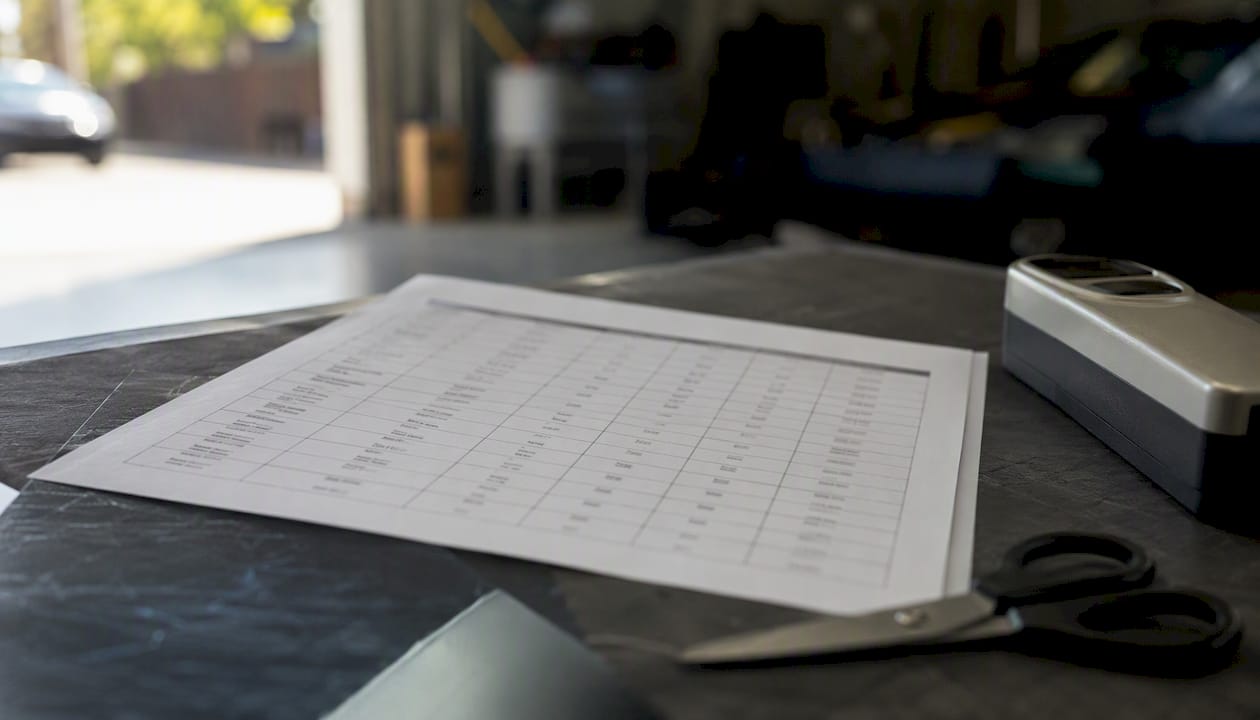
When you're reading a tech sheet, treat the VLT, TSER, and UV numbers as the verifiable core. Warranty length and "lifetime" claims are worth confirming directly with an authorized installer, since coverage terms can vary by film line and region.
If keeping your phone signal, GPS, and toll transponder working normally matters to you, non-metallic construction should be a hard requirement, not a nice-to-have. Color stable and ceramic films both typically qualify; older metalized films do not.
Pro Tip: Before your installation appointment, ask for the exact product code and request the manufacturer's data sheet by name. A legitimate installer will have this on hand instantly, and it lets you verify every claim yourself.
Is Color Stable Tint the Right Choice for Your Car?
Color stable tint fits a specific kind of buyer well: someone who wants a tint that will still look sharp in five to ten years, needs full electronics compatibility because they rely on GPS or hands-free systems, and wants strong UV and heat protection without paying top-dollar ceramic pricing.
If your absolute top priority is the maximum possible heat rejection number available, a premium ceramic or IR film will outperform color stable tint on raw numbers, though usually at a noticeably higher price point. Ceramic window tint uses a different nano-particle approach that pushes IR rejection even further.
A quick way to sort it out:
- Priority is fade resistance and a stable look for years → color stable tint fits well.
- Priority is zero electronics interference on a mid-range budget → color stable tint fits well.
- Priority is the absolute maximum heat rejection regardless of cost → look at premium ceramic film instead.
- Priority is the lowest possible upfront cost and you don't mind replacing tint sooner → basic dyed film is the budget option, with tradeoffs noted above.
What Should You Ask Your Installer Before the Job Starts?
A good film is only half the equation. Installation quality determines whether that film performs the way the data sheet says it will, and whether your warranty actually holds up if something goes wrong.
Before you book anyone, ask these questions directly:
- Can you show me the manufacturer's tech sheet for this specific product, including VLT and TSER numbers?
- Are you an authorized installer for this film line, and does that affect warranty coverage?
- What's your policy if I need the tint removed or replaced under warranty?
- Will you inspect the finished installation with me before I leave?
Mobile installation has become a common option for busy car owners, and it works well as long as the installer follows proper prep steps. Expect the technician to clean each window thoroughly, trim the film precisely to your vehicle's window shape, and give you clear curing time instructions, usually a few days before rolling windows down or washing the glass.
Watch for common installation problems: trapped bubbles that don't work themselves out after curing, edges lifting at the corners, or a noticeable mismatch between the VLT you ordered and what's actually on the glass. A qualified installer will catch and correct these issues before you ever leave the shop, and reputable technicians can walk you through how tint color is properly matched across different windows on your vehicle.
Pro Tip: Get the product code, your warranty card, and the installer's direct contact information in writing before you drive off. If a warranty claim ever comes up, that paperwork is what makes the process fast instead of frustrating.
A Straight Answer on Color Stable Tint
Color stable tint solves a real problem that a lot of car owners don't think about until they're staring at a purple rear window on a five-year-old car. It's not the flashiest option on the shelf, and it's not going to out-perform top-tier ceramic film on raw heat rejection numbers. What it does well is hold its color, protect your interior, and stay out of the way of your electronics, all at a price point that doesn't require a ceramic-tier budget.
My take after looking closely at how these films are actually built: too many buyers get sold on a heat rejection percentage alone and never ask about fade resistance or metal content, then wonder two years later why their tint looks worse than when they bought it. Color stable tint is the practical answer to that specific failure mode, and it deserves more attention than it usually gets in shop conversations that focus purely on darkness level. Before you commit to any film, verify the tech sheet yourself and confirm the warranty terms in writing. Don't take a sales pitch's word for numbers you can check in five minutes.
Ready to Get Color Stable Tint Installed the Right Way?
Southmiamitint installs 3M Color Stable film, 3M Ceramic IR, 3M Crystalline, and Iviron KoolMax ceramic tint directly at your home or office across Miami-Dade County, so you never have to sit in a shop waiting room. That's the real advantage over a traditional shop visit: you keep your schedule, and a certified technician brings the same authorized-installer product line and warranty support straight to your driveway.
Every installation includes access to manufacturer-backed warranty terms, and our technicians can walk you through the exact VLT and TSER specs for whichever film fits your priorities, whether that's color stable's fade resistance or ceramic film's maximum heat rejection. If you're ready to see pricing and available appointment times, check out mobile ceramic tint installation starting at $249 and request a quote for your vehicle today.
Where to Verify These Claims Yourself
- 3M's official Color Stable Series product page for solar rejection and technology claims straight from the manufacturer.
- Lightfastness testing standards to understand how fade resistance is measured across industries.
- HunterLab's explanation of color stability for a deeper look at why manufacturers test for it separately from color consistency.
- Southmiamitint's guide to UV exposure and window tinting for more on how UV bands affect your vehicle's interior.
- Southmiamitint's blog hub for additional local guides on tint laws, heat reduction, and ceramic film comparisons.
Frequently Asked Questions
What is color stable tint made of? It's typically a polyester-based film where color and UV blockers are extruded or infused directly into the material, sometimes combined with nano-ceramic or carbon particles, rather than a dye layer applied to the surface.
How is color stable tint different from ceramic tint? Color stable tint focuses primarily on fade resistance and non-metallic construction at a mid-range price, while ceramic tint uses nano-ceramic particles for the highest available heat and IR rejection, usually at a higher cost.
Will color stable tint interfere with my phone or GPS? No. Reputable color stable films are non-metallic by design, so they don't block or degrade cell signal, GPS accuracy, or key fob range the way older metalized films can.
How long does color stable tint typically last? Field reports suggest color stable film can hold its color and performance for a decade or longer, well beyond the two to four years you'd typically expect from basic dyed film before visible fading appears.
Is color stable tint worth the extra cost over basic dyed film? For most owners, yes. The higher upfront price buys you fade resistance, better warranty coverage, and stronger heat rejection, which usually means you avoid a second tint job just a few years down the road.
Sources
- 3M™ Automotive Window Film Color Stable Series
- Lightfastness
- What is Color Stable Window Tint?
- The Rise of Color-Stable Window Tint Explained in Detail
- What is color stability and why is it important?