
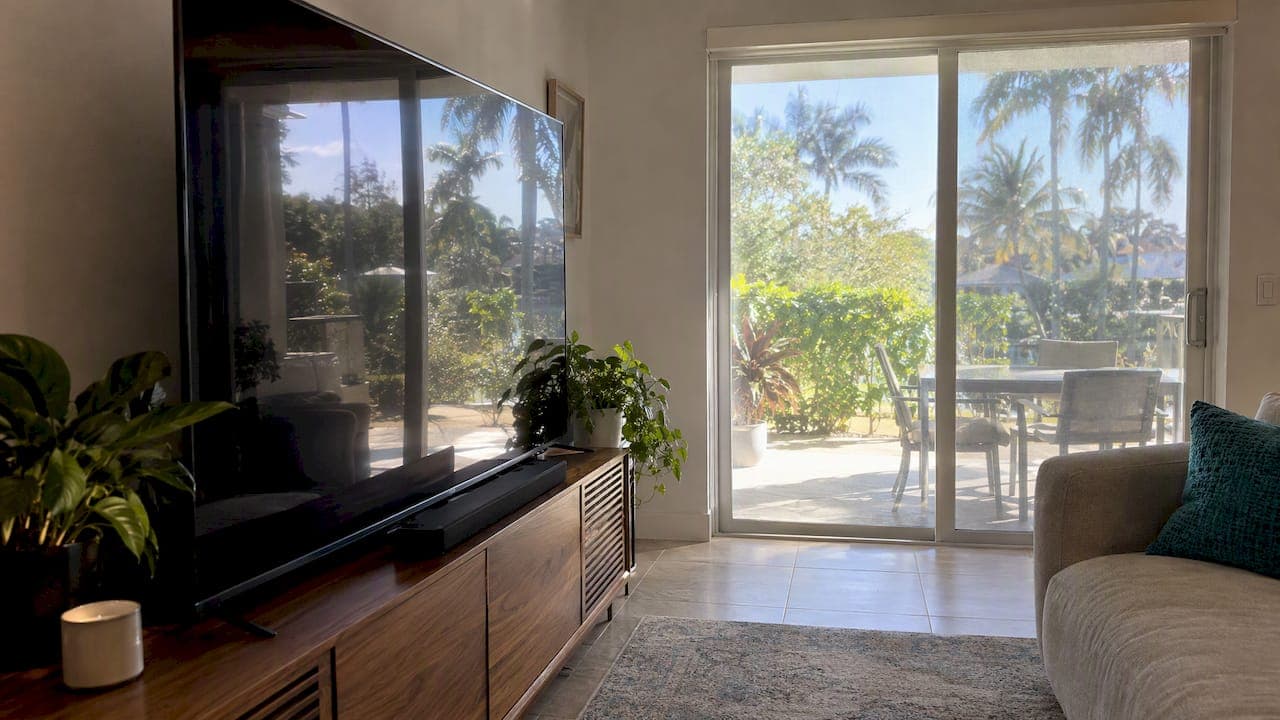
Window film can cut TV glare, but only when the glare comes from sunlight through your windows. A solar control film on the glass lowers the amount of light entering the room, so the screen stops looking like a mirror and the picture holds up in the afternoon. If the glare comes from a lamp, a glossy screen or a bad TV position, film on the window will not be the right fix. This guide shows how to tell the difference, which films are worth considering, what to check on your glass first and what to try before you spend anything.
TL;DR
- Window film reduces TV glare by cutting the sunlight that enters through the glass. It does not change the TV screen itself.
- Try cheap fixes first: move the TV, change its angle, add blackout curtains. Film makes sense when you want to keep the view and the daylight.
- Darker and more reflective films control glare best but also reduce daylight. Ceramic films give a clearer look and cost more.
- Check your window warranty and glass type before any film goes on. Some glass and sealed units can be stressed by films that absorb heat.
- In Miami-Dade, we install residential film on site. Get a quote and we will match the film to your glass.
Table of Contents
- Why your TV looks like a mirror in the afternoon
- Fix the position first, because it costs nothing
- When window film is the better answer
- What window film actually does
- Film types and how they compare
- What to check before film goes on your glass
- Do not confuse window film with TV screen film
- What about an outdoor TV?
- How to choose the right film for your room
- Our view on TV glare and film
- How we install residential film
- Get a quote for your TV room
- FAQ
- Sources
Why your TV looks like a mirror in the afternoon
A TV screen is a flat, fairly glossy surface. When a window is bright and sits across from or beside the screen, its image reflects off the panel and competes with the picture. Dark scenes suffer most, because a dark pixel cannot out-shine a reflection of a sunlit yard.
There are two separate problems, and they need different fixes:
- Reflections. You see a shape of the window, a bright patch or your own silhouette on the screen. This depends on where the TV sits compared with the window and where you sit.
- Washout. The whole room is so bright that the picture looks pale and low in contrast. This depends on how much light is in the room overall.
Window film helps most with washout and with bright, hard-edged reflections of the sun itself. It helps less with a reflection of a specific object, such as a lamp or a white wall, because that light is already inside the room.
Fix the position first, because it costs nothing
Before you pay for film, check placement. Tom's Guide calls placement the biggest factor in TV glare. Its advice is to keep the set away from windows, avoid sitting with a window directly behind you and choose the least bright wall or corner. That alone solves many cases.
If the TV is already mounted and cannot move, these options come next:
- Tilt or swivel it. Crutchfield recommends a tilting or full-motion mount when glare cannot be avoided, because small angle changes can deflect reflections away from where you sit.
- Diffuse the light. Philips suggests that when direct sun and strong reflections cannot be avoided, curtains or blinds can diffuse the light.
- Go blackout for a dedicated theater. Tom's Guide says blackout curtains are the strongest curtain choice for a home theater. It also notes that raising TV brightness helps on bright days but costs contrast.
These fixes work. Their weakness is that they all ask you to give something up: the view, the daylight or the screen's best picture quality. That is where window film earns its place.
When window film is the better answer
Film is a good fit when:
- The room has large glass, such as a sliding door or a wall of windows, and curtains would defeat the point of having it.
- The TV faces a window that cannot be avoided because of the room layout.
- You want less heat and UV in the room too. Film that controls glare usually also reduces solar heat and fading.
- Your windows face the sun in the afternoon, and the problem is strongest at the same hours every day.
Film is a poor fit when:
- The glare comes mostly from interior lamps or light-colored walls.
- You watch mainly at night. Then the film does little for the screen.
- The windows are old or damaged, or the warranty forbids film (see the checklist below).
What window film actually does
Solar control film reduces the sun's energy by reflecting and absorbing part of it. According to the NFRC Consumer Guide, solar-control film reduces solar heat gain by reflection and absorption. Two ratings tell you how a film behaves:
- Visible transmittance (VT): how much visible light passes through. A higher VT means a brighter room and, for TV glare, usually more glare.
- Solar heat gain coefficient (SHGC): how much solar heat gets through. A lower SHGC means less heat.
Manufacturers publish numbers for their own films. 3M says its home window films reflect much of the sun's heat and glare while allowing daylight through, and that its films block up to 99% of UV rays. Those are manufacturer figures for specific products, so ask for the spec sheet of the exact film you are quoted.
The International Window Film Association makes a point that matters for TV rooms: residential glare protection is directly related to the amount of light entering the home. Darker or more reflective films generally improve glare control, but they reduce daylight and can change how the building looks from outside. In other words, there is a trade-off, and you choose where to sit on it.
Film types and how they compare
The names vary by brand, but most films for TV rooms fall into a few groups.
| Film type | How it helps with glare | What you give up | Best for |
|---|---|---|---|
| Ceramic | Controls glare and heat while keeping a clearer, less mirror-like look | Usually costs more than basic film | Rooms where you want a view and a neutral look |
| Carbon or dyed tint | Cuts light through absorption; darker shades cut glare more | Darker interior, a more visible tint | Bedrooms, media rooms, budget-focused jobs |
| Reflective (metallized) | Strong against intense direct sun | Mirror look from outside, more change in appearance | Windows with harsh, direct exposure |
| Clear UV film | Blocks UV, protects furnishings | Very little glare reduction | Fading protection, not TV glare |
The last row matters. SnapTint's guide, drawing on manufacturer spec sheets, lists glare reductions from 48% to 85% for tinted or reflective films and about 1% for a clear UV film. We do not link that source because it sells film, but the point stands: a clear film will not fix a TV glare problem. Pick film for its light reduction, not just its UV number.
Ceramic film
Ceramic films are the ones we usually recommend when a customer wants to keep a natural view. They are built to control heat and glare without relying on a heavy mirror finish, so they look clearer from inside and outside. We install 3M ceramic films on vehicles every week, and the same product family has residential options. You can see the films we work with on our 3M window tinting page.
Carbon and dyed film
Carbon films absorb light and give a neutral dark look. They suit a media room where you want strong glare control and privacy more than a clear view. The darker you go, the less daylight you get during the day, so test a sample against your window before you decide.
Reflective film
Reflective films bounce a large share of sunlight away. They are effective on a window that gets punishing sun, but they change how the house looks from the street, and some neighborhoods and homeowner associations have rules about exterior appearance. Ask your HOA before choosing a reflective finish.
What to check before film goes on your glass
This is the part most guides skip, and it can save you money.
Film absorbs solar energy, and that energy turns into heat in the glass. The NFRC guide warns that absorbed solar energy can stress glass or the seals of insulated glazing. Its advice is to check your window warranty and have a professional assess the window's location, type and condition so the film matches the glass.
Use this checklist:
- Read the window warranty. Some manufacturers void coverage if film is added, or allow only certain film types.
- Know your glass. Single pane, double pane, laminated, tempered and low-E glass all behave differently under film.
- Look at the condition. Cracks, failing seals or fogging between panes are a reason to fix the window first.
- Consider winter. Films block solar heat gain in winter too, which matters in colder climates. In South Florida this is rarely a concern, but it is part of the full trade-off.
- Pick the glare level you need. Choose a film by VT and SHGC, not by shade name alone.
The point of a pro visit is to catch the risks above. We look at the glass before recommending a film, and we will tell you if a window should be left alone.
Do not confuse window film with TV screen film
Search results for this keyword are crowded with anti-glare films that go on the TV itself. They are a different product. They are sold as matte or frosted overlays for the screen.
They can reduce reflections, but they come with costs. A screen overlay can lower contrast or soften fine detail, so use one only after you have tried other fixes. Even built-in anti-glare screens carry trade-offs. In TechRadar's June 2025 test, Samsung's Glare-Free screen removed visible spotlight reflections more effectively than LG's anti-reflection screen, which contained the reflection rather than spreading it. But the Samsung treatment also reduced black-level performance.
The lesson is the same for both: cutting reflection on the surface of a screen usually costs some picture quality. Cutting the light before it reaches the room does not touch the picture at all, which is why window film is attractive for a good TV.
What about an outdoor TV?
If your TV is on a lanai or a covered patio, window film will not help much, because there is no window between the sun and the screen. Outdoor displays are built for bright daylight and weather. A regular indoor TV usually struggles outside because daylight is far brighter than indoor lighting. If you are putting a TV on a patio, buy a set made for it and shade the area with a roof, awning or screen. If the TV is indoors and faces a sliding door onto the lanai, film on that door is a reasonable fix.
How to choose the right film for your room
Walk through these questions in order:
- Which window causes the glare? Watch at the worst hour and note it. Often it is one or two windows, not the whole room.
- How much daylight can you give up? If you rarely watch in the day and the room is dim anyway, go darker. If the room is also your main living area, choose a lighter or ceramic film.
- Do you care about the outside look? If yes, avoid mirror finishes.
- Do you need privacy? Darker films give daytime privacy, but at night with lights on, the effect reverses.
- Do you want heat reduction? Ceramic and reflective films cut more heat per unit of darkness than basic dyed film.
- Does your glass allow it? Run through the checklist above.
Here are three example setups, described as general guidance rather than quotes:
- West-facing living room with a large sliding door. A mid-tone ceramic film on the door keeps the view and tames the afternoon sun. Pair it with a mount that tilts if the TV is high.
- Bedroom TV opposite a bright window. A darker carbon film does the job and adds privacy, and daylight loss matters less in a bedroom.
- Home office with a monitor and a side window. A lighter film plus a small angle change often does enough. Do not over-darken a room you work in all day.
Our view on TV glare and film
We tint glass for a living, mostly on cars, SUVs and trucks, with residential and commercial jobs too, so we deal with South Florida sun all day. Here is what we have learned that carries over to your living room.
First, darkness is not the only dial. A good ceramic film can reject a lot of heat without turning the glass into a dark mirror. People who start by asking for the darkest film often end up happier with a mid-tone ceramic once they see it on the glass.
Second, fit matters more than people expect. Film that is cut cleanly and applied without dust, bubbles or gaps looks like part of the window. We use computer-cut patterns for vehicle glass and bring that care to every install.

Third, we would rather tell you not to film a window than do a job that harms it. If your glass is old, your seals are failing or your warranty forbids film, we will say so. And if moving the TV three feet fixes your problem, we will say that too.
Finally, the sun in Miami-Dade is strong most of the year, so a film that suits a cooler place may not be enough here. Matching the film to the exposure of each window is the whole job.
— Jose
How we install residential film
We are a mobile service, so we come to you in Miami, Kendall, Homestead, Cutler Bay and Pinecrest, along with the rest of Miami-Dade. A typical visit looks like this:
- Quote. Tell us which windows face the TV and what you want to keep, such as the view or daylight. You can request a quote by phone or online form.
- Assessment. We look at the glass type and condition and check what your warranty allows.
- Film selection. We show you options, including 3M films, and explain the trade-off between glare control and daylight.
- Installation. We clean the glass, cut the film and apply it on site. You do not need to take anything anywhere.
- Cure. Film needs time to fully dry. We will tell you how long to wait before cleaning the glass.
We do not publish a residential price, because cost depends on the number of windows, their size and the film you pick. We quote after we know your glass. If you also have a car that needs tint, you can bundle the visit: our vehicle prices start at $150 for two front windows and $500 for a full car with windshield, as published on our main page.
Get a quote for your TV room
If afternoon sun is ruining movie night, send us the room details. Tell us which way the windows face, what kind of glass you have and what you want to keep. We will recommend a film or tell you honestly if another fix is better. Get a quote from Southmiamitint and we will come to you.
FAQ
Does window film really reduce TV glare?
Yes, when the glare comes from sunlight through your windows. The film reduces the light entering the room, so reflections get dimmer and the picture looks less washed out. It does little for reflections of lamps or bright interior walls.
What is the best window film for TV glare?
There is no single best film. Darker and more reflective films control glare most but also reduce daylight and change the look of the window. Ceramic film is a common choice when you want strong glare and heat control with a clearer look, and it usually costs more than basic film.
Is window film better than curtains?
It depends on what you want to keep. Blackout curtains block the most light for a dedicated theater, but they cover the window. Film lets you keep the view and some daylight, and it also cuts heat and UV. Many people use both: film for daytime and curtains for the darkest movie nights.
Will window film damage my windows?
It can if the film is wrong for the glass. Films absorb solar energy, which can stress some glass or insulated-glazing seals, and some warranties restrict film. Check your warranty and have a professional assess the glass before installation.
Should I put anti-glare film on the TV itself instead?
Only after trying other fixes. Screen overlays and some built-in anti-glare treatments can lower contrast or soften detail. Controlling the light at the window avoids that trade-off.
Sources
- What is TV glare and how do you get rid of it? | Tom's Guide
- How to wall-mount your TV | Crutchfield
- How to place your TV right in any room | Philips
- Home Window Glare Reduction | 3M United States
- Window Film | NFRC Consumer Guide to Windows
- Advanced Solar Control Education Guide | International Window Film Association
- Glare-Free vs anti-reflection OLED test | TechRadar