
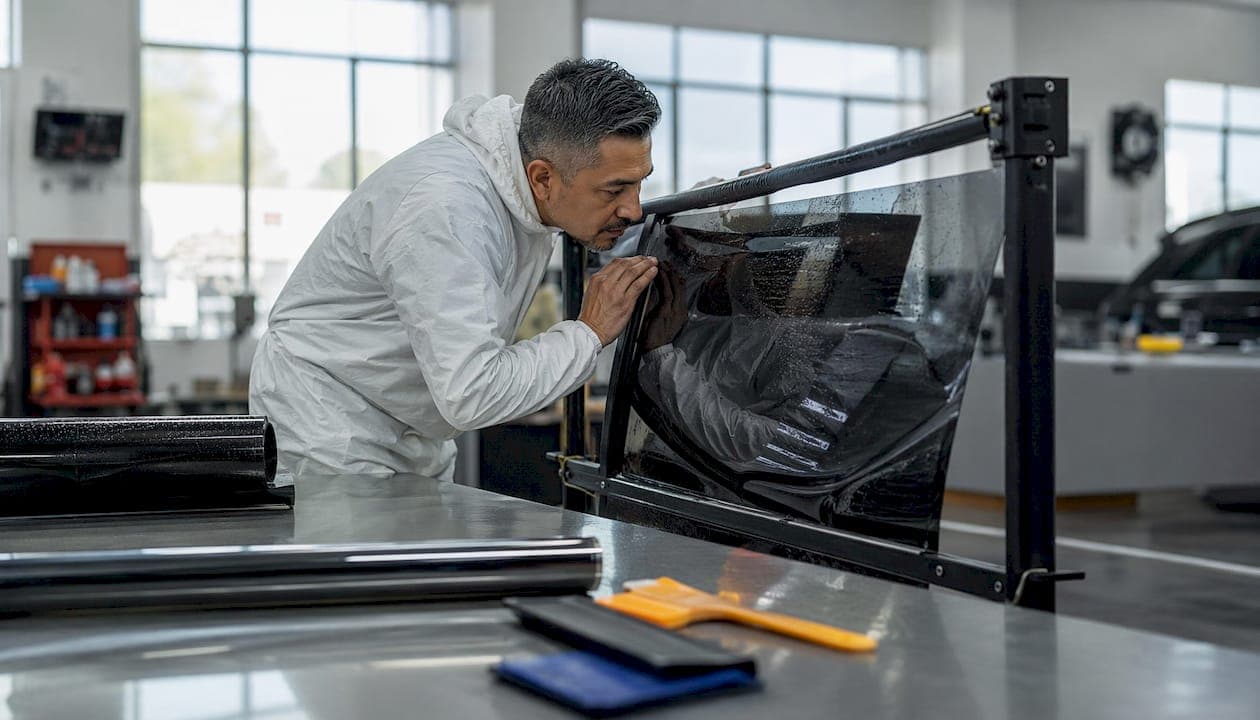
Certifications for tint installers are specialized credentials that verify professional competency, unlock manufacturer warranties, and directly improve career prospects in automotive window film installation. No U.S. state issues a dedicated window tint installer license, which means certification is voluntary yet carries real weight with dealerships, fleet clients, and premium customers. The two main credential categories are manufacturer-specific programs from brands like 3M, XPEL, Llumar, and SunTek, and the brand-neutral IWFA Accredited Installer credential. Together, these credentials form a professional portfolio that separates serious installers from hobbyists.
What are the main types of certifications for tint installers?
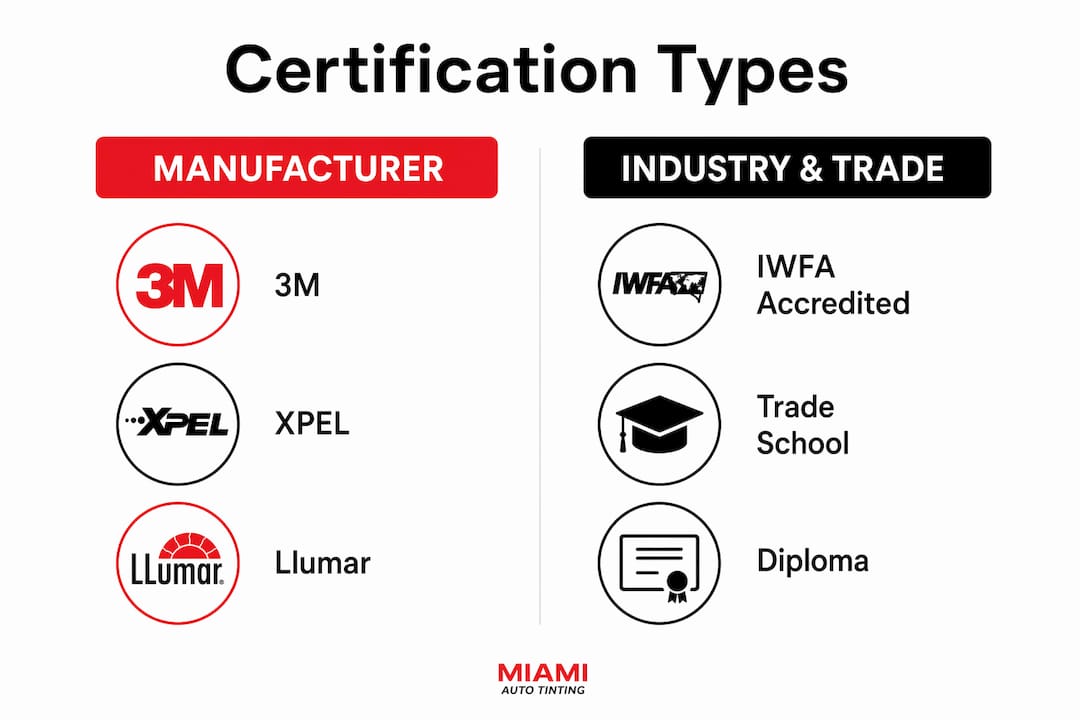
Three distinct credential types define the window tinting certification landscape: manufacturer programs, the IWFA Accredited Installer credential, and trade-school diplomas. Each serves a different purpose, and the strongest professional portfolios include all three.
Manufacturer-specific certifications
Manufacturer programs are the most direct path to warranty eligibility. Brands like 3M, XPEL, Llumar, and SunTek each run their own training programs that cover preparation, heat shrinking, and application standards specific to their film lines. Manufacturer certifications typically last 1–5 days and cost $500–$2,500, with annual renewal fees ranging from $150–$900. Passing requires both a written exam and a practical installation assessment. Without this credential, manufacturers will not honor warranty claims, even when the installation itself is flawless.

IWFA Accredited Installer
The International Window Film Association (IWFA) Accredited Installer credential is the industry's most respected brand-neutral certification. It requires passing both a written exam covering film science and installation theory, and a hands-on practical exam. IWFA certification costs $300–$500 initially, with annual renewal fees of $150–$250. Because it is not tied to any single product line, the IWFA credential signals broad competency to any employer or client.
Trade-school diplomas
A trade-school diploma is the foundation that makes every other credential more meaningful. These programs deliver 40–80 hours of hands-on training covering film cutting, surface preparation, and tool use. Most manufacturers expect applicants to have baseline installation experience before enrolling in their certification courses. Trade-school training is where you build the muscle memory that written exams cannot test.
| Credential Type | Duration | Cost Range | Key Benefit |
|---|---|---|---|
| Manufacturer (3M, XPEL, Llumar, SunTek) | 1–5 days | $500–$2,500 | Warranty registration eligibility |
| IWFA Accredited Installer | Exam-based | $300–$500 | Brand-neutral industry credibility |
| Trade-school diploma | 40–80 hours | Varies by school | Foundational hands-on skill |
Why is certification worth it without a mandatory license?
The absence of a state-issued license does not reduce the value of film installation certifications. It actually makes them more important. When no government body sets a minimum standard, certification becomes the only credible signal that an installer knows what they are doing.
Certified installers gain access to benefits that uncertified peers simply cannot offer:
- Warranty registration. Manufacturers will not honor warranty claims from uncertified installers, regardless of installation quality. Customers buying premium film expect warranty protection, and only certified installers can provide it.
- Dealership and fleet contracts. Commercial clients require proof of credentials before awarding contracts. Certification is the entry ticket.
- Higher rates. Certified installers command premium pricing because they can back their work with manufacturer warranties.
- Customer trust. A credential on the wall or a manufacturer logo on your website converts skeptical customers faster than any sales pitch.
- Insurance and liability. Some business insurance policies favor certified installers, reducing risk exposure.
Pro Tip: Align your manufacturer certifications with the film brands your target clients already know. If local dealerships use 3M film, a 3M certification carries more weight than a lesser-known brand's credential.
The Miami auto tinting regulations page from Southmiamitint covers how local compliance intersects with professional credentials, which is worth reviewing before you choose which certifications to pursue.
How do you get certified as a tint installer?
The full certification pathway is a structured process, not a single test. Follow these steps in order to build credentials that hold up with employers and clients.
-
Complete trade-school training first. Enroll in a program offering 40–80 hours of hands-on instruction. This covers surface prep, film cutting with plotters, heat shrinking, and squeegee technique. Do not skip this step. Manufacturer programs assume you already know the basics.
-
Choose your manufacturer certifications strategically. Research which film brands dominate your local market. If you plan to work with Southmiamitint-level clients who expect 3M ceramic film installations, a 3M certification is the logical first choice. XPEL, Llumar, and SunTek each have their own programs with similar structures.
-
Budget realistically. A full professional credential set covering trade school, multiple manufacturer certifications, and the IWFA credential typically costs $3,500–$8,000 and takes 12–18 months to complete. That is a significant investment, but certified installers recover it quickly through higher rates.
-
Sit the IWFA exam. After gaining manufacturer credentials and real-world experience, pursue the IWFA Accredited Installer exam. The written portion tests film science, VLT laws, and installation theory. The practical portion requires you to install film to a defined quality standard.
-
Practice beyond the classroom. Complete 40–70 practice installations after your certification courses before billing clients at full professional rates. Certification proves you understand the process. Practice proves you can execute it consistently.
-
Track renewal deadlines. Manufacturer renewals cost $150–$900 annually. IWFA renewal runs $150–$250 per year. Missing a renewal date voids your warranty registration ability until you reinstate.
Pro Tip: Keep a log of every installation you complete during your practice phase. Documenting vehicle types, film brands, and any challenges you solved builds a portfolio that impresses clients and employers before you have years of experience.
What are the common misconceptions about tint installer certifications?
Several myths circulate in the tinting community that lead new installers to make costly mistakes.
Myth 1: Certification equals competency. A certificate proves you passed an exam on a specific day. It does not guarantee consistent quality across 200 different vehicle models. Certification alone does not replace the hands-on experience needed for professional readiness. Treat the credential as a starting point, not a finish line.
Myth 2: Online certifications count. Online-only window tint certifications are not recognized by manufacturers or insurers. Legitimate certification requires a practical exam. Any program that awards a certificate without watching you install film is a marketing product, not a professional credential.
Myth 3: One certification is enough. A single manufacturer credential limits you to that brand's warranty program. Clients with different film preferences will go elsewhere. Building a portfolio of credentials across multiple manufacturers, plus the IWFA credential, gives you flexibility and broader market appeal.
Myth 4: The cost is too high to recover. The $3,500–$8,000 investment in a full credential set sounds steep until you factor in the 40–80% wage premium certified installers earn over uncertified peers. Most certified installers recover the cost within the first year of full-time work.
Myth 5: Business skills do not matter. True success in the tinting trade depends on systematic training in both technical skills and business management. Installers who focus only on film technique and ignore pricing, customer service, and scheduling often struggle to grow beyond basic residential work.
How do certifications affect earnings and career opportunities?
Certification has a direct and measurable impact on what tint installers earn and the types of work they can access. Certified installers earn 40–80% more than their uncertified counterparts. That gap reflects the market's willingness to pay for warranty-backed, professionally verified work.
Dealerships represent the most consistent high-volume opportunity for certified installers. Most dealership service departments require proof of manufacturer certification before adding an installer to their approved vendor list. Fleet contracts follow the same logic. A logistics company with 50 vehicles needs an installer who can warranty every job, not just complete it.
Access to premium product lines is another concrete benefit. Manufacturers like 3M restrict their ceramic IR film distribution to certified dealers and installers. Without certification, you cannot legally sell or install those products under warranty. That restriction keeps uncertified installers out of the premium market segment entirely.
Referral rates also improve with certification. Customers who receive warranty documentation after an installation are far more likely to recommend the installer to friends and family. The warranty becomes a marketing tool, and it only exists because of the underlying certification.
For those interested in how professional tinting works across different markets, OB's Auto Services offers a useful perspective on quality control and training standards in the automotive tint industry.
Key Takeaways
Certified tint installers earn more, access better contracts, and deliver warranty-backed work that uncertified installers simply cannot offer.
| Point | Details |
|---|---|
| No license required, but certification matters | No U.S. state issues a tint installer license; credentials are voluntary but critical for warranty and credibility. |
| Three credential types build a full portfolio | Trade-school diploma, manufacturer certifications, and IWFA Accredited Installer together form a complete professional profile. |
| Full certification costs $3,500–$8,000 | Budget 12–18 months and several thousand dollars to complete the full credential pathway. |
| Online-only certifications are not recognized | Legitimate credentials require a practical exam; online-only programs are not accepted by manufacturers or insurers. |
| Certified installers earn significantly more | The 40–80% wage premium over uncertified peers makes the certification investment recoverable within the first year. |
What I've learned about certifications after years in the tinting trade
The certification conversation in this industry tends to go one of two ways. Either someone treats a certificate like a golden ticket that will automatically bring in clients, or they dismiss credentials entirely and rely on word-of-mouth alone. Both approaches leave money on the table.
The installers I've seen build lasting businesses treat certification as one piece of a larger system. They get the credentials, yes. But they also log their practice installations obsessively, study the film science behind what they install, and learn how to price jobs so they are not working for less than their skill level deserves. A 3M certification matters. Knowing why 3M Ceramic IR blocks infrared heat differently than a standard dyed film matters just as much.
My honest advice: choose your first manufacturer certification based on what your local market actually buys. In Miami, ceramic film is the dominant demand because of the heat and UV intensity. Chasing a credential for a product line nobody in your area specifies is a waste of time and money. Get certified in what sells, then expand your portfolio as your client base grows. Credentials are a long-term investment in business sustainability, not a shortcut to instant credibility.
— Jose
Southmiamitint and professional-grade automotive tinting in Miami
Southmiamitint installs window film using certified techniques and premium materials, including 3M IR, 3M Color Stable, and Iviron Kollmax ceramic tint, across Miami-Dade for automotive, residential, and commercial clients.
Every installation Southmiamitint completes follows the preparation and application standards that manufacturer certification programs enforce, which is exactly what makes warranty registration possible. If you want 3M ceramic film installed by professionals who understand what certification actually requires, or you are looking for mobile tinting service delivered at your location across Miami-Dade, Southmiamitint brings that level of verified expertise directly to you. No shop visit required.
FAQ
Do tint installers need a license to work legally?
No U.S. state issues a dedicated window tint installer license. Certification is voluntary, but it is required by manufacturers to register warranties and by many commercial clients to award contracts.
What is the IWFA Accredited Installer credential?
The IWFA Accredited Installer is a brand-neutral industry credential that requires passing written and practical exams. It costs $300–$500 initially, with annual renewal fees of $150–$250.
Are online tint certifications legitimate?
Online-only certifications are not recognized by manufacturers or insurers. Legitimate window tinting certification requires a hands-on practical exam, not just online coursework.
How long does it take to get fully certified?
A complete professional credential set, covering trade school, manufacturer programs, and the IWFA credential, typically takes 12–18 months and costs $3,500–$8,000.
How many practice installs should I complete after certification?
Completing 40–70 practice installations after your certification courses is the standard recommendation before billing clients at full professional rates.