
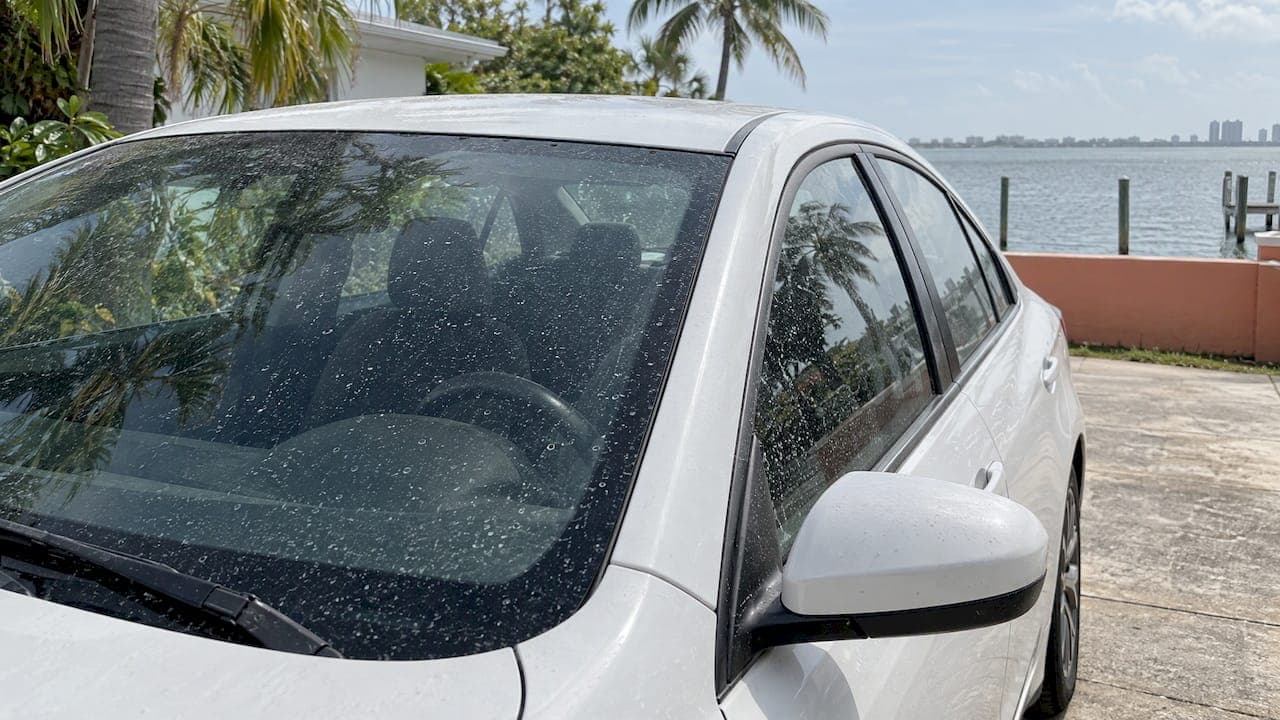
Salt air in Miami does not usually ruin window tint by itself. Most of the damage you see comes from the combination of salt, constant humidity, intense sun and a film that was not built or installed for this climate. Quality ceramic film, a clean install with sealed edges and a simple cleaning routine are what keep tint clear and tight near the water. Here is what salt does to glass, what it does to film, and how to choose and care for tint in Miami-Dade.
TL;DR
- Salt settles on glass and, with moisture, can etch it over time. Regular cleaning is the best defense for the glass and the film.
- Automotive and most home film is applied to the inside face of the glass, so the bigger threats to it are heat, UV, humidity and a poor install.
- Ceramic film with a real warranty is the safer choice in coastal Miami-Dade. Our ceramic films carry 3-year, 5-year and lifetime warranties.
- Florida limits how dark car tint can be: 28% on front side windows, 15% on the rear of a passenger car.
- Clean with a neutral, non-abrasive glass cleaner and a soft cloth, and wait 30 days after installation before the first cleaning.
Table of Contents
- How salt air affects glass in Miami
- What salt air does to window tint
- Signs your tint is failing
- Which film features matter most near the coast
- Why installation matters as much as the film
- Perspective: why we only install ceramic
- Florida tint rules: stay legal while you beat the heat
- How to clean and care for tint in a salty climate
- What mobile tinting costs in Miami-Dade
- Get tint that is built for Miami
- FAQ
- Sources
How salt air affects glass in Miami
Miami sits between the Atlantic and Biscayne Bay, and the air carries fine salt particles. They land on windshields, side glass, condo balconies and storefronts. According to a Miami commercial window-cleaning company, airborne salt that settles on glass combines with moisture to form an electrolyte that attacks the surface. The same page notes that salt can also contribute to aluminum frame oxidation and stainless-steel staining.
Another local cleaning company says salt residue can etch glass and deteriorate metal or wood frames, and that routine cleaning helps preserve clarity. The first company describes the damage as a progression: a surface film builds up, minerals bond to the glass, the surface etches, and in the worst cases the glass pits and needs replacing.

What this means for you is simple. Salt is a slow problem, and it is worst when it sits on glass for months. A vehicle parked a few blocks from the water in Miami Beach, Key Biscayne or Coconut Grove collects more than one parked inland. A bayfront condo collects more still.
What salt air does to window tint
This is the part many guides skip. Window film has a few layers: a protective coating, the film body, an adhesive and a liner that comes off during installation. On a car, the film goes on the inside of the glass. On most homes and offices, it also goes on the inside face. That means the salt is landing on the glass, not directly on the film.
So where does the trouble come from? In our experience, tint that fails early in Miami usually fails for one of these reasons:
- Heat and UV. Low-grade dyed film fades, turns purple or brown, and loses its grip as the adhesive breaks down. Miami's sun accelerates this.
- Humidity at the edges. Moisture can creep in where film is cut short or poorly sealed, which causes lifting and peeling.
- Poor prep. Salt, dust and oil left on the glass before installation weaken the bond and trap contamination under the film.
- Harsh cleaning. Abrasive products and ammonia-based sprays scratch or cloud the surface.
Salt matters most in two ways. It affects the glass the film is stuck to, and it gets wiped across the surface every time someone cleans a dirty window with a dry or abrasive cloth. Both are things you can control.
For more on the local climate, see our articles on how Miami weather affects your car's tinting needs and humidity considerations for tinting.
Signs your tint is failing
No single sign tells you the cause, but patterns help. These are the practical signals we look for when a customer asks us to check old film:
| What you see | Most likely cause |
|---|---|
| Purple or brown color shift across the whole window | Aging or low-quality dyed film, long sun exposure |
| Bubbles in the middle of the glass | Adhesive failure, often from heat or poor prep |
| Peeling or lifting along the edges | Moisture, edge cuts that were not sealed, or damage from window rolling |
| Small specks or hazy patches under the film | Contamination trapped during installation |
| Scratches and cloudy streaks | Abrasive cleaning or dirty cloths |
| Frosted or spotty look that stays after you remove the film | Etching on the glass itself, which is a glass problem, not a film problem |
The last row is worth knowing. If the haze is on the outside of the glass and does not wipe away, salt and minerals may have started to etch it. Film will not fix that, and a good installer will tell you before covering it up.
When old film is past saving, we offer old tint removal for $50 to $150, depending on the vehicle and the condition of the film.
Which film features matter most near the coast
If you live or work near the water, look at four things before you choose a film.
Heat rejection, not just darkness
Darker does not mean cooler. The heat you feel comes largely from infrared light. 3M's spec sheet for its Prestige line states that these films reject up to 97% of infrared light and block 99.9% of harmful UV, have low reflectivity and are not susceptible to corrosion in coastal environments. That sheet is for 3M's architectural line, so treat it as an example of what premium film is built to do, not as a promise for every product. Ceramic films work through technology that targets infrared, which is why they stay effective at lighter, legal shades.
Ceramic over dyed film
Ceramic film does not rely on dye to do its work, so it holds its color better under Miami's sun. We install ceramic films only. That is a deliberate choice for this climate. You can read more about the options on our ceramic tint page.
A warranty that covers discoloration
Film makers back their products differently. As one example, LLumar states that its automotive tint is designed to keep its color and integrity, and that if discoloration occurs a lifetime limited warranty may cover removal and replacement, subject to restrictions. Always read the restrictions. Our own films come with these warranties:
- 3M Ceramic IR: lifetime warranty
- SunTek CIR: 5-year warranty
- Uviron KoolMax: 3-year warranty
To see how the 3M options compare, visit our 3M window tinting page.
The right film for the right glass
Do not put car tint on house windows. LLumar notes that it discourages automotive tint in architectural projects because its heat absorption may be too high for that glass and could cause breakage. Homes and offices need film chosen for the glass type, which is why we handle residential and commercial jobs as their own services.
Why installation matters as much as the film
In a humid, salty city, the install decides how long a film lasts. A few details make the difference:
- Clean glass. Every trace of salt film, dust and oil has to come off before the film goes on.
- Exact fit. We use computer-cut patterns so edges sit where they should, not where a hand knife happened to land.
- Fewer seams. Our 60-inch rolls let us install large windshields in one piece, with no seam for moisture to find.
- A controlled spot. We come to you, and we pick the best available area at your home or office to work in, shaded and as free of dust as we can get it.
As a mobile service, we work at your home or office anywhere in Miami-Dade. If you are near the water, our page on window tinting in Miami Beach covers cars and condos on the barrier island, and our coastal UV and heat guide goes deeper on film choices.
Perspective: why we only install ceramic
After 28 years of tinting cars, homes and offices in Miami-Dade, we have seen what the climate does to cheap film. It fades, it bubbles, and people pay twice: once for the cheap job and once to strip it off.
That is why we install ceramic films only. Salt, humidity and sun hit hard here, and we want you to have film that is designed for them. 3M Ceramic IR comes with a lifetime warranty, SunTek CIR with 5 years and Uviron KoolMax with 3 years.
I install the film myself, with computer-cut patterns for an exact fit and 60-inch rolls so big windshields go on in one piece. We also work on Teslas and luxury and exotic cars regularly, so we know how careful those jobs need to be.
Coming to your door matters too. You should not have to lose half a day sitting in a shop. We bring the work to you.
Jose
Florida tint rules: stay legal while you beat the heat
Salt air is not the only thing that decides how dark you can go. Florida law sets limits for cars.
| Window | Visible light transmission | Reflectance |
|---|---|---|
| Front side windows | At least 28% | No more than 25% |
| Rear and back-side windows, passenger cars | At least 15% | No more than 35% |
| Rear and back-side windows, multipurpose vehicles (SUVs, vans) | At least 6% | No more than 35% |
The front side limits come from Florida Statute 316.2953, and the rear limits from Florida Statute 316.2954. Installers must also affix a nonremovable compliance label on the inside left door jamb, as Statute 316.2955 requires.
Enforcement is measured, not guessed. The Florida Highway Patrol policy manual says officers use approved meters, and those readings are presumed accurate as evidence in traffic violation cases. If you have a medical condition that requires limited light exposure, such as lupus, Florida offers a medical exemption certificate. Ask your physician whether you qualify.
Because ceramic film rejects heat without needing to be very dark, a legal shade can still make a big difference in cabin temperature. For a longer walkthrough, see what makes window tint legal for Florida drivers.

How to clean and care for tint in a salty climate
Good care takes minutes and protects both the film and the glass.
- Wait 30 days. After installation, give the film time to cure before the first cleaning. 3M's guidance says film can be cleaned after thirty days with a neutral, non-abrasive glass cleaner and a soft, lint-free cloth, and that abrasive products should not be used.
- Rinse salt first. If you have been at the beach or driven along the water, rinse the car before you wipe. Wiping dry salt across glass is how scratches start.
- Use soft cloths. Microfiber, clean and used only for glass.
- Skip harsh chemicals. Avoid abrasive pads, razor blades and strong solvents on film.
- Be careful with the edges. Roll windows down gently, and do not pick at lifted corners.
- Clean regularly. For homes and offices on the water, a regular wash keeps salt from bonding to the glass.
If you want to extend the life of your whole vehicle, not just the glass, these tips on how to make your car last longer cover routine upkeep that fits well with a film care routine.
What mobile tinting costs in Miami-Dade
Our published prices for cars start at:
| Service | Price |
|---|---|
| 2 front windows | from $200 |
| Windshield tint | from $150 |
| Full car + windshield | from $450 |
| Old tint removal | $50 to $150 |
Final pricing depends on the vehicle and film. Home and business jobs are quoted after we know the glass, the size and the film. See our mobile window tinting prices page for more detail.
Get tint that is built for Miami
We come to your home or office in Miami, Kendall, Homestead, Cutler Bay, Pinecrest and the rest of Miami-Dade. We install ceramic film only, with warranties from 3 years to lifetime, so you are not worrying about salt, sun or humidity a year from now.

Ready to book? Request a mobile tint quote or see all of our car packages on our main page. Learn how our mobile service works or check the areas we serve.
FAQ
Does salt air damage window tint?
Salt mainly lands on the outside of the glass, while film sits on the inside, so the film is usually not attacked directly. Salt can etch the glass over time, and heat, UV, humidity and poor installation are the bigger causes of film failure. Quality ceramic film and regular cleaning keep both in good shape.
How long does tint last in Miami?
It depends on the film and the install. Cheap dyed film can fade and bubble early in this sun, while ceramic film is designed to hold its color. Our 3M Ceramic IR has a lifetime warranty, SunTek CIR has 5 years and Uviron KoolMax has 3 years.
Can I clean my tint with Windex?
Use a neutral, non-abrasive glass cleaner and a soft, lint-free cloth, and only after the first 30 days. Avoid abrasive products. If a cleaner lists ammonia and you are unsure, check the film maker's care instructions or ask us.
What tint percentage is legal in Florida?
Front side windows must allow at least 28% of visible light. Rear and back-side windows on passenger cars must allow at least 15%, and on SUVs and vans at least 6%. Reflectance limits also apply, and the installer must attach a compliance label.
Do you come to my home or office?
Yes. We are fully mobile across Miami-Dade County, so you do not need to wait at a shop. Send us a quote request, tell us the vehicle and where you are, and we will schedule a time.
Sources
- Commercial Window Washing in Miami | Salt Air Protection
- How Miami's Intense Sunlight and Coastal Climate Impact Your Windows
- 3M Window Films Prestige spec data sheet
- Automotive Window Tint FAQ | LLumar
- 3M Automotive Window Film FX-HP Series
- Florida Statute 316.2953
- Florida Statute 316.2954
- Florida Statute 316.2955
- Florida Highway Patrol Policy Manual
- TL-55 Sunscreening Medical Exemption Certificate