
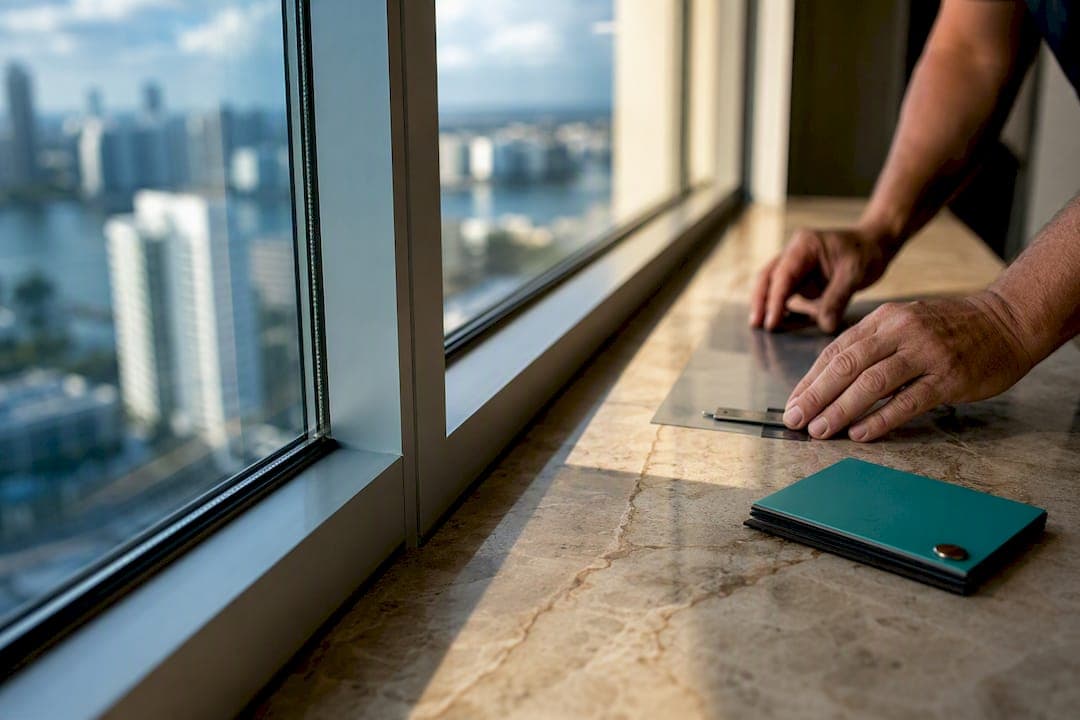
Your condo board, not you alone, typically controls whether window film goes on your unit's glass. Florida's Condominium Act gives associations authority over common and limited common elements, which usually includes exterior-facing windows. Before ordering anything, check your Declaration of Condominium to see how your windows are classified, then build a submittal packet with a manufacturer spec sheet and installer proof of insurance for the board.
TL;DR:
- Most Miami condominium associations control exterior window tint approval, requiring owners to submit detailed documentation including manufacturer specs and installer insurance.
- Approval depends heavily on the classification of windows as common or limited common elements under the declaration, with ambiguous language often defaulting to stricter board approval.
- Commonly approved films include ceramic, color-stable, carbon, and crystalline types that meet specified VLT and reflectivity limits, especially in hurricane zones.
- Unlicensed or uninsured installers are generally rejected, and unapproved tinting may result in fines and mandatory removal at the owner’s expense.
- Owners should prepare a complete, detailed request with product data, credentials, and mockups to expedite approval and avoid delays or enforcement actions.
Table of Contents
- Miami Condo Tint Rules: How Florida Law and Your Declaration Decide Approval
- How to Confirm Who Has Final Say in Your Building
- Board Approval Process: Documents That Get Requests Approved Fast
- What VLT, Reflectivity, and Hurricane Rules Mean for Your Approval
- Installer and Installation Requirements Boards Usually Request
- Costs, Timing, and Who Pays for Condo Window Tint
- How to Prepare a Board-Ready Approval Request
- Miami-Dade Building Codes That Add to Condo Tint Rules
- Enforcement and Penalties for Unapproved Tinting
- Resolving Conflicts Between Owner Preferences and Board Rules
- Why Miami's Climate Makes Compliant Tint Worth the Approval Process
- Common Film Types That Meet Miami Condo Standards
- Local Experience With Condo Approvals in Miami-Dade
- Get a Board-Ready Tint Quote Without the Guesswork
- Sources
- FAQ
Miami Condo Tint Rules: How Florida Law and Your Declaration Decide Approval
Florida's Condominium Act sets the baseline that governs most Miami-Dade buildings. Under Florida Statutes §718.113, associations maintain common elements, and exterior windows are usually classified as common or limited common elements rather than pure unit interior. That single distinction determines whether you need board sign-off before a tint installer ever shows up.
The difference matters in practice:
- Common elements serve the whole building, like the exterior wall face or the glass itself when the declaration assigns it that way.
- Limited common elements serve one unit but remain under association jurisdiction, a common designation for windows and balcony glazing.
- Unit interior covers items the declaration explicitly hands to the owner, which rarely includes exterior glass in Miami-Dade high-rises.
When a declaration says nothing about how alterations get approved, Florida law defaults to a steep bar: 75% of the total voting interests must approve a material alteration to a common element. That default rarely applies to routine tint approvals, since most boards handle window film through their architectural review process instead of a full membership vote, but it's the fallback if your declaration is silent and someone challenges the board's authority to approve individually.
How to Confirm Who Has Final Say in Your Building
Don't guess. Pull your Declaration of Condominium and work through it methodically before you contact an installer or the board.
- Search for "Maintenance" and "Architectural Alterations" sections. These clauses, not the general definitions section, usually contain the real controlling language on windows.
- Identify how windows are classified. Look for the words "common element," "limited common element," or language that places windows inside the unit boundary.
- Check for an existing window-film or tinting policy. Some Miami-Dade associations already adopted specific rules, which override the general default process.
- If the language is ambiguous, don't assume in your favor. Ambiguous declarations tend to resolve against the owner in disputes, according to property law commentary on window repair obligations, so check prior board minutes for past approvals or consult a condo attorney before installing anything.
A ten-minute read of the wrong section can cost you a removal order later. Get this step right first.
Board Approval Process: Documents That Get Requests Approved Fast
Boards reject window film requests far more often for missing paperwork than for the film itself. Bring a complete packet the first time and you'll usually clear review in one meeting cycle instead of three.
Standard items most Miami-Dade associations expect:
- A completed Architectural Review Committee (ARC) form, available from your property manager.
- A manufacturer technical spec sheet showing Visible Light Transmission (VLT), exterior reflectivity percentage, and color.
- Installer proof of license and liability insurance, plus a written warranty on the film and installation.
- A sample swatch or mockup photo showing how the film looks against your building's existing glass.
Boards care about VLT and exterior reflectivity because those two numbers predict whether your unit will look different from every other window on that facade. A film with high exterior reflectivity can turn one unit into a visible outlier on the building's skin, which is exactly the kind of inconsistency architectural review exists to prevent.
Pro Tip: Ask your property manager for the last three approved tint requests on file. Matching the VLT and reflectivity range the board has already approved is the fastest route through review.
What VLT, Reflectivity, and Hurricane Rules Mean for Your Approval
Two numbers on a spec sheet decide most board votes: VLT and exterior reflectivity. VLT measures how much visible light passes through the glass, expressed as a percentage; lower numbers mean darker film. Exterior reflectivity measures how mirror-like the outside surface looks from the street or the pool deck.
What boards generally look for:
- Neutral gray or clear tones over blue, purple, or heavily tinted colors.
- Low exterior reflectivity, since mirrored or metallic-looking film reads as a visible mismatch from outside.
- Consistency with film already installed elsewhere on the same facade.
Hurricane-protection status changes the analysis entirely. Under HB 293 guidance, boards must adopt hurricane-protection specifications and cannot deny installations that conform to those code-compliant, board-adopted specs. If your film or laminated glass assembly qualifies as hurricane protection, the board's discretion narrows considerably, provided your product meets the specification the board already put in writing.
Installer and Installation Requirements Boards Usually Request
Most associations won't approve an unlicensed or uninsured installer, and for good reason: a bad installation on shared building glass creates liability the association may end up carrying.
Expect your board to request:
- Proof of contractor license and current liability insurance, protecting the building if the installation causes damage.
- A written warranty covering both the film and workmanship.
- Confirmation of interior-mount installation, since film applied to the inside surface of the glass leaves the exterior appearance and any hurricane-rated assembly untouched.
If the association ever needs access to your window for repairs and must remove the film, Florida statute generally requires reimbursement or an assessment credit when the declaration doesn't already assign that cost to you. Get that removal responsibility in writing before installation, not after.
Costs, Timing, and Who Pays for Condo Window Tint
Who pays comes down entirely to your declaration's cost-allocation language, and it varies more than most owners expect.
- Owner-pays model: most common when windows are classified as limited common elements serving a single unit; you cover the film and installation.
- Association-pays model: less common, but it happens in buildings where the declaration treats window assemblies as shared common elements maintained collectively.
- Removal and reinstatement costs: if the association orders removal for repairs it initiates, statutory reimbursement rules typically apply unless your declaration says otherwise.
Timing depends on your building's ARC review schedule. Some boards review requests within two weeks; others only meet monthly, which can stretch approval to six weeks or more. Submit your packet as early as possible and ask your property manager for the next ARC meeting date before scheduling any installer.
How to Prepare a Board-Ready Approval Request
A complete, well-organized request moves faster through committee review than a partial one that generates follow-up questions.
- Attach the ARC form, completed in full of unit number and requested install date.
- Include the manufacturer spec sheet listing VLT percentage, exterior reflectivity, and color name.
- Add installer credentials: license number, insurance certificate, and warranty terms.
- Provide a mockup or comparison photo against the existing building glass.
- Write one summary paragraph stating the product, VLT percentage, reflectivity rating, interior-mount method, and installer name.
If the board asks for clarification, respond with the specific number they're questioning rather than a general reassurance. Boards approve specifics faster than promises.
Miami-Dade Building Codes That Add to Condo Tint Rules
State condominium law sets the baseline, but Miami-Dade County's building code adds another layer that owners often overlook. Miami-Dade operates under one of the strictest building codes in the country, largely because of hurricane and impact-glazing requirements dating back to Hurricane Andrew. If your building's windows are impact-rated or hurricane-rated glazing, any film application can potentially affect that rating, and your county permitting requirements may come into play depending on the scope of work.
For most interior-mounted residential window film jobs, county permitting isn't typically triggered, since the work doesn't alter the glazing assembly itself. But if a project involves replacing glass, adding security film rated as hurricane protection, or any structural change to the window frame, Miami-Dade's Product Approval system and permitting office may require documentation showing the film or glass meets the county's impact standards. This is separate from, and in addition to, whatever your condo association requires.
Coastal buildings and those in designated High-Velocity Hurricane Zones (which cover most of Miami-Dade and Broward counties) face the tightest scrutiny. If your building sits in that zone, ask your property manager whether your windows carry Miami-Dade Notice of Acceptance (NOA) approval, and confirm with your installer that any film product won't void that approval. A licensed installer familiar with South Florida code requirements should be able to answer this before work begins, and reputable manufacturers publish NOA-compatible product lines specifically for this market.
Bottom line: county code rarely blocks a straightforward interior tint job, but it can add a permitting step for anything touching the glazing assembly itself. Confirm this with your building management before assuming a straightforward condo board approval is the only hurdle.
Enforcement and Penalties for Unapproved Tinting
Installing film without board approval carries real consequences in most Miami-Dade associations, and boards enforce these rules more consistently than owners expect.
The typical enforcement path starts with a written violation notice, usually triggered when a board member or property manager notices the unapproved installation during a routine walkthrough or a neighbor complaint. From there, associations generally follow a graduated response: a warning letter with a compliance deadline, followed by a formal hearing before a fining committee if the owner doesn't respond, and finally a fine or a legal order to remove the film at the owner's expense.
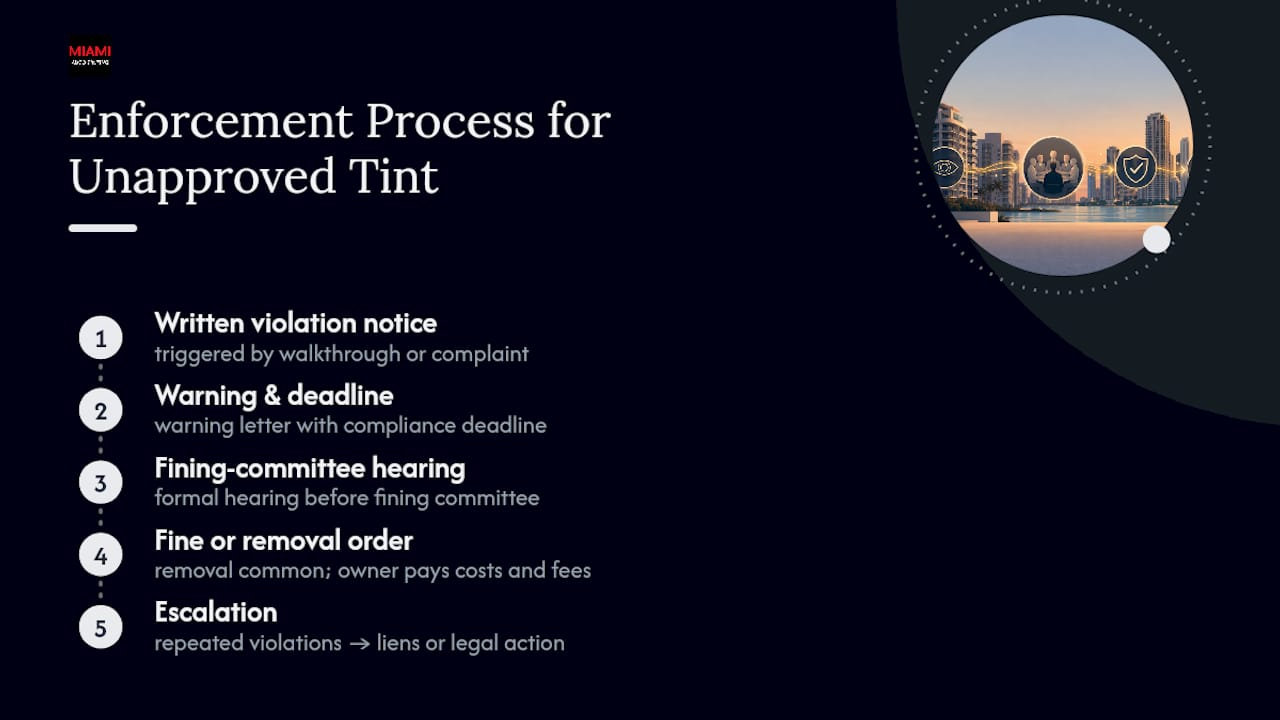
Fines vary by association bylaws, but Florida law allows condo associations to levy fines for rule violations, and repeated or ignored violations can escalate into liens or legal action in more serious cases. Removal orders are the most common outcome for unapproved tint specifically, since it's a straightforward fix compared to structural violations. The owner typically bears the full cost of removal, plus whatever legal or administrative fees accumulate during the enforcement process.
The practical lesson: getting caught after the fact costs more, in both money and time, than getting approval before installation. A board that finds unapproved film on a unit's windows has little incentive to grandfather it in, especially if the film is visibly different from what's approved elsewhere on the facade. Owners who skip the process because "it's just tint" are almost always the ones who end up paying for removal and reinstallation of a compliant product later.
Resolving Conflicts Between Owner Preferences and Board Rules
Disagreements over tint choice are common, and most of them come down to one thing: the owner wants a darker or more reflective film than the board's architectural standard allows. Understanding why boards hold that line, and how to push back constructively, saves everyone time.
Boards generally have legitimate reasoning rooted in building-wide consistency. A single unit with mismatched, highly reflective, or mirrored film stands out from the street and from neighboring units, and that inconsistency is precisely what architectural review exists to prevent. If your board rejects a request, ask specifically which spec, VLT, reflectivity, or color, failed to meet the standard, rather than assuming the rejection is arbitrary.
If you believe the board is applying its standard unevenly, request the approved specs from prior tint installations in your building. A pattern of inconsistent enforcement is a legitimate basis to raise the issue at a board meeting or through your property manager, and boards generally respond better to a documented comparison than a general complaint.
For hurricane-protection film specifically, remember that boards have less discretion. If your product meets the board's own adopted, code-compliant specifications, the board generally cannot deny it. That's a meaningful point of leverage if your film qualifies as hurricane protection and the board is stalling for unrelated reasons.
When a dispute doesn't resolve informally, a short letter from a condo attorney citing the specific declaration language often moves things faster than repeated emails to the board. Most disputes never reach that point once both sides have the actual spec numbers in front of them.
Why Miami's Climate Makes Compliant Tint Worth the Approval Process
Miami-Dade owners have real reasons to push through the approval paperwork, and it isn't just aesthetics. South Florida's climate puts unusual stress on glass-heavy condo units, and the right film addresses three problems at once.
Heat gain is the most immediate issue. Direct sun on unshaded glass in a high-rise unit can push interior temperatures up significantly during peak summer hours, driving air conditioning costs higher across the day. Quality film reduces solar heat gain by blocking a meaningful share of infrared energy before it enters the unit, which is why ceramic films in particular have become the standard recommendation for South Florida glazing.
UV exposure is a quieter but constant problem. Miami's sun angle and year-round intensity fade furniture, flooring, and artwork faster than in most other US markets. Films rated for UV rejection address this without requiring blackout curtains or permanently drawn blinds.
Privacy matters more in dense high-rise buildings than in single-family homes, where neighboring towers often have direct sightlines into units from similar or higher floors. A neutral, low-reflectivity film can reduce that exposure without changing how the building looks from outside, which is exactly the balance condo boards are trying to strike when they approve a spec.
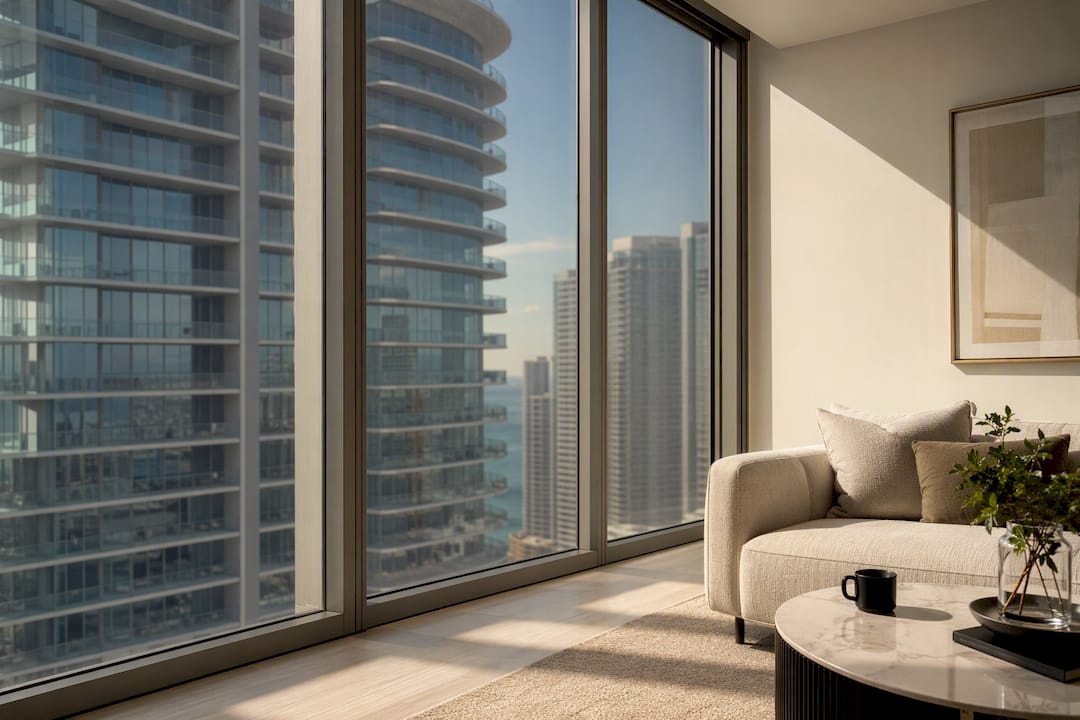
The tradeoff owners need to accept: the compliant options that satisfy a board's appearance standard, neutral tones, moderate VLT, low reflectivity, are also generally the options that perform best for Miami's climate. There's little conflict between what boards approve and what actually works here.
Common Film Types That Meet Miami Condo Standards
Not every film on the market suits a condo board's appearance requirements, but a few categories consistently clear review across Miami-Dade buildings.
Ceramic films, including options like 3M Ceramic IR, are the most commonly approved category for condo exteriors. They use ceramic particles rather than metal to block heat and UV, which means they don't carry the mirrored or metallic look that gets other films rejected. Ceramic films typically hold a neutral gray appearance and moderate-to-high VLT, satisfying both board aesthetics and heat rejection needs.
Color-stable films, such as 3M Color Stable, address a different board concern: fading and color shift over time. Older dyed films can turn purple or bubble within a few years, creating exactly the kind of visible inconsistency boards want to avoid. Color-stable formulations hold their original tone for the life of the warranty, which matters to a board approving a product for the long term.
Carbon films sit between dyed and ceramic options, offering solid heat rejection and a flat, non-reflective black finish that reads as neutral on most building exteriors.
Crystalline or spectrally selective films, like 3M Crystalline, block infrared heat at very high VLT levels, which appeals to owners who want strong heat rejection without a visibly dark window. This category often satisfies boards specifically concerned about units looking "too dark" from the street.
Whatever the category, the deciding factors stay the same: verify the exact VLT and reflectivity numbers against what your building has already approved, in writing, before you commit to a product.
Local Experience With Condo Approvals in Miami-Dade
A local window tinting company installs residential and commercial film across Miami-Dade using 3M Ceramic IR, 3M Color Stable, and Iviron KoolMax ceramic products, categories that condo boards approve most consistently because of their neutral, low-reflectivity finish. That pattern shows up repeatedly across buildings with different declarations and different boards.
Resources like Miami auto tinting regulations and the solar control window tint guide walk through VLT and reflectivity in more technical detail for owners preparing a spec sheet. Board approvals move faster when the request already speaks the board's language.
— Jose
Get a Board-Ready Tint Quote Without the Guesswork
Some Miami-Dade tint providers offer mobile, on-site estimates built specifically to survive board review. Instead of piecing together spec sheets and insurance documents on your own after the fact, you can receive manufacturer technical data on VLT and exterior reflectivity, proof of installer insurance, and a sample mockup ready to attach to your ARC form from the start.
The process is straightforward. An installer comes to your unit, measures your glass, and recommends a film from the 3M Ceramic IR, 3M Color Stable, or Iviron KoolMax lines based on what similar buildings in your area have already approved. A written warranty and licensed, insured installation are provided, the two items every board typically asks for first. For move-in coordination with building management, a resource like this condo move-in checklist can help you sequence the paperwork alongside your tint approval.
Ready to see what a compliant film looks like on your unit? Request your on-site estimate and get the spec sheet your board needs, or browse the 3M window tinting options built for exactly this kind of approval.
Sources
- Florida Statutes §718.113 (2022)
- Florida Statutes §718.113 (official state site)
- Florida architectural review guidance (HOA Weekly)
FAQ
Does Florida Law Let My Condo Board Reject Window Tint?
Yes. Under §718.113, boards generally control the appearance of common and limited common elements, which usually includes exterior windows, so they can deny a request that doesn't meet the building's architectural standard.
What Voting Threshold Applies if My Declaration Is Silent?
Florida law defaults to 75% of the total voting interests approving material alterations to common elements, though most boards handle routine tint requests through architectural review rather than a full vote.
Can My Board Deny Hurricane-Rated Window Film?
Generally no, if the film meets the board's own adopted, code-compliant hurricane-protection specifications, the board cannot arbitrarily deny it.
Who Pays if the Association Needs to Remove My Tint for Repairs?
The association typically owes reimbursement or an assessment credit when it orders removal for its own repairs, unless your declaration assigns that cost to you directly.
What Does Southmiamitint Provide for a Condo Tint Request?
Southmiamitint offers mobile, on-site estimates for residential window tinting using 3M Ceramic IR, 3M Color Stable, and Iviron KoolMax films, along with the spec sheets and insurance documentation most Miami-Dade boards require for approval.