
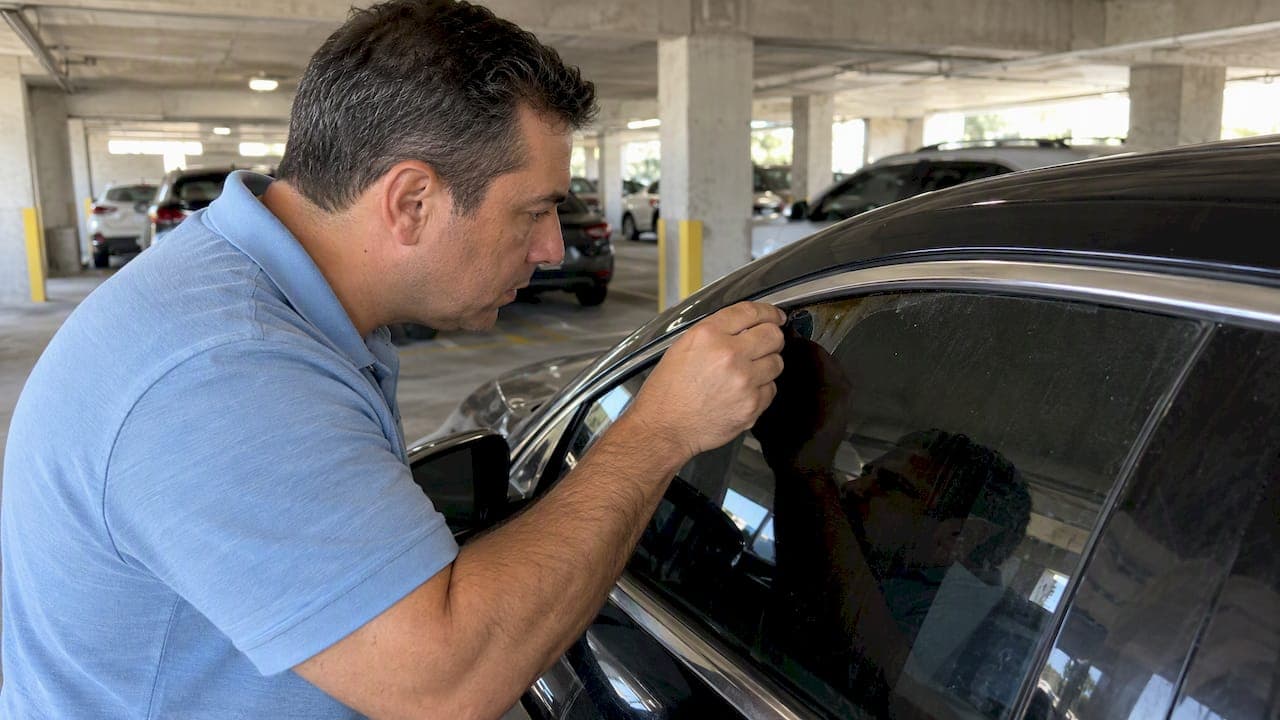
Yes, you can usually catch fake ceramic tint with a few quick visual and performance checks. Look for a purple cast, test your phone signal and GPS lock, feel the glass temperature in direct sun, and ask for the manufacturer serial or warranty lookup. These checks catch most counterfeits fast, but definitive proof comes from manufacturer-backed verification or a professional spec test.
TL;DR:
- A phone call, GPS lock, or radio test that stays weak suggests metal content; brief delays alone do not prove the film is counterfeit.
- After 15 to 20 minutes in direct sun, genuine high infrared rejection film should leave interior glass cooler than an untinted window.
- Ask for the product name, part number, and manufacturer warranty registration; verify any serial code directly with the film maker before paying.
- Darkness does not establish heat or UV protection: 3M Ceramic IR reports up to 95% infrared rejection and 99.9% UV rejection.
Table of Contents
- Quick checklist: minute-by-minute tests you can do now
- How ceramic film works and why fakes behave differently
- Step-by-step DIY verification tests with expected outcomes
- Red flags, installer behaviors, and warranty verification steps
- Health and safety implications of using fake ceramic tint
- How counterfeit ceramic tint impacts vehicle resale value
- Resources for reporting counterfeit tint products or installers
- Publisher perspective from Jose: why South Miami Tint focuses on verified ceramic films
- Book a verified mobile ceramic tint install or inspection
- FAQ
- Sources
- Manufacturer spec sheets and authoritative verification pages
Quick checklist: minute-by-minute tests you can do now
Before you call an installer or file a complaint, run through this short checklist. It takes about ten minutes and tells you whether a deeper check is worth your time.
- Look at the film in bright sunlight for a purple or blue tint, bubbling, or cloudy patches.
- Check the edges and release liner for printed brand names, part numbers, or batch codes.
- Make a phone call, check your GPS lock, and tune the radio while parked.
- Park in direct sun for 15 minutes and compare how hot the glass feels to an untinted window.
- Ask for the VLT percentage on paper and compare it to how dark the glass actually looks.
A few things to watch for as you go:
- A purple or faded hue almost always points to a cheap dyed film mislabeled as ceramic.
- Dropped calls, slow GPS lock, or static-filled radio suggest a metallized film, not genuine ceramic.
- Glass that stays noticeably hot despite a "high heat rejection" claim is a red flag worth testing further.
- Missing or handwritten paperwork with no serial number is a sign to pause before paying.
Pro Tip: Take photos of the release liner, edges, and any printed codes before you leave the shop. You will need them if you have to dispute a warranty claim later.
How ceramic film works and why fakes behave differently
Genuine ceramic film uses non-metallic nano-ceramic particles to absorb infrared heat instead of reflecting it. Because there is no metal layer, it does not interfere with phone signals, GPS, or satellite radio. A professional tint shop's explainer notes that ceramic film is genuinely non-metallic and that quality varies widely even within products labeled "ceramic."
Cheaper alternatives behave differently:
- Dyed film absorbs some light but offers little heat rejection and tends to fade or shift purple over time.
- Metallic film reflects heat using a thin metal layer, which can attenuate cellular, GPS, or radio signals.
- Carbon film sits between dyed and ceramic in performance but has no metal content either.
3M's Ceramic IR Series reports up to 95% infrared rejection and up to 66% total solar energy rejection, with a metal-free construction that avoids electronics interference. IR rejection and VLT (visible light transmission) are different specs: IR rejection measures heat blocked, while VLT measures how much light and darkness you see. A film can have a low VLT (looks dark) while rejecting little actual heat, which is exactly the mismatch counterfeiters rely on.
Step-by-step DIY verification tests with expected outcomes
Run these five tests in order. Each one builds on the last, so stop early only if you already see a clear red flag.
- Visual inspection. Check the film in direct sunlight and at an angle under shade. Photograph any purple cast, bubbling, or printed text on the release liner before it is thrown away.
- Signal check. Make a call, wait for GPS lock, and tune a radio station with the car parked in an open area. A brief delay can be normal, but a signal that stays weak or drops is a sign of metal content.
- Heat test. Park in full sun for 15 to 20 minutes, then touch the interior glass or use an infrared thermometer. High-IR ceramic film should keep the glass noticeably cooler than an untinted window; dyed film will show little difference.
- VLT measurement. A handheld VLT meter reads the actual light transmission through the glass. If the reading does not match the percentage on your invoice, something does not add up.
- Paperwork and serial check. Authentic 3M film typically ships with part numbers and, in many cases, a SAFE-GUARD serial code you can verify through the manufacturer. Ask for this before you leave the shop, not after a problem shows up.
Pro Tip: If an installer cannot produce a part number or serial code on request, treat that as a bigger warning sign than price alone.
Red flags, installer behaviors, and warranty verification steps
Certain installer habits point to gray-market or mislabeled film more reliably than the tint's appearance alone.
- A price far below competitors for a "ceramic" job, with no explanation for the gap.
- A handwritten or unsigned warranty instead of a manufacturer-backed document.
- Refusal to share the product name, part number, or spec sheet when asked directly.
- Vague answers like "signal fuzziness is normal" when you report phone or GPS issues.
Manufacturers document authenticity through serial numbers and electronic warranty registration, often tied to your VIN. The 3M product page for the Ceramic IR Series lists measurable specs and confirms the metal-free design, which gives you a baseline to compare against anything an installer tells you.
| Red flag | What it usually means | What to do |
|---|---|---|
| Price well below market average | Likely dyed or carbon film mislabeled as ceramic | Ask for the exact product name and spec sheet |
| Handwritten warranty, no serial | No manufacturer backing | Request electronic warranty registration |
| Signal issues dismissed as normal | Possible metallic film content | Run the signal test again at a different location |
| No part number on request | Installer may not know the actual product | Contact the manufacturer directly to verify |
Health and safety implications of using fake ceramic tint
Genuine ceramic film carries measurable UV protection. 3M's Ceramic IR Series is rated at 99.9% UV rejection and is recommended by the Skin Cancer Foundation. A mislabeled dyed or low-grade film may block visible light while doing little to stop UV radiation, since UV blocking depends on the film's chemical makeup, not how dark it looks.
That gap matters most for long drives and daily commutes, where UV exposure through side windows adds up over years. A film that looks dark but was never tested for UV rejection gives you a false sense of protection, which is arguably worse than no tint at all, since you may skip other sun protection assuming the glass has you covered.
Heat rejection has a safety angle too. If a counterfeit film underperforms on IR rejection, your cabin runs hotter in direct sun, which affects comfort and, over time, the materials inside your car. None of this is dangerous in the way a mechanical failure would be, but it does mean you are not getting what you paid for, and in the case of UV exposure, that gap has a real health cost over years of driving.

How counterfeit ceramic tint impacts vehicle resale value
A mislabeled or poorly installed tint job can hurt resale value in a few concrete ways. Bubbling, peeling, or purple discoloration are visible defects that buyers and dealers notice immediately, and they often ask for a price reduction to cover removal and reinstallation.
Beyond appearance, a car with undocumented tint and no transferable warranty is a harder sell to a buyer who specifically wants ceramic film for its heat and UV performance. If you cannot produce a serial number, spec sheet, or warranty registration, a cautious buyer may assume the film is the cheaper dyed or carbon type regardless of what the seller claims, and price accordingly.
Removing bad tint before a sale is also an added cost that a legitimate ceramic installation would have avoided entirely. A documented, manufacturer-backed install, by contrast, is something you can point to as a line item that adds value rather than one that needs fixing before a buyer will commit.

Resources for reporting counterfeit tint products or installers
If you believe you were sold counterfeit film, start with the manufacturer whose brand was used on your invoice or paperwork. Most major film makers, including 3M, maintain customer support channels that can confirm whether a serial number or part number is legitimate.
From there:
- Contact the manufacturer's customer service line with your serial number, part number, and photos of the film.
- Ask the manufacturer whether the installer is listed as an authorized dealer for that product line.
- File a complaint with your state's consumer protection office or attorney general if the installer refuses to resolve the issue.
- Leave a detailed, factual review describing what you found, including your test results, so other consumers can avoid the same installer.
Keeping your photos, invoice, and test notes organized makes any of these conversations faster and more likely to result in a refund or correction.
Publisher perspective from Jose: why South Miami Tint focuses on verified ceramic films
We have seen the same pattern over and over: a customer calls about weak phone signal or glass that still feels hot, and the film turns out to be dyed or metallic, not ceramic at all. Authentic ceramic matters because the IR rejection numbers are real, the film will not interfere with your electronics, and a genuine warranty actually protects you. That is why we install manufacturer-backed film, document serial numbers, and register warranties for every job.
— Jose
Book a verified mobile ceramic tint install or inspection
If you already suspect your current tint is not what you paid for, or you are starting from scratch, we make verification simple with help from Car Window Repair Experts In St. Peters MO - GWP Glassworks. We install genuine 3M Ceramic IR, 3M Crystalline, and Iviron KoolMax ceramic film, register warranties with serial documentation, and come to your home or office anywhere in Miami-Dade County.
Here is what that looks like in practice:
- Mobile service: we bring the tools and film to your driveway or office, no shop visit required.
- Verified materials: every job uses manufacturer-backed ceramic film with documented part numbers.
- Fast turnaround: most vehicles are quoted and scheduled the same week.
Mobile ceramic tint installs start from $249, and a full car plus windshield package starts from $500. Request a quote through our main booking page and we will confirm availability for your vehicle.
FAQ
How can you tell if ceramic tint is real?
Check for a purple or faded cast, test your phone signal and GPS lock while parked, and feel the glass temperature after sitting in direct sun. For certainty, ask the installer for the manufacturer part number and verify it through the manufacturer's product page.
Is ceramic tint legal in all states?
Legal tint darkness limits vary by state and apply to VLT percentage, not film type, so a ceramic film must still meet your local VLT rules. Check your state's motor vehicle code or ask your installer which VLT levels are street legal in your area before choosing a shade.
Is ceramic tint better than regular dyed tint?
Genuine ceramic film rejects significantly more heat than dyed film and resists fading, since it uses non-metallic particles instead of dye that degrades over time, according to industry explanations of ceramic film construction. It also avoids the signal interference that some metallic films can cause.
Can you see through 20% ceramic tint at night?
Visibility through darker tint at night depends on VLT percentage and lighting conditions, and lower VLT film generally reduces nighttime visibility more than lighter shades. If night visibility is a priority, discuss VLT options with your installer before committing to a darker percentage.
Sources
- 3M automotive window film Ceramic IR brochure
- 3M™ Automotive Window Film Ceramic IR Series 50, 40 in X 100 ft | 3M United States
- Johnson Window Films automotive spec sheet (SupremeIR)
Manufacturer spec sheets and authoritative verification pages
Use these sources to check real performance numbers before you trust an installer's claim:
- 3M Automotive Window Film Ceramic IR brochure: IR rejection and solar-energy rejection figures, plus non-metallic construction details.
- 3M Ceramic IR Series product page: VLT, UV rejection, and IR rejection specs for a specific film level.
- Johnson Window Films SupremeIR spec sheet: tabulated IR and VLT performance by film level for comparison.