
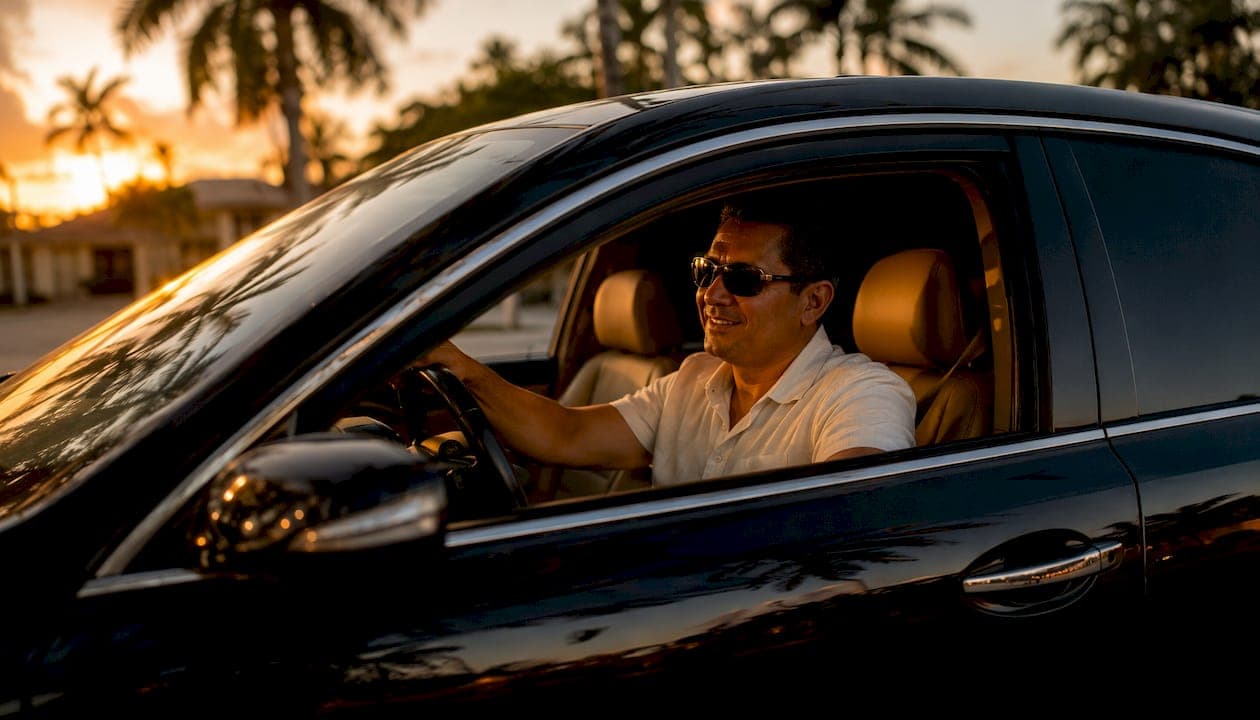
Multilayer Optical Film (MOF) is the best choice for vehicle owners who want maximum infrared heat rejection while keeping windows light, clear, and safe for modern electronics. Unlike darker dyed films that absorb heat and fade within a few years, MOF stacks hundreds of precision-tuned polymer layers that reflect infrared while passing visible light straight through. The result: a cooler cabin without blacked-out windows.
Here is what you get with a quality multilayer film:
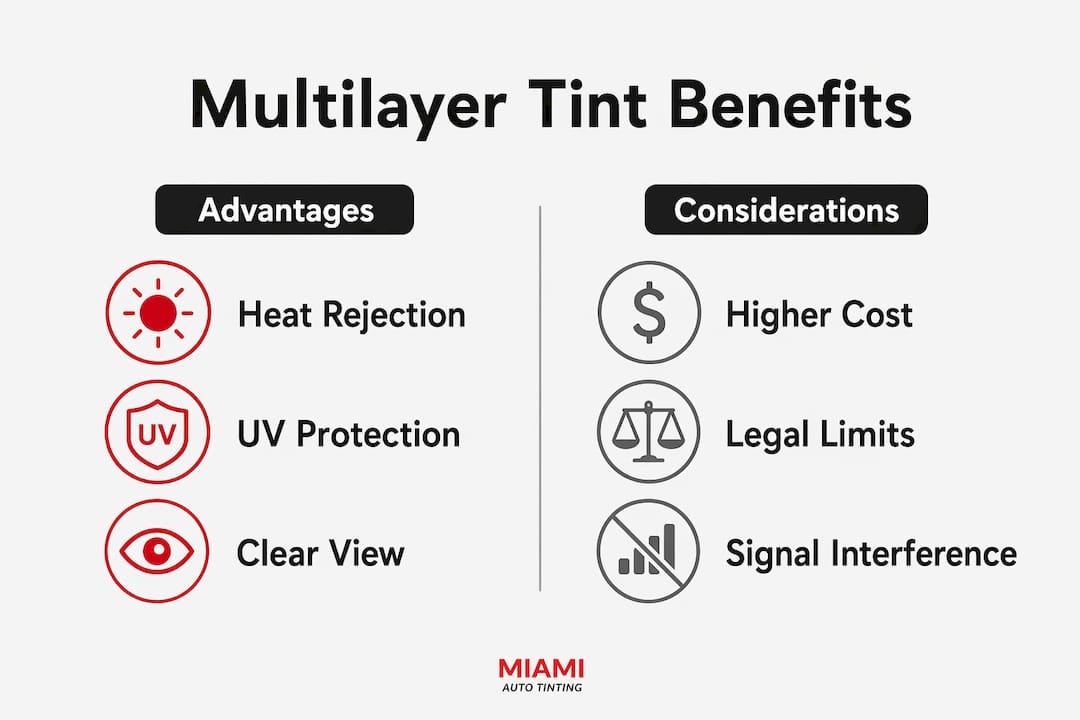
- Heat rejection: High IR rejection that drops cabin temperatures noticeably, even at lighter VLT levels
- UV blocking: Multilayer sputtered films block a high percentage of UV radiation, protecting your skin and interior
- Privacy options: Available in a range of VLT levels to match your preference and state law
- Color stability: Premium films resist fading, browning, and bubbling over years of use
- No signal interference: Non-metallic MOF keeps GPS, Bluetooth, toll tags, and ADAS systems working perfectly
Southmiamitint installs 3M Ceramic IR, 3M Crystalline, 3M Color Stable, and Iviron KoolMax ceramic films across Miami-Dade, all of which use multilayer or ceramic multilayer technology for exactly these benefits.
Table of Contents
- What is multilayer optical film and how does it work?
- What are the real benefits of multilayer tint for your car?
- What are the trade-offs of multilayer tint you should know?
- How does multilayer tint compare with dyed, metalized, ceramic, and carbon films?
- What should you expect from installation, layering, and long-term care?
- How do you choose a multilayer film and what should you ask your installer?
- Why do multilayer films reject heat without darkening the glass?
- Key Takeaways
- The case for multilayer tint in Miami's heat
- Southmiamitint brings premium multilayer tint to your door
- Useful sources and manufacturer resources
What is multilayer optical film and how does it work?
The term "multilayer" covers two distinct technologies in the window film trade, and knowing the difference helps you buy smarter.
Polymer-based Multilayer Optical Film (MOF) stacks hundreds of ultra-thin polymer layers, each tuned to reflect a specific band of the solar spectrum. The layers work through optical interference: they bounce infrared wavelengths back outward while letting visible light pass through. No metal is involved, so there is zero signal interference with your car's electronics.
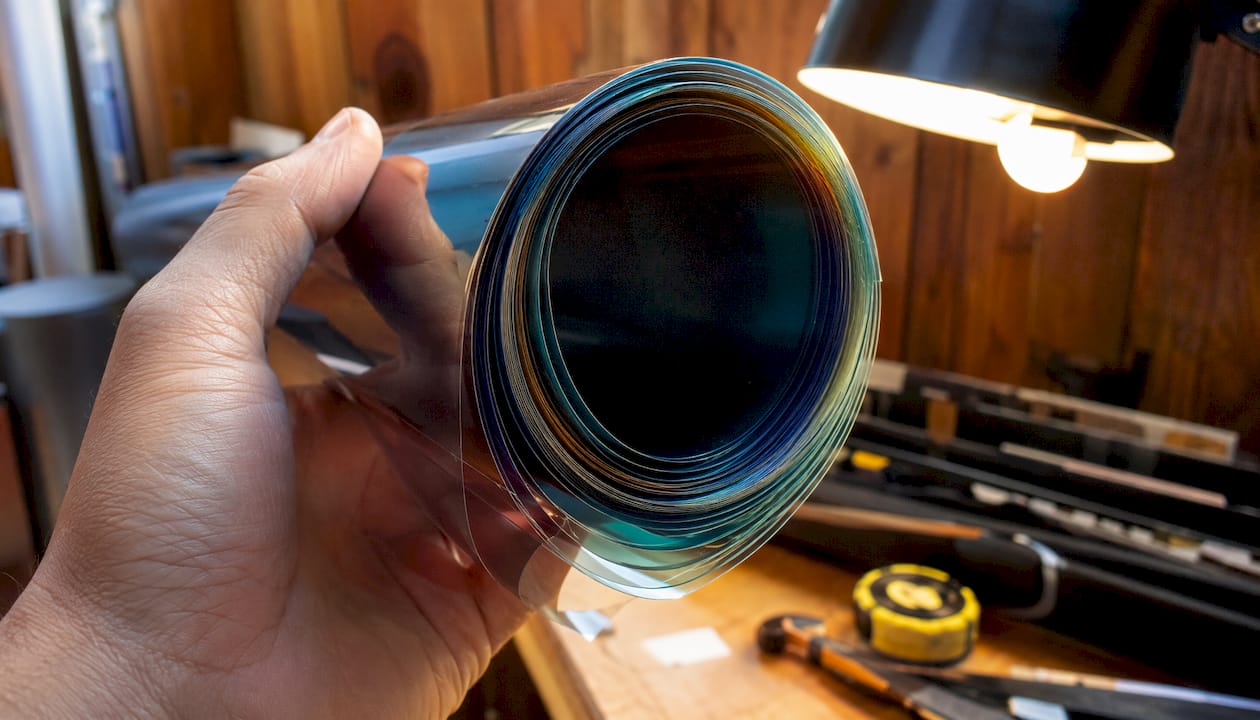
Vacuum-sputtered multilayer films use ultra-thin metal or metal-oxide layers deposited in a vacuum chamber. They also achieve high IR rejection and can block up to 99% of UV, but the metallic content can interfere with GPS, cellular, and Bluetooth signals if the film is not properly engineered and sealed.
A simplified look at the layer stack in a quality multilayer film:
| Layer | Role |
|---|---|
| Outer protective coat | Scratch resistance, environmental protection |
| Functional IR-blocking layers | Reflect or absorb infrared; the performance core |
| Polyester base | Structural carrier for functional layers |
| Inner adhesive | Bonds film securely to glass |
| Inner protective coat | Protects interior surface from cleaning damage |
Performance comes from the functional chemistry of those middle layers, not from how dark the film looks. A window film's heat rejection is determined by its material architecture, which is why a nearly clear MOF film can outperform a very dark dyed film on every heat metric.
What are the real benefits of multilayer tint for your car?
The core advantage of multilayer films is simple: you get a cooler, more comfortable cabin without having to go dark. Here is how each benefit plays out in practice.
- IR heat rejection: MOF reflects the near-infrared portion of sunlight, which carries the majority of solar heat. You feel the difference immediately when you get into a parked car.
- UV protection: Premium multilayer films block a very high percentage of UV radiation, which is the primary cause of dashboard cracking, seat fading, and leather drying out.
- Glare reduction: Even at higher VLT levels, multilayer films cut glare enough to reduce eye strain on long drives.
- Color stability: Quality films hold their appearance for years without the purple or brown shift you see in aging dyed films.
- Privacy: You choose the VLT level that fits your needs, from nearly clear to quite dark, while still getting strong heat performance at every shade.
Key stat: Multilayer sputtered films can block up to 99% of UV and deliver superior total solar energy rejection (TSER) compared with basic dyed or single-layer films.
For Miami drivers, the practical payoff is real. Your A/C runs less hard, your leather seats last longer, and your dashboard does not crack after two summers. Installers consistently report lower A/C cycles and noticeably reduced interior fading in vehicles treated with multilayer or ceramic multilayer films in high-UV markets like Florida.
Pro Tip: If you need strong heat rejection but your state requires 70% VLT on the windshield or front side windows, MOF is your best option. It achieves high IR rejection at light VLT levels that comply with most state laws, including Florida's.
What are the trade-offs of multilayer tint you should know?
Multilayer films are not the cheapest option on the shelf, and a few real-world limitations are worth knowing before you commit.
Cost vs. entry-level films. A quality multilayer or ceramic multilayer installation costs more upfront than a basic dyed or single-layer film. The long-term math usually favors the premium film: dyed films fade and lose performance within 3–5 years, while top-tier multilayer and ceramic films carry warranties of 7–10+ years and maintain their IR rejection throughout.
VLT and state law. Every state sets minimum VLT limits by window position. Florida, for example, requires front side windows to allow at least 28% VLT. The good news is that MOF gives you strong heat rejection even at legal, lighter VLT levels. Always verify your state's rules before choosing a shade. New York's DMV publishes window tint rules by window position, and Oregon's DOT does the same for its market. Check your own state's DMV for the exact numbers.
Signal interference with sputtered metal films. Metalized films contain conductive particles that can block GPS, cellular, and ADAS signals. If your vehicle has toll tags, a built-in GPS, or advanced driver-assistance systems, choose a non-metallic MOF or ceramic film to avoid this problem entirely.
Installation and layering risks. Applying new film over existing tint is generally not recommended. Layering can create adhesion, edge-seal, and VLT-stacking issues, and stacking two films may push your combined VLT below the legal limit. Most professional installers recommend removing old film first to protect warranty coverage and get the best optical result. Poorly sealed sputtered films can also oxidize over time, causing browning or bubbling, which is why sealing quality and installer skill matter as much as the film brand.
How does multilayer tint compare with dyed, metalized, ceramic, and carbon films?
| Feature | Dyed | Metalized | Carbon | Ceramic | Multilayer / MOF |
|---|---|---|---|---|---|
| IR heat rejection | Low | Moderate | Good | High | High to very high |
| UV blocking | Moderate | Good | Good | Up to 99% | Up to 99% |
| VLT / darkness options | Wide range | Wide range | Wide range | Wide range | Wide range, high VLT possible |
| Signal transparency | Yes | No (RF interference) | Yes | Yes | Yes (non-metal MOF) |
| Optical clarity / color stability | Fades 3–5 yrs | Moderate | Good | Excellent | Excellent |
| Durability / scratch resistance | 3–5 years | 5–7 years | 7–10 years | 10–15+ years | 7–15+ years |
| Cost | Lowest | Low–moderate | Moderate | Moderate–high | Moderate–high |
| Warranty (typical) | 1–3 years | 3–5 years | 5–7 years | Lifetime / 10+ yrs | 7–10+ years |
Ceramic films and non-metallic MOF sit at the top of this table for a reason. Both deliver strong IR and UV rejection, excellent optical clarity, and no signal interference, making them the right choice for modern connected vehicles. The difference is in the manufacturing approach: ceramic films use nano-ceramic particles, while MOF uses tuned polymer layers. Both achieve similar real-world outcomes.
The films Southmiamitint installs fit squarely in the top tier of this comparison. 3M Ceramic IR is an industry benchmark for IR rejection and clarity. 3M Crystalline is a non-metallic multilayer optical film that achieves exceptional heat rejection at very high VLT levels, ideal for windshields and front windows. 3M Color Stable delivers reliable heat rejection and color stability at a more accessible price point. Iviron KoolMax is a ceramic film that combines strong heat performance with a clean, neutral appearance. All four are available through Southmiamitint's mobile installation service in Miami-Dade.
For a deeper look at how these options stack up in Miami's specific conditions, the window tint comparison guide from Southmiamitint breaks down each film by local climate factors.
What should you expect from installation, layering, and long-term care?
Professional installation and curing
Precision matters with optical films. A professional installer will clean the glass thoroughly, cut the film to exact panel dimensions, and apply it without dust contamination or edge gaps. Mobile installation, like what Southmiamitint offers, brings the same professional prep to your driveway or parking spot. The main on-site constraint is shade: direct sunlight during application can cause premature adhesive tack, so a covered or shaded area is preferred.
Curing time runs roughly 3–5 days in warm weather. During that window, avoid rolling windows down or cleaning the interior glass. Haze or small water pockets visible right after install are normal and disappear as the adhesive fully cures.
Layering over existing tint
Layering new film over old creates several problems: adhesion is weaker on film-to-film than on glass-to-film, edge sealing is harder to achieve cleanly, and the combined VLT of two films stacked together may fall below your state's legal limit. Most professional installers recommend full removal of old film before applying a new multilayer or ceramic product. This also protects your warranty, since most manufacturers void coverage when film is applied over existing tint.
If you are unsure whether your current glass is in good shape for a fresh install, it is worth checking out professional window repair before booking a tint appointment. Chips, cracks, or delaminating glass affect adhesion and can ruin a new film.
Lifespan by film type
| Film type | Typical lifespan | Warranty (typical) |
|---|---|---|
| Dyed | 3–5 years | 1–3 years |
| Metalized | 5–7 years | 3–5 years |
| Carbon | 7–10 years | 5–7 years |
| Ceramic | 10–15+ years | Lifetime / 10+ years |
| Multilayer / MOF | 7–15+ years | 7–10+ years |
Maintenance checklist
- Wait at least 3–5 days after install before cleaning interior glass
- Use a soft microfiber cloth and an ammonia-free cleaner only
- Avoid abrasive scrubbers, razor blades, or stiff brushes on tinted surfaces
- Do not use newspaper or paper towels, which can scratch the protective coat
- Inspect edges annually for lifting or bubbling, especially in high-humidity climates
Pro Tip: In Miami's salt-air environment, edge sealing is especially important. Ask your installer to confirm that all edges are fully sealed before you leave. Unsealed edges are the most common entry point for moisture that causes bubbling over time.
How do you choose a multilayer film and what should you ask your installer?
Selection checklist
Before you book an installation, run through these criteria:
- IR / TSER specs: Ask for the manufacturer's lab-rated IR rejection percentage and Total Solar Energy Rejection (TSER) figure, not just a verbal claim
- UV blocking percentage: Confirm it is 99% or close to it for premium films
- VLT options: Choose a shade that meets your state's legal limit for each window position
- Metal-free construction: For any vehicle with toll tags, GPS, or ADAS, specify a non-metallic MOF or ceramic film
- Color stability: Ask whether the film is dye-based or uses a stable ceramic or polymer construction
- Scratch resistance: Confirm the film has a hard coat on the exposed surface
- Warranty length and coverage: Look for 7+ years on premium films; check whether the warranty is transferable if you sell the vehicle
Questions to ask your installer
- Is this film a non-metallic MOF or ceramic, or does it contain sputtered metal layers?
- Can you show me the manufacturer's TSER and IR rejection lab data for this specific film?
- What VLT levels are available, and which ones comply with Florida law for my window positions?
- Does the warranty cover bubbling, color change, and delamination, and is it transferable?
- Will you remove my existing tint first, or apply over it?
- How do you handle edge sealing, especially on curved rear windows?
- What is the curing time, and what should I avoid during that period?
Warranty red flag: A warranty shorter than five years on a film marketed as "premium" is a sign the manufacturer lacks confidence in the product's longevity. Top-tier multilayer and ceramic films from brands like 3M carry warranties that reflect their actual lifespan.
For guidance tailored specifically to Miami's climate and legal limits, the best tint for Miami's climate guide from Southmiamitint covers VLT rules and film recommendations by window position.
Why do multilayer films reject heat without darkening the glass?
Standard dyed films work by absorbing solar energy across the visible and infrared spectrum. They get hot, re-radiate some of that heat inward, and darken the glass to reduce light transmission. The darker the film, the more it absorbs, but absorption is an inefficient mechanism for heat control.
Multilayer optical films work differently. Each polymer layer in an MOF stack is calibrated to a specific wavelength band. When infrared light hits the stack, the layers create destructive interference that reflects those wavelengths back outward before they enter the cabin. Visible light, which occupies a different part of the spectrum, passes through largely unimpeded. The result is a film that can reject a large portion of solar heat while maintaining high visible light transmission.
Non-metallic MOF achieves high IR rejection through optical interference in tuned polymer layers, not through absorption or metallic content, which is why it does not interfere with RF signals used by GPS, cellular, Bluetooth, and ADAS systems.
This is the key technical distinction between MOF and older metalized films. Metalized films use conductive metal particles that block or reflect RF signals along with infrared, creating the signal interference that causes problems with modern vehicle electronics. Non-metallic MOF and ceramic films avoid this entirely. For vehicles with built-in navigation, toll transponders, or collision-avoidance radar, this distinction is not minor.
Installers working in high-UV markets consistently report that switching customers from dyed or basic metalized films to multilayer or ceramic options produces measurable cabin temperature reductions and slower interior fading. The UV protection benefit is particularly relevant in Florida, where UV exposure is among the highest in the continental United States and interior degradation of leather and plastics accelerates without adequate film protection.
Key Takeaways
Multilayer Optical Film delivers the highest combination of IR heat rejection, UV protection, and signal transparency available in automotive window tint, making it the top choice for vehicle owners in high-sun climates.
| Point | Details |
|---|---|
| Heat rejection without dark glass | MOF reflects infrared through optical interference, giving high heat rejection at legal, lighter VLT levels. |
| UV protection up to 99% | Premium multilayer and ceramic films block up to 99% of UV, slowing interior fading and protecting occupants. |
| No signal interference | Non-metallic MOF and ceramic films leave GPS, Bluetooth, toll tags, and ADAS fully functional. |
| Cost reflects long-term value | Premium films carry 7–10+ year warranties versus 1–3 years for dyed films, making them cheaper over time. |
| Southmiamitint installs top-tier films | 3M Ceramic IR, 3M Crystalline, 3M Color Stable, and Iviron KoolMax are available via mobile install in Miami-Dade. |
The case for multilayer tint in Miami's heat
Miami is one of the toughest environments a car's interior faces anywhere in the United States. The combination of intense UV radiation, high humidity, and salt air accelerates every form of interior degradation: leather cracks, dashboards warp, and plastics fade faster here than in most other U.S. cities. After seeing the difference multilayer and ceramic films make in vehicles across Miami-Dade, the recommendation is clear: standard dyed films are not adequate for this climate.
What customers notice most after switching to a quality multilayer or ceramic film is the cabin temperature on a parked car. The difference between a vehicle with no tint and one with a properly installed MOF or ceramic film is immediate and significant. The A/C reaches comfort faster, the steering wheel is not scorching, and the seats are tolerable even after hours in direct sun. Interior fading slows down noticeably too, which matters when you are trying to protect a vehicle's resale value.
Mobile installation also changes the experience for Miami owners. You do not drive to a shop and wait. The installer comes to your location, works in your driveway or covered parking, and the vehicle is ready the same day. For a city where time and convenience matter, that is a real practical advantage. The impact of Miami's climate on tinting choices is something every local vehicle owner should understand before picking a film.
Southmiamitint brings premium multilayer tint to your door
If you are ready to stop cooking in your car and start protecting your interior, Southmiamitint offers mobile ceramic and multilayer window tint installation starting at $249, with service across Miami-Dade County. No shop visit required. The team installs 3M Ceramic IR, 3M Crystalline, 3M Color Stable, and Iviron KoolMax ceramic films, all backed by manufacturer warranties and installed at your location on your schedule.
Every installation includes professional edge sealing, full glass prep, and a post-install walkthrough so you know exactly what to expect during the curing period. Whether you drive a sedan, SUV, or truck, the right film and VLT for your vehicle and Florida's legal limits are part of every quote. Get your ceramic tint quote today, or check mobile tinting prices to see what fits your budget.
Useful sources and manufacturer resources
- New York DMV: window tint rules by window position — check your own state's DMV for equivalent rules
- Oregon DOT: window tint regulations — useful reference for understanding how VLT limits are structured
- fueleconomy.gov: hot weather and A/C load — background on how cabin heat affects fuel economy
- PubMed: UV exposure and vehicle glass — peer-reviewed data on UV transmission through automotive glass
- Infratint: multilayer film glossary — clear technical explanation of MOF and IR rejection
- ShieldSmith: multilayer sputtered film overview — covers TSER, UV blocking, and sputtered film construction
- Southmiamitint: ceramic window tint Miami — book a mobile installation or get a quote for Miami-Dade
Before you purchase any film, ask your installer for the manufacturer's lab-rated TSER and IR rejection data. Marketing claims vary widely; the spec sheet does not lie.