
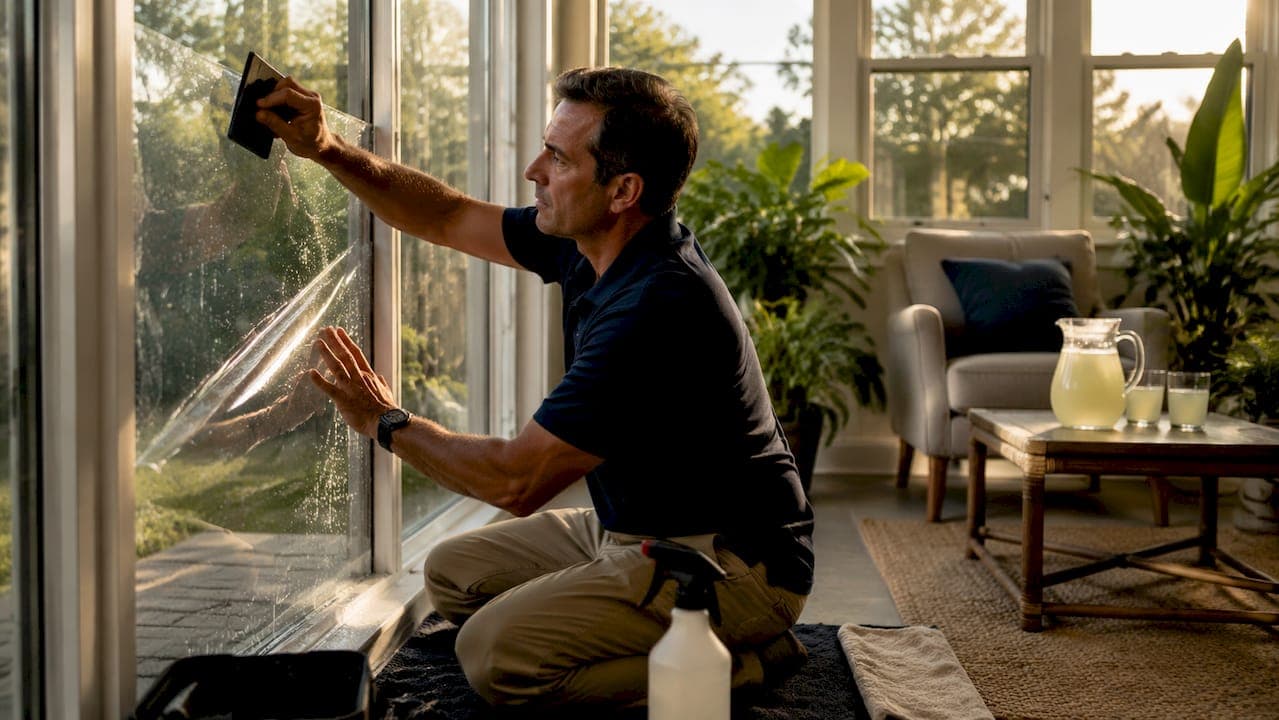
3M window film is a specialized adhesive film applied directly to glass surfaces to block heat, filter UV rays, increase privacy, and improve the appearance of automotive and residential windows. It is not a coating or spray. The film bonds to the glass and works continuously without fading or washing away. For homeowners in South Florida and car owners dealing with intense sun exposure, it solves real, daily problems.
3M has been developing window film technology since 1966, making it the longest-standing manufacturer in the category. That history translates into verified performance data, stronger warranties, and more product options than most competitors can match. Southmiamitint installs 3M IR and 3M Color Stable films for both vehicles and residential properties across Miami-Dade, giving local customers access to the full range of what this technology can do.
What is 3M window film and what makes it different?
3M window film stands apart from generic tint because of how it is built. Most budget films use a single layer of dyed polyester. Over time, that layer turns purple, peels, and loses its blocking ability. 3M uses multi-layer optical film technology that bonds hundreds of microscopically thin layers together. The result is better optical clarity, longer durability, and consistent performance across the film's entire lifespan.

The UV protection in 3M film is not sprayed on the surface. It is chemically embedded into the adhesive and coating layers. That means it cannot degrade from cleaning, humidity, or weather exposure. For Miami homeowners and drivers, where UV intensity is extreme year-round, this distinction matters more than it would in a cooler climate.
3M also holds a Fortune 500 position, which backs its warranty commitments. Residential installations carry a lifetime warranty, and commercial installations carry up to 15 years. No budget film brand can match that.
What are the main types of 3M window films?
3M produces three primary film categories, each built for a different purpose. Choosing the wrong type is the most common mistake homeowners and car owners make.
Sun control films are the most widely used category. They reduce heat, cut glare, and block UV rays. The 3M Prestige Series and 3M Ceramic IR series fall here. These films use non-metallized construction, which means Wi-Fi, cell phone signals, and smart home devices work without interference. Metallic tints block radio frequencies. 3M's non-metal films do not.
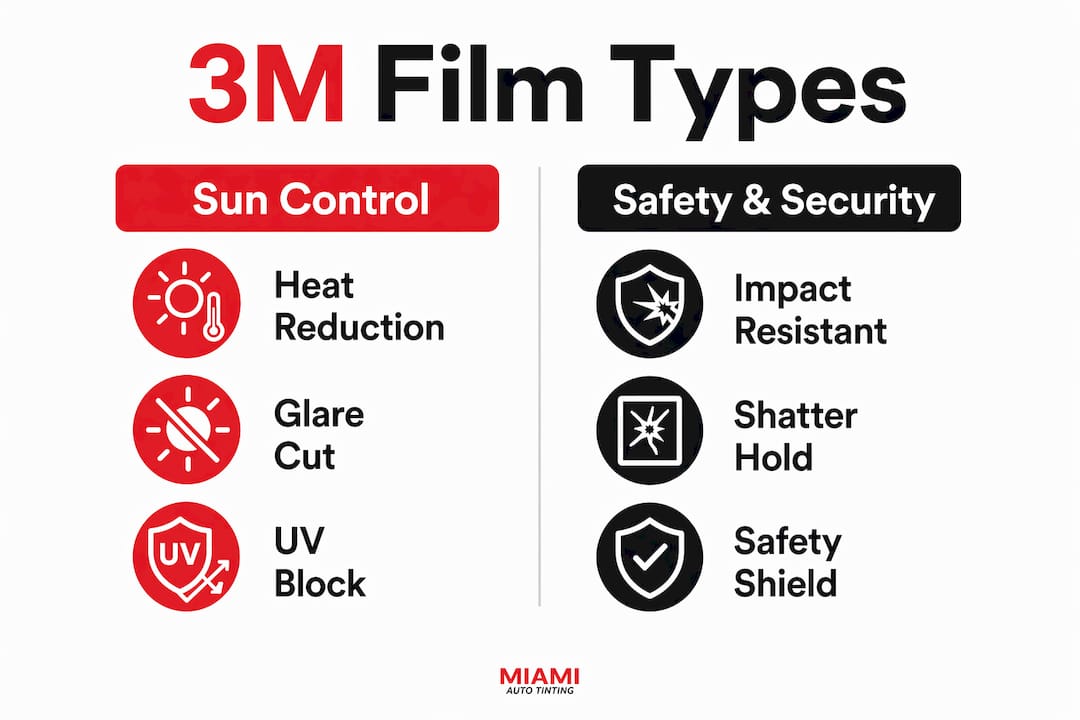
Safety and security films serve a completely different function. They hold glass fragments together on impact, absorbing fracture energy to reduce injury and delay forced entry. Security films differ fundamentally from sun control films in both construction and purpose. A homeowner buying security film for heat rejection will be disappointed. A homeowner buying sun control film for break-in protection will be unprotected.
Decorative and privacy films include frosted, patterned, and tinted options. These are common in bathrooms, office partitions, and front-facing residential windows. They provide visual privacy without blocking natural light entirely.
Key applications by setting:
- Automotive: Sun control and ceramic IR films for heat rejection, UV protection, and glare reduction
- Residential: Sun control films for energy savings, decorative films for privacy, security films for ground-floor windows
- Commercial: Large-scale sun control for HVAC cost reduction, security films for storefronts, decorative films for branding
How does 3M window film block heat and UV rays?
The physics behind 3M film performance comes down to its multi-layer construction. Each microscopic layer targets a specific part of the solar spectrum. Visible light, infrared radiation, and UV rays each behave differently, and 3M's layering system addresses all three simultaneously.
3M sun control films block up to 99% of UV rays and reject up to 78% of solar heat. They also block up to 97% of infrared light in the 900–1000nm range. Infrared radiation is the primary driver of heat buildup inside a car or room. Blocking it at the glass level means your air conditioning works less to maintain a comfortable temperature.
| Performance Metric | 3M Sun Control Film |
|---|---|
| UV ray blockage | Up to 99% |
| Solar heat rejection | Up to 78% |
| Infrared blockage (900–1000nm) | Up to 97% |
| Signal interference | None (non-metallized) |
| UV protection durability | Permanent (chemically embedded) |
Pro Tip: If you have smart home devices or rely on strong Wi-Fi near your windows, specify a non-metallized 3M film like the Prestige Series. Metallic films from other brands can noticeably degrade signal strength in rooms with large glass surfaces.
Curtains and blinds only block sunlight temporarily and require manual adjustment. 3M films manage solar energy passively and permanently, reducing the thermal load on your HVAC system without any daily effort from you.
What practical benefits does 3M window film offer?
The benefits split into five clear categories, and each one has a direct financial or physical impact on your daily life.
Energy savings are the most measurable benefit. 3M window film reduces cooling costs by 15%–30%, with a typical return on investment of about three years. Some buildings save up to 19 kWh per square foot of glass annually. In Miami, where air conditioning runs nearly year-round, that payback period can be even shorter.
Glare reduction directly improves comfort. Glare from the sun causes eye strain, makes screens harder to read, and forces you to close blinds during the best daylight hours. 3M film cuts glare without making rooms dark or giving windows a mirrored appearance. You keep your view. You lose the squinting.
UV protection for health and interiors is a benefit many owners underestimate. UV rays fade furniture, flooring, and car interiors over time. They also contribute to skin damage during long drives or time spent near sunny windows. With 99% UV blockage, 3M film protects both your skin and your belongings simultaneously.
Aesthetic improvement without the funhouse mirror effect is a real differentiator. Unlike cheap metallic tints, 3M's non-metal films preserve clear outward views and resist coastal corrosion in humid climates like Miami. Your windows look clean and professional, not reflective or dark.
Safety enhancement applies specifically to security films. Glass that shatters into sharp fragments during a storm or break-in attempt becomes glass that holds together. For ground-floor home windows or car glass, that difference can prevent serious injury.
For Miami drivers, the UV protection benefits of automotive 3M film are especially relevant given the region's year-round sun intensity.
How to choose and maintain 3M window film for best results
Selecting the right film starts with identifying your primary goal. Heat reduction, privacy, security, and aesthetics each point to a different product line. Mixing up categories is the most expensive mistake you can make.
-
Define your primary goal. Heat and glare reduction calls for sun control or ceramic IR films. Privacy needs point to decorative or frosted options. Break-in or storm protection requires security film. Write down your goal before you speak to any installer.
-
Match the film to the window's exposure. South-facing and west-facing windows receive the most direct sun. These need higher heat rejection ratings. North-facing windows may only need privacy or decorative film.
-
Use a certified installer. 3M's warranty is only valid when the film is installed by an authorized dealer. Improper installation causes bubbles, peeling, and edge lifting that voids coverage. The film itself is only as good as the installation behind it.
-
Clean it correctly. After installation, wait at least 30 days before cleaning the film. Use a soft cloth and a mild, ammonia-free cleaner. Ammonia degrades the adhesive over time and causes premature peeling.
-
Inspect annually. Check edges and corners once a year for early signs of lifting. Catching a small edge lift early costs nothing to fix. Ignoring it leads to full film replacement.
Pro Tip: Ask your installer specifically whether the film you are getting is a sun control film or a security film. The two look similar but perform completely differently. A reputable installer will explain the distinction without hesitation. If they cannot, find a different installer.
Homeowners often treat window film as a low-cost commodity, but selecting the correct technical specification is what separates a film that performs for 20 years from one that fails in three.
Key Takeaways
3M window film is the most technically advanced adhesive glass film available, combining permanent UV protection, measurable heat rejection, and warranty-backed durability that generic films cannot match.
| Point | Details |
|---|---|
| Film type selection matters | Sun control, security, and decorative films serve different purposes and are not interchangeable. |
| UV protection is permanent | 3M's UV blocking is chemically embedded, not surface-applied, so it never degrades or washes away. |
| Energy savings are real | Cooling costs drop 15%–30%, with a typical return on investment of about three years. |
| Non-metallized films protect signals | 3M Prestige Series films do not interfere with Wi-Fi, cell phones, or smart home devices. |
| Certified installation protects your warranty | 3M's lifetime residential warranty is only valid through authorized dealers and proper installation. |
Why I think most people buy the wrong film the first time
After working with 3M films across hundreds of Miami installations, the pattern I see most often is this: a homeowner or car owner picks a film based on how dark it looks in a photo. They want privacy or a certain aesthetic, so they choose by appearance. Then they are surprised when their room is still hot or their car interior still fades.
The film's visible tint level and its heat rejection rating are two separate things. A very dark film can have mediocre infrared blocking. A nearly clear film like 3M Prestige can reject more heat than a dark metallic tint. That is counterintuitive, and most people never learn it until after they have already paid for the wrong product.
The second mistake I see is skipping the certified installer to save money. 3M's warranty is real and meaningful. A lifetime residential warranty from a Fortune 500 company is not something you find in most home improvement categories. But that warranty disappears the moment an uncertified installer puts the film on. You end up with a premium product and no protection if something goes wrong.
My honest recommendation: tell your installer your goal in plain terms. "I want my living room to stay cooler." "I want my car seats to stop fading." "I want privacy in my bathroom without losing light." A good installer translates that into the right product. The technology is there. The question is whether you give it the right direction.
— Jose
Get expert 3M window film installation from Southmiamitint
Southmiamitint installs 3M IR and 3M Color Stable films for cars, homes, and commercial properties across Miami-Dade. Every installation is mobile, meaning the team comes to your location. You do not drive anywhere or wait at a shop.
All films installed by Southmiamitint are warranty-backed 3M products applied by certified technicians. Whether you need 3M ceramic film for your vehicle or sun control film for your home windows, the process starts with a straightforward consultation. Southmiamitint also offers mobile tinting services at your door for maximum convenience. Contact Southmiamitint to get a quote and find out which film fits your specific windows and goals.
FAQ
What is 3M window film made of?
3M window film is made of multiple microscopically thin polyester layers bonded together using 3M's proprietary optical film technology. The UV-blocking agents are chemically embedded into the adhesive and coating layers, not applied to the surface.
How long does 3M window film last?
3M residential window film carries a lifetime warranty when installed by a certified dealer. Commercial installations are covered for up to 15 years. Proper maintenance, including ammonia-free cleaning, extends the film's performance throughout its warranty period.
Does 3M window film block cell phone or Wi-Fi signals?
3M Prestige Series and other non-metallized 3M films do not interfere with Wi-Fi, cell phone signals, or smart home devices. Metallic films from other brands can block radio frequencies, but 3M's non-metal construction avoids that problem entirely.
Is 3M window film worth it for Miami homeowners and drivers?
3M window film reduces cooling costs by 15%–30% and blocks up to 99% of UV rays, making it especially cost-effective in high-sun climates like Miami. The typical return on investment is about three years, after which the energy savings are pure gain.
What is the difference between 3M sun control and security window film?
Sun control films reduce heat, glare, and UV rays. Security films hold glass fragments together on impact to reduce injury and delay forced entry. The two products look similar but serve completely different functions and should not be substituted for each other.