
Choosing the right window tint shade for your car in Homestead means balancing Florida's legal limits, real heat protection, privacy, and how your vehicle looks. The process of how to pick tint shades in Homestead starts with knowing your Visible Light Transmission (VLT) requirements under 2026 Florida law, then layering in performance metrics like Solar Heat Gain Coefficient (SHGC) and Total Solar Energy Rejected (TSER) to match Homestead's punishing sun. Getting this wrong costs you a citation, a failed inspection, or a sweltering cabin. Get it right, and your car stays cooler, your interior lasts longer, and you drive legally every day.
What are Florida's 2026 legal tint limits for Homestead drivers?
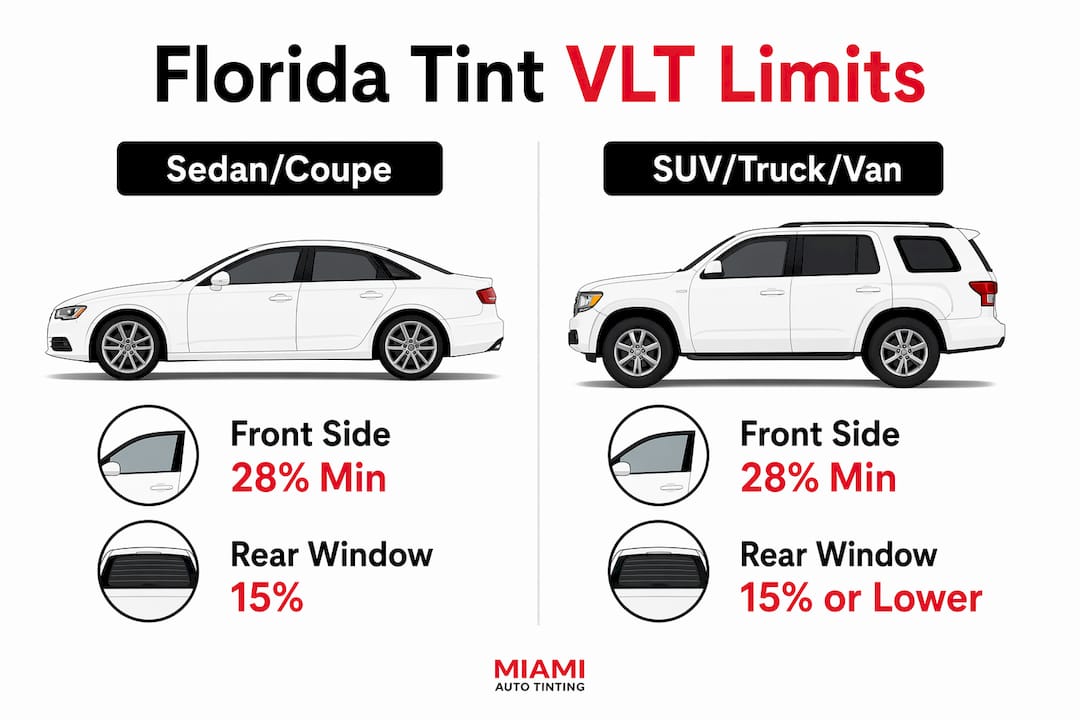
Florida law sets the darkest shade you can legally apply to each window, and those limits vary by window position and vehicle type. Front side windows require a minimum 28% VLT, meaning at least 28% of visible light must pass through the combined glass and film. That single number eliminates a large portion of the darkest films on the market for your driver and passenger windows.
Rear windows follow different rules depending on what you drive. Sedans and coupes must maintain 15% VLT minimum on rear side and rear windows, while SUVs, trucks, and vans can go as dark as 6% VLT on those same windows. That gap is significant. If you own a Ford F-150 or a Chevy Tahoe, you have far more shade options for your rear glass than a Honda Civic owner does.
The windshield is the most restricted surface. Florida allows only a non-reflective tint strip above the AS-1 line, which sits roughly five inches from the top of the glass. No full-windshield tinting is permitted.
Reflectivity and color restrictions
Reflectivity limits are 25% on front side windows and 35% on rear windows, and Florida prohibits red or amber tinted films entirely. Mirrored or highly metallic films that exceed these reflectivity thresholds will fail inspection and can draw a traffic citation on the spot. Stick to neutral tones: gray, charcoal, and carbon-look films all comply.
| Window | Minimum VLT (Sedan/Coupe) | Minimum VLT (SUV/Truck/Van) |
|---|---|---|
| Front side windows | 28% | 28% |
| Rear side windows | 15% | 6% |
| Rear windshield | 15% | 6% |
| Windshield | Non-reflective strip only | Non-reflective strip only |
Pro Tip: Florida enforcement measures the combined VLT of the glass and the film together, not just the film's rated percentage. A factory-tinted rear window combined with an aftermarket film can push you below the legal limit even if each layer appears compliant on its own.
How do VLT, SHGC, TSER, and infrared rejection affect your shade choice?
Most drivers pick a shade by looking at a sample and choosing how dark they want it. That approach misses the most important performance factors entirely. VLT measures how dark the tint appears, but heat-blocking effectiveness is better gauged by SHGC and TSER. A film can look nearly clear and still block a substantial amount of heat.
Here is what each metric actually means for your comfort in Homestead:
- VLT (Visible Light Transmission): The percentage of visible light passing through. Lower VLT means darker appearance. Legal compliance is tied directly to this number.
- SHGC (Solar Heat Gain Coefficient): Measures how much solar heat enters through the glass. Lower is better. Films with SHGC below 0.25 are ideal for Homestead's climate.
- TSER (Total Solar Energy Rejected): The percentage of total solar energy the film blocks. Higher is better. Films with TSER above 70% deliver meaningful cabin cooling.
- Infrared rejection: Measures how well the film blocks near-infrared radiation, the part of sunlight you feel as heat. 3M Ceramic IR film rejects infrared heat up to 95%, which is why it keeps cabins cooler even at lighter VLT percentages.
The practical implication is that choosing tint based on darkness alone is a common mistake. Two films at 35% VLT can perform completely differently in Homestead's heat if one uses ceramic IR technology and the other uses basic dyed film.
Pro Tip: Ask your installer to show you the SHGC and TSER spec sheet for any film you are considering, not just the VLT number. Those two figures tell you far more about how cool your car will actually feel.
Which tint shades balance privacy, heat protection, and style in Homestead?
Homestead sits at the southern edge of Miami-Dade County, where UV index levels and ambient heat are among the highest in the continental United States. Prioritizing films with excellent UV and infrared rejection is the right call for year-round cabin comfort in this climate. The shade percentage you choose should follow from that performance goal, not precede it.
Medium shades: 20% to 50% VLT
Films in the 20% to 50% VLT range give you the widest flexibility. A 35% film on front side windows sits comfortably above Florida's 28% legal floor, provides visible privacy from outside the car, and pairs well with a ceramic IR film that delivers strong heat rejection. This range works well on sedans where rear window options are more restricted.
Darker shades: 5% to 20% VLT
Darker films in the 5% to 20% range are reserved for rear windows on SUVs, trucks, and vans where Florida law permits them. A 5% "limo tint" on the rear windows of a Toyota 4Runner or a RAM 1500 provides near-complete privacy and maximum heat blocking on the glass area that receives the most direct afternoon sun in South Florida. The trade-off is reduced interior brightness and slightly reduced rear visibility at night.
| Shade Range | Best For | Trade-Off |
|---|---|---|
| 35% to 50% VLT | Front windows, sedans, daily drivers | Less privacy, lighter appearance |
| 20% to 35% VLT | Balanced privacy and heat control | Approaches legal floor on front windows |
| 5% to 20% VLT | Rear windows on SUVs/trucks/vans | Reduced night visibility, restricted to rear glass |
Experts recommend selecting shade based on heat rejection goals first, then confirming the VLT sits within legal limits. That reversed approach, performance before aesthetics, consistently produces better results in hot climates. Southmiamitint's Homestead car tint recommendations follow this exact logic for different vehicle types.
For color and style, gray and charcoal films are the most popular choices in Homestead because they complement most vehicle colors, comply with Florida's neutral-tone requirement, and do not shift the appearance of your car's exterior color the way bronze or green films can.
How to verify tint shade compliance and get a quality installation
Selecting the right shade on paper means nothing if the installation is off or the film is uncertified. These steps protect you from legal exposure and poor performance:
- Request the film's spec sheet before installation. Confirm the rated VLT, SHGC, TSER, and infrared rejection values. Reputable films from 3M and Iviron Kollmax ceramic lines include published performance data.
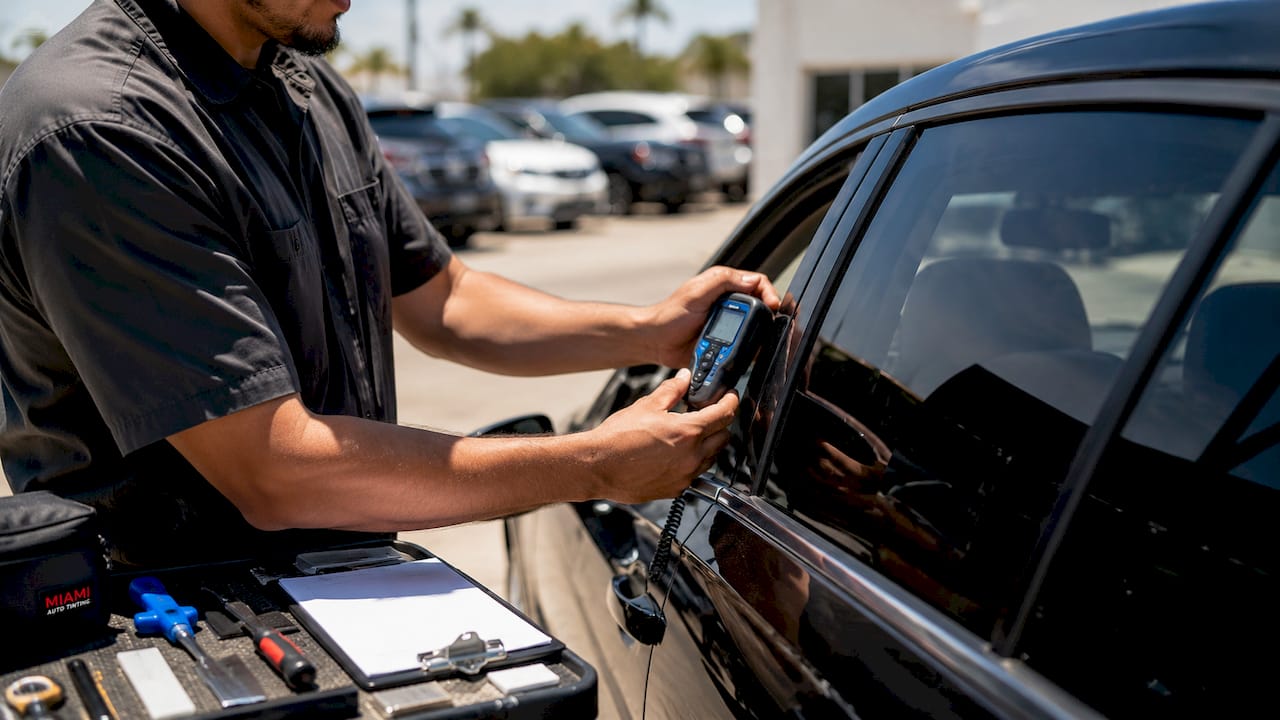
- Ask for on-site VLT meter verification. Professional installers verify tint VLT with calibrated meters during installation and provide compliance documentation. This step is non-negotiable for legal protection.
- Account for factory glass tint. Florida measures the combined VLT of the glass and the film. If your rear windows already have factory tint, a 15% film on top may push you below the legal threshold.
- Get written compliance documentation. Your installer should provide a certificate or receipt showing the film's VLT rating and the vehicle's measured post-installation VLT. Keep this in your glove box.
- Check warranty coverage. Quality films from brands like 3M carry manufacturer warranties covering bubbling, peeling, and color fade. A warranty is a signal that the product meets published specs.
Pro Tip: Keep your compliance paperwork in the car at all times. Florida law enforcement can request it during a traffic stop, and having it on hand prevents a citation even if an officer's meter reads slightly different from your installer's measurement.
Key takeaways
Picking the right tint shade in Homestead requires matching legal VLT limits to performance metrics like SHGC and TSER, with ceramic IR films delivering the best heat protection at any legal shade level.
| Point | Details |
|---|---|
| Legal VLT limits vary by window | Front windows require 28% VLT minimum; rear windows allow 15% for sedans and 6% for SUVs. |
| Darkness does not equal heat rejection | SHGC and TSER measure actual heat control better than VLT alone. |
| Ceramic IR films outperform at lighter shades | 3M Ceramic IR rejects up to 95% infrared heat even at higher VLT percentages. |
| Vehicle type expands your options | SUVs, trucks, and vans can use much darker rear tints than sedans under Florida law. |
| Documentation protects you legally | Always retain calibrated VLT meter results and compliance certificates from your installer. |
What I tell every Homestead driver who asks about shade selection
The most common mistake I see is someone walking in with a specific percentage in mind, usually 20% or 35%, because they saw it on another car and liked how it looked. That is the wrong starting point. The right question is: how much heat do you need to block, and what is the darkest shade the law allows for your specific windows?
Homestead is not Phoenix or Atlanta. The UV index here stays elevated year-round, and the combination of direct sun and high humidity makes a poorly chosen film feel like a failure within weeks. I have seen drivers install a 20% dyed film on their sedan's front windows, which is already below the legal 28% floor, and then wonder why they got a fix-it ticket and their car still felt like an oven. Both problems trace back to skipping the spec sheet conversation.
Ceramic IR technology changed what is possible at legal shade levels. A 35% 3M Ceramic IR film on front windows will outperform a 15% dyed film on heat rejection while keeping you fully legal. The infrared vs. ceramic tinting comparison makes this clear with side-by-side data. Lighter does not mean hotter when the film technology is right.
My honest advice: stop picking shades by eye. Start with the performance numbers, confirm legal compliance for your vehicle type, and then choose the darkest shade within those constraints that matches your style. That sequence produces cars that stay cool, look sharp, and never fail inspection.
— Jose
Get legal, high-performance tinting for your Homestead vehicle
Southmiamitint installs 3M Ceramic IR, 3M Color Stable, and Iviron Kollmax ceramic films on cars throughout Homestead and Miami-Dade, with every job verified by calibrated VLT meters and backed by compliance documentation. The service comes to you. No shop visit, no waiting room.
If you want the best combination of heat rejection, legal compliance, and clean aesthetics for your vehicle, Southmiamitint's 3M ceramic window tint service covers every window with published spec sheets and a manufacturer warranty. You can also review mobile tinting prices to plan your budget before booking. Premium protection, installed at your door.
FAQ
What is the darkest legal tint for front windows in Florida?
Florida law requires a minimum of 28% VLT on front side windows for all vehicle types. Any film that brings the combined glass and film measurement below 28% is illegal.
Can I use 5% tint on my SUV in Homestead?
Yes. SUVs, trucks, and vans can legally use tint as dark as 6% VLT on rear side and rear windows under 2026 Florida law. Front side windows still require 28% VLT minimum regardless of vehicle type.
Does darker tint always mean better heat rejection?
No. Heat rejection depends on SHGC and TSER values, not just darkness. A lighter ceramic IR film can outperform a darker dyed film on actual heat blocking.
How do I know if my tint is legally compliant after installation?
A professional installer should measure your windows with a calibrated VLT meter after installation and provide written documentation showing the measured VLT for each window. Retain that documentation in your vehicle at all times.
What film brands are best for Homestead's climate?
3M Ceramic IR and Iviron Kollmax ceramic films are among the top performers for South Florida heat. 3M Ceramic IR blocks up to 99.9% UV and rejects up to 95% of infrared heat, making them well-suited for Homestead's year-round sun intensity.