
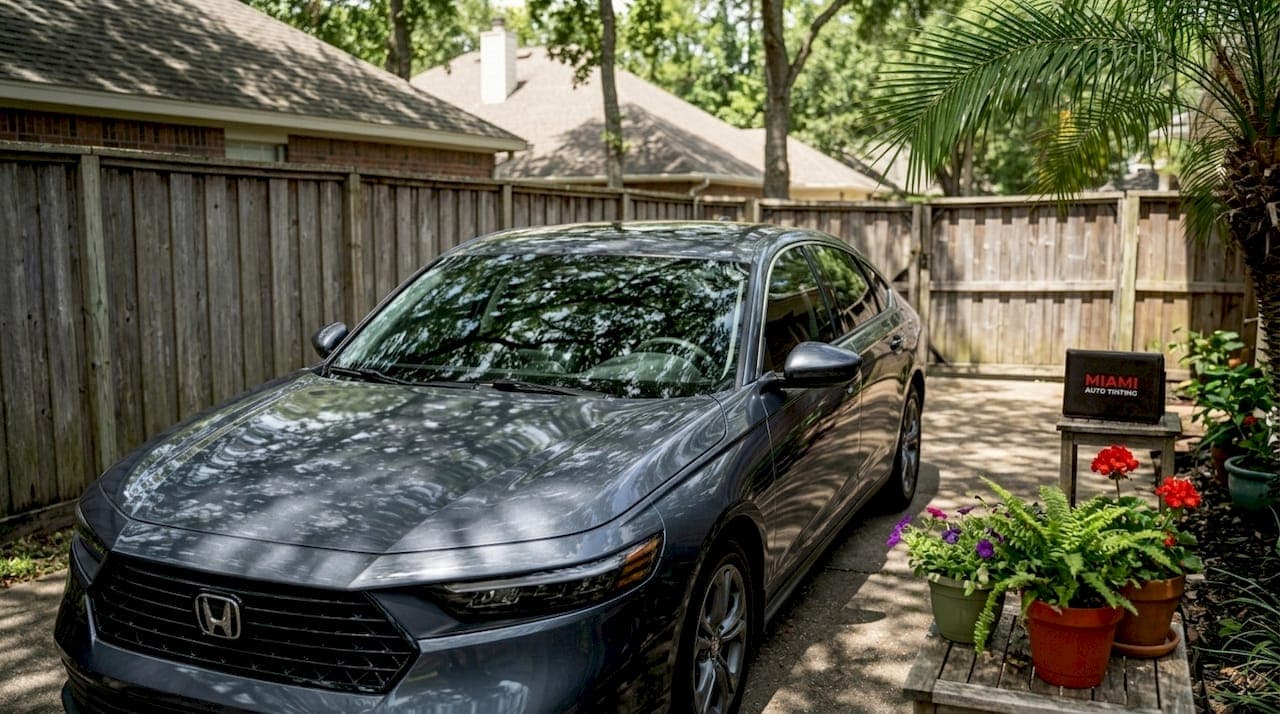
Privacy automotive tint is a window treatment that darkens vehicle glass to limit outside visibility, block UV rays, and reduce interior heat. Two distinct approaches exist: factory privacy glass, which is glass dyed during manufacturing, and aftermarket window tint film, a thin layer applied to the inside of your windows after purchase. Most SUVs, minivans, and trucks ship with factory privacy glass on rear windows, but that glass alone rarely delivers the UV protection or heat control that aftermarket films provide. Understanding the difference between these two options, and how they interact, is the foundation for making a smart tinting decision.
What is the difference between factory privacy glass and aftermarket privacy tint?
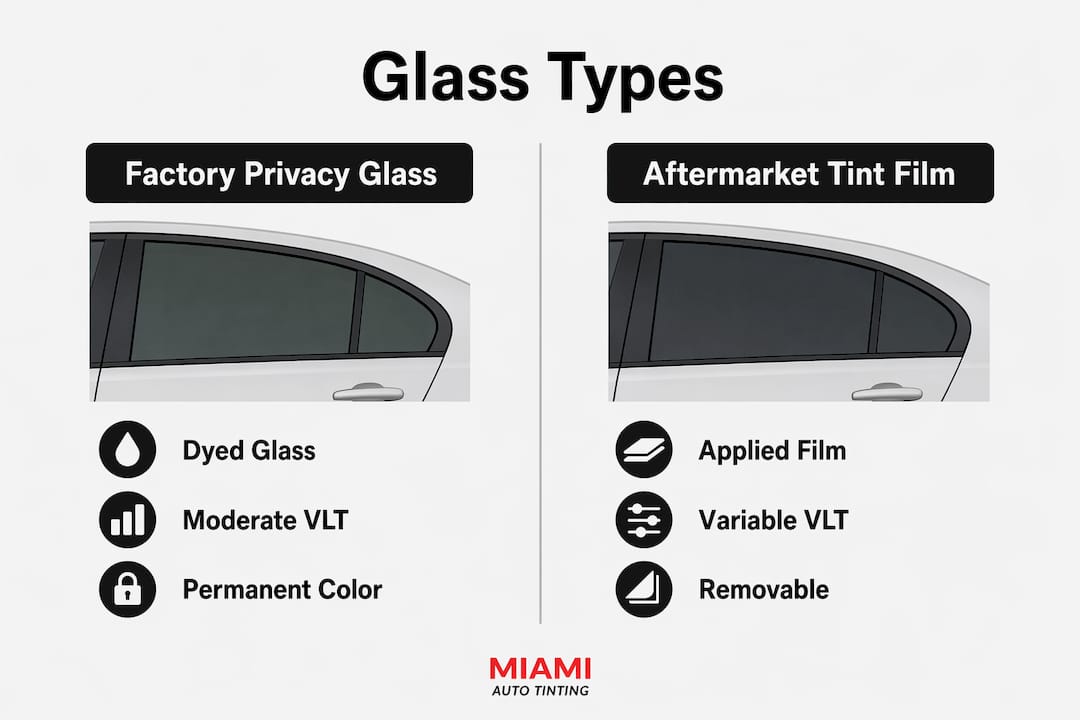
Factory privacy glass gets its dark appearance from dye baked into the glass itself during production. It reduces transparency visually, but it does not block significant amounts of UV radiation or heat. Aftermarket tint film is a separate product entirely. It is a thin polyester sheet applied to the interior surface of your window, and it controls light, heat, and UV transmission through its material composition rather than glass color.
The key technical measure for both is Visible Light Transmission, or VLT. VLT is the percentage of visible light that passes through the combined glass and film. A 5% VLT blocks 95% of light, producing a very dark appearance. A 70% VLT blocks only 30%, leaving the glass nearly clear. Factory privacy glass on rear windows typically sits around 20% to 26% VLT. Aftermarket films are sold with their own VLT rating, but that rating applies to the film alone, not to the combined result when layered over factory glass.
This layering effect is where most car owners get into trouble. Applying aftermarket film on top of factory privacy glass multiplies the darkness well beyond what either product achieves alone. A 35% film applied over 20% factory glass produces a net VLT of roughly 7%, which falls into limo-tint territory and is illegal in most states. Professional installers calculate net VLT by multiplying the two percentages together to catch this before installation.
| Feature | Factory privacy glass | Aftermarket tint film |
|---|---|---|
| Application method | Dyed during glass manufacturing | Film applied inside window after purchase |
| UV protection | Minimal | High, up to 99% with premium films |
| Heat reduction | Low | Moderate to high depending on film type |
| VLT control | Fixed at manufacture | Selectable by product choice |
| Legal flexibility | Not adjustable | Must comply with state VLT minimums |
| Cost to change | Requires glass replacement | Film can be removed or replaced |
Pro Tip: Before ordering any aftermarket film, photograph your window sticker or ask your dealer for the factory glass VLT. Then use a net VLT calculator to confirm your chosen film keeps you legal.
How does privacy tint work to improve vehicle comfort and security?
Privacy tint works by controlling how much visible light, infrared radiation, and ultraviolet energy pass through your windows. The film's composition determines its performance. Dyed films absorb light to create darkness. Ceramic films use non-conductive ceramic particles to block heat and UV without significantly darkening the glass. Carbon films fall between the two in both price and performance.
The benefits of privacy tint extend well beyond appearance. Here is what a quality film actually delivers:
- Glare reduction: Cuts reflected sunlight from roads and other vehicles, reducing eye strain on long drives.
- UV protection: Premium films like XPEL PRIME block over 99% of UV rays, protecting both skin and interior materials from sun damage.
- Heat control: XPEL PRIME reduces interior temperatures by up to 15°F compared to untreated vehicles. That is a meaningful difference on a Miami summer afternoon.
- Privacy and security: Darker windows prevent passersby from seeing valuables left in your car, reducing the visual incentive for break-ins.
- Interior preservation: UV blockage slows fading and cracking of dashboards, seats, and door panels.
The security benefit is practical and underappreciated. A bag left on a seat is invisible through a properly tinted window. That single factor removes the opportunity that motivates most smash-and-grab thefts. For Miami drivers, where ceramic tint benefits include measurable cabin cooling, the heat argument alone justifies the investment.
Ceramic films, including the 3M IR and Iviron Kollmax products Southmiamitint installs, achieve heat rejection through infrared blocking rather than visible darkening. This means you can get significant heat control with a relatively light VLT, which matters when you need to stay legal on front side windows.
What legal regulations affect automotive privacy tint?
Window tint law in the United States is entirely state-controlled, and the variation between states is significant. Most states set minimum VLT requirements separately for the windshield, front side windows, rear side windows, and rear windshield. Front side windows face the strictest limits because law enforcement needs to see the driver during traffic stops.
Florida, for example, requires front side windows to allow at least 28% VLT and rear side windows at least 15% VLT. Michigan takes a different approach: rear windows allow unrestricted darkness, while front side windows permit tint only on the top four inches. These differences mean a tint job that is perfectly legal in one state can earn you a citation the moment you cross a state line.
Enforcement uses tint meters that measure net VLT on the combined glass and film. Officers do not care what the film label says. They measure what the meter reads. This is why factory glass matters so much legally. A car with 20% factory rear glass that receives a 50% film ends up at roughly 10% net VLT, well below the legal limit in most states, even though the film itself would be legal on clear glass.
Follow these steps to stay compliant:
- Identify your factory glass VLT. Check your owner's manual, ask your dealer, or use a tint meter before installation.
- Look up your state's VLT minimums. Check each window position separately. Front and rear limits differ in almost every state.
- Calculate net VLT before ordering film. Multiply factory glass VLT by film VLT. A 20% factory glass times a 35% film equals 7% net VLT.
- Choose film that keeps net VLT above your state minimum. Build in a small buffer, since meters can vary slightly.
- Get a certificate of compliance from your installer. Reputable shops provide documentation showing the film's VLT and the net result.
Pro Tip: Southmiamitint's technicians measure factory glass before recommending any film. If you are unsure about Miami tint regulations, ask during your consultation rather than after installation.
What practical factors should car owners consider when choosing privacy tint?
Choosing the right privacy tint for your car requires balancing four things: your state's legal limits, your personal comfort with reduced visibility, your budget, and the type of film that fits your priorities.
Start with the legal ceiling, not your aesthetic preference. Once you know the darkest legal net VLT for each window position, you can choose a film that sits comfortably within that range. Going right to the legal limit leaves no margin for meter variation or future resale in a different state.
Film type matters more than most buyers realize. Consider these options:
- Dyed films are the most affordable but fade over time, shifting from dark to purple as the dye breaks down. They offer limited heat rejection compared to ceramic options.
- Carbon films resist fading better than dyed films and provide moderate infrared blocking without the premium price of ceramic.
- Ceramic films like 3M IR and Iviron Kollmax deliver the best heat rejection, the most stable color over time, and the highest UV blockage. They cost more upfront but outperform dyed films over a three to five year ownership period.
Night visibility is a factor that buyers consistently underestimate. Darker tints reduce depth perception and make nighttime driving genuinely more difficult, even when the tint is technically legal. A 20% rear window tint looks great during the day and feels like wearing sunglasses at night. If you drive frequently after dark, a 35% film on rear windows is a better balance than pushing to the legal minimum.
Installer quality determines whether your film lasts three years or ten. Ask whether the shop uses a calibrated tint meter, whether they calculate net VLT before installation, and whether they provide a written warranty. A film that bubbles or peels within a year is not a bargain at any price. Southmiamitint uses 3M IR, 3M Color Stable, and Iviron Kollmax ceramic films, all of which carry manufacturer backing and are installed by trained technicians who measure before they cut.
Key takeaways
Privacy automotive tint requires calculating net VLT from both factory glass and aftermarket film to stay legal, protect your interior, and maintain safe visibility at night.
| Point | Details |
|---|---|
| Factory glass vs. aftermarket film | Factory glass is dyed during production; aftermarket film is applied inside the window and offers far better UV and heat control. |
| Net VLT is the legal measure | Multiply factory glass VLT by film VLT to get the number law enforcement actually measures. |
| State laws vary significantly | Florida requires 28% front side VLT; Michigan allows unlimited rear darkness. Always check your state before installing. |
| Ceramic films outperform dyed films | Products like 3M IR and Iviron Kollmax block more heat and UV and resist fading far longer than basic dyed films. |
| Night visibility is a real tradeoff | Tints darker than 20% reduce nighttime depth perception even when legal. Build in margin above the legal minimum. |
What I've learned after years of tinting cars in Miami
The most common mistake I see is a car owner who bought a vehicle with factory privacy glass, assumed it was "already tinted," and then added a 20% film to the rear windows without checking net VLT. The result is a 4% to 5% net VLT that looks like a limousine and gets flagged immediately during a traffic stop.
Factory privacy glass is a cosmetic feature, not a tinting solution. It gives the rear of your vehicle a darker look, but it does almost nothing for heat or UV. In Miami, where interior temperatures in a parked car can exceed 150°F, relying on factory glass alone is a real comfort problem.
The other misconception I run into constantly is that darker always means better privacy. It does not. A 35% ceramic film on rear windows is genuinely private during the day and still allows safe visibility at night. A 5% limo tint looks dramatic but creates a safety liability after sunset. The goal is not the darkest legal tint. The goal is the right tint for how and where you actually drive.
Technology has moved the conversation forward. Ceramic films now block infrared heat without requiring extreme darkness, which means you can have a lighter, legal, and more visible film that still keeps your cabin dramatically cooler than factory glass alone. That is the combination worth pursuing.
— Jose
Get professional privacy tint installed at your location
Southmiamitint offers mobile ceramic window tinting across Miami-Dade, bringing professional installation directly to your home, office, or parking lot. The team installs 3M IR, 3M Color Stable, and Iviron Kollmax ceramic films, measuring factory glass VLT before recommending any product to confirm legal compliance. If you want ceramic tint in Miami that delivers real heat rejection, UV protection, and privacy without the guesswork, Southmiamitint handles the calculation, the installation, and the documentation. Check mobile tinting prices and book a consultation to get the right film for your vehicle and your state's legal requirements.
FAQ
What is privacy automotive tint?
Privacy automotive tint is an aftermarket film applied to the inside of vehicle windows to reduce outside visibility, block UV rays, and control interior heat. It is distinct from factory privacy glass, which is dyed during manufacturing and provides minimal UV or heat protection.
How does privacy tint work?
Privacy tint film controls how much visible light, UV radiation, and infrared heat pass through your windows. Lower VLT percentages mean darker glass and less light transmission. Ceramic films block heat and UV without requiring extreme darkness.
Is privacy film legal on all car windows?
No. State laws set minimum VLT levels for each window position, and front side windows face the strictest limits. Net VLT combining factory glass and film is what enforcement measures, so layering film over factory privacy glass can push you below legal limits even with a compliant film.
What VLT percentage is best for privacy?
Most car owners find 20% to 35% VLT on rear windows delivers strong daytime privacy while maintaining safe nighttime visibility. Going darker than 20% creates real visibility challenges after dark and leaves no legal margin in most states.
Does factory privacy glass count toward tint laws?
Yes. Law enforcement tint meters measure the combined darkness of factory glass and any applied film. A vehicle with 20% factory rear glass that receives a 35% aftermarket film registers approximately 7% net VLT, which is illegal in most states regardless of what the film label says.